Summary: If you have ever sat in a banquet hall and heard the wedding sangeet from the next room bleeding through the wall, you already understand why the STC Rating of Sliding Partitions matters more than most buyers realise. Sound Transmission Class, or STC, is the single number that tells you whether a movable wall will actually keep two events, two meetings, or two classrooms acoustically separate, or whether it will just look like a wall while letting sound pass through freely. For hotels, banquet venues, offices, and event spaces investing in flexible layouts, this rating is not a technical footnote. It is the difference between a partition that works and one that becomes a recurring complaint.
What Is STC Rating and How Is It Measured?
STC is a standardised laboratory measurement, defined under ASTM E90 and rated per ASTM E413, that describes how effectively a wall assembly blocks airborne sound across a range of frequencies, typically 125 Hz to 4,000 Hz. Testing engineers generate sound on one side of a partition and measure how much of it reaches the other side, then average the reduction into a single integer. The higher that number, the better the isolation. A partition rated STC 30 lets loud speech through clearly, while one rated STC 50 or above reduces normal conversation to a barely noticeable murmur.
Why Does the STC Rating of Movable Partition Wall Systems Differ From Fixed Walls?
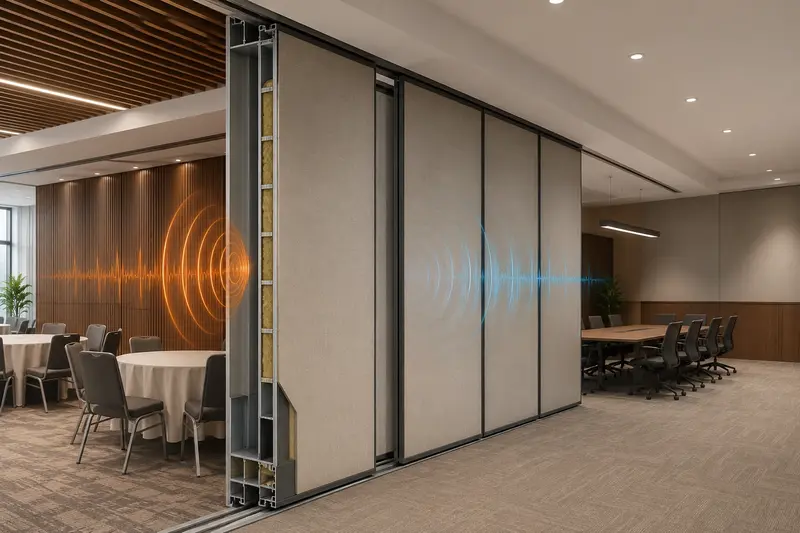
Fixed drywall partitions are continuous, sealed, and rigid, which naturally supports better sound isolation. A movable partition wall, by contrast, is built from individual panels that must slide, fold, or stack, which means it relies on interlocking edges, top and bottom seals, and track systems rather than a solid, monolithic surface. This is precisely why the STC Rating of Movable Partition Wall products can vary widely, often between STC 30 on lightweight economy panels and STC 50 or higher on premium acoustic systems. The panel core material, its density, the quality of the perimeter gasket, and how tightly panels compress against each other all directly influence the final rating.
What Sound Rating for Movable Walls Should You Actually Look For?
Not every space needs the same performance. A reasonable sound rating for movable walls depends on the intended use:
- STC 30 to 35: Suitable for casual visual separation with minimal acoustic need, such as storage divisions.
- STC 40 to 45: Adequate for offices and classrooms where normal conversation should not be easily overheard.
- STC 50 and above: Recommended for conference rooms, hospitals, hotel meeting spaces, and any environment demanding real speech privacy.
Why Is STC for Banquet Hall Partition Systems a Special Case?
Buyers should always request lab-tested documentation for the sound rating for movable walls rather than relying on marketing claims, since field performance can drop below the tested figure if installation is poor. Also Check: Wooden Sliding Partitions.
Banquet halls present one of the toughest acoustic challenges in commercial design. Two or more functions often run simultaneously in adjoining sections, complete with music, speeches, and applause, so a weak partition becomes obvious within minutes. The STC for banquet hall partition installations should generally target 48 to 55, since anything lower allows bass-heavy music and amplified speech to travel across the divide. Venues that skip this consideration frequently face guest complaints and repeat bookings lost to poor sound isolation, which makes the rating a direct commercial concern rather than just a technical specification.
What Factors Improve the STC Rating of Sliding Partitions Beyond the Panel Itself?
The panel material sets the baseline, but real-world performance depends on several additional details. Continuous top and bottom seals close the gaps that sound would otherwise flank through. Properly aligned tracks prevent gaps from developing as panels age. Mass and internal insulation, such as mineral wool or dense composite cores, absorb more sound energy than thin hollow panels. Even wall-to-floor and wall-to-ceiling junctions need careful sealing, because sound frequently bypasses a well-rated panel through poorly finished edges. Companies like Packsound.in focus on these installation details alongside panel selection, since a high rated panel installed carelessly will underperform its certified number.
Conclusion
The STC Rating of Sliding Partitions is not just a number on a spec sheet. It determines whether a movable wall genuinely separates two functions or simply gives the illusion of privacy. Whether you are evaluating the STC Rating of Movable Partition Wall options for an office, comparing sound rating for movable walls across vendors, or specifically assessing STC for banquet hall partition needs, always ask for tested documentation, understand your usage context, and prioritise installation quality alongside panel choice. Getting this right upfront saves venues and businesses from costly rework and unhappy occupants later.
Frequently Asked Questions:
What STC rating is considered good for a sliding partition?
Most professionals consider STC 45 and above good for general privacy needs. For sensitive spaces like hospitals or executive meeting rooms, STC 50 or higher is preferred.
Does a higher STC rating mean a partition is completely soundproof?
No, even high STC partitions allow some sound through since STC only measures airborne sound reduction, not total elimination. Complete soundproofing requires additional structural isolation.
Can the STC rating of a movable wall drop after installation?
Yes, poor sealing at tracks, floors, or ceilings can reduce real-world performance below the lab-tested rating. Regular maintenance of seals helps maintain the original rating.
Is STC 50 enough for a banquet hall hosting two events at once?
STC 50 works for moderate noise levels, but venues with loud music or amplified speech often need STC 52 to 55 for comfortable separation. Testing under actual event conditions is advisable before finalising.
How is STC different from NRC when choosing acoustic partitions?
STC measures how much sound a partition blocks between two rooms, while NRC measures how much sound a surface absorbs within a single room. Both matter, but STC is the correct metric for privacy between adjoining spaces.