
Soft Fiber Acoustic Ceiling Tiles
Your ceiling is the most underused acoustic surface in any room. Every conversation, every phone call, every keyboard click sends sound straight upward – and an untreated ceiling fires it all straight back down into the space. Hard plaster, bare concrete, and conventional painted ceilings are near-perfect sound reflectors. The result is a room that feels louder than it should, where speech lacks clarity, where meetings become exhausting, and where concentration is a constant effort. The fix is directly overhead – and it starts with the right ceiling tile.
Class A / Class 1Fire resistance standard
12–20 mm thickSoft fibre core
T-grid ready600 × 600 & 1200 × 600 mm
Get a Free QuoteReply within 1 working day
Your details stay private. No spam.
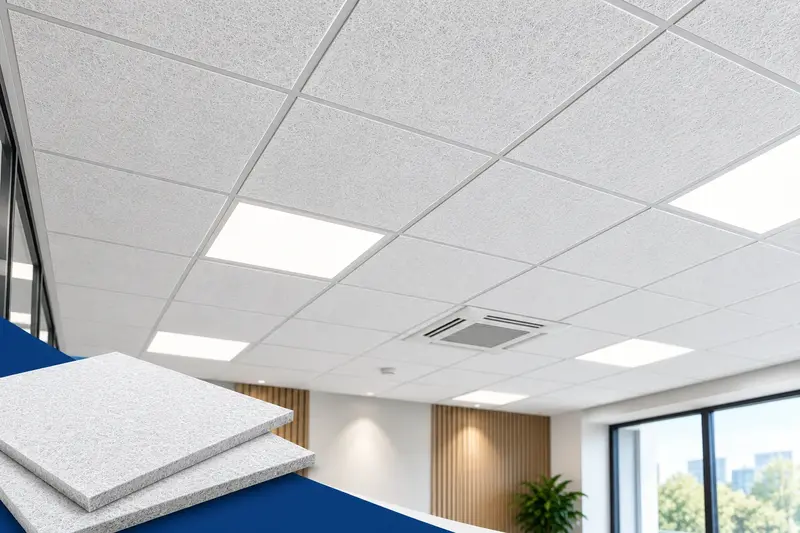
Packsound’s PerfoAudile™ Soft Fiber Ceiling Tiles are a precision-engineered acoustic ceiling solution manufactured for India’s commercial, educational, healthcare, and hospitality markets. Made from compressed polyester or mineral fiber composites with a micro-perforated MDF or HDHMR face, these tiles drop into any standard T-grid suspended ceiling system and immediately transform the acoustic character of a space — reducing reverberation, lowering background noise levels, and improving speech intelligibility in a way that occupants notice from the first day.
If you are specifying a false ceiling for a new office, school, hospital, hotel, or commercial interior and acoustic performance is part of the brief — PerfoAudile™ soft fiber ceiling tiles are the specification that earns its place on every project.
PerfoAudile™ Soft Fiber Ceiling Tiles
High acoustic absorption, premium ceiling aesthetics, standard T-grid compatibility, and custom finish options for commercial, educational, healthcare, hospitality, retail, and residential interiors.
What Are Soft Fiber Ceiling Tiles and What Makes PerfoAudile™ Different?
| Soft Fiber Ceiling Tiles | Acoustic ceiling panels made from compressed fibrous materials such as polyester fibre, mineral fiber, or engineered composite blends. Their porous internal structure absorbs sound energy instead of reflecting it back into the room. |
| Dual Layer Construction | PerfoAudile™ uses a micro-perforated MDF or HDHMR face panel over a compressed acoustic fleece backing. Sound passes through the perforated face and is absorbed in the fibre matrix. |
| Premium Appearance | The smooth, uniform face presents as an architectural ceiling finish. Precisely sized perforations remain visually minimal while allowing strong acoustic transmissibility. |
| Structural Rigidity | The face layer helps maintain rigidity across the tile span and reduces sag and delamination risk in humid conditions. |
| Acoustic Result | Up to NRC 0.90, combining high sound absorption with a refined architectural finish. |
PerfoAudile™ Soft Fiber Ceiling Tile: Full Technical Specifications
| Property | Specification |
|---|---|
| Product Name | PerfoAudile™ Soft Fiber Ceiling Tile |
| Core Material | Compressed polyester fibre or mineral fiber composite |
| Face Material | Micro-perforated MDF or HDHMR |
| Backing | Acoustic fleece / non-woven acoustic membrane |
| NRC | Up to 0.90 |
| Standard Tile Sizes | 600 × 600 mm |
| Thickness | 12 mm to 20 mm standard; custom on request |
| Edge Profiles | Square edge |
| Surface Finishes | White textured |
| Light Reflectance | ≥ 0.80, high reflectance for improved indoor brightness |
| Fire Rating | Class 1 fire resistance standard; Class A available |
| VOC Emissions | Low-VOC; formaldehyde-free materials |
| Humidity Resistance | Moderate to high depending on grade |
| Installation System | Standard T-grid suspended ceiling, compatible with major grid systems |
| Weight | Lightweight, minimal structural loading |
| Perforation Patterns | Micro-perforation standard; macro and custom patterns on request |
Why NRC 0.90 Changes the Acoustic Experience in Any Space
| NRC Explained | NRC measures how much sound energy a surface absorbs across key frequencies. A painted gypsum tile around NRC 0.10 reflects most incident sound, while a tile at NRC 0.90 absorbs most of it. |
| Open Plan Office Example | In a 10 × 15 metre office with a 3 metre ceiling, replacing a reflective ceiling with high absorption tiles can substantially reduce reverberation, subject to the room's full absorption profile and layout. |
| Reverberation Control | Proper ceiling coverage can help move hard-surfaced rooms toward the shorter reverberation ranges preferred for offices, classrooms, and healthcare spaces. |
| Background Noise | Reducing reverberant buildup can lower the perceived background noise level and improve comfort. |
| Speech Intelligibility | Lower reverberation can improve Speech Transmission Index and make spoken communication easier to understand. |
| Project Calculation | Acoustic outcomes should be calculated from room dimensions, ceiling height, surface finishes, occupancy, and the selected treatment area before purchase. |
Project-specific acoustic calculations are recommended because actual reverberation time and dB improvement depend on the complete room, not NRC alone.
Edge Profiles Explained: Square, Tegular, and Concealed
| Square Edge | The tile sits flush in the T-grid with the grid visible at junctions. It is economical and widely used in commercial, educational, and healthcare interiors. |
| Tegular Edge | The tile face drops slightly below the grid to create a shadow line and a more dimensional ceiling appearance. Common in corporate offices, hotels, and retail interiors. |
| Concealed Edge | The grid is visually hidden to create a more continuous ceiling plane. This is suited to premium hospitality and executive interiors. |
| Service Compatibility | Profiles can be coordinated with lighting, HVAC diffusers, sprinkler heads, and other ceiling services when penetrations are correctly detailed. |
Surface Finishes and Customisation
| White Textured | Clean and bright with high light reflectance. Suitable for offices, schools, healthcare, and general commercial interiors. |
| Smooth Painted | A contemporary finish using acoustically transparent coatings that keep perforations open. |
| Laminate | Wood grain, solid colour, and metallic laminate options for premium corporate and hospitality interiors. |
| Digital Printed | Custom graphics, patterns, brand visuals, and designs can turn the ceiling into a visual communication element. |
| Custom Perforations | Logos, geometric patterns, and bespoke perforation geometries can be produced for design-led projects. |
Where PerfoAudile™ Soft Fiber Ceiling Tiles Are Specified
| Corporate Offices | Full ceiling coverage provides a large absorption area for open-plan workspaces. It can be combined with acoustic wall panels, AcoFascia™ divider partitions, and Sonicguard™ acoustic wooden doors for broader room acoustic control. |
| Schools and Universities | High absorption ceilings help control classroom reverberation, improve speech clarity, and reduce teacher vocal strain. Final performance depends on room volume and other finishes. |
| Healthcare | Useful in patient rooms, wards, waiting areas, and consultation rooms where lower reverberation supports acoustic comfort and communication. Low-VOC and formaldehyde-free options support material-conscious specifications. |
| Hospitality | Restaurants, lobbies, corridors, meeting rooms, and banquet spaces benefit from reduced reverberant buildup without sacrificing interior design. |
| Retail and Public Spaces | Helps control sound in hard-surfaced interiors with glass, marble, and concrete while high light reflectance can support bright ceiling design. |
| Home Theatres | Provides broad ceiling absorption in media rooms and listening spaces using a familiar suspended ceiling format. |
Soft Fiber vs. Mineral Fiber vs. Gypsum
| Property | Gypsum Tiles | Mineral Fiber Tiles | PerfoAudile™ Soft Fiber Tiles |
|---|---|---|---|
| NRC Rating | 0.05 to 0.20 | 0.50 to 0.75 | Up to 0.90 |
| Fire Rating | Good, Class A | Good, Class A | Class 1 standard; Class A available |
| Humidity Resistance | Moderate | Moderate to good | Good, grade dependent |
| Light Reflectance | High | High | High, ≥ 0.80 |
| Aesthetics | Smooth, plain | Textured, limited finishes | Multiple finishes and custom options |
| Acoustic Performance | Poor | Moderate to good | Excellent |
| Fragility | Moderate | Can shed fibres | Dimensionally stable |
| VOC / Formaldehyde | Standard | Standard | Formaldehyde-free, low-VOC |
| Best For | Areas prioritising fire rating | General commercial interiors | Acoustic-priority specifications |
| Choose Gypsum When | Fire-rated ceiling performance is the main requirement and high acoustic absorption is not required. |
| Choose Mineral Fiber When | Moderate acoustic improvement is acceptable and budget is the main constraint. |
| Choose PerfoAudile™ When | High acoustic absorption, premium finishes, and low-VOC or formaldehyde-free material options are project priorities. |
Installation: Straightforward T-Grid Compatibility
| 1. Grid Installation | A suspended aluminium T-grid framework is hung from the structural ceiling using hanger wires at standard centres, then levelled and aligned. |
| 2. Perimeter Condition | A wall angle is fixed around the room perimeter at the specified ceiling height to support edge tiles and create a clean wall junction. |
| 3. Tile Placement | Tiles are placed into grid openings from below. Standard lay-in installation requires no adhesive or screws. Concealed profiles use the appropriate grid connection. |
| 4. Cutting | Tiles can be cut to fit perimeter dimensions and ceiling penetrations. Cut edges can be finished as required. |
| 5. Service Integration | Lighting, HVAC diffusers, sprinklers, data ports, and PA speakers can be coordinated with the ceiling layout. |
| 6. Tile Replacement | Individual tiles can be removed for above-ceiling service access and replaced without disturbing the full ceiling. |
Why PackSound for Soft Fiber Ceiling Tiles?
| Manufacturer Direct | PerfoAudile™ tiles are supplied with direct technical specification support from the acoustic products team. |
| NRC Performance | Project documentation and available laboratory test information can be provided for the selected product specification. |
| Low-VOC Materials | Formaldehyde-free and low-VOC material options are available for projects with indoor environmental quality requirements. |
| Custom Manufacturing | Custom sizes, finishes, laminate options, digital print, and bespoke perforation patterns can be developed to suit the interior scheme. |
| Complete Ceiling Range | Complementary solutions include acoustic baffles, acoustic clouds, FeatherLite ceiling tiles, AirLite ceiling tiles, and metal ceiling tiles. |
| Pan-India Support | Supply and project support are available across major Indian cities, including Delhi NCR, Mumbai, Bengaluru, Hyderabad, Chennai, Pune, and Ahmedabad. |
Specify PerfoAudile™ for Your Project
Share your room dimensions, ceiling height, application, finish preference, and acoustic target with the PackSound team to develop a suitable ceiling tile specification.
Frequently Asked Questions About Soft Fiber Ceiling Tiles
What is the difference between soft fiber and mineral fiber ceiling tiles?
Soft fiber tiles use a fibrous composite core — polyester or engineered fiber — with a perforated facing for acoustic performance. Mineral fiber tiles use a compressed mineral wool or slag fiber basemat. Soft fiber tiles typically achieve higher NRC values (up to 0.90 versus 0.50 to 0.75 for mineral fiber) and offer better design flexibility. PerfoAudile™ tiles are also formaldehyde-free, a material safety advantage over standard mineral fiber products.
Will soft fiber ceiling tiles work with my existing suspended ceiling grid?
Yes. PerfoAudile™ tiles are dimensionally compatible with all standard 600 × 600 mm and 1200 × 600 mm T-grid systems. If you are replacing existing tiles, PerfoAudile™ tiles drop directly into the existing grid.
Can the tiles be painted after installation?
We do not recommend site-applied painting, as conventional paints can seal the micro-perforations and significantly reduce NRC performance. Our tiles are supplied in finished condition. Custom colours and finishes are available at the manufacturing stage — specify your requirement at the quotation stage.
Are the tiles suitable for areas with high humidity, such as kitchens or bathrooms?
Standard PerfoAudile™ tiles offer moderate humidity resistance suitable for most commercial spaces. For areas with sustained high humidity (above 90% RH), our AquaSonic range is specifically engineered for wet and high-humidity environments. Contact our team to confirm the appropriate product for your specific application.
Can PerfoAudile™ tiles be used in cleanrooms or healthcare facilities?
Yes. The formaldehyde-free, low-VOC construction and non-particulate surface make PerfoAudile™ tiles appropriate for healthcare and cleanroom environments. Fire-rated variants are available for patient areas governed by fire safety regulations. Confirm the specific fire rating requirement at the specification stage.
What is the lead time for supply?
Standard sizes and finishes are available from stock or with a 7 to 10 working day manufacturing lead time. Custom sizes, finishes, and perforation patterns typically require 12 to 18 working days from approved specification. We confirm lead times at the quotation stage.
How do I calculate how many tiles I need?
Divide your ceiling area (in square metres) by the tile area (0.36 m² for 600 × 600 mm tiles; 0.72 m² for 1200 × 600 mm tiles) and add 10 percent for waste and cutting. Our team can assist with quantity estimation for any project as part of the quotation process.
Get a Quote for PerfoAudile™ Soft Fiber Ceiling Tiles
Packsound manufactures and supplies PerfoAudile™ Soft Fiber Ceiling Tiles directly to architects, interior designers, contractors, and facility owners across India. Whether you need a sample for specification approval, a quantity and pricing estimate, or a complete supply proposal for a project in progress, our team responds within one working day.
- Call us: +91 9809802016 | +91 9891320678
- Email: Sales@packsound.in
- Address: NX One, A-717, Techzone-4, Greater Noida West, U.P. 201306
Explore our complete ceiling acoustic range — acoustic clouds, acoustic baffles, FeatherLite ceiling tiles, AirLite ceiling tiles, and metal ceiling tiles — or browse our wall acoustic panels and ThinkPod™ office pods for a complete acoustic solution across every surface and space type.