
Acoustic Clouds: Suspended Ceiling Sound Absorbers
Bottom line: Acoustic Clouds are suspended, cloud-shaped acoustic ceiling panels that hang below a slab on cables and absorb sound from both faces at once. This page is written for architects, MEP consultants, office fit-out contractors, and facility managers who need to cut echo in open-plan offices, auditoriums, cafeterias, gyms, and lobbies, especially where a full false ceiling is not possible or not in the budget. Use it when your ceiling is hard, high, or exposed, and you need targeted reverberation control rather than total coverage.
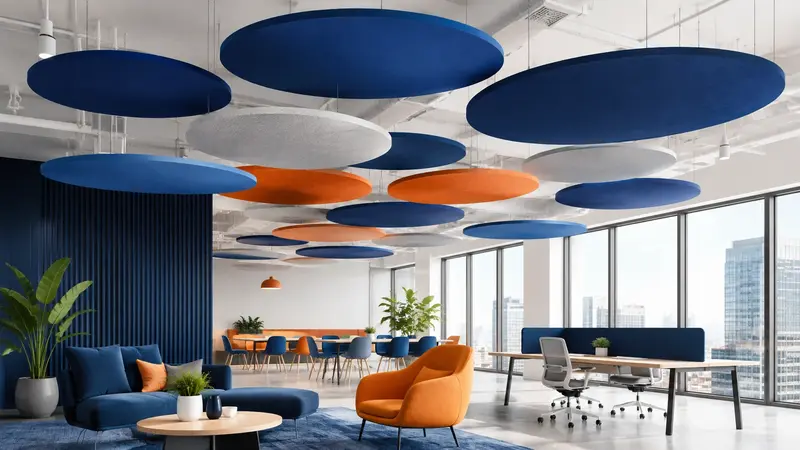
What Are Acoustic Clouds?
Acoustic Clouds are freestanding, horizontal sound absorbing ceiling clouds suspended a fixed distance below a structural slab instead of being fixed flush against it. Because both the top and bottom faces sit in open air, acoustic cloud panels absorb sound from two directions at once, which is why suspended acoustic clouds typically out-perform a same-size flat wall or ceiling panel per square metre. Packsound manufactures acoustical ceiling clouds in fiberglass, mineral wool, and recycled PET fiber cores, finished as fabric covered acoustic panels or painted PET, and cut to standard grid sizes or custom shapes.
Who Should Use Cloud Acoustic Panels, and When
If your project has an exposed concrete or metal deck ceiling, a ceiling height above 3 metres, live building services you cannot box in, or a heritage structure you cannot alter, a full acoustic ceiling is often the wrong specification. Acoustic ceiling cloud panels solve this by treating only the zones where people talk, present, or gather, such as huddle areas, cafeteria seating, reception desks, and stage fronts. This makes them the go-to ceiling clouds suspended acoustic solution for retrofit projects in occupied buildings, where added structural load and downtime both need to stay near zero.
How Do Acoustic Ceiling Clouds Actually Work?
Short answer: they shorten reverberation time (RT60) by giving sound waves a soft, absorptive surface to hit from above and below instead of bouncing off a hard slab.
- Sound striking the underside is absorbed by the panel core
- Sound striking the topside is absorbed again, since the panel is not sealed to the ceiling
- The air gap behind the panel adds low frequency absorption that a flush mounted panel cannot achieve
- Spacing and layout control how much of the room’s reflected sound field gets treated
On a recent BPO floor retrofit our team handled in Delhi NCR, switching from flush mounted PET panels to a 100mm suspended air gap behind 25mm sound absorbing clouds produced a noticeably tighter, less boomy sound in the seating bays, a result consistent with published room acoustics research on rear air gaps and low frequency absorption (see Noise Reduction Coefficient, Wikipedia for how NRC and absorption testing under ASTM C423 actually work).
Suspended Acoustic Clouds vs a Full False Ceiling: Which Do You Need?
Choose suspended acoustic clouds when you need partial, targeted absorption and want to keep the structural ceiling visible. Choose a full acoustic ceiling when the entire room needs uniform coverage and a finished, closed look.
| Spec | Detail |
|---|---|
| Core Material | Fiberglass, Mineral Wool, or Recycled PET Fiber |
| Finish | Fabric Wrapped, Painted, or Laminated PET |
| Shape Range | Square, Rectangular, Circular, Oval, Free-form |
| Thickness | 25mm to 75mm |
| Suspension | Cables, Rods, Adjustable Mounting Kits |
| Weight Class | Lightweight, low structural load |
| Custom Options | Branding, printing, and colour matching |
| Benefit | Why It Matters |
|---|---|
| Two-sided absorption | Higher NRC per sqm than flat panels |
| Fast RT60 reduction | No full ceiling rebuild needed |
| Improves speech clarity | Fewer repeated conversations, less strain |
| Retrofit friendly | Installs in occupied, live buildings |
| Design flexibility | Cloud ceiling layouts double as decor |
| Partial coverage saves cost | Treat only high-noise talk zones |
| Works on high ceilings | Positions absorption near the source |
| Space Type | Use Case |
|---|---|
| Corporate Offices | Open floors, huddle zones, reception |
| Schools & Colleges | Classrooms, seminar halls, libraries |
| Healthcare | Waiting areas, corridors, nursing stations |
| Hospitality | Restaurants, lobbies, banquet halls |
| Auditoriums | Speech rooms, AV and conference spaces |
| Retail | Malls, showrooms, food courts |
| Transit Hubs | Airports, stations, government offices |
| Step | Action |
|---|---|
| 1 | Site survey: slab type, height, acoustic target |
| 2 | Layout plan: panel count, spacing, drop height |
| 3 | Mark and fix anchor points on the slab |
| 4 | Install cable or rod suspension hardware |
| 5 | Hoist and level each acoustic cloud panel |
| 6 | Adjust spacing per approved drawing |
| 7 | Final inspection and client sign-off |
| Myth | Reality |
|---|---|
| More panels always cut more echo. | Placement and air gap matter more than count. |
| Clouds only suit modern offices. | They work well in schools, clinics, and retrofits. |
| Thicker panels always sound better. | Thickness mainly helps bass, not speech clarity. |
| Full ceiling coverage is always needed. | Targeted, partial coverage often fixes the issue. |
| All acoustic clouds look industrial. | Fabric, print, and shape options suit any style. |
Technical Data Sheet (TDS)
Parameter
Value
Product Type
Suspended Acoustic Ceiling Clouds
Core Material
Fiberglass / Mineral Wool / PET Fiber
Standard Sizes
1200x600mm, 1200x1200mm, 2400x1200mm (Custom)
Thickness Range
25mm to 75mm
NRC Rating
0.75 to 0.95 (tested per ASTM C423)
Fire Rating
Fire-retardant grades available on request
Suspension Height
150mm to 300mm below slab, adjustable
What Problem Do Acoustic Clouds Actually Solve?
They cut reverberation time (RT60) and reduce mid to high frequency echo in rooms with hard, reflective ceilings, without requiring a full suspended ceiling grid.
- Reduce speech echo in open offices and call centres
- Lower background noise buildup in cafeterias and lobbies
- Improve speech intelligibility in classrooms and auditoriums
- Control flutter echo under exposed concrete or metal deck ceilings
How Do Ceiling Clouds Suspended Below a Slab Outperform Flat Panels?
A flat wall or ceiling panel absorbs sound from one exposed face. A suspended acoustic cloud is surrounded by air on both sides, so both faces absorb sound, and the air gap behind it boosts low-frequency performance too. In practice, on a recent BPO floor retrofit, adding a 100mm air gap behind 25mm PET clouds measurably improved low-frequency absorption versus the same panels mounted flush, an effect well documented in room acoustics literature and something worth specifying deliberately rather than leaving to the installer’s default.
Acoustic Clouds FAQ
Do acoustic clouds actually reduce echo or is it marketing?
Yes, tested installs show measurable RT60 drops when air gap and NRC are specified correctly.
Can I install acoustic ceiling clouds myself?
Not recommended; suspension anchoring needs a structural check and trained installers.
How many acoustic clouds do I need for a room?
Depends on room volume, ceiling height, and target RT60; a site survey gives the number.
Are suspended acoustic clouds better than a false ceiling?
For partial noise fixes and exposed-ceiling looks, yes; full ceilings suit total coverage needs.
Do acoustic cloud panels work with exposed concrete ceilings?
Yes, they are a common fix specifically for hard, reflective concrete or metal deck ceilings.
What is the ideal height to hang ceiling clouds?
Generally 150mm to 300mm below slab for meaningful top-face absorption benefit.
Can acoustic clouds be painted or branded?
Yes, custom printing, color matching, and branding are available on request.
Do acoustic clouds help with low frequency noise?
Partially; thicker panels with a larger air gap improve low-frequency absorption somewhat.
Are acoustic clouds fire safe for commercial buildings?
Fire-retardant graded materials are available and commonly specified for public buildings.
How long do acoustic ceiling clouds last?
With minimal cleaning, quality PET or fiberglass core clouds last many years indoors.