
Best Wall Combination with Acoustic Material for Sound Control
Choosing the right wall combination with acoustic material is the single biggest factor in whether a room actually sounds quiet or just looks acoustically treated. At PackSound, a brand of Ecotone Acoustic Limited with over 10 years and 500+ installed projects across India, we engineer layered wall systems, not single products, because sound control depends on what is behind the surface as much as what is on it.
Your details stay private. No spam.
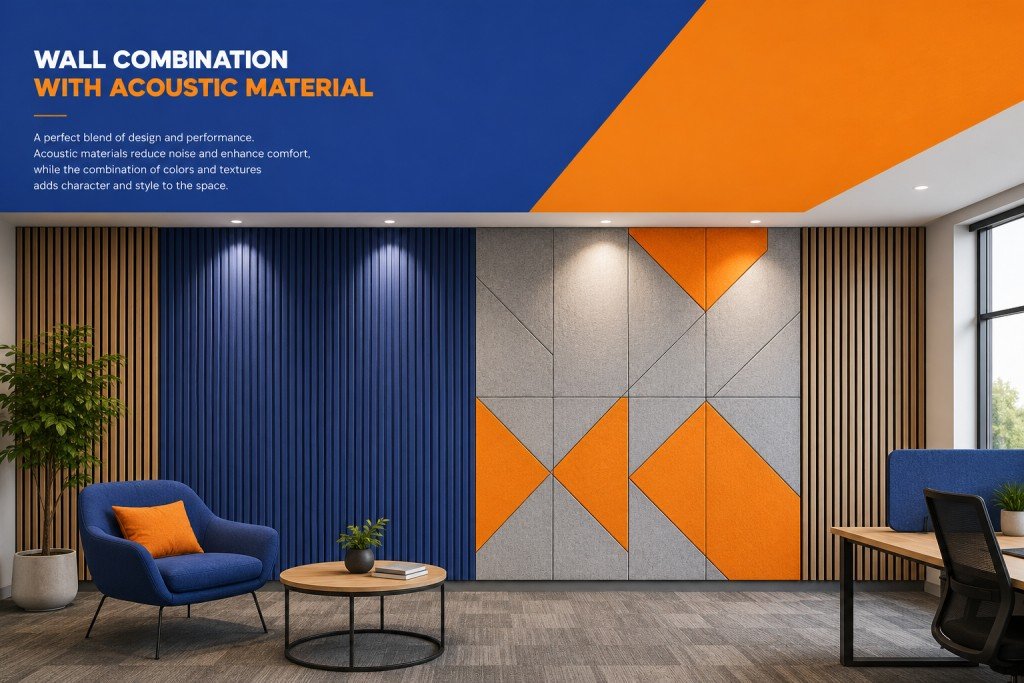
Interior Wall Combination with Acoustic Material
For offices, studios, and home theatres, our recommended interior wall combination with acoustic material pairs a rigid acoustic core (mineral wool or PET felt) with a fabric-wrapped or perforated wooden finish. This layering absorbs mid and low frequencies that single-layer foam misses entirely.
Also Read : Ceiling Combination & Underdeck Panels.
| Parameter | Detail |
|---|---|
| NRC Range | 0.75 to 0.95 |
| Fire Rating | IS 11871, Class A |
| Core Options | Mineral wool, PET felt, wood wool |
| Thickness | 12mm to 50mm |
| Standard Sizes | 600x600mm to 1200x2400mm |
| Finish | Fabric, wood veneer, perforated |
| Recycled Content | Up to 35% certified |
| Key Benefits |
|---|
| Reduces echo and reverberation |
| Improves speech clarity |
| Enhances interior aesthetics |
| LEED India credit eligible |
| Low maintenance over 10 years |
| Custom finish options |
| Fire-safe for commercial use |
| Space | Recommended Acoustic Benefit |
|---|---|
| Corporate Offices | Noise control and improved speech clarity |
| Recording Studios | Enhanced sound isolation and balanced acoustics |
| Auditoriums | Echo reduction and uniform sound distribution |
| Home Theatres | Immersive audio experience with reduced reverberation |
| Hospitals | Reduced ambient noise for patient comfort |
| Hotels | Better guest privacy and acoustic comfort |
| Classrooms | Improved speech intelligibility and concentration |
| Installation Process Step |
|---|
| Site Acoustic Assessment |
| Wall Substrate Check |
| Core Panel Mounting |
| Air Gap Optimization |
| Finish Layer Fixing |
| Edge Sealing |
| Post-Install Measurement |
| Myth | Reality |
|---|---|
| Higher NRC always sounds better | Frequency range matters too |
| Foam panels stop noise transfer | Foam absorbs, does not block |
| Thicker always means quieter | Air gap matters more |
| Any wall can mount panels | Substrate affects durability |
| Fabric color affects acoustics | Core material does the work |
Exterior Wall Combination with Acoustic Material
For facades and semi-outdoor zones, our exterior wall combination with Acoustic Material Characterization uses weather-resistant wood wool boards tested to IS 3308, bonded over a moisture barrier, so performance does not degrade through monsoon humidity.
Acoustic Wall Panels Material We Use
Our acoustic wall panels material range includes grooved wooden slats, micro-perforated MDF, fabric-wrapped glass wool, and CNC-cut PET felt, each NRC-tested to ISO 354 and ASTM C423.
Frequently Asked Questions
Mineral wool core with fabric-wrapped finish works best for offices.
No, panels absorb echo; soundproofing blocks transfer between rooms.
Yes for small panels, but professional installation ensures correct NRC performance.
Costs vary by material, typically Rs 150 to Rs 800 per square foot.
Wood wool suits humid areas; fabric panels suit indoor aesthetic-focused spaces.
Yes, fabric or foam panels noticeably reduce echo and reverberation indoors.
NRC 0.85 or above is recommended for home theatre walls.
Yes, PackSound panels meet IS 11871 and NBC 2016 fire standards.
Yes, weather-resistant wood wool panels suit exterior and semi-outdoor applications.
Quality panels last 10 plus years with minimal maintenance required.