
Micro Perforated Ceiling Tile – Acoustic & Modern Design
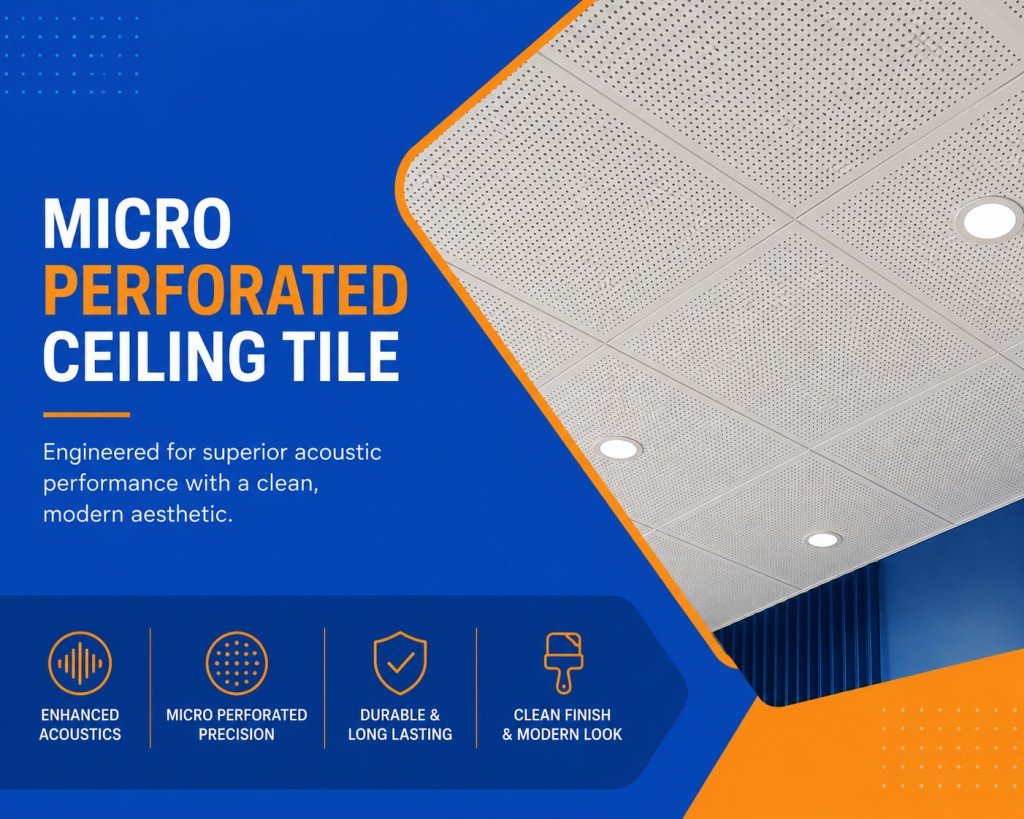
A Micro Perforated Ceiling Tile is not simply a ceiling board with holes punched through it. The perforations in a true micro perforated tile are typically between 0.8 mm and 1.8 mm in diameter – small enough to be nearly invisible to the human eye at standing height, yet acoustically significant enough to deliver Noise Reduction Coefficient (NRC) values between 0.70 and 0.90 when paired with the correct absorptive backing.
What separates a micro perforated ceiling tile from a standard perforated ceiling gypsum tile is the science behind the hole geometry. The perforation ratio – the percentage of open surface area relative to the total panel face – is precisely controlled during manufacturing. Too low and sound reflects rather than enters; too high and the tile loses structural integrity and visual uniformity. Industry-tested micro perforated ceiling tiles maintain a perforation ratio typically between 15% and 25%, calculated to maximise mid-frequency absorption where human speech and HVAC noise primarily occur.
Why Architects and Acoustic Consultants Specify Micro Perforated Ceiling Tiles
The Ceiling Is the Largest Untreated Surface in Most Rooms
In most commercial interiors, walls receive acoustic treatment through panels and partitions, while the ceiling is simply painted plaster or a basic grid tile. This is a significant oversight. Sound waves generated at desk height travel upward, reflect off the ceiling, and return as flutter echo and reverberation. In a 50-person open-plan office, an untreated ceiling can push reverberation times above 1.2 seconds – well above the 0.6 to 0.8 seconds recommended by global workplace acoustic standards for speech intelligibility.
A micro perforated ceiling tile installed across even 60% of a ceiling area can pull reverberation time down into the acceptable range without any visible acoustic treatment on the walls. For architects working within tight design briefs, this is not a small advantage.
Seamless Visual Integration That Fabric Panels Cannot Match
Micro perforated acoustic panels on the ceiling preserve the clean, continuous surface plane that high-end commercial interiors demand. Unlike ceiling baffles or exposed acoustic clouds, a micro perforated metal ceiling tile sits flush within a standard T-grid or concealed-grid system. Visitors and occupants simply see a ceiling. Acoustic consultants see a treatment strategy.
This dual identity – invisible performance – is why micro perforated ceiling tiles are the default specification choice for premium corporate offices, five-star hotel lobbies, airport lounges, healthcare facilities, and courtrooms, where both speech clarity and interior aesthetics are non-negotiable.
PackSound PerfoAudile: Technical Specifications
| Parameter | Specification |
|---|---|
| Panel Size | 600 x 600 mm / 600 x 1200 mm |
| Panel Thickness | 12 mm / 15 mm |
| Perforation Diameter | 0.8 mm to 1.5 mm (CNC precision) |
| Perforation Ratio | 15% to 22% |
| NRC Rating | 0.70 to 0.90 (backing-dependent) |
| Backing Material | Certified glass wool / mineral wool |
| Fire Rating | Class A (IS 1580 compliant) |
| Humidity Resistance | Up to 95% RH |
| Grid Compatibility | 15 mm / 24 mm T-grid, concealed grid |
| Weight | 4.2 to 6.8 kg/m² |
| Finish | White, off-white, custom paint-ready |
| Warranty | 1 Year Warranty (Contional*) |
Key Benefits of Micro Perforated Ceiling Tiles
Micro perforated ceiling tiles combine acoustic performance, modern aesthetics, and long-term durability, making them an ideal solution for commercial, institutional, and industrial spaces.
| # | Benefit | What It Means |
|---|---|---|
| 1 | Certified Acoustic Performance | Third-party NRC ratings let you commit to a measurable RT60 target before installation begins. |
| 2 | Seamless Visual Integration | Sits flush in a standard T-grid and looks identical to a painted plaster ceiling at standing height. |
| 3 | Class A Fire Rating | Non-combustible gypsum-composite face satisfies hospital, school, and multiplex fire safety compliance. |
| 4 | 95% RH Humidity Resistance | Rated for India’s most humid coastal climates with no sagging, warping, or discoloration during monsoon cycles. |
| 5 | Minimal Maintenance | Hard surface requires only vacuuming or compressed air cleaning with no re-covering needed unlike fabric panels. |
| 6 | Full MEP Compatibility | Standard module sizes allow lighting fixtures, sprinklers, and HVAC diffusers to integrate cleanly. |
| 7 | IGBC and LEED Credit Contribution | Supports LEED v4 Indoor Environmental Quality and low-emitting materials certification requirements. |
Applications of Micro Perforated Ceiling Tiles
Micro Perforated Ceiling Tiles are widely used in modern architectural spaces where superior acoustic control, clean aesthetics, and long-term durability are essential. These ceiling systems help reduce reverberation, improve speech clarity, and create acoustically balanced environments across commercial and specialized applications.
| Space | Why Micro Perforated Ceiling Tiles Are Specified |
|---|---|
| Open-Plan Corporate Offices | Reduces RT60 from 1.4 to 0.7 seconds across large floor plates without requiring additional wall treatment. |
| Conference Rooms and Boardrooms | Eliminates ceiling-to-floor flutter echo and improves Speech Transmission Index above 0.75 for clearer communication. |
| Five-Star Hotels and Hospitality | Provides effective mid-frequency sound absorption invisibly within coffered ceilings and luxury architectural designs. |
| Hospitals and Healthcare Facilities | Features wipeable, non-combustible surfaces that meet NABH hygiene standards while minimizing clinical echo. |
| Schools and Colleges | Brings classroom reverberation levels within ANSI S12.60 standards using only ceiling-based acoustic treatment. |
| Multiplexes and Cinemas | Delivers consistent, batch-matched NRC performance across multiple screen rooms and foyer acoustic zones. |
| Airports and Transit Terminals | Enhances public announcement intelligibility in check-in halls, baggage claim areas, and passenger waiting zones. |
| Recording Studios and Broadcast Rooms | Controls ceiling-to-floor flutter echo in control rooms and vocal booths using frequency-specific sound absorption. |
| Step | Phase | Action |
|---|---|---|
| 1 | Pre-Installation | Scan structural slab for post-tension cables and MEP conduits before drilling any suspension rod positions. |
| 2 | Pre-Installation | Establish finished ceiling height using a laser level and mark perimeter wall angle position on all four walls. |
| 3 | Pre-Installation | Plan tile layout from room centre outward to ensure equal perimeter cut tiles on opposite sides. |
| 4 | Pre-Installation | Inspect all tiles for transit damage, perforation blockage, and matching batch codes before installation begins. |
| 5 | Grid Installation | Fix perimeter L-angle at ceiling height using masonry anchors at 300 mm centres. |
| 6 | Grid Installation | Install plumb suspension rods at 1200 mm centres and hang main T-bar runners levelled by string line or laser. |
| 7 | Grid Installation | Clip cross tees at 600 mm centres to form grid modules; verify squareness by diagonal measurement. |
| 8 | Acoustic Backing | Lay glass wool or mineral wool backing continuously above the grid with no gaps at joints or service penetrations. |
| 9 | Acoustic Backing | Maintain 50 mm to 100 mm air cavity between backing face and tile face for low-frequency cavity absorption. |
| 10 | Tile Installation | Tilt tiles through grid opening and rotate flat onto T-bar flanges; ensure no rocking on any of the four flanges. |
| 11 | Tile Installation | Mark and cut service penetrations using a fine-tooth jigsaw; seal all cut edges with edge sealant. |
| 12 | Tile Installation | Score and snap perimeter cut tiles against a steel edge on a fully supported flat surface. |
| 13 | Post-Installation | Inspect completed ceiling for plane irregularities, colour consistency, and tight fit at all service cutouts. |
| 14 | Post-Installation | Measure post-installation RT60 and compare against acoustic model; deviations above 15% indicate backing shortfall. |
| 15 | Handover | Record in the O and M manual that future repainting must use low-viscosity spray only to avoid perforation clogging. |
| Myth | Reality |
|---|---|
| More perforations = better acoustics | Perforation ratio must be optimised, not maximised. Over-perforating reduces structural strength without improving NRC. |
| Micro perforated tiles soundproof a room | They absorb echo within a room. Soundproofing requires mass and decoupling, not perforation. |
| Any gypsum tile with holes qualifies | True micro perforated ceiling tiles use CNC-controlled sub-1.5 mm holes with engineered backing. Ordinary punched gypsum does not qualify. |
| Painting tiles after installation is harmless | Paint clogs micro perforations and measurably degrades NRC by 15 to 30 percent. |
How PackSound PerfoAudile Micro Perforated Ceiling Tiles Are Built
The Panel Face: Engineered Board With Controlled Perforation
PackSound’s micro perforated ceiling tiles use a high-density fibre cement or gypsum-composite face panel, precision-drilled using CNC machinery to maintain perforation uniformity across every tile. Unlike manually punched perforated ceiling gypsum tiles that suffer from inconsistent hole sizing, CNC-drilled micro perforations ensure that every tile in a project performs identically – which matters when specifying to a target NRC value.
Available finish options include pure white, off-white, and custom paint-ready surfaces. The tile face is compatible with standard emulsion paints without perforation clogging, provided low-viscosity formulations are used – a specification detail that most generic suppliers omit from their datasheets.
Industry Insider Knowledge: What Experienced Acoustic Specifiers Know That Others Do Not
The Mid-Frequency Trap That Catches Every Novice Specifier
Micro perforated ceiling tiles perform best between 500 Hz and 4000 Hz – the critical speech intelligibility band. However, most project briefs also include low-frequency noise problems: HVAC rumble, bass from mechanical equipment, or floor-transmitted vibration from adjacent floors. No micro perforated ceiling tile, regardless of NRC rating, addresses low-frequency noise effectively on its own. Experienced Micro-Perforated Acoustic Panels with low-frequency bass absorbers or mass-loaded vinyl (MLV) underlays within the plenum cavity. Specifying micro perforated tiles alone for a mechanical plant room or a cinema is an expensive mistake that acoustic novices make repeatedly.
Paint Is the Hidden Enemy of Acoustic Performance
Once a micro perforated ceiling tile is installed, subsequent repaints by facility management teams using standard roller-applied emulsions can reduce NRC by 15% to 30% by partially or fully blocking micro perforations. PackSound recommends specifying this risk in handover documentation and suggests spray application or pre-finished tiles for projects with long maintenance cycles.
The Difference Between NRC and CAC – and Why Both Numbers Matter
NRC (Noise Reduction Coefficient) measures how much sound a tile absorbs within a space. CAC (Ceiling Attenuation Class) measures how much sound the ceiling tile blocks from passing between adjacent rooms through a shared plenum. Specifiers focused only on NRC often install micro perforated ceiling tiles in open-plan offices with shared plenums, creating privacy problems because sound passes freely over the partition walls through the lightweight tile. High-performance projects require tiles with CAC ratings above 35 for spaces with confidentiality requirements.
The T-Grid Colour Mismatch Problem in Indian Projects
In Indian commercial construction, grid systems from different suppliers are often mixed on the same project. A micro perforated ceiling tile specified in RAL 9010 pure white can appear visibly different alongside a T-grid in standard white from a hardware supplier. Experienced project managers always specify grid and tile from the same manufacturer or conduct colour matching on-site before full installation. This is never mentioned in product brochures.
Frequently Asked Questions About Micro Perforated Ceiling Tiles
Can micro perforated ceiling tiles handle high humidity like bathrooms or spas?
PackSound PerfoAudile tiles are rated up to 95% RH, making them suitable for spas, pool enclosures, and commercial kitchens where standard gypsum fails quickly.
How is a micro perforated ceiling tile different from regular perforated gypsum tiles sold locally?
Local perforated gypsum uses 4 to 6 mm holes and rarely exceeds NRC 0.50. Micro perforated tiles use CNC-drilled sub-1.5 mm holes with engineered backing, achieving NRC up to 0.90.
Will these tiles work in a home studio or podcast room?
Yes for echo control, but low ceilings also need bass trapping. Pair micro perforated ceiling tiles with corner-mounted fiberglass acoustic panels for complete treatment.
Are micro perforated ceiling tiles worth the cost compared to foam?
Foam degrades in three to five years in Indian humidity and is a fire risk. PerfoAudile tiles carry a five-year structural warranty with certified NRC performance – far better lifetime value.
Can they be used in semi-open or outdoor covered spaces?
Standard tiles are not recommended for rain-exposed areas. PackSound can specify weatherproof configurations for covered transit terminals and outdoor walkways on request.