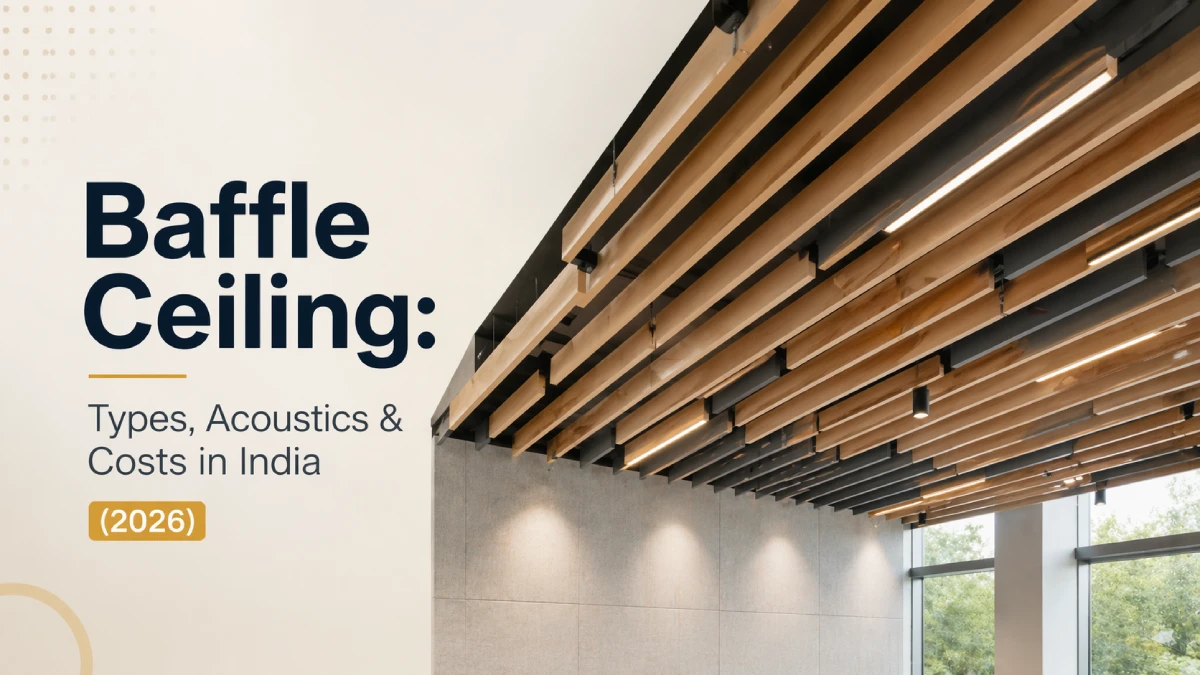
There is a moment in almost every large commercial or institutional project when someone looks up at the ceiling and realises it is the one surface nobody has properly thought about. The floor has been specified. The walls have a finish. But the ceiling — often the largest single uninterrupted surface in the room — is just a flat expanse of concrete or metal deck, reflecting every sound that reaches it straight back down into the space.
Baffle ceilings solve this problem with an elegance that few other design solutions can match. A row of vertical panels suspended from the structural soffit does three things simultaneously: it absorbs reflected sound energy and reduces reverberation, it conceals the services, ductwork, and structural elements above without fully enclosing them, and it creates a visual rhythm that can be one of the most powerful design moves in a large interior.
In offices, airports, sports halls, restaurants, schools, and industrial buildings across India, baffle ceiling systems have become the specification of choice wherever ceiling height, acoustic performance, and design quality all matter simultaneously.
This guide covers everything you need to know about baffle ceilings in India in 2026 — what they are made from, how they work acoustically, which materials suit which environments, how to specify spacing and depth for target performance, how installation works in practice, what they cost in India, and which Packsound products are right for different project types.
What Is a Baffle Ceiling?
A baffle ceiling is a system of panels suspended vertically from the ceiling structure in parallel rows. Unlike a conventional false ceiling that creates a continuous horizontal plane, baffle panels hang down into the room as individual fins or blades, leaving open space between them.
Sound waves travelling in any horizontal or diagonal direction through the space will encounter a baffle surface. Energy is absorbed on contact, converted into a negligible quantity of heat through friction within the panel’s porous structure, and removed from the reverberant field. In a correctly spaced run of baffles, the total absorptive surface area presented to the room is far greater than an equivalent area of ceiling tile, because every panel contributes two absorptive faces rather than one.
The open gaps between the panels serve a practical purpose beyond aesthetics. They allow air to circulate freely, meaning HVAC ductwork can operate through the ceiling zone without obstruction. Lighting fixtures, sprinkler heads, smoke detectors, and data cabling can all be accommodated between and above the baffles without the coordination conflicts that arise with closed ceiling systems. In refurbishment and retrofitting projects — which represent the majority of acoustic treatment work in India’s existing building stock — this is a decisive practical advantage.
Baffle Ceiling vs. Acoustic Cloud: What Is the Difference?
Both acoustic baffles and acoustic ceiling clouds are suspended from the ceiling structure and made from sound-absorbing materials. The distinction comes down to orientation:
- Acoustic baffles hang vertically — perpendicular to the floor. They intercept sound travelling horizontally through the room (which is the dominant direction of noise propagation in most commercial spaces) and present both faces to the sound field simultaneously.
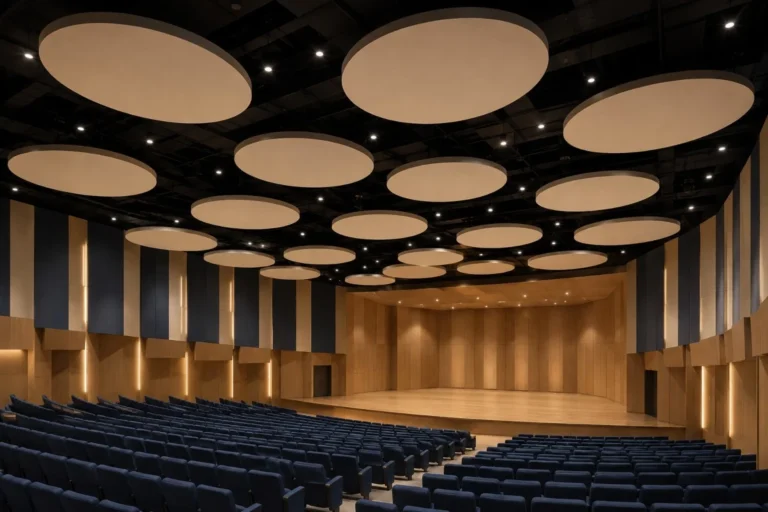
- Acoustic clouds hang horizontally — parallel to the floor. They intercept sound reflecting off the ceiling and address late-arriving ceiling reflections, but present only their upper and lower faces rather than two vertical faces running the full length of the panel.
In practical terms, baffles are more acoustically efficient per unit of ceiling plan area in large, high-ceilinged spaces because they expose more absorptive surface to a greater proportion of the room’s reverberant field. Clouds are better suited to spaces where a horizontal ceiling element serves a specific acoustic purpose — such as directing early reflections toward an audience in a performance venue.
Many projects use both. Explore the full comparison in our guide: Acoustic Clouds vs Acoustic Baffles — Which to Choose.
How Does a Baffle Ceiling Work Acoustically?
To understand why baffle ceilings work, you need a basic model of how sound behaves inside a room.
When a person speaks, a machine operates, or music plays in an enclosed room, sound waves radiate outward from the source in all directions. They travel through the air until they hit a surface — wall, floor, ceiling, or any object in the room. At every surface, a portion of the sound energy is reflected back into the room and a portion is absorbed. Hard, dense surfaces (concrete, glass, polished tile, plaster) reflect the great majority of energy; soft, porous surfaces absorb more.
In a typical large commercial or institutional building in India — concrete structure, tiled or polished floor, glass partitions, smooth plasterboard or exposed concrete ceiling — almost all surfaces are highly reflective. Sound reflects repeatedly, bouncing between surfaces many times before finally losing enough energy to become inaudible. This sustained presence of reflected sound after the source has stopped is called reverberation, and it is measured by the reverberation time (RT60) — the time in seconds for sound energy to decay by 60 decibels.
A long RT60 means sound from one moment in a conversation overlaps with and obscures the next moment. Speech becomes muddy, unintelligible, and fatiguing to follow. Background noise from multiple simultaneous conversations accumulates to uncomfortable levels. The problem is not volume — it is the acoustic character of the room.
Why Vertical Panels Are So Effective
Conventional ceiling tiles address ceiling reflections but leave wall and cross-room reflections untreated. Baffle panels attack the problem differently. Because they hang vertically across the width or length of the space, they intercept sound travelling in any direction that intersects the plane of the panel — which, in any large room, is a very large proportion of all sound paths.
The effective absorptive area of a baffle run is substantially greater than its plan footprint. A baffle panel 300 mm wide and 1200 mm deep, suspended with 300 mm of open space on each side, contributes approximately 2400 mm × 1200 mm = 2.88 m² of absorptive surface (both faces) while occupying only 300 mm × 1200 mm = 0.36 m² of ceiling plan area. That is an 8:1 ratio of absorptive surface to plan area — far better than any conventional ceiling tile.
This is why well-specified baffle ceilings can dramatically transform the acoustic character of large, high-ceilinged spaces where conventional ceiling treatment either cannot be installed or cannot provide enough total absorption.
NRC — The Key Performance Metric
The acoustic performance of any baffle panel is measured by its NRC (Noise Reduction Coefficient) — a number between 0 and 1 representing the fraction of incident sound energy absorbed across the key speech frequencies (250 Hz, 500 Hz, 1000 Hz, and 2000 Hz). An NRC of 0.85 means the panel absorbs 85% of the sound that strikes it.
For suspended baffles tested to ASTM C423, manufacturers typically publish “NRC (Mounted)” figures that account for absorption from both panel faces and any edge effects — resulting in values that sometimes exceed 1.0 for thick panels. This is acoustically valid because the panel intercepts and absorbs sound from multiple directions simultaneously, but it requires careful interpretation: always ask for the full frequency-band absorption data, not just the headline NRC number.
Minimum NRC targets for baffle ceilings by application:
| Application | Minimum NRC | Recommended Baffle Material |
|---|---|---|
| Open-plan office | 0.80 | Mineral fibre or fabric-wrapped |
| School classroom | 0.80 | Mineral fibre |
| Sports hall / gymnasium | 0.85 | Mineral fibre or polyester fibre |
| Restaurant / food court | 0.75 | Mineral fibre or wooden |
| Industrial / manufacturing | 0.85 | Mineral fibre |
| Airport terminal / transport hub | 0.80 | Aluminium or mineral fibre |
| Auditorium / conference hall | 0.90 | Fabric-wrapped mineral fibre |
All Packsound baffle ceiling products are tested to ASTM E1264 and ASTM C423 by accredited independent laboratories. Test documentation is available for all products and provided as standard with project specification submissions.
Types of Baffle Ceiling: Materials and Applications
The material a baffle panel is made from determines its acoustic performance, fire rating, durability, aesthetic character, and appropriate application environments. Four core materials dominate the Indian commercial baffle ceiling market.
1. Mineral Fibre Acoustic Baffles
Mineral fibre is the professional standard for acoustic performance in commercial and institutional projects in India. The mineral wool core achieves high NRC ratings — typically 0.80 to 1.05 — across a broad frequency range that includes the mid and low frequencies that matter most for speech intelligibility and industrial noise control.
Fire performance is the mineral fibre baffle’s defining advantage for many Indian projects. Mineral fibre panels carry Euroclass A1 or A2 non-combustible fire ratings, which are mandatory for public buildings, schools, hospitals, and government facilities under India’s National Building Code 2016 fire safety provisions. For projects requiring LEED v4.1 or IGBC Green Homes certification, NABL-accredited NRC test documentation is available.
Mineral fibre baffles are faced with acoustically transparent fabric or perforated facing that allows sound to enter the absorptive core freely. They are available in a range of colours, panel depths (typically 150–600 mm), and widths (typically 100–300 mm) to suit different acoustic and design requirements.
Where to specify mineral fibre baffles: Schools, colleges, universities, hospitals, government offices, data centres, industrial facilities, call centres, airport terminals, railway stations, public assembly spaces, and any project requiring non-combustible fire classification.
Packsound mineral fibre baffles: Available in standard and custom dimensions. Fabric facing in a wide colour palette. Full test documentation to ASTM C423 provided on specification. See the full acoustic baffles range →
2. Wooden Acoustic Baffles
Wooden acoustic baffles bring natural warmth, material richness, and premium visual quality to the baffle ceiling aesthetic. They are constructed from engineered timber profiles — typically MDF with real wood veneer, solid hardwood, or thermoformed wood composites — with an acoustic backing layer (black acoustic felt or high-density fibre mat) that provides sound absorption.
Wooden baffles achieve NRC ratings in the range of 0.65–0.85, depending on panel profile, backing thickness, and whether slots or perforations are incorporated into the timber face. The acoustic mechanism combines diffusion at the timber surface (which scatters sound energy in multiple directions, reducing flutter echo) and absorption through the backing layer.
In premium commercial interiors — corporate headquarters, luxury hotels, high-end retail, restaurant design, boutique co-working spaces, and premium education institutions — wooden baffles are the specification of choice. Their visual impact is significantly greater than mineral fibre alternatives, and they integrate naturally with timber flooring, furniture, and the biophilic design language that is increasingly prevalent in premium Indian commercial interiors.
Where to specify wooden baffles: Corporate headquarters and C-suite reception areas, boutique hotels and restaurant interiors, premium co-working spaces, premium educational institutions (business schools, design schools), conference centres, luxury retail, and high-specification hospitality projects.
Packsound wooden acoustic ceiling range: Available in natural timber veneer profiles (walnut, oak, teak, ash, and custom species on request). Custom profile geometries — straight, tapered, and curved forms — available for signature projects. See the Auraluxe 3D Acoustic Blades →
3. Aluminium / Perforated Metal Baffles
Metal baffle ceiling systems — typically formed from aluminium extrusions or perforated steel panels — deliver the durability, cleanability, and contemporary industrial aesthetic that a significant segment of the Indian commercial market demands. They are specified wherever the design language calls for a hard, smooth, architectural finish rather than the softer character of fabric or timber.
The acoustic mechanism in metal baffles relies on perforations or slots in the metal face that allow sound to pass through to an absorptive backing layer (typically mineral wool or polyester fibre). The perforation pattern, hole diameter, and open area percentage determine how much sound energy accesses the backing and is absorbed. Correctly designed metal baffles achieve NRC ratings of 0.70–0.90.
Metal baffles offer specific practical advantages in challenging environments: they can be wet-cleaned, they are immune to moisture damage, they resist biological growth, and they withstand accidental impact from service vehicles and industrial equipment. In food production facilities, pharmaceutical clean rooms, sports facilities with ball-impact risk, and healthcare buildings where infection control requires cleanable surfaces, metal baffles are the only appropriate choice.
Where to specify metal baffles: Industrial facilities, warehouses and distribution centres, food production and pharmaceutical manufacturing, healthcare spaces requiring cleanable ceilings, airports and transport hubs, sports facilities, car parking structures with covered sections, and contemporary commercial interiors where a metallic industrial aesthetic is desired.
Packsound metal ceiling range: See Metal Ceiling Tiles →
4. Polyester Fibre (PET) Acoustic Baffles
Polyester fibre baffles are manufactured from compressed recycled PET (polyethylene terephthalate) — the same material as plastic bottles — processed into dense, rigid acoustic panels. They offer acoustic performance comparable to mineral fibre (NRC 0.75–1.00), with some specific advantages that make them the preferred specification in certain environments.
The primary advantage of polyester fibre baffles is moisture resistance. Unlike mineral wool or glass fibre, PET fibre does not absorb water or humidity, does not support mould or mildew growth, and does not degrade structurally in high-humidity environments. For Indian coastal cities — Mumbai, Chennai, Kochi, Mangalore, and other locations where sustained humidity above 80% RH is normal for months of the year — polyester fibre baffles are significantly more durable than mineral fibre alternatives.
PET baffles are also lighter than mineral fibre, easier to cut on site, and available in a wider range of bold colours (because PET fibre can be dyed through its full depth rather than just on the surface). The sustainability narrative around recycled content appeals to projects pursuing green building certification.
Where to specify PET/polyester fibre baffles: Coastal locations, swimming pool and aquatic centre surrounds (above the splash zone), food production and catering facilities, humid industrial environments, green building projects requiring recycled content, and projects where a broader colour palette or lighter weight is operationally advantageous.
Baffle Ceiling Spacing: How to Get the Acoustics Right
The acoustic performance of a baffle ceiling installation is determined by two variables: the NRC of the panels themselves, and the total absorptive surface area they present to the room. That total surface area is a direct function of spacing — how far apart the panels are hung from one another.
The fundamental spacing rule is that closer spacing provides more total surface area (and better absorption), while wider spacing reduces coverage but preserves more visual openness and reduces material cost.
Spacing Guidelines by Application
Open-plan offices and call centres: Recommended spacing: panel width = gap width (1:1 ratio). For example, 200 mm wide panels with 200 mm open gaps between them. This provides approximately 50% coverage of the ceiling area with absorptive surface on each face, resulting in high total absorption. Target RT60: 0.4 to 0.6 seconds.
Sports halls and gymnasiums: Recommended spacing: 1:1 to 1:1.5 ratio (panel width to gap width). Closer spacing addresses the extreme reverberation common in hard-surfaced sports halls (typically 4–8 seconds untreated). A common specification is 300 mm panels at 300 mm spacing. Target RT60: 1.0 to 1.5 seconds.
Restaurants and hospitality: Recommended spacing: 1:1.5 to 1:2 ratio. Slightly wider spacing preserves the visual openness desirable in hospitality interiors while providing sufficient absorption for comfortable acoustic levels. Target RT60: 0.8 to 1.2 seconds.
Industrial facilities: Recommended spacing: 1:1 to 1:2 depending on noise source intensity and target noise level reduction. Industrial applications often prioritise maximum absorption over aesthetics.
Airport terminals and large transport hubs: Recommended spacing: 1:2 to 1:3. The very large volumes and open plans of terminal buildings typically require wide runs of baffles at moderate spacing rather than dense coverage over a smaller area.
Panel Depth and Low-Frequency Performance
Baffle depth (the vertical dimension of the panel hanging down into the room) affects both acoustic and visual character.
Deeper panels — 600 mm or more — absorb more effectively at lower frequencies (below 500 Hz), because sound energy at lower frequencies requires a physically larger absorber to be effectively attenuated. They also create a more dramatic visual presence and provide more effective concealment of services above the ceiling line.
Shallower panels — 150–300 mm — provide excellent mid and high frequency absorption, which is the dominant frequency range of human speech and most commercial ambient noise. They have a more delicate visual character and take up less vertical space in rooms where ceiling-to-floor height is already limited.
For most commercial office applications, a 200–300 mm panel depth provides the optimum balance of acoustic performance, practical service clearance, and proportional visual character. For sports halls, industrial facilities, and spaces with significant low-frequency machinery noise, panels of 400–600 mm are recommended.
Baffle Ceiling Design: Layouts and Patterns
One of the distinctive qualities of baffle ceilings compared to conventional ceiling tiles is the visual impact they create. A well-designed baffle ceiling layout is an architectural gesture — it organises the visual complexity of an open, high-ceilinged interior, creates rhythm and scale, and gives the space a sense of purposeful design rather than the flat, neutral character of a grid ceiling.
Parallel Linear Layouts
The most common baffle ceiling configuration: panels running in parallel rows in a single direction — typically aligned with the long axis of the room or with the primary structural grid. Linear layouts work well in open-plan offices, corridors, airport concourses, and industrial spaces where a directional rhythm reinforces the spatial organisation.
Crossed and Grid Patterns
Two sets of baffles running perpendicular to each other, creating a grid of open cells in plan. This configuration provides excellent acoustic performance (both sets of panels absorb sound from the same space) and a more dynamic visual character than simple linear runs. It is often specified in large reception and lobby spaces where the ceiling is a visual focal point.
Angled and Radial Patterns
In signature commercial and institutional projects, baffle panels can be arranged in converging or radiating patterns that create visual dynamism and help articulate specific zones within a large open interior. Angled layouts require custom-length panels and more complex suspension hardware but deliver a ceiling that reads as a bespoke design element rather than a product selection.
Varied Depth Patterns
Hanging baffles of different depths within the same installation creates a three-dimensional ceiling landscape — deeper panels in some zones creating shadow and depth contrast. This approach is increasingly common in premium hospitality and corporate interiors where the ceiling is expected to contribute to the overall design narrative rather than serve as a neutral backdrop.
Baffle Ceiling and HVAC, Lighting, and Services Integration
A critical practical advantage of baffle ceilings over closed false ceilings is their inherent compatibility with building services. This is particularly significant in Indian commercial buildings where the coordination of ceiling systems with MEP (mechanical, electrical, and plumbing) services is frequently a project management challenge.
HVAC Integration
Baffle panels leave the ceiling zone above them open, allowing supply air diffusers and return air grilles to be positioned freely throughout the ceiling field without being constrained by panel grid lines. Circular and linear diffusers can be located above the baffle runs with supply air flowing down between panels into the occupied zone below. This provides excellent air distribution without the acoustic compromise of cutting large penetrations through continuous ceiling tiles.
In buildings with exposed concrete soffit ceilings and visible ductwork — a common aesthetic in contemporary Indian office design — baffle panels can be positioned selectively to conceal the most visually intrusive ductwork elements while leaving the overall exposed ceiling aesthetic largely intact.
Lighting Integration
Linear LED lighting systems can be run above or between baffle rows, with illumination directed downward through the open spaces between panels. Pendant luminaires can hang below baffle panels, positioned for task illumination at workstation level. In restaurants and hospitality spaces, the interplay of baffle panels and pendant or linear lighting creates layered visual depth that is one of the signature characteristics of contemporary ceiling design.
Track lighting mounted above the baffle line provides flexibility for directional lighting of display areas, reception desks, and feature elements within the space below.
Sprinklers and Fire Detection
Sprinkler head positioning in baffle ceiling spaces requires coordination to ensure adequate coverage of the floor area below in accordance with the relevant Indian Standards and NBC 2016 fire safety requirements. Sprinklers are typically positioned above the baffle line or between panels, with coverage calculations confirming that the open spaces between panels allow adequate water distribution to the occupied zone. Consult your project fire protection engineer for confirmation of sprinkler layout compliance during the design stage.
Data Cabling and Technology Infrastructure
Data cables, AV infrastructure, and low-voltage systems can be routed freely through the ceiling zone above baffle panels without the constraints of a closed ceiling void. Cable trays and conduits are typically installed parallel to or perpendicular to baffle rows, invisible from below.
Baffle Ceiling Installation in India: What to Expect
How Baffle Panels Are Suspended
Acoustic baffle panels are suspended from the structural slab, exposed ceiling, or steel framework above using one of the following systems:
Aircraft cable suspension: Stainless steel wire rope of 1–2 mm diameter, attached to the ceiling structure via anchor bolts or specialist fixings and to the baffle panel via adjustable swage ferrules or loop-through hardware at each panel end. Aircraft cable systems allow rapid height adjustment during installation and are the standard for most commercial applications.
Threaded rod suspension: For heavy panels or where precise, rigid positioning is required, threaded steel rod (M6 or M8) with adjustable locking nuts provides structural rigidity that cable systems cannot match. Used primarily for metal baffles and deep wooden panels in high-occupancy public spaces.
Concealed panel rail systems: A horizontal rail installed at the top of the baffle run, with individual panels slotted or clipped into the rail. This system is faster to install for long, regular runs and is commonly used for aluminium baffle systems.
Installation Sequence
1. Structural survey and layout setting out Prior to any installation work, the suspension fixing positions are marked out on the existing ceiling structure. Structural fixings for aircraft cable or threaded rod must be located into the concrete slab, structural steel frame, or purpose-installed backing channels — not into plasterboard or lightweight ceiling materials. A load calculation should confirm that the existing structure can support the additional suspended weight of the baffle installation.
2. Suspension fixing installation Fixing anchors — typically M8 or M10 resin anchors into concrete, or Hilti-type expansion bolts — are drilled and installed at the calculated suspension point positions. Where the existing ceiling has a concealed steel structure, self-drilling fixings into the steel may be used.
3. Cable or rod installation and levelling Suspension cables or rods are installed and adjusted to the design baffle hanging height. Laser levels or tensioned string lines are used to set the consistent hanging level across the installation.
4. Panel installation Baffle panels are installed sequentially along each run. Panel end caps and edge details are applied where required for a finished appearance at the perimeters of the installation.
5. Snagging and alignment The completed installation is inspected for panel alignment, consistent spacing, and correct hanging depth. Any panels requiring adjustment are re-levelled and re-secured.
Indian Site Conditions — Practical Considerations
Concrete slab quality: Most commercial buildings in India are cast-in-situ reinforced concrete. Concrete quality varies considerably, particularly in older buildings. Anchor pull-out loads should be verified on site before loading the suspension system; where concrete quality is doubtful, through-bolt systems or structural steel backing channels should be specified.
Humidity and dust during construction: Indian construction sites experience high dust concentrations during finishing phases. Baffle panels should be installed after dusty finishes are complete, or covered with protective film if installed earlier in the programme. Mineral fibre panels are particularly susceptible to surface staining from construction dust.
Seismic considerations: India’s IS 1893 seismic zoning categorises much of the country in seismic zones III, IV, and V. Suspended baffle systems in buildings in higher seismic zones should include lateral bracing or cross-cable systems to prevent excessive panel movement during seismic events. Packsound’s suspension systems are designed to comply with IS 1893 seismic requirements on request.
Baffle Ceiling Cost in India (2026 Guide)
Baffle ceiling costs in India vary significantly depending on material, panel depth, surface finish, suspension system, and project scale. The following ranges are realistic for 2026, based on supply and installation costs in the Delhi-NCR, Mumbai, and Bangalore markets. Costs in tier-2 cities and smaller centres will typically be lower.
Mineral Fibre Acoustic Baffles
₹700 to ₹2,000 per square metre of ceiling area covered (both supply and installation, based on standard 1:1 panel-to-gap ratio). NABL-accredited NRC test documentation for LEED or IGBC credit submissions is available at this price point.
Polyester Fibre (PET) Acoustic Baffles
₹800 to ₹1,800 per square metre of ceiling area covered. Pricing comparable to mineral fibre, with modest premium for moisture-resistant configurations in coastal or humid environments.
Wooden Acoustic Baffles
₹2,500 to ₹6,000+ per square metre of ceiling area covered, depending on timber species, profile complexity, and finish specification. Engineered veneer profiles are at the lower end; solid hardwood and custom-profiled elements at the upper.
Aluminium / Metal Baffles
₹1,800 to ₹4,500 per square metre of ceiling area covered, depending on extrusion geometry, anodised vs. powder-coat finish, and acoustic backing specification.
Factors That Significantly Affect Cost
Panel depth: Deeper panels contain more material and require more suspension hardware per panel. Moving from 200 mm to 400 mm depth typically adds 30–50% to panel supply cost.
Custom dimensions and finishes: Standard catalogue sizes are significantly less expensive than bespoke panel dimensions and custom colour or veneer specifications.
Ceiling height and access: Installations at heights above 6 metres require scaffolding or scissor lift equipment, adding to installation labour costs. Buildings in use during installation (live office or institutional environments) require restricted working hours and careful site management, increasing labour costs.
Project scale: Large-quantity contracts — typically above 1,000 m² — attract volume pricing discounts on material supply. Smaller orders command standard list prices.
Suspension system complexity: Standard cable systems are the lowest-cost option. Rigid rod systems, custom rail systems, and architecturally specified suspension hardware carry premiums.
Which Spaces Need a Baffle Ceiling? Application Guide for India
Corporate Offices and Open-Plan Workspaces
Open-plan offices in India — the dominant format in the country’s rapidly expanding technology, finance, and professional services sectors — are acoustically among the most challenging commercial spaces to specify correctly. Hard floors, glass partitions, exposed concrete ceilings, and dozens of simultaneous conversations create ambient noise levels that regularly exceed 65 dB during peak working hours.
Baffle ceilings are typically specified as the primary acoustic treatment for open-plan offices in combination with acoustic wall panels at perimeter and partition surfaces. The ceiling treatment addresses the overhead reverberant field; the wall treatment addresses lateral reflections and provides visual acoustic character at the occupied eye level. Together, they deliver the RT60 of 0.4 to 0.6 seconds recommended for productive cognitive work environments.
For enclosed meeting rooms within open-plan offices, baffle ceilings or acoustic ceiling clouds provide targeted overhead treatment in the meeting zone. The ThinkPod range offers fully self-contained acoustic workspace pods for offices requiring private work and meeting spaces without permanent construction.
Schools, Colleges, and Educational Institutions
India’s vast investment in school and university construction — both government and private — is creating enormous demand for acoustic ceiling solutions. Research consistently demonstrates that poor classroom acoustics reduce learning outcomes, particularly for younger children, second-language learners, and children with hearing difficulties.
IS 4954 specifies RT60 targets of 0.4–0.6 seconds for classrooms and 0.8–1.2 seconds for multi-purpose halls. Mineral fibre baffle ceilings with NRC 0.80+ are the most practical solution for meeting these targets in India’s standard reinforced concrete school buildings, where the slab-to-slab height makes closed false ceilings acoustically and practically challenging.
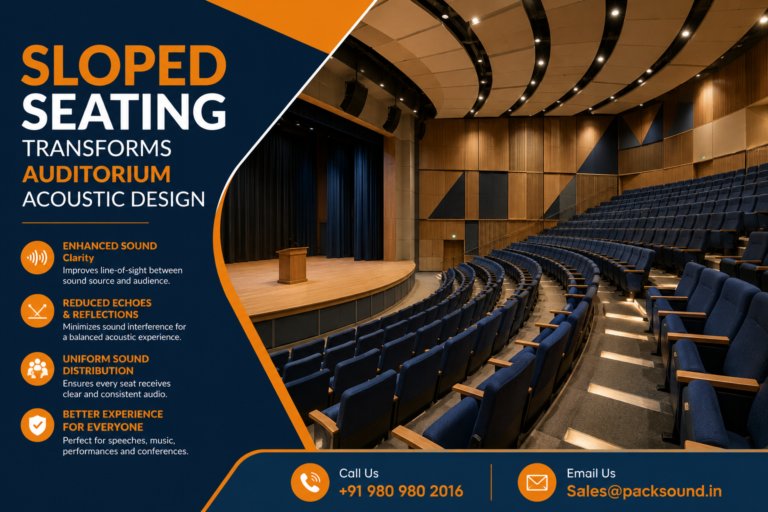
For school and university auditoriums, baffle ceilings are combined with auditorium acoustic treatment on walls and rear surfaces for comprehensive acoustic management.
Sports Halls, Gymnasiums, and Multipurpose Halls
Sports halls present the most extreme acoustic challenge in institutional buildings — large volumes, all-hard surfaces, high ambient noise from physical activity, and a requirement for clear spoken communication between coaches and athletes for both performance and safety reasons. Untreated sports halls routinely have RT60 values of 4–8 seconds.
Deep mineral fibre baffles at 1:1 or closer spacing are the standard solution for Indian sports halls, capable of bringing RT60 from 6+ seconds to 1.5–2.5 seconds in a single installation. Polyester fibre baffles are specified where moisture resistance is a priority — particularly in spaces doubling as changing areas or adjacent to pool facilities.
Restaurants, Cafes, and Hospitality Venues
The Indian dining and hospitality industry has learned through experience that acoustic comfort is not a luxury — it is a commercial necessity. Restaurants with reverberation times above 1.5 seconds generate consistent negative acoustic comments in online reviews, drive away repeat custom, and force customers and staff to raise their voices, creating a self-reinforcing spiral of increasing noise.
Wooden acoustic baffles are particularly effective in premium restaurant contexts — they provide the natural warmth and material quality appropriate for a dining environment while delivering the acoustic performance needed to bring RT60 to the 0.8–1.2 second range comfortable for conversation. Mineral fibre baffles at wider spacing work well in casual dining contexts where budget and durability are higher priorities.
Industrial Facilities, Warehouses, and Manufacturing Plants
Industrial acoustic treatment in India has historically been neglected compared to commercial and institutional applications, but increasing awareness of worker health, growing enforcement of the Factories Act noise exposure provisions, and the demands of multinational manufacturing clients for international workplace standards are driving rapid change.
Baffle ceilings are the dominant treatment for industrial acoustic applications — they withstand the physical environment of industrial spaces (dust, humidity, occasional chemical exposure, mechanical vibration), they are compatible with the unrestricted overhead working space that industrial operations require, and they deliver the substantial noise level reductions (5–10 dB reduction in equivalent continuous noise level is achievable with well-specified baffle installations in reverberant industrial spaces) that improve worker safety and comfort.
Mineral fibre and metal baffles are the appropriate specifications for most Indian industrial applications. Metal baffles are specified where resistance to oil, chemical splash, or high-pressure cleaning is required.
Airport Terminals and Transport Hubs
India’s infrastructure investment in new airports, metro stations, bus terminals, and railway concourses represents a significant opportunity for baffle ceiling specification. Large, open, high-ceilinged transit spaces generate extreme reverberation that makes public address announcements incomprehensible — a safety issue as much as a comfort one.
Aluminium baffles are the most commonly specified solution for major Indian transport infrastructure — they are durable, cleanable, aesthetically neutral, and available in large-format custom configurations appropriate for the architectural scale of these buildings.
How to Specify Baffle Ceilings: A Checklist for Architects and Designers
Whether you are specifying a baffle ceiling for a new build or a refurbishment project, the following checklist covers the key decisions that determine acoustic performance and project success.
1. Define the acoustic target Determine the target RT60 for your space based on its primary use. Use IS 4954 for educational buildings, NBC 2016 for commercial and industrial applications, and established international benchmarks (ISO 3382 series) for performance spaces.
2. Calculate required absorption Using the room volume and existing surface absorption (estimated from material absorption coefficients), calculate the additional absorption needed to achieve the target RT60 using the Sabine or Eyring equation. This gives you the required total Sabin of absorption.
3. Select panel material based on environment Use the material selection guide above. If in doubt: mineral fibre for most commercial applications, PET fibre for humid or coastal environments, wooden for premium aesthetics, metal for industrial or cleanable surface requirements.
4. Select panel NRC Choose a panel with tested NRC that — when applied at the coverage ratio you are planning — delivers the required total absorption calculated in step 2.
5. Determine spacing and depth Select the spacing and depth that balances acoustic performance, visual character, and budget. Use the spacing guidelines above as a starting point. For complex or high-specification projects, acoustic modelling by a qualified acoustic consultant will give more precise coverage recommendations.
6. Verify fire rating Confirm that the specified panel meets the fire classification required for the building type and occupancy under NBC 2016. Public buildings, schools, and hospitals require non-combustible (Euroclass A1 or A2) materials.
7. Confirm HVAC, lighting, and services coordination Resolve diffuser, grille, sprinkler, and luminaire positions in relation to the baffle layout before finalising the ceiling plan.
8. Request test documentation Always request the independent ASTM C423 or ISO 354 test report for the specific panel and mounting condition being specified. NRC claims without referenced laboratory data are not reliable.
9. Obtain samples Request physical panel samples in the specified material and finish before committing to the specification. Acoustic panel finishes, colours, and surface textures frequently look different in person than in digital images or brochure photography.
Packsound Baffle Ceiling Products
Packsound supplies and installs acoustic baffle ceiling systems across India. Our range spans every material type and application environment described in this guide.
Acoustic Baffles — Our high-performance suspended baffle range in mineral fibre, polyester fibre, and fabric-wrapped configurations. NRC up to 1.05. Available in standard and custom dimensions, multiple depths, and full colour range. ASTM C423 test documentation provided as standard.
Acoustic Clouds — Horizontal ceiling cloud systems for targeted overhead acoustic treatment. Complementary to baffles in mixed installations.
Auraluxe 3D Acoustic Blades — Premium architectural baffle elements in engineered timber profiles. The specification choice for signature interiors where the ceiling is a design statement.
AeroLoom Acoustic Clouds — Woven acoustic ceiling cloud elements for premium hospitality and high-specification commercial interiors.
Metal Ceiling Tiles — Perforated metal ceiling systems for industrial, healthcare, and contemporary commercial applications.
AirLite Ceiling Tile — Our lightweight, high-performance standard ceiling tile for spaces where a flat ceiling is preferred over suspended baffles.
FeatherLite Ceiling Tile — Ultra-lightweight acoustic ceiling tile for weight-sensitive applications.
For complex or large-scale projects, Packsound provides free acoustic consultation — including RT60 target setting, absorption calculation, and specification recommendation. Contact our team at the enquiry stage to discuss your project.
Request a Free Acoustic Consultation →
Frequently Asked Questions About Baffle Ceilings
How much does a baffle ceiling reduce noise?
A well-specified baffle ceiling can reduce reverberation time by 50–80% compared to an untreated space, which typically translates to a perceived noise level reduction of 5–10 dB for occupants. In a sports hall with an untreated RT60 of 6 seconds, a mineral fibre baffle installation at appropriate spacing can bring reverberation to 1.5–2.0 seconds — a transformation that is immediately perceptible as a dramatic improvement in acoustic clarity and comfort.
Can baffle ceilings be installed in an existing building?
Yes — and this is one of the primary applications for baffle ceilings in India. Because baffles are suspended from the existing structure (concrete slab, steel frame, or exposed ceiling) and do not require a complete false ceiling infrastructure, they can be installed in occupied buildings with minimal disruption. The installation sequence typically requires 2–5 working days for a standard commercial space of 300–1000 m², depending on panel type and ceiling height.
Do baffle ceilings require maintenance?
Baffle panels require minimal maintenance. Annual light vacuuming with a soft brush attachment removes accumulated dust that can reduce acoustic performance over time. Fabric-faced panels can be spot-cleaned for surface soiling. Metal and PET panels can be wiped clean with a damp cloth. Panels that are physically damaged should be replaced — Packsound supplies replacement panels to match existing installations.
Are baffle ceilings suitable for humid Indian climates?
Mineral fibre baffle panels perform well up to approximately 80–85% RH in most installations. For Indian coastal cities (Mumbai, Chennai, Kochi, Goa, and others) where sustained humidity regularly exceeds 85–90% RH, specify polyester fibre (PET) or metal baffles rather than mineral fibre. Packsound’s AirLite tile is rated to 95% RH for ceiling tile applications.
What is the typical lead time for baffle ceiling supply in India?
Standard mineral fibre and PET fibre baffles in catalogue sizes are typically available within 2–4 weeks from order. Custom dimensions, non-standard colours, and wooden baffle profiles carry longer lead times of 4–8 weeks. For large project quantities, confirm lead times with Packsound at the point of order placement to ensure programme alignment.
Do I need an acoustic consultant for a baffle ceiling project?
For straightforward commercial applications — offices, classrooms, restaurants — the guidelines in this article are sufficient for a well-informed specification without an acoustic consultant. For complex or high-specification applications — performance venues, broadcasting facilities, industrial noise control projects, and spaces with specific regulatory targets — an acoustic consultant’s involvement at the design stage is strongly recommended. Packsound can connect you with qualified acoustic consultants in major Indian cities.
Can baffle ceilings be used outdoors or in semi-outdoor spaces?
Standard acoustic baffle products are designed for interior use in conditioned or semi-conditioned environments. For semi-outdoor covered spaces — stadium concourses, covered walkways, airport external areas — weather-resistant metal baffles or UV-stabilised exterior-grade products should be specified. Contact Packsound for guidance on exterior acoustic treatment requirements.
Summary: When to Specify a Baffle Ceiling
Baffle ceilings are the right specification when:
- The ceiling height is above 3.5 metres and a closed false ceiling would reduce the space unacceptably
- The acoustic problem is primarily excessive reverberation rather than sound transmission between rooms
- HVAC, lighting, and services need to remain accessible through the ceiling zone
- The visual character of an exposed ceiling is architecturally desirable
- A flat closed ceiling would conflict with the design language of the space
- The project budget does not stretch to a complete closed ceiling system but acoustic treatment is required
Baffle ceilings are not the primary solution when:
- The acoustic problem is sound transmission between floors (this requires mass and structure, not absorption)
- Hygiene requirements demand a fully sealed, cleanable ceiling surface throughout (hospitals’ sterile areas, pharmaceutical clean rooms)
- The ceiling height is below 2.7 metres and baffle panels would reduce the effective room height uncomfortably
For any acoustic ceiling specification question, contact Packsound → for a free consultation with our acoustic team.
PackSound is a brand of Ecotone Acoustic Limited — manufacturer and supplier of acoustic panels, baffle ceiling systems, noise control solutions, and acoustic design services across India.
Read more: Acoustic Baffles vs Ceiling Panels · NRC Rating Explained · Best Acoustic Panels for Recording Studios in India · Acoustic Baffles Product Page · Auditorium Acoustics