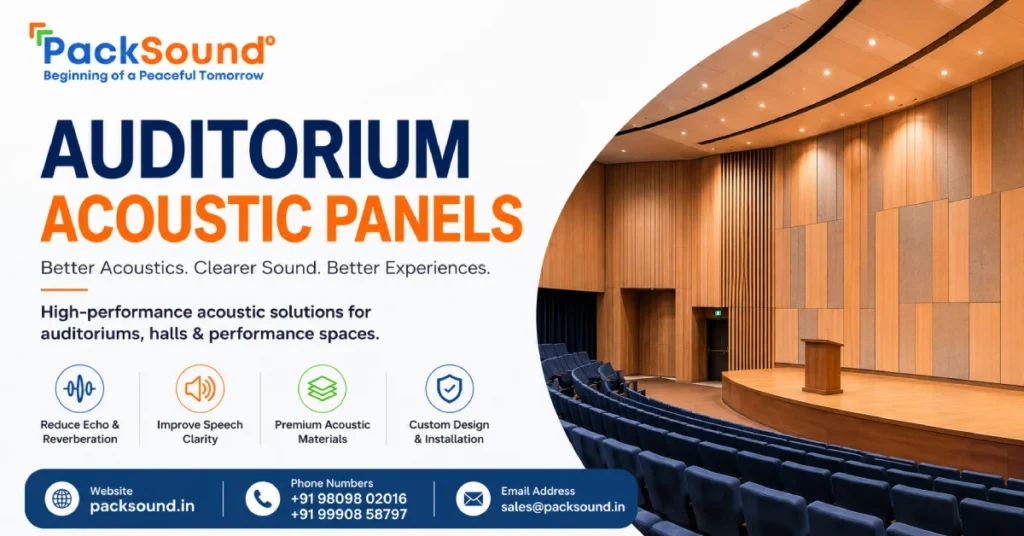
Auditorium Acoustics: Design, Panels & Treatment
Packsound delivers complete auditorium acoustics solutions — design, acoustic panels, wall & ceiling treatment, and professional installation across India. Get a free quote.
Auditorium Acoustics: Design, Panels, Treatment & Installation in India
Sound is the soul of every auditorium. It does not matter how powerful your PA system is, how skilled the performer is, or how carefully the seating layout was designed — if the acoustic environment is wrong, every seat in the hall suffers. Voices blur into one another. Music loses definition. Audiences lean forward straining to hear and still leave having missed half of what was said.
Packsound designs, manufactures, and installs complete auditorium acoustics solutions across India. From reverberation time modelling and acoustic panel specification to on-site installation and post-treatment verification, we provide end-to-end acoustic services that turn ordinary halls into genuinely professional listening environments — for speech, music, drama, conferences, and everything in between.
What Is Auditorium Acoustics — And Why Does It Matter?
Auditorium acoustics is the science and practice of controlling how sound behaves inside an enclosed performance or presentation space. It covers four interconnected disciplines: sound absorption, sound reflection, sound diffusion, and sound isolation — each of which must be carefully balanced to create an environment where every audience member, at every seat, receives clear, even, and undistorted sound.
In India, the vast majority of auditoriums — in schools, universities, government institutions, corporate campuses, and community centres — are built from concrete, brick, and tile. These materials are acoustically among the worst possible choices: high-density, hard, non-porous, and highly reflective. An untreated concrete auditorium can have a reverberation time (RT60) of 3 to 5 seconds or more — far above the 1.0 to 1.5 seconds that speech-focused venues should target. In practical terms, this means every word a speaker delivers is accompanied by a decaying cloud of its own echoes, making speech difficult to follow and reducing audience attention rapidly.
The consequences of poor auditorium acoustics are measurable and serious:
- Audiences miss large portions of spoken content
- Music performances sound muddy and undefined
- Presenters and performers must work significantly harder to be heard
- Amplification systems are pushed beyond their design parameters to compensate
- Audience fatigue sets in early, reducing engagement and satisfaction
The solution is not a louder PA system. The solution is proper acoustic treatment for auditoriums — designed from first principles, specified to the room, and installed correctly.
The Science Behind Auditorium Acoustic Design
Before selecting any material or panel, understanding the key acoustic parameters that define auditorium performance is essential. Packsound’s acoustic design process is built around these metrics.
Reverberation Time (RT60)
RT60 is the foundational measurement of auditorium acoustics. It measures the time, in seconds, for sound energy to decay by 60 decibels after the source stops. In practical terms: it is the gap between a speaker finishing a sentence and that sentence completely fading away in the hall.
The ideal RT60 for an auditorium depends entirely on its primary use:
| Auditorium Use | Target RT60 |
|---|---|
| Speech / Lectures / Conferences | 0.6 – 1.0 seconds |
| Drama and Theatre | 0.8 – 1.2 seconds |
| Multi-purpose (speech + music) | 1.0 – 1.5 seconds |
| Classical Music (orchestral) | 1.5 – 2.5 seconds |
| Choral / Sacred Music | 2.0 – 3.0 seconds |
Most untreated Indian auditoriums with concrete walls and tiled floors have RT60 values between 3.0 and 5.0 seconds — two to five times higher than recommended for speech. Bringing this into the target range requires a carefully calculated quantity and distribution of sound absorbing acoustic panels.
Packsound calculates RT60 using the Sabine and Eyring equations as appropriate to the room geometry, then models the required absorption at each octave band frequency to deliver the target reverberation time across the full audio spectrum.
Speech Transmission Index (STI)
RT60 tells you about the room’s acoustic character. STI tells you whether audiences can actually understand what is being said. STI is a number between 0 and 1 that directly quantifies the intelligibility of speech in a space:
| STI Range | Interpretation |
|---|---|
| 0.75 and above | Excellent — ideal for lectures and conferences |
| 0.60 – 0.75 | Good — suitable for general performances and presentations |
| 0.45 – 0.60 | Fair — audiences will miss some words |
| Below 0.45 | Poor — significant speech comprehension loss |
A well-treated Indian auditorium should target an STI of 0.65 or above. Most untreated concrete halls in India fall below 0.50. Packsound’s treatment designs are verified against STI targets — not just RT60 — ensuring the acoustic investment delivers measurable improvements in the quality of the audience experience.
Reference: Acoustic design of auditoriums in India is governed by IS 2526:1963 — the Indian Standard Code of Practice for Acoustical Design of Auditoriums and Conference Halls. Packsound’s design team works to IS 2526 compliance on all institutional and government auditorium projects.
Early and Late Sound Reflections
Not all reflections in an auditorium are harmful. Early reflections — arriving within approximately 25 milliseconds of the direct sound — actually reinforce speech clarity and musical presence. They are valuable acoustic assets and should be directed toward the audience from the ceiling and side walls.
Late reflections — arriving more than 50 milliseconds after the direct sound — are the source of echo, reverberation buildup, and speech confusion. These must be absorbed or diffused.
Effective auditorium acoustic design distinguishes between these two categories and treats surfaces accordingly: reflective surfaces where early reflections are beneficial; absorptive and diffusive treatment where late reflections cause problems. This nuanced approach is what separates professionally designed auditorium acoustics from a simple “stick panels on walls” approach.
The Five Acoustic Problems Most Indian Auditoriums Face
Understanding the specific problems in your space is the starting point for any effective acoustic treatment plan. These are the five most common acoustic failures Packsound encounters in Indian auditoriums:
1. Excessive Reverberation
The most widespread problem — particularly in government school and university auditoriums built with concrete, brick, and tile. Reverberation above 2.0 seconds for a speech-primary venue means every word overlaps with its own echo. Treatment: calibrated distribution of acoustic wall panels and acoustic ceiling panels to bring RT60 to target.
2. Flutter Echo
A rapid, metallic “ping-ping-ping” echo between two parallel hard walls — common in rectangular halls where side walls are bare concrete or plaster. Treatment: absorptive or diffusive panels on one or both parallel wall surfaces. 3D acoustic panels are particularly effective here, combining diffusion and absorption in a single surface.
3. Uneven Sound Distribution — Dead Spots and Hot Spots
Some seats receive too much direct and reflected sound (hot spots — uncomfortably loud); others receive too little (dead spots — where speech is barely audible). This is typically caused by the geometry of the ceiling and balcony overhangs. Treatment: strategically angled acoustic ceiling reflectors, acoustic ceiling clouds, and absorptive panels at problem reflection surfaces.
4. Under-Balcony Zones
Many Indian auditoriums feature deep balconies that create enclosed under-balcony zones with critically poor acoustics. Audience members seated beneath the balcony receive little direct sound from the stage and elevated reflections from the low balcony soffit above — creating a distinctly worse listening experience than the main floor. Treatment: dedicated acoustic treatment on balcony soffits, combined with distributed speaker systems for under-balcony zones.
5. HVAC and Mechanical Noise
India’s tropical climate means air conditioning runs at significant capacity for most of the year. Poorly specified or maintained HVAC systems introduce a constant broadband noise floor that raises the ambient noise level in the auditorium and dramatically reduces effective speech intelligibility. Any serious acoustic project must address HVAC noise alongside room treatment — acoustic duct lining, vibration isolation mounts, and careful diffuser positioning all contribute to solving this. Packsound integrates HVAC noise control as a standard part of comprehensive auditorium acoustic projects.
Acoustic Materials for Auditoriums: What Packsound Uses and Why
The selection of acoustic materials for an auditorium is not one-size-fits-all. Different surfaces, different frequency ranges, and different functional requirements demand different materials. Packsound’s auditorium acoustic specifications typically draw from the following material categories:
Fabric-Wrapped Acoustic Panels
High-density fiberglass or rock wool cores wrapped in acoustically transparent fabric — the most widely used absorptive treatment for auditorium side walls and rear walls. Fabric-wrapped panels deliver excellent broadband absorption (NRC 0.85–1.0) and are available in an extensive range of fabrics, colours, and custom shapes, allowing the acoustic treatment to integrate seamlessly with the auditorium’s interior design.
Packsound manufactures fabric-wrapped panels in any size and shape — including curved, angled, and geometric formats — to suit both acoustic requirements and architectural aesthetics. Explore our acoustic wall panels range.
Grooved Wooden Slat Panels
Grooved wooden acoustic panels combine the visual warmth and premium appearance of solid timber with genuine acoustic performance through slot resonance absorption. They are particularly effective at mid-frequency absorption and are the preferred specification for premium auditorium interiors, hotel ballrooms, and conference centres where the aesthetic standard is high.
These panels are increasingly popular in Indian auditorium fitouts — especially in institutional projects where the client wants a premium finish that reads as architectural panelling rather than acoustic treatment.
Perforated Acoustic Panels
Perforated panels — available in timber, metal, or MDF faces — use precision hole patterns to allow sound to pass through to the absorptive backing layer. The relationship between hole size, spacing, and panel depth determines the absorption frequency response, allowing acoustic engineers to tune the panel for specific frequency targets.
Perforated wooden panels provide an elegant, near-seamless surface appearance with genuine acoustic depth — making them well-suited to auditorium rear walls, box fronts, and balcony faces where both performance and aesthetics are critical. Explore Packsound’s 3D acoustic panels for premium perforated and textured options.
Acoustic Ceiling Clouds and Baffles
The auditorium ceiling is simultaneously the most acoustically critical surface and the most architecturally prominent. It must direct beneficial early reflections toward the audience, prevent harmful late ceiling reflections, and contribute the correct amount of absorption to achieve target RT60 — all while remaining visually consistent with the overall design.
Packsound’s acoustic ceiling clouds are suspended absorptive panels that reduce RT60 in large volumes without requiring complete ceiling treatment. They are particularly effective in the mid- and rear-stall zones where the structural ceiling is high and provides minimal early reflection benefit.
For venues requiring significant ceiling absorption combined with strong visual impact, Packsound’s Auraluxe 3D Ultra Luxury Acoustic Ceiling Clouds deliver architectural drama alongside genuine acoustic performance — a combination unavailable from standard panel suppliers.
Acoustic Baffles
Acoustic baffles are vertically suspended absorption panels hung from the ceiling structure. In large-volume auditoriums where horizontal cloud installation is not structurally practical, baffles provide effective absorption at mid and high frequencies by presenting absorptive surface area on both sides of each panel element.
Printed and Decorative Acoustic Panels
A growing category for Indian auditoriums — particularly in schools and cultural institutions — is printed acoustic panels that combine full-colour high-resolution print (institutional branding, artistic imagery, or decorative patterns) with genuine acoustic absorption. These panels deliver aesthetic value and acoustic function in a single surface element, which is increasingly important for project budgets that must satisfy both acoustic engineers and interior designers.
Acoustic Ceiling Tiles
For auditorium anteroom spaces, green rooms, foyers, and back-of-house areas, Packsound’s standard acoustic ceiling tiles — including the AirLite and FeatherLite series — provide efficient, cost-effective acoustic control in a format compatible with standard suspended ceiling grid systems.
Auditorium Acoustic Treatment: Surface by Surface
Effective acoustic treatment for auditoriums requires a surface-by-surface strategy. Here is how Packsound approaches each major surface:
Side Walls
Side walls are the primary site of late-arriving reflections that cause echo and reverberation. In a well-designed auditorium, side wall treatment balances absorption with diffusion: absorptive panels reduce the intensity of late reflections; diffusive surfaces (such as 3D textured panels or geometric forms) scatter the remaining reflections in multiple directions, creating a more even, natural-sounding acoustic field.
Packsound typically specifies a combination of fabric-wrapped absorptive panels and diffusive elements — grooved wood, 3D surface panels, or geometric fins — on auditorium side walls, with the specific ratio determined by the RT60 calculation and the room’s primary use.
Rear Wall
The rear wall of an auditorium is the most critical single surface for echo control. A flat, hard rear wall directly opposite the stage reflects sound back toward the performers and front audience rows with a long delay — creating a distinct, disruptive echo. Packsound treats rear walls with thick absorptive panels (typically 50 mm or greater effective depth) combined with diffusive elements to prevent this direct rear-wall echo while maintaining acoustic liveliness in the rear seating zones.
Ceiling
The ceiling above the stage and front stalls should ideally be shaped to direct sound outward and downward toward the audience — functioning as an acoustic reflector. Above the mid and rear stalls, acoustic ceiling clouds or baffles reduce RT60 without eliminating the reflective contribution of the structural ceiling. Packsound models ceiling acoustic behaviour in three dimensions before specifying treatment, ensuring the ceiling contributes positively to the acoustic balance rather than creating unwanted late reflections.
Stage and Proscenium Area
The acoustic environment immediately around the stage affects the performer’s monitoring experience and the quality of early reflections reaching the front rows. Stage risers, orchestra pits, and proscenium arches all require specific acoustic consideration. Packsound designs stage acoustic environments in coordination with the PA system specification where applicable.
Balcony Faces and Soffits
Balcony front faces are major reflection surfaces for audience in the stalls. They should be treated with absorptive or diffusive panels to prevent strong early reflections that could confuse the direct sound field. Balcony soffits must be treated to prevent the under-balcony acoustic problem described above — typically with absorptive ceiling panels installed on the balcony underside.
Packsound’s Auditorium Acoustic Design Process
Every Packsound auditorium acoustic project follows a structured process designed to deliver predicted, verifiable acoustic performance — not guesswork.
Stage 1 — Acoustic Assessment Packsound’s acoustic team conducts an on-site survey (or reviews architectural drawings for new-build projects) to measure or model the room’s acoustic characteristics: volume, surface areas and materials, seating capacity, existing RT60 (where applicable), and any specific acoustic problems reported by the client. Background noise levels and HVAC noise contributions are also assessed.
Stage 2 — Acoustic Modelling and Design Using the survey data, Packsound prepares a room acoustic model — calculating the required sound absorption at each octave band frequency (125 Hz, 250 Hz, 500 Hz, 1000 Hz, 2000 Hz, 4000 Hz) to achieve the target RT60. Panel types, quantities, and placement positions are determined at this stage. For complex venues, computer-aided acoustic modelling provides three-dimensional visualisation of sound propagation and reflection paths.
Stage 3 — Specification and Material Selection Based on the acoustic model, Packsound prepares a detailed specification: panel types, core materials, facing options, dimensions, quantities, fixings, and installation method for each surface. Material samples and mock-up panels are provided for client and design team approval before production begins.
Stage 4 — Manufacturing All acoustic panels are manufactured at Packsound’s production facility in Greater Noida. Each panel is produced to the approved specification with quality-controlled core materials and facing. Custom shapes, printed faces, and bespoke colour specifications are accommodated within standard production workflows.
Stage 5 — Installation Packsound’s trained installation teams handle all on-site work — including substrate preparation, framework installation where required, panel fixing, and finishing. Installation is managed to minimize disruption to the auditorium’s operational schedule.
Stage 6 — Post-Installation Verification After installation, Packsound conducts post-treatment acoustic measurements to verify that the installed treatment achieves the modelled RT60 and STI targets. Measurement reports are provided to the client as part of project handover documentation.
Types of Auditoriums Packsound Has Treated in India
Packsound has delivered auditorium acoustic treatment projects across a wide range of venue types throughout India:
School and University Auditoriums: The most common category in India — typically concrete construction with tile floors, requiring significant absorption treatment to bring RT60 from 3–5 seconds into the 0.8–1.2 second range for multipurpose use. Packsound has completed school auditorium projects across Delhi-NCR, Greater Noida, and beyond, including the Assam Rifles auditorium and Nalanda University auditorium.
Government and Institutional Halls: Government-built auditoriums for ministries, armed forces, and public institutions often require compliance with IS 2526 and specific acoustic performance standards. Packsound has extensive experience with institutional procurement and specification requirements.
Corporate Conference and Event Centres: Large corporate auditoriums used for town halls, investor presentations, product launches, and training events require speech-optimised acoustics with RT60 in the 0.6–0.9 second range. These projects also often require integration with sophisticated AV systems.
Cultural and Performing Arts Centres: Multi-purpose cultural venues in India — used for music, drama, dance, and speech — present the most complex acoustic design challenges. The acoustic environment must accommodate very different requirements across different programme types. Packsound designs variable acoustic solutions (adjustable absorption panels) for venues requiring this flexibility.
Multiplex Cinemas and Screening Rooms: Cinema auditoria require precisely controlled reverberation for dialogue clarity and surround-sound immersion. Packsound’s acoustic treatment for cinema environments draws from the same design methodology used for performance venues, adapted to the specific requirements of film reproduction.
Why Choose Packsound for Auditorium Acoustics in India?
Design-First Approach
Packsound does not sell panels by the square foot and leave the acoustic outcome to chance. Every auditorium project begins with acoustic modelling and design — ensuring the treatment delivers measurable, predictable results rather than approximate improvements.
Manufacturer Advantage
As a direct manufacturer of acoustic panels and treatment systems, Packsound controls quality, dimensions, and specification at every stage of production. There are no intermediary suppliers introducing tolerance variations or material substitutions. Custom sizes, shapes, and finishes are accommodated as standard.
Comprehensive Product Range
From fabric-wrapped wall panels and wooden acoustic panels to ceiling clouds, acoustic baffles, printed panels, and luxury 3D ceiling elements, Packsound offers the full spectrum of auditorium acoustic materials from a single manufacturing partner. No coordination between multiple suppliers; no aesthetic inconsistencies between product ranges.
Aesthetic Intelligence
In auditorium projects, acoustic performance and architectural aesthetics must coexist. Packsound’s design team works closely with architects, interior designers, and project consultants to specify acoustic treatments that enhance — not compromise — the visual character of the space. Our Auraluxe premium range was developed specifically for high-specification interiors where the acoustic treatment must be architecturally indistinguishable from premium finishing materials.
Pan-India Installation Capability
Packsound’s installation teams operate across India — from Delhi-NCR and Greater Noida to projects in other major cities and states. All installations are managed by trained, experienced site teams familiar with the specific demands of acoustic panel installation in large public spaces.
Auditorium Acoustic Consultation | FAQ
For a school auditorium used primarily for assemblies, speeches, drama, and lectures, the target RT60 is between 0.8 and 1.2 seconds. Most untreated school halls in India have RT60 values between 3.0 and 5.0 seconds. Reducing this to the target range requires a calculated quantity of absorptive wall and ceiling treatment — typically covering 25–40% of wall area and a significant portion of the ceiling, depending on room volume.
The required panel quantity depends on the room’s volume, existing surface materials, target RT60, and the NRC values of the panels specified. Packsound calculates this precisely using the Sabine equation during the acoustic design stage. There is no generic answer — a 500-seat concrete hall with a 5-second RT60 requires very different treatment from a 200-seat hall with plaster walls and padded seating.
Yes. The majority of Packsound’s auditorium projects are retrofits — acoustic treatment added to an existing hall without structural modification. Wall-mounted acoustic panels, ceiling-suspended clouds and baffles, and balcony soffit treatment can all be installed without altering the building structure, making acoustic improvement accessible for existing auditoriums with limited renovation budgets.
Not adversely. Packsound’s acoustic panels are specified to complement and enhance the existing or planned interior — not conflict with it. Fabric-wrapped panels in coordinating colours, grooved wood panels in matching timber species, printed panels with institutional branding, and premium 3D ceiling clouds all contribute to the visual character of the space. Our design team treats aesthetics as integral to the acoustic brief, not secondary to it.
Small to medium auditoriums (up to 300 seats) typically require 1 to 2 weeks for installation. Larger or more complex venues — with extensive ceiling treatment, custom panel shapes, or staged access requirements — may require 3 to 6 weeks. Packsound provides detailed project programmes at the tender stage, including phasing to minimise disruption to school or institutional operations.
Sound absorbing panels address acoustic problems within the auditorium — reverberation, echo, and sound distribution. They do not prevent noise from entering through walls, floors, or ceilings from external sources. Noise isolation — blocking traffic noise, corridor noise, or HVAC noise from penetrating the auditorium — requires different measures: additional wall mass, acoustic seals on doors and windows, and vibration isolation for HVAC equipment. Packsound addresses both internal acoustics and noise isolation as part of comprehensive auditorium projects.
IS 2526:1963 is the Indian Standard Code of Practice for Acoustical Design of Auditoriums and Conference Halls, published by the Bureau of Indian Standards. It specifies acoustic design criteria — including reverberation time targets and noise isolation requirements — for different categories of auditorium. Packsound’s acoustic design team works to IS 2526 compliance on all institutional, government, and public sector auditorium projects where this standard is required.
Yes. Multi-purpose auditoriums that must accommodate both speech-focused and music-focused events benefit from variable acoustic systems — panels or curtains that can be deployed or retracted to adjust the room’s reverberation time between programme types. Packsound designs variable acoustic systems as part of complex multi-purpose venue specifications. Contact our team for more details.
Get a Free Auditorium Acoustic Consultation
Whether you are building a new auditorium, retrofitting an existing hall, or troubleshooting a specific acoustic problem — Packsound has the design capability, the manufacturing resources, and the installation experience to deliver a measurable acoustic improvement.
Share your auditorium’s dimensions, seating capacity, primary use, and any existing acoustic issues, and our team will respond with an initial assessment and consultation proposal.
Visit Us: A-719 Tower 3, NX One Techzone IV, Greater Noida West, Uttar Pradesh 201306, India
Email: sales@packsound.in | abhinav@packsound.in Call: +91 980 980 2016 | +91 9990 858 797 Hours: Monday to Saturday, 9:00 AM to 7:00 PM
Enquire Now — Free Consultation →
Explore Packsound’s Full Acoustic Product Range
- Acoustic Wall Panels — Full range of wall acoustic treatment
- Acoustic Ceiling Panels — Ceiling tiles, clouds, and baffles
- Acoustic Ceiling Clouds — Suspended ceiling absorption elements
- Acoustic Baffles — Vertically hung ceiling absorption panels
- AirLite Ceiling Tile — Lightweight, high-performance ceiling tile
- FeatherLite Ceiling Tile — Ultra-lightweight acoustic ceiling tile
- Metal Ceiling Tiles — Acoustic metal ceiling system
- 3D Luxury Acoustic Wall Panels — Premium textured acoustic wall panels
- 3D Acoustic Ceiling Clouds — Ultra-luxury ceiling acoustic elements
- Auraluxe Silenza Acoustic Panels — Premium fabric and wood acoustic panels
- 3D Acoustic Blades — Architectural acoustic fin elements
- AeroLoom Acoustic Clouds — Woven acoustic ceiling clouds
- EchoGlow Acoustic Ceiling Lights — Integrated acoustic and lighting panels
- Printed Wall Panels — Full-colour printed acoustic panels
- AquaSonic Acoustic Solutions — Advanced acoustic systems for specialist applications
Packsound is a brand of Ecotone Acoustic Limited — manufacturer, supplier, and installer of premium acoustic panels and auditorium acoustic solutions across India.