If you are searching for acoustic wall panels in India right now, you have almost certainly come across two names: Armstrong and Packsound. Armstrong is a global brand with over 160 years of history. Packsound is an Indian manufacturer that has delivered acoustic solutions to more than 1900+ projects across the country. Both make acoustic wall panels. But they serve very different buyers in very different ways. (Armstrong acoustic wall panels vs Packsound)
This article explains everything you need to know before spending money on acoustic treatment. We cover what acoustic wall panels actually do, how to read performance ratings, and how Armstrong and Packsound compare on the things that matter most to buyers in India: acoustic performance, availability, customisation, pricing, installation support, and after-sales service. By the end, you will know exactly which option suits your project.
What Are Acoustic Wall Panels and Why Do You Need Them
Think of a room as a giant echo chamber. Every time someone speaks, sound waves travel outward in all directions. When those waves hit a hard surface like concrete, glass, or painted plaster, most of the sound bounces straight back into the room. This bounced sound creates what we call reverberation or echo. Too much reverberation makes speech hard to understand, meetings feel exhausting, and rooms feel noisy even when the actual sound source is quiet.
Acoustic wall panels are specially made panels that absorb sound energy instead of reflecting it. When a sound wave hits an acoustic panel, the panel’s porous or fibrous core converts the energy of that wave into a tiny amount of heat. The result is a quieter, clearer, more comfortable room.
This matters in a huge number of spaces. Corporate offices lose productivity because background noise and echoing conversations make it hard to concentrate. Recording studios need near-zero reverberation to capture clean audio. School classrooms with poor acoustics produce students who strain to hear their teachers and teachers who strain their voices to be heard. Hotels and restaurants with poor acoustic treatment feel chaotic and drive guests away. Auditoriums with untreated reflective surfaces deliver muddy sound that neither performers nor audiences enjoy.
Acoustic wall panels are the single most practical and cost-effective way to fix these problems.
The Key Performance Numbers You Must Understand Before Buying
Before comparing brands, you need to understand two numbers that every acoustic panel manufacturer will quote to you.
NRC (Noise Reduction Coefficient) measures how well a panel absorbs sound. The scale runs from 0.0 to 1.0, though some materials can technically exceed 1.0 in laboratory conditions due to measurement artefacts. A panel with NRC 0.0 reflects all sound. A panel with NRC 0.90 absorbs 90 percent of the sound energy striking its surface. For most commercial and institutional projects in India, you want panels with an NRC of at least 0.75. For critical acoustic environments like recording studios or auditoria, you want NRC 0.85 or above.
STC (Sound Transmission Class) measures how well a partition or wall blocks sound from travelling from one room to another. This is a completely different measurement from NRC. A panel with a high NRC rating does not necessarily block sound from passing through the wall. If you need privacy between rooms or floors, you need STC data in addition to NRC data. Most acoustic wall panels are designed for absorption within a room, not for sound isolation between rooms.
A third number you may see on high-performance panels is CAC (Ceiling Attenuation Class), which measures how much sound passes through a suspended ceiling into a neighbouring space. This is primarily relevant for ceiling tiles rather than wall panels, but some manufacturers quote it for completeness.
For any panel you are considering, always ask the supplier for the full laboratory test report, not just the headline number. A reputable manufacturer will provide independent third-party test certificates without hesitation.
Armstrong Acoustic Wall Panels: What the Brand Actually Offers
Armstrong World Industries is headquartered in Lancaster, Pennsylvania, USA, and has been manufacturing ceiling and wall systems since 1860. The company is publicly listed on the New York Stock Exchange and operates primarily in North America, with a portfolio that spans mineral fibre panels, metal ceilings, wood systems, felt panels, and specialty translucent products.
In India, Armstrong products are available through authorised distributors and dealers who import or source panels under the Armstrong brand. The flagship fabric acoustic wall panel product available in the Indian market is the Armstrong Optra, which consists of a soft-fibre inner core wrapped in acoustic-transparent fabric. The product is designed to absorb up to 90 percent of sound striking the surface and is available in a range of fabric finishes.
Where Armstrong performs well:
Armstrong’s global reputation gives architects and project managers confidence during specification. Many government and institutional procurement processes prefer brands with international credentials and long track records. Armstrong panels are generally well-made and deliver consistent acoustic performance when correctly installed.
Where Armstrong creates challenges for Indian buyers:
The challenges are practical and significant.
Armstrong is a US-headquartered company. Its products are manufactured primarily for North American markets. In India, you are buying through distributors and dealers, which adds multiple layers to the supply chain. This affects lead times, pricing, and after-sales support.
Lead times for custom sizes or specific fabric finishes can be long because products may need to be manufactured to order and shipped or cleared through customs. For a fast-moving commercial fitout project, this can create serious delays.
Pricing in India for Armstrong panels through distributor channels is typically higher than for comparable locally manufactured products, and this premium does not always translate into proportionally better acoustic performance. Indian buyers are often paying partly for the brand name rather than for measurably superior sound absorption.
After-sales support and technical consultation through distributor networks can be inconsistent. If a panel needs to be replaced or a specification question arises mid-project, you may find yourself working through multiple intermediaries with slow response times.
Finally, Armstrong’s core product range was developed for North American construction standards, climate conditions, and design preferences. Customisation options for Indian projects, such as specific sizes to match Indian modular grid systems, local fabric preferences, or finishes suited to tropical humidity conditions, can be limited or expensive through import channels.
Packsound Acoustic Wall Panels: What Indian Buyers Get
Packsound is the trading name of Ecotone Acoustic Limited, an Indian acoustic solutions manufacturer based in Greater Noida, Uttar Pradesh. The company has been operational since 2015 and has completed over 1900+ acoustic projects across India, serving corporate offices, recording studios, schools, auditoriums, multiplexes, hotels, and healthcare facilities.
Unlike international brands sold through Indian distributors, Packsound manufactures its acoustic panels in India for Indian projects. This distinction has real consequences for buyers.
Acoustic performance:
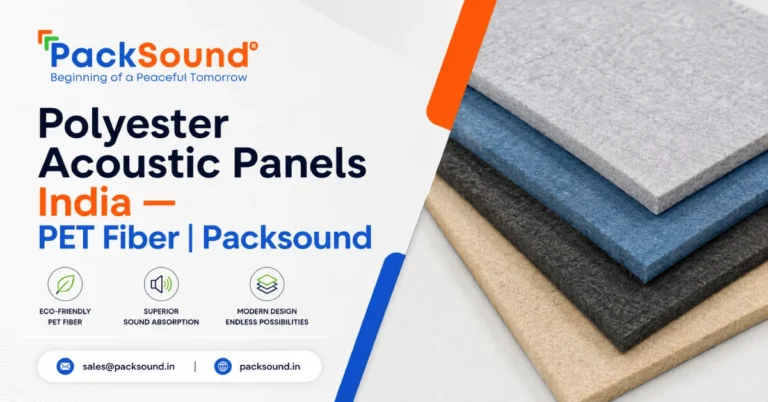
Packsound’s fabric-wrapped acoustic wall panels use a high-density glass wool or polyester fibre core, typically 50mm or 75mm thick, wrapped in acoustic-transparent fabric stretched over a rigid frame. These panels achieve NRC values ranging from 0.75 to 0.95 depending on product specification, thickness, and installation method. All products are tested by certified independent laboratories, and full technical documentation including test certificates and product data sheets are available upon request.
For projects requiring even higher performance or architectural distinction, Packsound’s Auraluxe range includes 3D luxury acoustic wall panels, Silenza acoustic panels, printed wall panels, and 3D acoustic blades. These products combine high acoustic performance with premium visual design, making them suitable for hospitality interiors, boardrooms, high-end retail, and branded corporate environments.
Made in India, designed for India:
Because Packsound manufactures in India, the supply chain is shorter and more responsive than any imported product. Standard panels are available quickly. Custom sizes, fabric colours, and finishes are achievable within the lead times that real Indian construction projects actually operate on.
Packsound offers acoustic panels in over 20 fabric colours. Custom dimensions are standard rather than exceptional. This matters because Indian commercial spaces rarely conform to the standard panel sizes that international products are designed around.
Technical support and consultation:
Packsound provides end-to-end acoustic solutions including free site assessment, acoustic design consultation, product supply, and professional installation. This means a buyer does not need to hire a separate acoustic consultant, a separate product supplier, and a separate installation contractor. The entire process is handled by one team that understands both the acoustic science and the practical realities of installation in Indian commercial spaces.
The company serves clients across Delhi NCR, Mumbai, Bengaluru, Hyderabad, Chennai, Pune, and other cities across India. For site-specific projects, Packsound’s technical team can visit the site, assess existing acoustic conditions, and recommend the right combination of products to achieve the target NRC, reverberation time, or speech clarity for the specific space.
Range beyond wall panels:
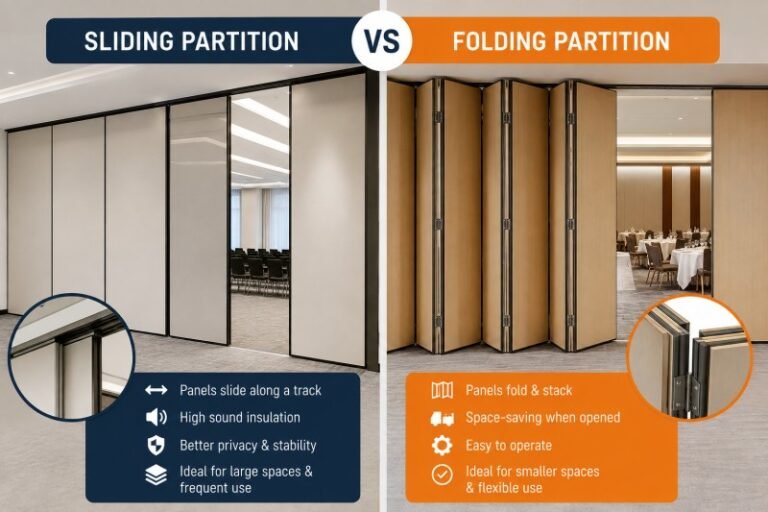
Packsound’s product portfolio extends well beyond wall panels alone. For buyers with complex acoustic requirements, the full range includes fabric acoustic wall panels, wooden acoustic panels in slat and perforated designs, acoustic ceiling baffles and clouds, soundproof partitions and dividers, the ThinkPod range of prefabricated acoustic office work pods, and the AquaSonic range for wet and humid environments. This breadth means that a single vendor relationship can address the complete acoustic brief for most commercial projects.
Head-to-Head Comparison: Armstrong vs Packsound
Here is a clear, direct comparison across the factors that matter most to buyers making a purchasing decision in India today.
Acoustic Performance
Both brands deliver solid acoustic performance in the NRC 0.75 to 0.95 range for their fabric-wrapped wall panel products. There is no meaningful acoustic performance gap between the two at standard specification. Both are capable of achieving the acoustic targets required for offices, conference rooms, educational facilities, and hospitality spaces. Packsound’s Auraluxe range adds premium design options that Armstrong’s standard India-available range does not match.
Availability and Lead Times
Packsound has a clear and significant advantage here. As an Indian manufacturer supplying Indian projects, Packsound can fulfil standard orders and custom requirements within lead times that imported products cannot compete with. Armstrong products in India depend on distributor stock levels and import logistics. For projects with tight construction schedules, this difference is not trivial.
Customisation
Packsound manufactures to project-specific requirements as standard practice. Custom dimensions, specific fabric finishes, bespoke shapes, and printed surface options are available. Armstrong’s India-available product range has more limited customisation options because products are designed for North American standard specifications and are imported rather than locally made.
Pricing
Packsound offers competitive pricing that reflects Indian manufacturing costs and a direct-to-project supply model rather than a multi-tier distributor markup structure. Armstrong products in India carry a brand premium that often reflects distributor margins and import costs rather than superior acoustic performance. For budget-conscious buyers or large-scale projects where panel quantity is high, the cost difference can be substantial.
Technical Support and Consultation
Packsound offers in-house acoustic design consultation, site assessment, and professional installation. Buyers get a single point of contact from enquiry through to project completion. Armstrong’s India support is provided through distributor networks, and the level of technical expertise and after-sales responsiveness varies by distributor. There is no standardised consultation or installation service attached to the Armstrong brand in India.
Compliance with Indian Standards
Both products can be specified to meet relevant Indian standards including IS 11871 for flame spread and the National Building Code 2016 requirements for acoustic treatment in public buildings. Packsound’s team is specifically knowledgeable about Indian building codes and can advise on compliance requirements for specific project types. This local regulatory expertise is not something that a distributor of an imported brand can reliably provide.
Brand Recognition in Global Specifications
Armstrong has an advantage here for buyers where international brand recognition is a procurement requirement. Some multinational corporations specifying for Indian offices may require globally recognised brand names in their fitout standards. For these buyers, Armstrong’s global credentials matter. For all other buyers, acoustic performance, lead time, customisation, and value for money matter more.
Which Spaces Benefit Most from Acoustic Wall Panel Treatment
Understanding which spaces need acoustic wall panels helps you size your project correctly and choose the right product specification.
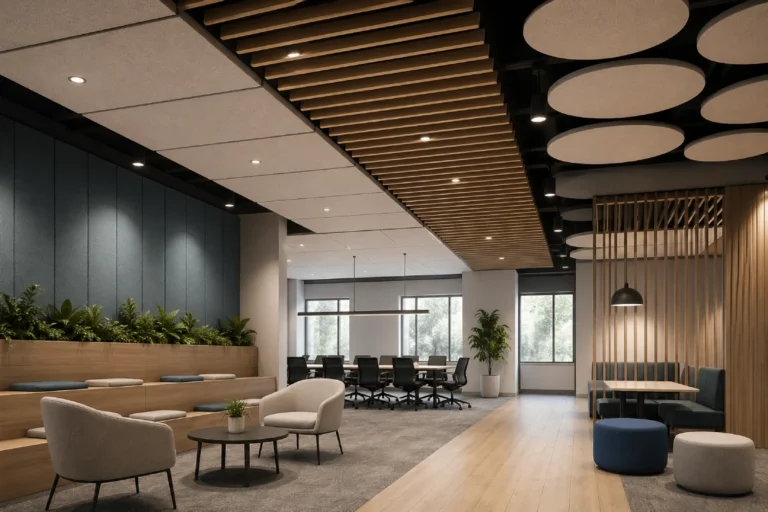
Corporate offices and open-plan workspaces are probably the single largest application for acoustic wall panels in India today. Modern office design favours open floors, glass partitions, polished concrete, and minimal soft furnishing. All of these choices create highly reflective acoustic environments. Background noise levels in untreated open-plan offices typically exceed 55 to 65 decibels during working hours, well above the 40 to 45 decibels recommended for productive cognitive work. Fabric-wrapped acoustic wall panels installed at ear height along primary reflective surfaces are the most effective single intervention to reduce noise levels and improve speech clarity. For open-plan offices, Packsound’s fabric acoustic wall panels and acoustic ceiling baffles are a proven combination that has been deployed across multiple Delhi NCR and Mumbai corporate projects.
Conference rooms and boardrooms need acoustic treatment to achieve speech intelligibility targets for both in-room participants and remote video call attendees. A poorly treated conference room creates a reverberant environment where words blur together and remote participants struggle to follow the conversation. The target reverberation time for a conference room of typical size is 0.4 to 0.6 seconds. Untreated rooms with glass, hard walls, and polished floors routinely have reverberation times of 1.5 seconds or more. Packsound’s Silenza acoustic panels from the Auraluxe range are a particularly appropriate choice for boardrooms where both acoustic performance and visual premium are required.
Recording studios and podcast studios need the highest NRC values available combined with specific frequency-range tuning. For these applications, 75mm thick panels rather than 50mm are typically specified to address lower-frequency absorption. Packsound has completed recording studio and podcast studio projects in Mumbai and other cities, delivering near-zero reverberation environments for professional audio production.
School classrooms and lecture halls benefit significantly from acoustic treatment. Research consistently shows that students in acoustically treated classrooms perform better on comprehension tests and report lower fatigue levels. Teachers in treated classrooms experience less vocal strain. For educational projects, Packsound’s panels comply with IS:4954 guidelines and the company has completed school auditorium projects including a 450-seat auditorium in Bengaluru.
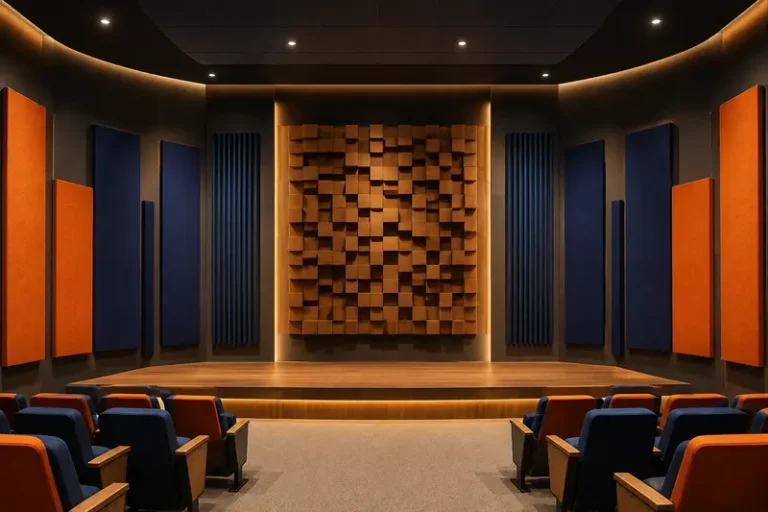
Auditoriums and multipurpose halls require careful acoustic design to balance sound absorption with the natural reverberation that makes music sound full and live. Both perforated wooden panels and fabric-wrapped panels are used in these spaces, often in combination, to achieve the target RT60 for the primary use case of the space. Packsound’s wooden acoustic panels in perforated and slat designs are engineered for auditorium applications.
Healthcare facilities including hospitals, clinics, and diagnostic centres benefit from acoustic treatment to reduce noise-related stress for patients and improve communication between staff and patients. Acoustic panel specifications for healthcare environments must include appropriate surface cleanability and should comply with relevant infection control requirements.
Restaurants and hospitality spaces are increasingly investing in acoustic treatment as restaurant operators recognise that noise level is one of the top negative factors in guest experience reviews. High-end restaurants, hotel lobbies, and banquet halls are increasingly specified with acoustic ceiling clouds and wall panels that are both functional and architecturally integrated.
How to Specify Acoustic Wall Panels Correctly
Getting the specification right before ordering panels is critical. Here is a simple framework for approaching acoustic specification for any commercial project.
Start by identifying the target reverberation time for the space. This depends on the primary use. Offices and conference rooms target 0.4 to 0.6 seconds. Lecture theatres target 0.6 to 0.8 seconds. Music performance spaces target 1.2 to 2.0 seconds depending on the type of music.
Calculate the total acoustic absorption area you need to achieve that target. This involves measuring the room volume, calculating the existing absorption from furniture and soft furnishings, and determining how much additional absorption the panels need to provide. Packsound’s technical team can do this calculation for you as part of the free consultation service.
Choose the panel product based on NRC requirement, thickness, fabric finish, and fire rating. For most office and conference room applications, 50mm thick fabric-wrapped panels with NRC 0.85 or above are sufficient. For critical listening environments, 75mm panels with supplementary bass traps are typically required.
Determine the installation pattern. Panels do not need to cover every wall surface to be effective. Strategic placement at primary reflection points, typically the wall behind the listener, the two side walls at listening position, and the rear wall of a conference room, delivers the most efficient use of panel area.
Check fire rating compliance. All panels in commercial buildings in India must comply with relevant flame spread requirements. Packsound’s panels are available with appropriate fire ratings for commercial occupancy buildings and the technical team can confirm compliance for your specific project type.
Common Mistakes Buyers Make When Purchasing Acoustic Wall Panels
Knowing what not to do is as valuable as knowing what to do.
Specifying on NRC alone without considering frequency range. A panel rated NRC 0.90 may perform exceptionally well at mid frequencies but poorly at low frequencies. For spaces with significant bass energy, such as music rehearsal rooms or home theatres, you need to check the full octave band absorption data, not just the averaged NRC number.
Underestimating how many panels the room needs. Many buyers purchase a minimal quantity of panels to save money and are disappointed with the results. Acoustic treatment requires a minimum coverage area to meaningfully reduce reverberation. Packsound’s free consultation includes calculation of the required panel area for your specific room.
Choosing decorative foam products that are marketed as acoustic panels but deliver very low NRC values. Thin foam tiles with attractive surface patterns are widely sold online and at hardware stores. Many of these products achieve NRC values of only 0.25 to 0.40, which is insufficient for commercial acoustic treatment. Always ask for an independent laboratory test certificate before purchasing.
Ignoring installation quality. Even the best panels will underperform if installed incorrectly. Panels installed flat against a wall will perform differently from panels installed with an air gap behind them. The air gap improves low-frequency absorption. Panels installed too close to the ceiling or floor add less value than panels installed at ear height. Professional installation by a team that understands acoustic placement principles makes a significant difference to real-world outcomes.
Treating soundproofing and acoustic treatment as the same thing. If your goal is to prevent sound from passing between rooms or floors, acoustic wall panels alone will not solve the problem. Sound isolation requires mass-loaded construction, decoupled structures, and sealed penetrations. Packsound offers soundproofing solutions alongside acoustic treatment panels, and the technical team can advise which approach is appropriate for your situation.
Why Indian Buyers Are Choosing Packsound Over Imported Brands
The conversation around acoustic wall panels in India has shifted significantly over the past five years. A decade ago, the default assumption was that imported international brands offered better quality than Indian alternatives. That assumption no longer holds.
Indian manufacturing quality for acoustic products has matured to the point where the products being made in India by companies like Packsound match or exceed the acoustic performance of imported alternatives. The advantages of working with an Indian manufacturer, including faster delivery, better customisation, lower cost, local technical expertise, and integrated installation support, are real and significant.
Architects and interior designers who have specified Packsound products for corporate projects in Delhi NCR report consistently high satisfaction with both product quality and project support. Facility managers at schools and institutions who have worked with Packsound describe the end-to-end service model as a major differentiator compared to product-only suppliers.
For buyers who previously defaulted to Armstrong because it was the recognised international name in acoustic panels, the honest assessment is that Packsound delivers comparable or superior acoustic performance for Indian projects, with advantages in availability, customisation, pricing, and support that imported brands cannot match through their Indian distributor networks.
Packsound Product Range: What to Explore for Your Project
Packsound’s full product range covers every common acoustic treatment requirement for commercial and institutional projects in India.
The fabric acoustic wall panels are the core product for offices, conference rooms, and educational spaces. High-density fibre core wrapped in acoustic-transparent fabric, available in over 20 fabric colours, achieving NRC 0.75 to 0.95. These panels form the foundation of most acoustic treatment projects. You can explore the full fabric panel range at packsound.in/acoustic-wall-panels.
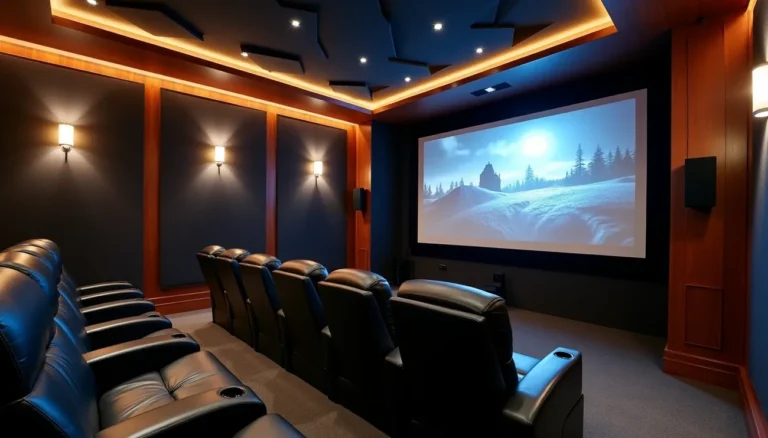
The wooden acoustic panels in slat and perforated designs combine structural elegance with sound absorption. Premium engineered wood with precision perforations or slat patterns, ideal for auditoriums, home theatres, hospitality interiors, and premium offices where natural material finishes are preferred. See the wooden panel options through the Packsound product pages.
The Auraluxe range represents Packsound’s premium acoustic design offering. This includes 3D luxury acoustic wall panels, Silenza acoustic panels with ultra-clean surface finishes, printed wall panels with bespoke imagery, AeroLoom acoustic ceiling clouds, EchoGlow acoustic ceiling lights that combine illumination with sound absorption, and 3D acoustic blades. The Auraluxe range is designed for clients where the acoustic product must also function as an architectural feature rather than a background treatment. Explore the Auraluxe collection at packsound.in/auraluxe.
The acoustic ceiling baffles and clouds address reverberation control in open spaces where wall surface area alone is insufficient. Suspended baffles and clouds are particularly effective in large volume spaces such as airport terminals, sports halls, co-working spaces, and food courts. Browse ceiling solutions at packsound.in/acoustic-ceiling-panels.
The ThinkPod range offers prefabricated acoustic office work pods for open-plan offices that need private working and meeting spaces without permanent construction. Available in single-occupancy and multi-occupancy configurations, ThinkPods are fully equipped with ventilation, lighting, and power. Details are at packsound.in/thinkpod.
For wet and humidity-exposed environments including swimming pools, commercial kitchens, food processing areas, and outdoor-covered spaces, the AquaSonic range provides acoustic treatment solutions engineered for moisture resistance. See packsound.in/aquasonic.
How to Get Started with Packsound
The process of working with Packsound is straightforward and is designed to take the technical complexity off the buyer’s plate.
The first step is a free consultation. Contact the Packsound team by phone or through the contact form at packsound.in/contact. The team serves clients across India including Delhi NCR, Mumbai, Bengaluru, Hyderabad, Chennai, and Pune. For large projects, a site visit and acoustic assessment can be arranged. The sales team is reachable at Sales@packsound.in, at +91 980 980 2016, or at +91 9809802016, Monday to Saturday from 9:00 AM to 7:00 PM.
The second step is acoustic design and product selection. Based on your space dimensions, intended use, and budget, Packsound’s technical team will recommend the right products, coverage area, and installation approach to achieve your acoustic goals. This is not a generic brochure recommendation but a project-specific calculation.
The third step is supply and installation. Packsound handles both product supply and professional installation, ensuring that panels are placed correctly and perform as specified. Post-installation acoustic measurement can be arranged to verify that the target performance has been achieved.
Final Verdict: Armstrong Acoustic Wall Panels vs Packsound
For buyers in India making a straightforward product comparison, here is the honest conclusion.
Armstrong is a well-established global brand with proven acoustic products. If your procurement process requires an internationally recognised brand name, Armstrong may be necessary to satisfy that requirement. The panels are competent and perform within their rated NRC values.
For every other buying consideration that matters to real Indian projects in 2026, Packsound is the stronger choice. Better availability, faster lead times, more customisation options, stronger local technical support, end-to-end project management, competitive pricing, and products that are engineered and stocked for Indian market requirements make Packsound the more practical and cost-effective acoustic partner for most commercial and institutional buyers in India.
The acoustic performance is comparable. The buying experience is not.
If you are planning an acoustic treatment project for a corporate office, conference room, school, auditorium, studio, hotel, or any other commercial space, start the conversation with Packsound. The free consultation costs nothing and will give you a clear, technically grounded recommendation for your specific space.
Visit packsound.in to explore the full product range or contact the team directly to discuss your project.
Frequently Asked Questions
What is the difference between NRC and STC?
NRC (Noise Reduction Coefficient) measures how much sound a panel absorbs within a room. STC (Sound Transmission Class) measures how much sound a partition blocks between two rooms. Acoustic wall panels improve NRC but do not significantly improve STC. If you need privacy between rooms, you need a soundproofing solution in addition to acoustic treatment panels.
How many acoustic panels does a room need?
The number of panels required depends on the room’s volume, the existing room finishes, and the target reverberation time. As a rough starting point, treating 20 to 30 percent of total wall surface area with high-NRC panels is typically sufficient to bring a standard office room within recommended reverberation targets. Packsound’s free consultation includes a calculation specific to your room dimensions and use case.
Are Packsound panels compliant with Indian fire safety standards?
Yes. Packsound panels are available with fire ratings compliant with IS 11871 and the National Building Code 2016 requirements for commercial occupancy buildings. Fire rating certificates are available upon request.
Can acoustic wall panels be installed over existing walls without structural modification?
Yes. Most fabric-wrapped acoustic wall panels are installed using adhesive, Z-clips, or proprietary mounting systems that attach directly to existing wall surfaces without requiring structural modification. Installation is typically completed within one to two days for a standard commercial space.
Does Packsound serve cities outside Delhi NCR?
Yes. Packsound serves clients across India including Mumbai, Bengaluru, Hyderabad, Chennai, Pune, and other cities. For large-scale projects outside the primary service areas, the team can arrange site visits and manages logistics for nationwide delivery.
What is the warranty on Packsound acoustic panels?
Packsound provides product warranty covering manufacturing defects. Specific warranty terms depend on the product selected. Contact the sales team at Sales@packsound.in for warranty details relevant to your product and project.
PackSound is a brand of Ecotone Acoustic Limited, Greater Noida, India. Serving offices, studios, schools, auditoriums, hotels, and institutions across India since 2015. All acoustic specifications quoted are based on independent laboratory test data available on request.