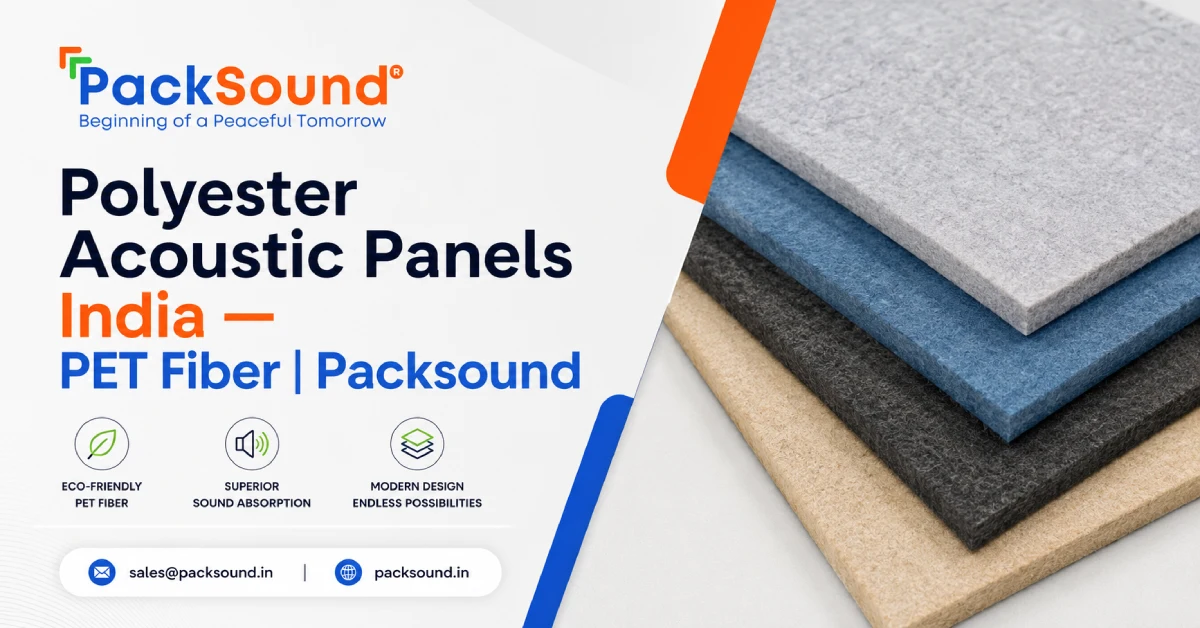
100% Recycled PET Fiber | NRC up to 0.95 | 30+ Colours | Fire-Retardant | Supply & Installation PAN India
Walk into most Indian offices, co-working spaces, and meeting rooms today and you will encounter one of two acoustic realities: either the room echoes so badly that every conversation bleeds into the next, or someone has stuck foam wedges to the wall and called it solved. Neither is acceptable in a modern workspace. Neither reflects where acoustic design has actually arrived.
Polyester acoustic panels – engineered from recycled PET (polyethylene terephthalate) fiber – are now the most specified acoustic wall treatment across premium commercial, hospitality, educational, and residential projects in India. They outperform acoustic foam on nearly every dimension: higher NRC ratings, far better durability, a complete colour and pattern range, and a material that is safe, non-toxic, and made from recycled plastic bottles.
This guide covers everything architects, interior designers, facility managers, and procurement teams need to know about polyester acoustic panels – how they work, what the specifications mean, where they belong, and how to choose between the options available in India’s market today.
Packsound, manufactured by Ecotone Acoustic Limited, supplies premium CNC PET polyester acoustic panels and polyester fiber ceiling clouds across India, with a complete EchoStop® wall panel range covering every commercial acoustic application.
📞 Talk to an Acoustic Specialist: +91 98098 02016 | +91 98913 20678
What Are Polyester Acoustic Panels?
Polyester acoustic panels are sound-absorbing panels manufactured from densely compressed polyester fibre – specifically recycled PET fibre derived from post-consumer plastic bottles. The fibre is processed through a needle-punching and thermal compression process that creates a rigid, dense, porous panel structure capable of absorbing sound energy across a broad frequency range.
They are distinct from:
- Acoustic foam – polyurethane foam wedge/pyramid panels that absorb only high-frequency sound, degrade rapidly, and have no place in professional architectural applications
- Fabric-wrapped panels – glass wool or rockwool core panels with a fabric facing, which perform well but at higher cost and with allergen risks from the mineral fibre core
- Wooden acoustic panels – perforated or grooved MDF/timber panels that combine absorption and diffusion, specified where aesthetics demand a wood finish
PET polyester panels sit at a distinct and increasingly preferred point in the specification matrix: excellent acoustic performance, eco-friendly material credentials, wide colour and design range, competitive price, and zero allergen or VOC concerns.
How They Work
Sound energy is absorbed rather than reflected when it enters the porous structure of a PET panel. The interconnected air pockets within the compressed fibre matrix cause sound waves to convert into small amounts of heat through friction. This is the same physical mechanism as mineral wool, but without the irritant fibres.
The result is measurable reduction in reverberation time (RT60) – the time it takes for sound to decay by 60 dB in a space – and improvement in speech clarity and acoustic comfort.
Key Specifications: What the Numbers Mean
Before purchasing polyester acoustic panels, understanding the core specifications allows buyers to make decisions based on performance rather than appearance.
NRC (Noise Reduction Coefficient)
NRC is the most important single metric for a sound-absorbing panel. It is a number between 0 and 1 (sometimes expressed as a percentage) representing the average sound absorption across the four standard test frequencies: 250 Hz, 500 Hz, 1000 Hz, and 2000 Hz.
- NRC 0.50 = 50% of incident sound energy absorbed
- NRC 0.85 = 85% absorbed
- NRC 0.95 = 95% absorbed
Polyester fiber panels by thickness:
| Thickness | Typical NRC (direct fix) | Typical NRC (with air gap) |
|---|---|---|
| 9 mm | 0.60–0.70 | 0.70–0.80 |
| 12 mm | 0.70–0.80 | 0.80–0.90 |
| 18 mm | 0.80–0.88 | 0.88–0.95 |
| 24 mm | 0.85–0.95 | Up to 0.95+ |
An air gap between the panel and the wall surface increases low-frequency absorption – the range where thin panels typically underperform. For spaces with significant low-frequency noise (music practice rooms, cinemas, restaurants with background music), 24 mm panels with an air gap are the correct specification.
Density and GSM
Panel density, expressed in GSM (grams per square metre) or kg/m³, determines both acoustic performance and physical durability. Higher-density panels absorb more sound and are more resistant to surface damage and indentation. Standard PET panels range from approximately 1,800 to 2,400 GSM at 9–12 mm thickness.
Fire Rating
In commercial and institutional applications, fire performance is non-negotiable. Polyester acoustic panels are available in fire-retardant grades that meet Class B or Class A fire performance standards under EN ISO 11925-2. Verify fire rating credentials before specifying for any commercial project – not all PET panels on the market are genuinely fire-retardant.
Packsound’s CNC PET Panels are available in fire-retardant grades suitable for commercial and institutional applications.
Standard Dimensions
Most PET acoustic panels in India are manufactured in a standard sheet size of 2440 × 1220 mm (8 × 4 feet), available in thicknesses of 9 mm, 12 mm, 18 mm, and 24 mm. CNC-patterned panels can be cut to any shape or size from the base sheet.
Our Polyester Acoustic Panel Products
CNC PET Panel – EchoStop® Series
View Product → packsound.in/acoustic-wall-panels/cnc-pet-panel/
Packsound’s CNC PET Panel is a precision-cut acoustic panel manufactured from 100% recycled high-density PET fiber, engineered using CNC machining to create striking architectural patterns alongside excellent sound absorption. This is the product that resolves the longstanding tradeoff between acoustic performance and interior design quality.
| Specification | Detail |
|---|---|
| Material | 100% recycled PET felt (polyester fiber) |
| Manufacturing | CNC precision-cut – custom patterns available |
| Thickness | 9 mm, 12 mm, 18 mm, 24 mm |
| Standard Size | 2440 × 1220 mm (custom sizes available) |
| Density | Approx. 1,800–2,400 GSM depending on thickness |
| NRC | 0.60–0.95 depending on thickness and installation |
| Fire Rating | Fire-retardant grades available |
| Colours | 30+ through-dyed colours – no surface laminate |
| Finish | Through-colour – no peeling or fading |
| Mounting | Wall-mounted, suspended, framed installations |
| VOC | Low VOC, safe for all indoor environments |
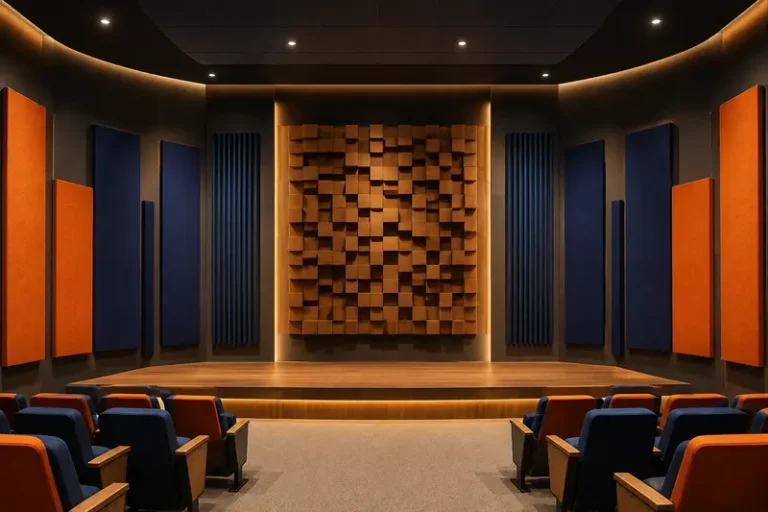
CNC pattern options allow custom geometric, organic, or brand-aligned cut designs – making these panels a dual-function specification: they treat the room acoustics and create a designed feature wall or ceiling element simultaneously.
Applications: Open-plan offices, meeting rooms, co-working spaces, restaurants, cafes, hotels, classrooms, libraries, home theatres, media rooms, residential interiors, retail showrooms.
Polyester Fiber Ceiling Clouds – PET Fiber Clouds
View Product → ecotone.co.in/polyester-fiber-clouds/
Where wall-mounted acoustic treatment is limited by furniture, glazing, or design constraints, ceiling-suspended polyester fiber clouds provide targeted acoustic treatment directly above key listening and working zones. Packsound’s Polyester Fiber Clouds deliver the same PET fiber acoustic performance in a suspended ceiling element, available in custom shapes, sizes, and colours.
Applications: Open-plan offices, atriums, restaurants, co-working spaces, hotel lobbies, educational facilities.
🔗 For ceiling-mounted acoustic treatment, also see: Acoustic Hanging Clouds | Acoustic Hanging Baffles
Composite Acoustic Panels – Multi-Layer PET + Wood + Fabric
View Product → ecotone.co.in/composite-acoustic-panels/
For projects requiring wide-band absorption across all frequencies – not just the mid and high range addressed by standard PET panels – Packsound’s Composite Acoustic Panels combine polyester fiber with wood and fabric layers for full-spectrum acoustic control. NRC up to 0.95, impact-resistant, available in premium finishes.
Polyester Acoustic Panels vs. Other Acoustic Materials
One of the most common specification questions is how PET polyester panels compare to the alternatives. Here is an honest assessment.
| Parameter | PET Polyester Panels | Acoustic Foam | Fabric-Wrapped (Glass Wool) | Wooden Acoustic Panels |
|---|---|---|---|---|
| NRC Range | 0.60–0.95 | 0.25–0.70 | 0.70–0.95 | 0.40–0.85 |
| Frequency Response | Mid + high frequency; low freq. with air gap | High frequency only | Broad spectrum | Mid + high; diffusion at low |
| Allergen Risk | None – inert PET fiber | None | Mineral fibre – irritant risk during install | None |
| Durability | High – impact-resistant | Low – degrades rapidly | Moderate – fabric subject to damage | High |
| Fire Performance | Class A/B available | Poor – generally flammable | Class A standard | Class B–A depending on treatment |
| Colour Range | 30+ colours, through-dyed | Limited | Limited by fabric supply | Limited by veneer/finish |
| CNC/Pattern Cutting | Yes – key advantage | No | No | Yes – perforated/grooved patterns |
| Eco Credentials | 100% recycled PET bottles | Petroleum-based | Virgin mineral fibre typically | FSC timber options |
| Price (India) | ₹55–200/sq ft | ₹30–80/sq ft | ₹150–300/sq ft | ₹200–500/sq ft |
| Best for | Commercial, hospitality, education | Home studios (budget) | Premium commercial, auditoria | Luxury hospitality, boardrooms |
The takeaway: Acoustic foam is a consumer product that has no place in professionally specified commercial or institutional interiors. PET polyester panels are the correct baseline specification for most commercial acoustic treatment applications, offering the best balance of performance, durability, cost, and design flexibility. Fabric-wrapped and wooden panels are the upgrade path where premium aesthetics or specialist acoustic targets demand it.
Where Polyester Acoustic Panels Work Best
Open-Plan Offices and Co-Working Spaces
Open-plan offices are India’s single largest application for polyester acoustic panels. The removal of cellular offices and the shift to open, activity-based working has created a widespread acoustic crisis: reverberation times of 1.2–2.0 seconds in spaces where 0.4–0.6 seconds is the design target for speech clarity.
PET panels on walls, combined with ceiling clouds or baffles, can bring most open-plan offices within design targets. The colour range allows panels to be integrated into the brand palette without appearing as an obvious acoustic treatment.
🔗 For open-plan office acoustic solutions, also see: ThinkPod™ Office Pods – soundproof work and meeting pods that remove the need for private offices while providing full acoustic privacy.
Conference Rooms and Meeting Rooms
Meeting rooms with parallel hard walls, glass surfaces, and no soft furnishings can generate reverberation times of 0.8–1.5 seconds – significantly reducing speech intelligibility and making video conferencing difficult. A 20–30% coverage of wall surface area with 12–18 mm PET panels, combined with acoustic ceiling tiles, brings most meeting rooms within the target RT60 of 0.3–0.5 seconds.
Restaurants, Cafes, and Hospitality Spaces
Excessive noise is consistently ranked among the top complaints about restaurant dining experiences. Hard surfaces – concrete floors, glass partitions, exposed ceilings – create reverberation times that make conversation difficult at normal volumes. Coloured PET panels integrated into restaurant interior design provide acoustic treatment that is invisible as a functional intervention and visible as a design feature.
🔗 For hospitality acoustic solutions: Auraluxe™ 3D Luxury Acoustic Wall Panels – premium acoustic surfaces for luxury hospitality interiors.
Educational Institutions
Schools and universities are chronically under-treated acoustically. A reverberant classroom reduces speech intelligibility – the percentage of words a student correctly hears – by up to 40% compared to a treated space. This directly affects learning outcomes. PET panels are the standard specification for classroom acoustic treatment in new educational projects in India, combining good performance with durability, low maintenance, and safety (non-toxic, no loose fibres).
🔗 Fabric Wrapped Acoustic Panels are an alternative for classrooms where a softer aesthetic finish is preferred.
Recording Studios and Podcast Studios
In recording studio applications, PET panels are widely used for broadband mid and high-frequency absorption in control rooms, vocal booths, and live rooms. For studio applications, 24 mm panels with an air gap, positioned at first and second reflection points on side walls and ceiling, are the standard treatment. Bass control requires dedicated low-frequency absorbers (bass traps) rather than PET panels alone.
Home Theatres and Media Rooms
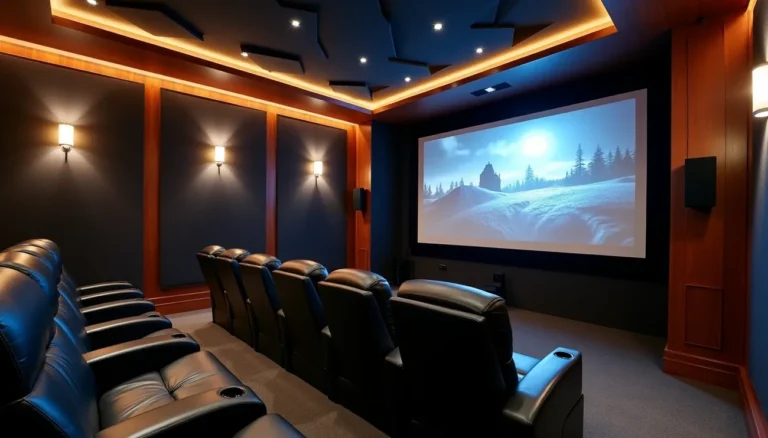
Residential home theatre acoustic treatment is one of the fastest-growing application segments for PET panels in India. 18–24 mm PET panels in dark finishes, placed at reflection points on side walls and the rear wall, combined with acoustic ceiling treatment, transform a reverberant room into a cinema-quality listening environment.
Hospitals and Healthcare Facilities
Healthcare acoustic design is increasingly recognised as a patient wellbeing and recovery factor. Excessive noise – a consistent finding in hospital surveys – is addressed in new and refurbished healthcare facilities through ceiling clouds, acoustic ceiling tiles, and PET wall panels in corridors, waiting areas, and ward spaces. PET panels are specified in healthcare because they are non-toxic, easy to clean, resistant to moisture, and do not harbour bacteria (inorganic composition).
Common Mistakes When Buying Polyester Acoustic Panels in India
1. Treating NRC as the Only Specification
NRC is an average across four frequencies. A panel with NRC 0.85 may still perform poorly at low frequencies (below 250 Hz) – the range responsible for boomy, muddy acoustics in rooms with music or HVAC noise. Always check the full octave-band absorption data, not just the single NRC number.
2. Buying Thin Panels for Reverberant Spaces
9 mm panels at NRC 0.60 are suitable for modest acoustic treatment in relatively dead rooms. For a reverberant open-plan office or restaurant with an RT60 above 1.0 seconds, 9 mm panels will not deliver the required improvement. Specify 18–24 mm panels or contact an acoustic designer for a coverage calculation.
3. Ignoring Fire Rating
A PET panel without a verified fire-retardant certification is not appropriate for commercial, hospitality, or institutional applications. This is not a bureaucratic formality – it is a genuine life safety requirement. Always ask for the fire test certificate and verify it covers the specific product and thickness you are purchasing.
4. Covering Insufficient Surface Area
The most common acoustic treatment failure in Indian commercial projects is insufficient coverage. 10–15% wall coverage does almost nothing measurable. Effective acoustic treatment typically requires 20–40% of total room surface area (walls + ceiling combined). A proper acoustic calculation before specifying quantities is the only reliable approach.
5. Confusing Acoustic Absorption with Soundproofing
PET panels absorb sound within a room – they reduce echo and reverberation. They do not prevent sound transmission between rooms. This distinction is frequently misunderstood. If your requirement is to stop sound traveling from one room to another, you need mass-loaded partitions or acoustic doors, not absorptive panels.
🔗 For sound isolation between rooms: Soundproof Fixed Partition / Drywall | SonicGuard® Acoustic Fire Rated Doors
6. Purchasing Generic Panels Without Manufacturer Support
The Indian market is flooded with commodity PET panels from unbranded sources. The problem is not the material – it is the absence of acoustic consultation, installation guidance, and post-installation support. Specifying from a manufacturer with an acoustic design capability means your panel selection is based on a room acoustic calculation, not a guess.
Installation Guide: Getting It Right
Surface Preparation
Walls must be clean, dry, dust-free, and structurally sound. Remove any loose paint or surface treatment. Check wall flatness – major undulations affect adhesive contact area and the visual flatness of the finished installation.
Adhesion Methods
PET panels can be fixed using:
- Water-based construction adhesive – the standard method for permanent wall installation. Apply in a continuous perimeter bead plus internal zigzag pattern. Press firmly and hold or prop until adhesive sets.
- Mechanical fasteners (impaling clips or Z-clips) – used where a demountable installation is required, or where the wall substrate cannot accept adhesive (glazed surfaces, certain cladding systems).
- Suspended framing – for ceiling clouds and suspended ceiling elements, use manufacturer-specified hanging hardware rated for the panel weight.
Layout Planning
Acoustic panels are most effective at the reflection points in a room – the surfaces where sound from speakers, voices, or HVAC bounces toward the listening position. For offices and meeting rooms: side walls at ear height (approximately 1.2–1.8 m from floor), rear wall, and ceiling above the primary seating zone.
For CNC patterned panels: plan the layout on paper or in a design tool before cutting and installing – the pattern must align across adjacent panels for the visual effect to work.
Air Gap Technique
Where low-frequency absorption is a priority, install panels with a 25–50 mm air gap behind them using a timber or metal framework. This significantly improves absorption at frequencies below 500 Hz without changing the visible appearance of the installation.
Pricing Guide: Polyester Acoustic Panels in India (2026)
| Panel Type | Thickness | Indicative Price |
|---|---|---|
| Standard PET flat panel | 9 mm | ₹55–90/sq ft |
| Standard PET flat panel | 12 mm | ₹75–120/sq ft |
| Standard PET flat panel | 18 mm | ₹110–160/sq ft |
| CNC-patterned PET panel (Packsound EchoStop®) | 9–18 mm | ₹120–200/sq ft |
| Polyester fiber ceiling clouds | Custom | Project-specific quote |
| Composite acoustic panel | 25–50 mm | ₹150–300/sq ft |
Prices are indicative and vary with quantity, custom sizing, fire-rating grade, and installation scope. Contact Packsound for project-specific quotations.
What drives price variation:
- Thickness (thicker = higher material cost and better acoustic performance)
- CNC patterning (adds machining cost; provides design value)
- Fire-retardant treatment (small premium; non-negotiable for commercial projects)
- Custom colours beyond standard range
- Minimum order quantities – smaller orders typically carry a premium
- Supply vs. supply-and-install – professional installation adds 15–25% but ensures correct coverage and layout
Why PackSound for Polyester Acoustic Panels
Packsound, manufactured by Ecotone Acoustic Limited, is not simply a panel supplier. We are an acoustic design and manufacturing company that happens to manufacture panels. This distinction matters for how we approach every project.
What this means in practice:
- Acoustic design first – our team calculates the reverberation time of your space, identifies the correct coverage and panel specification, and recommends a layout before you purchase anything. This prevents the most common failure: incorrect specification or insufficient coverage.
- Manufacturer, not reseller – we manufacture our PET panels in India, allowing us to offer custom sizes, custom CNC patterns, and project-specific colour matching that commodity suppliers cannot provide.
- Complete ecosystem – PET panels are one part of a full acoustic treatment spectrum. Where your project needs ceiling baffles, partitions, acoustic doors, or a full consultancy service, we provide it from a single source.
- Installation capability – our installation teams manage the complete process from acoustic assessment through to final installation and post-installation acoustic verification.
Our Polyester and Acoustic Panel Range
| Product | URL |
|---|---|
| CNC PET Panel (EchoStop® Series) | packsound.in/acoustic-wall-panels/cnc-pet-panel/ |
| Polyester Fiber Ceiling Clouds | ecotone.co.in/polyester-fiber-clouds/ |
| Composite Acoustic Panels | ecotone.co.in/composite-acoustic-panels/ |
| Fabric Wrapped Acoustic Panels | ecotone.co.in/fabric-wrapped-acoustic-panels/ |
| Acoustic Wall Panels (full range) | ecotone.co.in/acoustic-wall-panels/ |
| Acoustic Hanging Baffles | ecotone.co.in/acoustic-hanging-baffles/ |
| Acoustic Hanging Clouds | ecotone.co.in/acoustical-hanging-clouds/ |
| Auraluxe™ 3D Luxury Wall Panels | packsound.in/auraluxe/3d-luxury-acoustic-wall-panels/ |
| ThinkPod™ Office Pods | packsound.in/thinkpod/ |
| Acoustic Design & Consultancy | ecotone.co.in/acoustic-design-consultancy/ |
| Download Catalogue | ecotone.co.in/wp-content/uploads/2026/01/Packsound-Master-catalogue-.pdf |
Conclusion
Polyester acoustic panels have become the default acoustic treatment specification in India’s commercial interior market and for good reason. They deliver high NRC performance, come in a complete colour and design range, are manufactured from recycled materials, are safe for every indoor environment, and are competitively priced against every alternative.
The decisions that determine whether a polyester acoustic panel installation succeeds or fails are not about which panel to buy – they are about correct specification: the right thickness for the acoustic target, sufficient coverage area for the room volume, and appropriate placement at acoustic reflection points.
Packsound’s CNC PET Panel adds one further dimension that standard flat PET panels cannot: precision-cut architectural patterns that transform acoustic panels from a functional necessity into a designed interior feature, without any compromise in acoustic performance.
Frequently Asked Questions About Polyester Acoustic Panels
Q: Are polyester acoustic panels better than PET felt panels?
They’re closely related – polyester panels are made from PET (polyethylene terephthalate) fibers, so “polyester” and “PET felt” often describe the same material family. Differences usually come down to density, finish, and fire rating rather than the base material itself.
Q: Are polyester acoustic panels fire safe?
Most commercial-grade polyester acoustic panels are treated to meet fire safety standards (typically Class B or better), but always confirm the specific fire rating with the manufacturer before installing in public or high-occupancy spaces.
Q: Where are polyester acoustic panels commonly used?
They’re popular in offices, schools, restaurants, and home theaters because they combine decent sound absorption with a wide range of colors and finishes, unlike more industrial-looking materials.
📞 Get a Free Acoustic Consultation
Whether you are specifying a single meeting room or a 50,000 sq ft campus, Packsound’s acoustic design team will calculate your reverberation target, recommend the correct panel specification and coverage, and provide a complete supply-and-install quotation.
📱 +91 98098 02016 | +91 98913 20678
🌐 ecotone.co.in/contact-us/
📄 Download Packsound Master Catalogue
🔍 Explore All Acoustic Wall Panels
🔍 Acoustic Design & Consultancy