
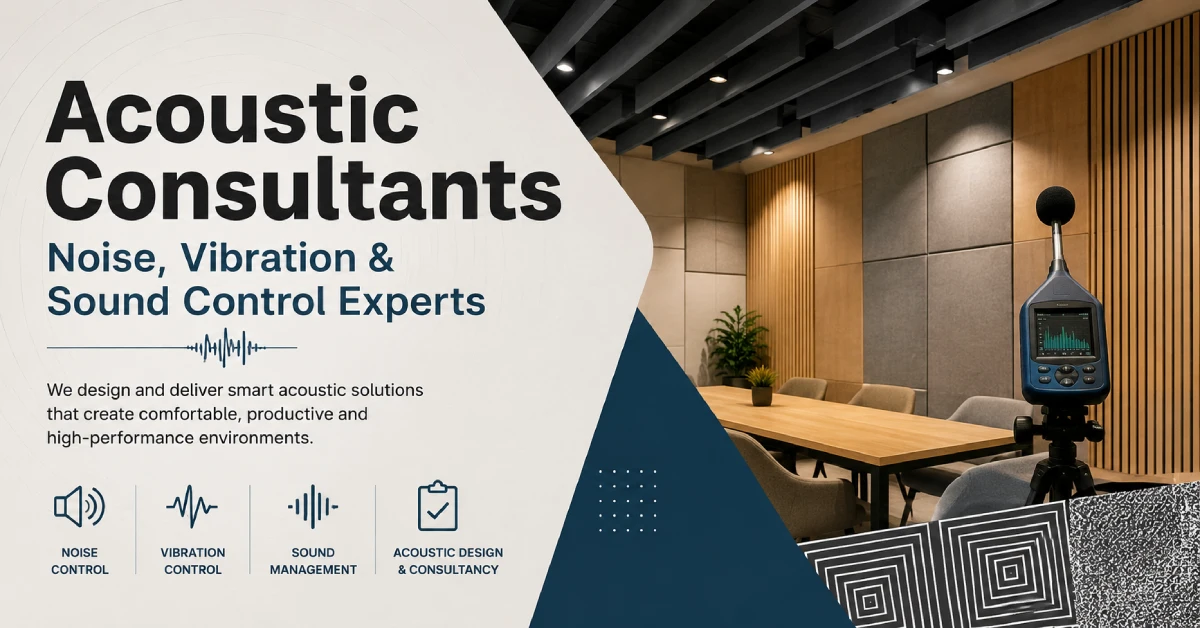
Poor acoustics can quietly damage the performance of any space. In offices, excessive echo affects communication and productivity. In hospitals, unwanted noise disrupts patient recovery. In factories, high noise levels can create compliance risks and unsafe working conditions. In auditoriums and recording studios, even minor acoustic issues can completely affect sound clarity and user experience.
This is why working with an experienced acoustic consultant becomes essential during project planning rather than after noise problems begin affecting operations.
An acoustic consultant helps identify sound-related challenges, measures existing noise conditions, designs effective noise control solutions, and ensures that buildings meet required acoustic performance standards. Whether the project involves architectural acoustics, industrial noise reduction, environmental noise compliance, or soundproofing design, the right acoustic expertise helps create spaces that perform better, remain compliant, and deliver long-term comfort.
📞 Talk to an Acoustic Consultant: +91 98098 02016 | +91 98913 20678
What Is an Acoustic Consultant?
An acoustic consultant specialises in the science of sound and vibration. Their work spans the full project lifecycle: measuring existing conditions, predicting noise impacts, designing solutions, and confirming performance through post-installation measurement.
Every engagement answers three questions: What is the acoustic problem? What does the environment need to be? How do you get from one to the other?
In India, acoustic consultants operate across several distinct domains:
- Architectural acoustics – designing the acoustic environment inside buildings: offices, schools, hospitals, hotels, auditoriums, recording studios
- Environmental acoustics – assessing and mitigating community noise from highways, industrial facilities, construction, and infrastructure
- Building services acoustics – controlling noise and vibration from HVAC systems, generators, pumps, and mechanical plant
- Industrial acoustics – workplace noise management for factories, manufacturing facilities, and processing plants to meet CPCB and Factories Act requirements
- Noise barriers and sound walls – outdoor noise mitigation for transport, industrial, and infrastructure applications
🔗 PackSound’s dedicated service page: Acoustic Design & Consultancy
Why Acoustic Consulting Matters in India: The Regulatory Context
India has a structured set of noise regulations that govern permitted noise levels across residential, commercial, industrial, and silence zones. Understanding this framework is essential for developers, industrial operators, and project teams.
CPCB Ambient Noise Standards
The Central Pollution Control Board (CPCB) prescribes ambient noise limits under the Environment (Protection) Act, 1986 and the Noise Pollution (Regulation and Control) Rules, 2000:
| Zone | Day (6 AM – 10 PM) | Night (10 PM – 6 AM) |
|---|---|---|
| Industrial | 75 dB(A) | 70 dB(A) |
| Commercial | 65 dB(A) | 55 dB(A) |
| Residential | 55 dB(A) | 45 dB(A) |
| Silence Zone (hospitals, schools) | 50 dB(A) | 40 dB(A) |
Industrial facilities, construction projects near residential areas, and commercial developments in mixed-use zones are all required to demonstrate compliance with these limits. Non-compliance can result in closure notices, fines, and community legal action.
🔗 Related: Industrial Noise Barriers | Metallic Noise Barriers
NBC 2016 Acoustic Provisions
The National Building Code of India 2016 Part 8 (Building Services) includes provisions for acoustic design in commercial, institutional, and residential buildings – specifying minimum sound isolation standards between dwelling units, maximum reverberation time targets for different space types, and noise control requirements for building services equipment.
Compliance with NBC 2016 acoustic requirements is a condition of occupancy certificate issuance in an increasing number of jurisdictions, and is routinely specified by international hotel brands, healthcare accreditation bodies (NABH), and education regulators (UGC).
What Does an Acoustic Consultant Do? Services Explained
1. Architectural Acoustic Design
Inside buildings, the acoustic consultant’s role is to ensure each space performs optimally for its intended use. This means managing two distinct acoustic phenomena:
Reverberation time (RT60) – how long sound takes to decay after a source stops. A conference room with RT60 of 1.2 seconds makes speech difficult to follow. The target for a medium conference room is 0.3–0.5 seconds. The consultant specifies the correct NRC-rated absorption material – area, placement, and product type – to achieve this target.
Sound isolation (STC / Rw) – how much sound passes between adjacent spaces. A meeting room wall with STC 35 allows all speech to be intelligible next door. The target for genuine speech privacy is STC 45+. The consultant specifies the correct wall construction, seals, and door specification to achieve this.
Solutions deployed by Packsound acoustic consultants include:
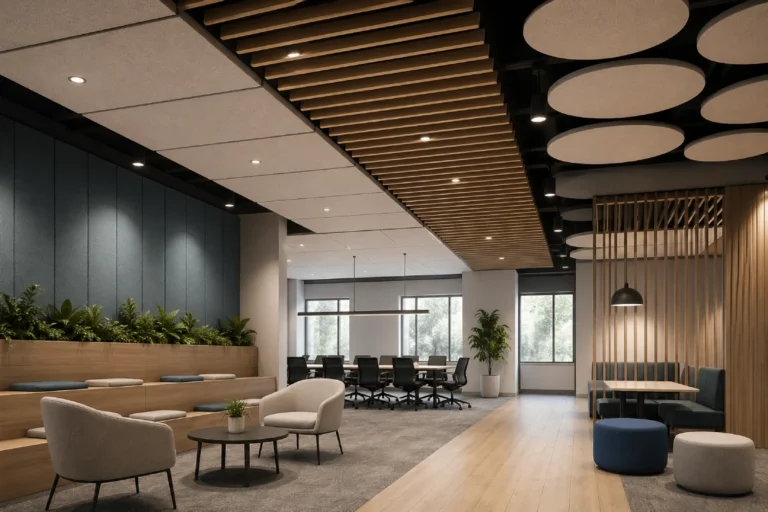
- Acoustic Wall Panels – NRC 0.60–0.95, wide range of finishes for offices, hotels, healthcare, education
- Acoustic Hanging Baffles – suspended ceiling absorption for large open volumes
- Acoustic Hanging Clouds – targeted ceiling absorption directly above key zones
- Fabric Wrapped Acoustic Panels – premium architectural finish, NRC up to 0.90
- Grooved Wooden Acoustic Panels – hardwood aesthetic with controlled absorption and diffusion
- Composite Acoustic Panels – multi-layer high-performance panels for demanding targets
- Acoustic Ceiling Tiles – standard ceiling grid systems, NRC 0.65–0.85
- Soundproof Fixed Partition / Drywall – high-STC wall assemblies for permanent sound isolation
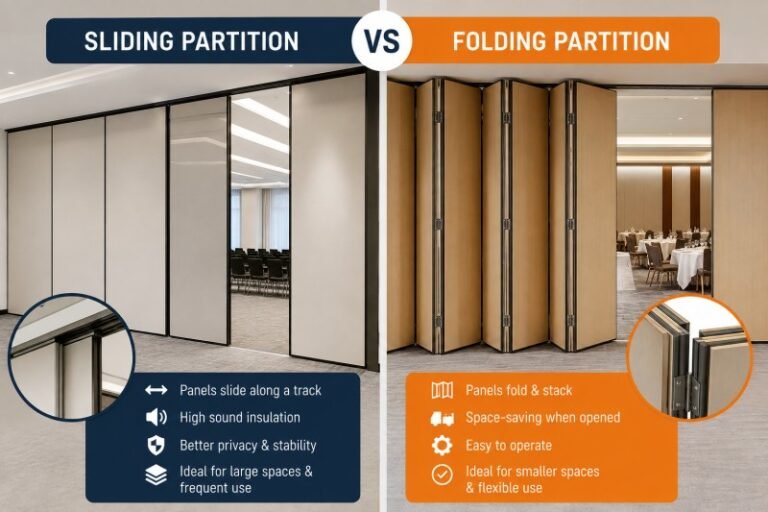
- AcoFascia™ Sliding Folding Partition – operable walls STC up to 55 for flexible spaces
2. Environmental Noise Assessments
Environmental noise assessments quantify how much noise a site generates or is exposed to. They are required for:
- New housing developments near highways, ring roads, or metro/rail lines
- Industrial facilities generating community noise above CPCB limits
- Data centres with cooling tower noise
- Outdoor event venues
- Infrastructure expansion projects (airports, ports, transport hubs)
- Construction permits in noise-sensitive zones
The consultant measures existing ambient noise levels over representative periods (typically 24–72 hours minimum), identifies dominant noise sources, predicts future levels with or without the proposed development, and designs mitigation measures – barriers, landscaping, building orientation, facade treatment.
🔗 Related: Noise Barrier Manufacturer | Polycarbonate Noise Barrier | Mobile Noise Barrier
3. Industrial Noise & Vibration Control
Industrial noise is among the most complex acoustic consulting specialisation. Sources include:
- Metal pressing, forging, stamping: 95–110 dB(A) at source
- Textile weaving and spinning machinery: 90–100 dB(A)
- Stone cutting and processing: 95–108 dB(A)
- Compressors, pumps, blowers: 85–100 dB(A) – radiated from equipment casings
- Generator sets: 90–105 dB(A) at 1 metre
An industrial acoustic consultant’s workflow follows three phases:
Assessment: On-site noise mapping survey – sound pressure level measurements at all workstations, equipment locations, and site boundaries. Identifies which sources are responsible for the overexposure and which workers are most affected.
Design: Engineering control specification – acoustic enclosures around individual machines, barriers between high-noise areas and occupied zones, vibration isolation of machinery from floors and structures, acoustic lining of plant rooms, silencers on air intakes and exhausts.
Verification: Post-installation measurement to confirm the designed noise reduction has been achieved and that occupational exposure is within permissible limits.
🔗 Related blog: How Industrial Building Sound Consultants Solve Noise Problems Efficiently
4. Building Services Noise & Vibration
Mechanical and electrical building services are among the most commonly overlooked noise sources in Indian commercial construction. HVAC systems, cooling towers, lift machinery, generator sets, and pressurised plumbing can all generate noise levels that affect occupants and neighbours – and in many cases violate CPCB or NBC 2016 limits.
Solutions include:
- Vibration isolation mounts for air handling units, chillers, and pumps
- Acoustic enclosures around cooling towers and generator sets
- Duct silencers and acoustic lining on ventilation systems
- Floating floor systems for mechanical rooms
- Acoustic treatment of lift motor rooms
5. Noise Barrier Design
Noise walls – acoustic barriers designed to block, absorb, or diffuse outdoor sound – are specified for highways, railway corridors, industrial perimeters, and commercial facilities generating community noise. They are one of the most visible tools in the environmental acoustic consultant’s toolkit.
How noise walls work:
- Height – taller walls block more direct sound paths; the geometric relationship between source, wall top, and receiver determines insertion loss
- Length – the wall must extend significantly beyond the noise source to prevent flanking around the ends
- Material – reflective (concrete, steel), absorptive (mineral wool faced panels), or combined. Absorptive materials on the source face prevent reflected noise reaching other sensitive receptors
- Position – placement relative to source and receiver is often more critical than height; a wall close to the source is more effective than the same wall close to the receiver
PackSound noise barrier products:
- Metallic Noise Barriers – steel-faced absorptive barriers for highways, industrial perimeters
- Polycarbonate Noise Barrier – transparent barriers for views, light, and aesthetic requirements
- Mobile Noise Barrier – temporary/relocatable barrier systems for construction and events
6. Specialist Space Acoustic Design
Certain space types require acoustic design beyond standard commercial specifications — where the acoustic environment is the primary functional requirement.
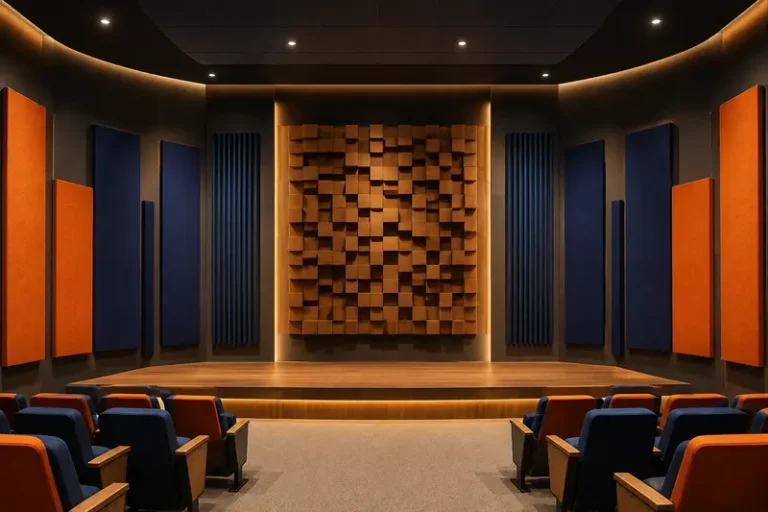
Auditoriums and performance spaces: RT60 targets, early reflection management, stage acoustic design, sound system integration. PackSound has delivered Auditorium Acoustic Treatment for spaces including BAPS Shri Swaminarayan Mandir, Ahmedabad – a 40,000-person capacity venue representing one of the most technically demanding acoustic projects in India.
Recording and broadcast studios: Maximum isolation (STC 60+), controlled RT60 (0.2–0.4 seconds for vocal recording, longer for live music), bass trap specification, reflection point treatment. Packsound has delivered complete studio builds including mass-loaded barriers, floating floors, and acoustic treatment for professional podcasting and music recording facilities.
Hospitals and healthcare: NABH guidelines require acoustic privacy between consulting rooms, ward noise management, and hearing-critical spaces such as audiology suites. Healthcare acoustic treatment is a specialist discipline requiring familiarity with infection control requirements alongside acoustic targets.
Hotels and hospitality: Guest room noise is consistently among the top two complaints in hotel reviews. Acoustic consultants specify wall constructions, floor/ceiling assemblies, corridor door specifications, and HVAC noise control to meet brand acoustic standards (Marriott, Hyatt, IHG all publish STC requirements). The AcoFascia™ Sliding Folding Partition – STC up to 55 – is specified for hotel ballrooms and conference facilities.
🔗 Related: Acoustic Treatment for Hotel Banquet Halls & Conference Rooms
Tunnel and transport acoustics: Road tunnels, metro stations, bus terminals, and airport concourses present unique acoustic challenges. Tunnel Acoustics treatment controls reverberation, manages PA system intelligibility, and reduces traffic noise reflection for driver and passenger safety.
7. Acoustic Measurement & Monitoring
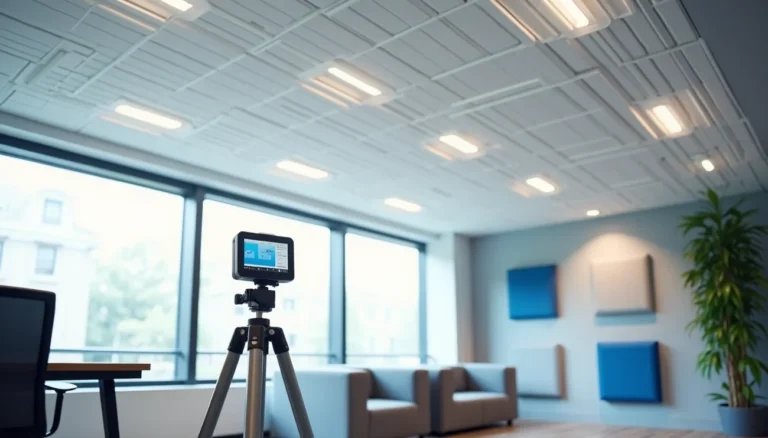
Quantitative acoustic assessment is the foundation of all consulting work. Packsound’s acoustic team uses:
- Type 1 Sound Level Meters (Class 1 IEC 61672-1:2013) – precision measurement of dB(A), dB(C), and frequency-weighted noise levels
- Long-term environmental noise monitors – unattended monitoring for 24-hour, multi-day, or seasonal campaigns providing Leq, Lmax, L90, and full percentile data
- Vibration measurement – ground vibration, structural vibration, and machinery vibration assessment
- RT60 measurement – impulse response and interrupted noise method in completed spaces
- Acoustic modelling software – predictive modelling of noise propagation, room acoustics simulation, and performance verification before construction
8. Expert Witness and Dispute Resolution
When noise disputes escalate – a factory receiving a complaint from a neighbouring housing society, a developer facing community opposition to a project, a commercial tenant in dispute with a landlord over building noise – an acoustic consultant provides objective, data-driven evidence that resolves the situation.
Services include on-site measurement to document the situation, comparison to CPCB standards and applicable regulations, formal technical reports, and where required, testimony before courts, NGT (National Green Tribunal), or regulatory authorities.
The PackSound Acoustic Consulting Advantage: Manufacturer + Consultant
This is the distinction that sets PackSound apart from every pure acoustic consultancy in India.
A pure acoustic consultant measures your space, writes a specification, and hands it to a contractor. The contractor sources products from multiple suppliers. If performance targets are not met, responsibility is diffuse.
Packsound as acoustic consultant measures your space, designs the solution, specifies the exact products from our own manufacturing range, and installs them. When we predict an NRC 0.85 or STC 50, we have the manufacturing capability to deliver it and the installation team to achieve it. Performance accountability is complete and singular.
This model works across every project type — from a single meeting room acoustic treatment to a 40,000-person auditorium. From a hotel ballroom requiring STC 55 operable walls to a pharmaceutical facility requiring acoustic and fire-rated door sets certified to IS 3614.
Sectors We Serve
Commercial Offices
Open-plan acoustic treatment, meeting room design, AcoFascia™ partition systems, ThinkPod™ office pods for individual privacy. Clients include IT parks, co-working operators, corporate headquarters, and BPO facilities. Packsound has treated open-plan offices achieving ambient noise reductions of 8+ dB and speech intelligibility improvements across all workstations.
Healthcare
NABH-compliant acoustic design for hospitals, clinics, and diagnostic centres. Ward noise management, consulting room privacy, acoustic wooden doors and fire rated doors for clinical areas. Acoustic treatment that meets both sound isolation requirements and infection control standards.
Education
School and university acoustic design – classroom reverberation, auditorium acoustic treatment, auditorium seating, library quiet zones, multipurpose hall partition systems. Projects include school auditoria serving 400+ students and university lecture theatres requiring high speech intelligibility at the rear of the room.
Hospitality
Hotel acoustic consulting – guest room wall and ceiling specifications, SonicGuard® acoustic fire rated doors, AcoFascia™ ballroom partitions to STC 55, restaurant noise management with acoustic ceiling baffles and Auraluxe™ 3D luxury panels. Installed at Hyatt Regency Bhikaji Cama Place, New Delhi.
Industrial
Factory noise mapping and control, CPCB compliance assessment, Factories Act occupational noise management, metallic noise barriers for perimeter noise control, machine enclosures, vibration isolation. Industrial clients include pharmaceutical manufacturers (Pfizer, Schedule M-compliant facilities), manufacturing plants, and processing facilities.
Auditoriums and Performance Spaces
Specialist acoustic design for large venues – RT60 optimisation, acoustic wall panels, ceiling acoustic treatments, auditorium curtains and staging, stadium acoustics. Largest project: BAPS Shri Swaminarayan Mandir, Ahmedabad – 40,000-person capacity acoustic treatment.
Recording Studios and Broadcast
Complete studio builds – STC 60+ isolation, floating floors, mass-loaded barrier systems, acoustic foam and melamine foam treatment, composite acoustic panels for controlled RT60. Professional podcasting studios, music recording, and broadcast facilities across India.
Government and Infrastructure
Tunnel acoustics, transport corridor noise barriers, public building acoustic design, CPWD-specification acoustic products, noise monitoring for infrastructure compliance.
Full project portfolio: ecotone.co.in/projects/
Frequently Asked Questions
Is acoustic treatment the same as soundproofing?
No. Treatment reduces echo inside a room. Soundproofing blocks sound transmission between rooms.
How much does acoustic consulting cost in India?
Single-room assessments start around Rs 15,000. Environmental surveys range from Rs 75,000 to Rs 2,00,000.
What is the CPCB noise limit for residential areas?
5 dB(A) daytime and 45 dB(A) at night under Noise Pollution Rules 2000.
Can acoustic panels stop noise from neighbours?
No. Panels reduce reverberation only. Neighbour noise needs mass, decoupling, and sealed wall construction.
Get a Free Acoustic Consultation
No noise problem is too simple or too complex. We have treated a single 20 sq m recording room and a 40,000-person religious auditorium. The process begins the same way: a conversation about what the space is, what the problem is, and what the target needs to be.
📞 +91 98098 02016 | +91 98913 20678
🌐 ecotone.co.in/contact-us/
🔍 Acoustic Design & Consultancy Service
🏆 Awards & Recognition
📁 View Our Projects
📄 Download Packsound Master Catalogue


One Comment