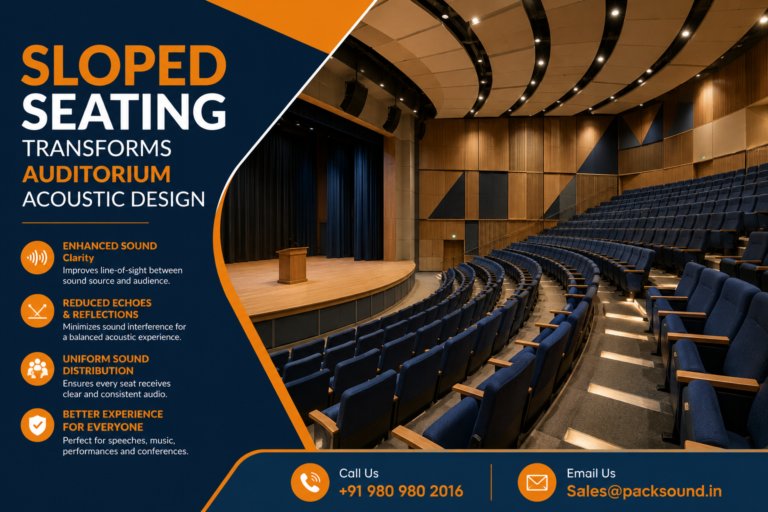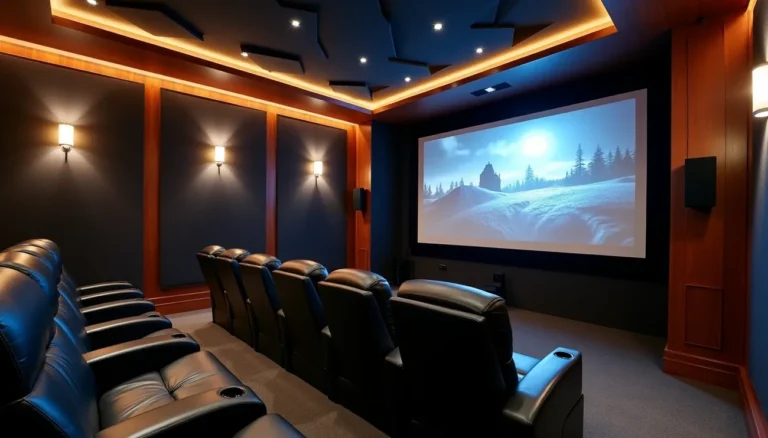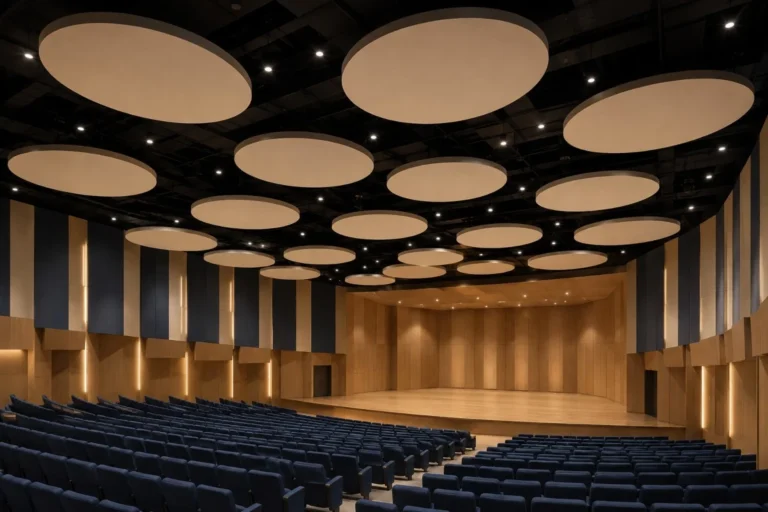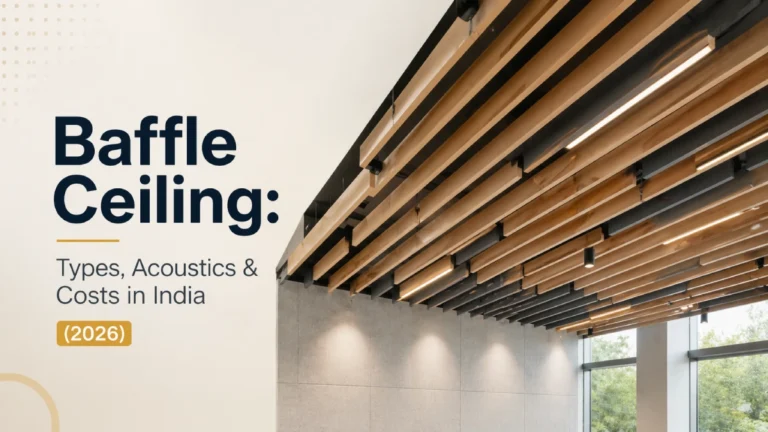
Struggling with echo, noise, or a bland ceiling in your office, hotel, or auditorium? Baffle ceiling design solves both problems at once – cutting reverberation while transforming your overhead space into a striking architectural feature. Here’s everything architects, designers, and buyers need to know before specifying one.
What Is a Baffle Ceiling?
A baffle ceiling is a sound-absorbing ceiling system where flat panels – called baffles – are suspended vertically from the structural ceiling in parallel rows or custom configurations. Unlike standard drop ceilings, baffles hang with open gaps between them, leaving ductwork, lighting, and structural elements visible above.
This open geometry is the key to their acoustic performance. Sound traveling horizontally through a room must pass between the panels. Every time it does, both faces of each panel absorb energy – delivering twice the absorptive surface area compared to a flat acoustic tile of the same size.
Baffle Ceiling vs. Acoustic Cloud: What’s the Difference?
| Feature | Acoustic Baffle | Acoustic Cloud |
|---|---|---|
| Orientation | Vertical | Horizontal |
| Best for | Tall spaces (4m+) | Medium-height rooms |
| Sound Intercepted | Horizontal propagation | Vertical reflections |
| Design Impact | Fins, blades, depth | Floating panels, shapes |
| Ideal Spaces | Open offices, halls, gyms | Conference rooms, restaurants |
How Baffle Ceilings Perform: Key Acoustic Metrics
Understanding acoustic performance terminology allows buyers to evaluate product claims intelligently and specify confidently.
Noise Reduction Coefficient (NRC)
NRC measures sound absorption on a scale of 0 (fully reflective) to 1.0 (fully absorptive). Commercial acoustic baffles typically achieve:
PET felt baffles: NRC 0.85–0.95+
Timber/wood baffles: NRC 0.40–0.70
Fabric-wrapped or fibrous baffles: NRC 0.75–0.90
| NRC Value | Absorption Performance |
|---|---|
| 0.00–0.20 | Highly reflective (glass, concrete, plaster) |
| 0.25–0.50 | Moderate absorption |
| 0.55–0.75 | Good absorption (most fabric-wrapped panels) |
| 0.80–0.95 | High absorption (dense acoustic baffles, thick PET felt) |
| 0.95–1.00+ | Exceptional absorption (thick fibrous baffles) |
PackSound’s acoustic baffles are engineered to achieve NRC values ranging from 0.75 to 0.95 depending on product specification, thickness, and installation configuration – placing them firmly in the high-performance absorption category.
Reverberation Time (RT60)
Reverberation time – the duration for sound to decay by 60 dB after its source stops – is the metric used to characterise how a complete room sounds. A high RT60 means the room is excessively reverberant: speech becomes unclear, music sounds muddy, and ambient noise levels accumulate. A correctly specified baffle ceiling installation brings RT60 within the recommended range for the room’s primary use: typically 0.4–0.6 seconds for a conference room, 0.8–1.2 seconds for a classroom, and 1.2–2.0 seconds for a concert auditorium.
5 Best Baffle Ceiling Design Types for Commercial Spaces
Linear Wooden Baffle Ceiling

Parallel timber-finish fins running the full length of a room. Narrow profiles (40–80 mm wide, 200–500 mm drop) create strong visual directionality and a sense of warmth. Typically paired with mineral wool above the baffles to boost acoustic performance (NRC 0.40–0.70 for timber alone).
Best for: Restaurants, hotel lobbies, corporate reception, premium co-working spaces.
PET Felt Acoustic Baffle Ceiling

Softly textured panels in recycled polyester felt — available in a wide colour palette and die-cut shapes. PET felt delivers the highest NRC of any commonly specified baffle material (0.85–0.95+), making it the acoustic consultant’s first choice for highly reverberant spaces.
Best for: Open-plan offices, school gyms, canteens, libraries, co-working hubs, sports facilities.
Metal & Aluminium Baffle Ceiling
Extruded aluminium U- or C-profiles in powder-coat or anodised finishes (matte black, white, gunmetal). Durable, fire-resistant, and low-maintenance. Acoustic infill (mineral wool) must be added inside the profile for meaningful NRC (0.55–0.75 with infill).
Best for: Airports, shopping centres, retail, corporate headquarters, transport hubs.
Design tip: Integrated linear LED strips inside the aluminium profile create dramatic lighting without additional ceiling fittings.
Geometric & Custom-Pattern Baffle Ceiling
Diagonal grids, wave patterns, radial layouts, or curved baffles configured as an architectural centrepiece. Multi-directional baffle arrangements address sound traveling in multiple axes simultaneously – ideal for irregularly shaped rooms.
Best for: Luxury retail, creative studios, boutique hotels, event venues, co-working flagships.
Integrated Acoustic Cloud + Baffle Ceiling
A hybrid treatment combining vertical baffles with horizontally suspended acoustic clouds. Clouds intercept vertical ceiling reflections; baffles address horizontal propagation. Combined, they consistently achieve superior RT60 results at lower total coverage than either product alone.
Best for: Hotel lobbies, auditoriums, restaurant dining rooms, multipurpose conference centres.
Materials Used in Baffle Ceiling Systems
| Material | NRC Range | Best Environment |
|---|---|---|
| PET Felt (Recycled Plastic) | 0.85 – 0.95+ | Offices, Schools, Co-working Spaces |
| Fibreglass / Mineral Wool | 0.75 – 0.90 | Auditoriums, Industrial Spaces, Offices |
| Natural Wood / Veneer | 0.40 – 0.70 | Hospitality, Retail, Premium Offices |
| MDF with Fabric Facing | 0.65 – 0.85 | General Commercial Interiors |
| Aluminium (With Infill) | 0.55 – 0.75 | Airports, Retail, Transport Areas |
| uPVC | Low (Without Infill) | Wet/Humid Areas, Healthcare Facilities |
Where Baffle Ceilings Deliver the Most Value
Open-Plan Corporate Offices
Modern open layouts with hard floors and glass walls routinely exceed 60 dB ambient noise. A correctly specified baffle ceiling can reduce ambient noise by 6–10 dB and measurably improve speech clarity and worker productivity.
Auditoriums & Performance Venues
Precise RT60 control across speech and music frequencies. Baffle ceilings allow acoustic designers to tune reverberation without over-treating or under-treating the space.
Hotels and Hospitality Interiors
Wooden baffles in restaurant dining areas reduce reverberant noise and warm the space visually. Double-height lobby baffles create architectural drama while controlling large-volume sound.
Educational Institutions
Research consistently shows poor classroom acoustics disproportionately harm children with hearing difficulties, second-language learners, and students with attention challenges. Acoustic baffles in schools are a functional necessity, not a design preference.
Healthcare Facilities
Acoustic comfort supports patient recovery. Materials must meet clinical cleaning protocols and relevant fire safety standards.
Industrial and Manufacturing Facilities
Sustained noise above 85 dB is a regulated occupational health risk. High-density fibrous baffles with durable facings provide maximum absorption in factory-floor environments.
Co-Working Spaces and Creative Studios
PET felt baffles in brand-specific colours deliver acoustic performance while communicating design identity – often a key differentiator for operators.
Key Benefits of a Baffle Ceiling System
- Higher absorption per m² of ceiling coverage -Two exposed panel faces absorb more than a single flat tile of equal area.
- Service integration – Open geometry accommodates lighting, HVAC, sprinklers, and AV without coordination conflict.
- Three-dimensional visual depth – Shadow, rhythm, and texture create a ceiling that actively contributes to the interior design, not just the background.
- Design flexibility – Fully customisable in width, depth, length, finish, colour, spacing, and pattern.
- Lighting integration – Linear LEDs, pendants, and integrated acoustic-lighting panels work naturally within baffle layouts.
- Sustainability – PET felt from recycled bottles, certified timber, and high-recycled-content aluminium contribute to LEED, IGBC, and GRIHA green building credits.
Conclusion
Baffle ceiling design has become an essential specification tool for architects and commercial buyers across India in 2026 – not because it is a trend, but because it solves two real problems simultaneously: excessive reverberation in large, hard-surfaced spaces, and the missed opportunity of leaving the ceiling as a blank, unfinished plane.
The correct approach is to start with an acoustic target – a defined RT60 range for the room’s primary use – then work backwards to the material, NRC, coverage, and configuration needed to achieve it. Whether that leads you to timber for a hotel lobby, PET felt for an open office, aluminium for an airport atrium, or a combined cloud-and-baffle treatment for an auditorium, the principle is the same: specification should follow acoustic science, not aesthetics alone.
When acoustic performance and design intent are both taken seriously, a baffle ceiling delivers results that no other ceiling system can match in large, open, or tall commercial spaces.
Frequently Asked Questions
What is the difference between a baffle ceiling and a regular false ceiling?
A false ceiling is a solid horizontal layer. A baffle ceiling uses vertical suspended panels with open gaps, providing superior acoustics and visual depth – especially in tall spaces.
How much does a baffle ceiling cost in India?
Fabric-wrapped and fibrous acoustic baffles typically range from ₹800 to ₹2,500 per square metre. Premium decorative and timber options can exceed ₹3,500 per square meter depending on customization.
Do baffle ceilings actually reduce noise in open offices?
es. A correctly specified baffle ceiling typically reduces ambient noise by 6–10 dB and measurably improves speech clarity – making a tangible difference to focus and productivity in open-plan workspaces.
Can baffle ceilings be installed in rooms with low ceilings (below 3 meters)?
Baffle ceilings work best in rooms 3.5 m and above. In lower rooms, acoustic wall panels or horizontal ceiling clouds are more practical and visually proportionate alternatives.
Are baffle ceilings fire-rated and safe for schools, hospitals, and public buildings?
Yes, when correctly specified. Acoustic baffles are available with fire ratings compliant with India’s National Building Code. Always request fire certification documentation from your supplier before specifying for regulated occupancy types.
Contact PackSound today:
Visit packsound.in to explore the full product range or request your free consultation.
Call: +91 980 980 2016 | +91 9990 858 797
Email: Sales@packsound.in
Explore acoustic hanging baffles at packsound.in/acoustic-ceiling-panels/acoustic-baffles.
Explore acoustic ceiling clouds at packsound.in/acoustic-ceiling-panels/acoustic-clouds.
PackSound is a brand of Ecotone Acoustic Limited, Greater Noida, Uttar Pradesh, India. Manufacturer and installer of acoustic panels, soundproof partitions, acoustic ceiling baffles, acoustic clouds, and complete acoustic treatment systems for commercial, institutional, and hospitality projects across India.