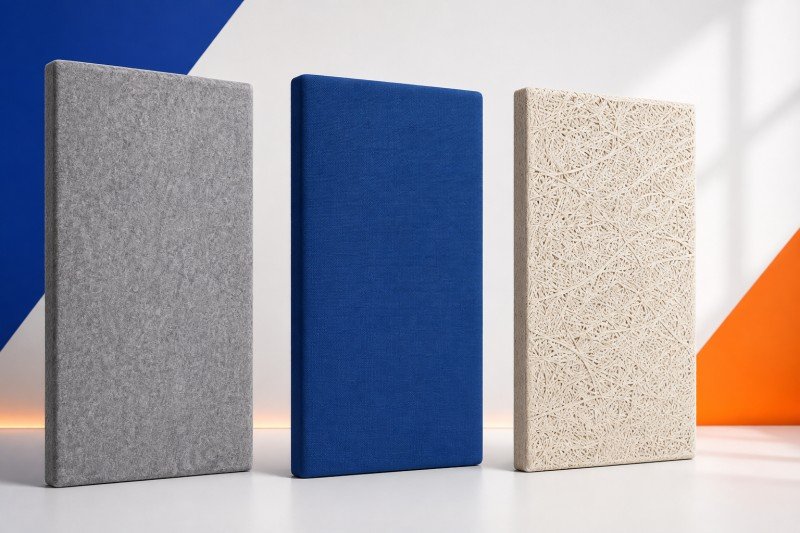
Quick Answer: When comparing PET Felt vs Fabric-Wrapped vs Wood Wool Acoustic Panels, each option offers unique advantages for different environments. PET felt panels are an excellent all-purpose choice for modern offices and contemporary interiors because they are lightweight, eco-friendly, and available in a wide range of colours. Fabric-wrapped panels provide superior acoustic performance, making them ideal for recording studios, conference rooms, and other spaces where sound clarity is essential. Wood wool acoustic panels are best suited for auditoriums, hotels, educational institutions, and premium commercial spaces that require durability, natural aesthetics, and reliable sound absorption. The best option depends on your required NRC rating, budget, application, and overall interior design goals.
Key Takeaways:
- PET felt, fabric-wrapped, and wood wool panels each target different acoustic needs and interior aesthetics – none is universally “the best”
- Fabric-wrapped panels offer the highest NRC ratings (up to 0.95), making them the top choice for studios and critical listening environments
- PET felt panels are made from recycled polyester, making them the most sustainable option and ideal for LEED/GRIHA-certified projects
- Wood wool panels combine mid-to-high frequency absorption with structural hardness – perfect for high-traffic commercial and institutional spaces
- For most Indian offices, co-working spaces, and corporate environments, PET felt delivers the best balance of performance, aesthetics, and cost
If you’ve spent any time researching acoustic treatment, you already know the frustration. You search for acoustic panels, and within minutes you’re staring at product pages with NRC ratings, GSM weights, core materials, and finish options – without a single clear explanation of which material actually suits your project.
Here’s what most acoustic guides won’t tell you: the panel material matters just as much as the NRC number printed on the datasheet. Two panels with identical NRC ratings can perform completely differently depending on the frequency range of your noise problem, your room’s construction, your climate zone, and how the panels are installed.
At PackSound, we’ve designed and installed acoustic solutions across 150+ projects in India – from corporate offices in Gurugram to recording studios in Bengaluru to auditoriums in Hyderabad. What we’ve learned is that choosing the wrong material isn’t just a visual mistake. It’s a performance mistake that no amount of coverage can fix.
This guide cuts through the noise. By the end, you’ll know exactly which panel type suits your space, your budget, and your acoustic goals.
What Makes These Three Panel Types Different?
Before comparing them head-to-head, it’s worth understanding why these three materials behave differently. It comes down to how each material interacts with sound waves at different frequencies.
Sound absorption works by converting sound energy into a tiny amount of heat through friction inside the panel’s porous structure. The denser, thicker, and more fibrous the material, the more friction – and the more absorption, particularly at lower frequencies.
PET Felt Panels
PET felt (Polyethylene Terephthalate felt) is made from compressed, needle-punched polyester fibres – often manufactured from recycled plastic bottles. The resulting material is semi-rigid, lightweight, and available in a wide spectrum of colours and shapes.
What makes PET felt acoustically interesting is its fine fibre structure. Sound waves entering the panel encounter millions of tiny air pockets, where mid and high-frequency energy is dissipated as heat. Typical NRC values for PET felt range from 0.75 to 0.90 depending on thickness – with 9mm panels performing well in the speech frequency range (500Hz–4000Hz), which is exactly the range that matters most in offices, meeting rooms, and co-working spaces.
The big practical advantage in Indian contexts: PET felt is moisture-resistant. In cities like Mumbai, Chennai, and Kolkata where humidity is a persistent concern, fabric-wrapped panels can absorb moisture over time, leading to sagging cores and reduced acoustic performance. PET felt handles humidity without losing structural integrity.
Fabric-Wrapped Acoustic Panels
Fabric-wrapped panels consist of an absorptive core – usually high-density fibreglass, rockwool, or polyester wadding – wrapped in a stretched acoustic fabric. The fabric is acoustically transparent, meaning sound passes through it freely to interact with the absorptive core behind.
This construction is what allows fabric-wrapped panels to achieve the highest NRC ratings available in architectural acoustics – up to 0.95 on a scale of 0 to 1. The combination of a dense, thick core and an open-weave fabric creates the conditions for exceptional broadband absorption, capturing everything from mid-frequency speech reflections to some lower-frequency room resonances (depending on mounting depth and core density).
Fabric-wrapped panels are the first choice for professional studios, broadcast environments, and high-stakes boardrooms where every decibel of reverberation matters. The trade-off is that the fabric surface can collect dust in high-traffic spaces and isn’t the easiest to clean.
Wood Wool Acoustic Panels
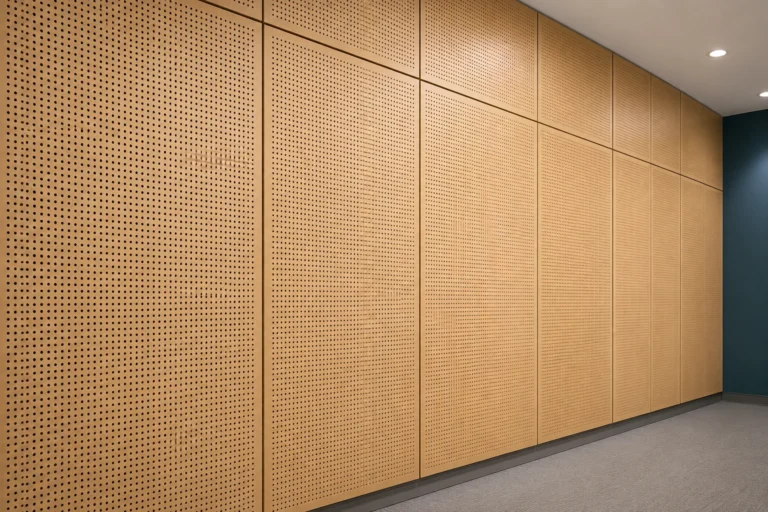
Wood wool panels – also known as wood fibre panels or mineral-bonded wood wool – are manufactured by binding shredded wood fibres with a cementitious or magnesite binder. The result is a rigid, textured panel with an open, rough surface that scatters and absorbs sound simultaneously.
Unlike PET felt and fabric-wrapped panels, wood wool provides a degree of sound diffusion alongside absorption. This makes it particularly valuable in large spaces where you want to reduce echoes without making the room feel acoustically dead. Auditoriums, school gymnasiums, airport lounges, and hotel lobbies benefit from this combined scatter-and-absorb effect.
Wood wool panels are also the most physically robust of the three. They can be painted, plastered over, or left in their natural finish. They withstand impacts, moisture, and decades of use better than any soft panel. If you’re specifying acoustics for a primary school corridor or a sports hall – where panels will take a beating – wood wool is typically the only sensible choice.
Head-to-Head Comparison: PET Felt vs Fabric-Wrapped vs Wood Wool Acoustic Panels
Let’s get specific. Here’s how the three panel types stack up across the dimensions that actually matter for a project specification:
| Specification | PET Felt | Fabric-Wrapped | Wood Wool |
|---|---|---|---|
| Typical NRC Range | 0.75 – 0.90 | 0.80 – 0.95 | 0.55 – 0.80 |
| Best Frequency Range | Mid & High (500Hz+) | Full Spectrum | Mid & High (250Hz+) |
| Moisture Resistance | Excellent | Moderate | Good |
| Impact Resistance | Moderate | Low | Excellent |
| Design Flexibility | Very High (30+ colours, CNC shapes) | High (20+ fabrics) | Moderate (Paints, veneers) |
| Fire Rating | B-s1 to B-s2 | B-s1 to B-s2 | B-s1 (Most grades) |
| Typical Price Range (India) | ₹800 – ₹1,800/sq ft | ₹1,200 – ₹2,500/sq ft | ₹1,500 – ₹3,000/sq ft |
| Sustainability | High (Recycled content) | Moderate | Moderate–High (FSC certified options) |
| Best For | Offices, Co-working, Creative Studios, Residential | Recording Studios, Boardrooms, Conference Rooms | Auditoriums, Schools, Hotels, Industrial Spaces |
| Cleaning & Maintenance | Easy (Wipe clean) | Moderate (Fabric care) | Easy (Painted surfaces wipe clean) |
📐 Want help calculating how many panels your space needs? Book a free acoustic consultation with PackSound – our team will assess your room dimensions, reverberation targets, and recommend the right panel type and coverage percentage.
Acoustic Performance Deep Dive: What the NRC Number Doesn’t Tell You
NRC (Noise Reduction Coefficient) is the most cited number in acoustic panel specifications – and also the most misunderstood. An NRC of 0.85 means the panel absorbs 85% of incident sound energy averaged across four test frequencies (250Hz, 500Hz, 1000Hz, and 2000Hz). But that average can hide a lot.
A fabric-wrapped panel with an NRC of 0.90 might absorb 0.95 at 1000Hz but only 0.65 at 250Hz. A wood wool panel with an NRC of 0.70 might have excellent absorption at 500Hz but fall off sharply below 250Hz. The shape of the absorption curve matters enormously – and most product datasheets don’t make this easy to read at a glance.
Where Each Panel Type Excels Acoustically
PET felt is a genuine mid and high-frequency specialist. In the 500Hz–4000Hz range – the band that covers most conversational speech, keyboard sounds, and the “harshness” of open-plan offices – PET felt panels perform exceptionally well relative to their cost. For most office environments in India, this is the frequency range causing the most occupant discomfort. Installing 25–35% wall coverage with PET felt panels will transform most open offices from chaotic to calm.
Fabric-wrapped panels with high-density rockwool or fibreglass cores start absorbing meaningfully from around 200Hz and maintain strong performance through the full speech range. This makes them the choice for environments where low-to-mid frequency control is critical – home theatre rooms, professional podcasting setups, or boardrooms with HVAC rumble issues. The PackSound Auraluxe™ Silenza Acoustic Panels represent this category at the premium end, delivering superior broadband performance with a refined aesthetic.
Wood wool panels shine in the 250Hz–2000Hz range but don’t extend absorption as low as thick fabric-wrapped panels can. What they add that the other two don’t is diffusion – the scattering of sound waves in multiple directions rather than pure absorption. In a large hall, this diffusion effect prevents the acoustic “flatness” that can result from over-absorbing with soft panels. Think of it this way: absorption removes energy from a room, diffusion redistributes it. Auditoriums need both.
Choosing by Space Type: A Practical Guide for Indian Projects
Theory is useful. But what most people actually need is a clear answer for their specific space. Here’s how to match panel type to project type in Indian contexts.
Corporate Offices and Open-Plan Workspaces
Open offices are acoustically brutal. Concrete floors, glass partitions, low ceilings, and 40+ people on calls simultaneously create a reverberant environment that tanks productivity. Research from the Acoustical Society of America consistently shows that speech privacy and noise distraction are the top two complaints in open-plan offices globally.
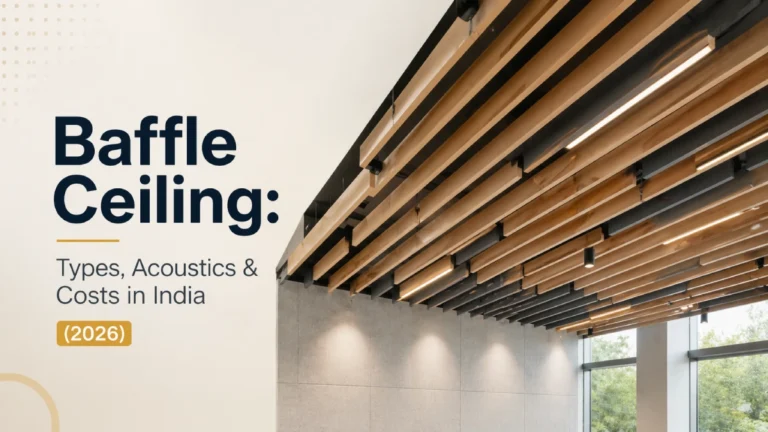
Recommendation: PET felt panels, supplemented with acoustic baffles for ceiling coverage. Target 25–35% surface coverage on walls, with additional ceiling treatment above the noisiest zones. PET felt’s design flexibility is a major asset here – colourful, CNC-cut shapes can complement a brand’s interior design rather than fighting it.
For spaces where privacy is the primary concern – executive meeting rooms, HR interview rooms, or call-centre pods – consider upgrading to ThinkPod™ acoustic office pods that provide both absorption and isolation in a fully contained unit.
Recording Studios and Podcast Rooms
In a recording or broadcast environment, acoustic treatment isn’t about comfort – it’s about precision. A room with too much reflection colours the sound; a room that’s over-deadened sounds flat and lifeless. The goal is controlled reverberation time (RT60) appropriate for the source material.
Recommendation: Fabric-wrapped panels as the primary wall treatment, combined with dedicated bass traps in room corners. Fabric-wrapped panels with high-density fibreglass cores deliver the NRC performance and absorption bandwidth that professional recording requires. For vocal booths and isolation applications, the AcoFascia™ Acoustic Divider Partition can create isolated zones within a larger studio footprint.
We’ve seen Indian home studio owners make a common mistake: buying foam panels for a room with concrete walls, low ceilings, and strong bass resonance. Foam doesn’t absorb below 400Hz. The result is a room that sounds dull in the mid-range but boomy and uncontrolled at the bottom – worse than the untreated room in some cases.
If you’re designing a studio setup, read our detailed guide on the best acoustic panels for recording studios in India.
Auditoriums, Schools, and Institutional Spaces
These spaces share three characteristics: large volumes, high foot traffic, and long service life requirements. A panel that looks great at installation but degrades after three years of students leaning against it isn’t fit for purpose.
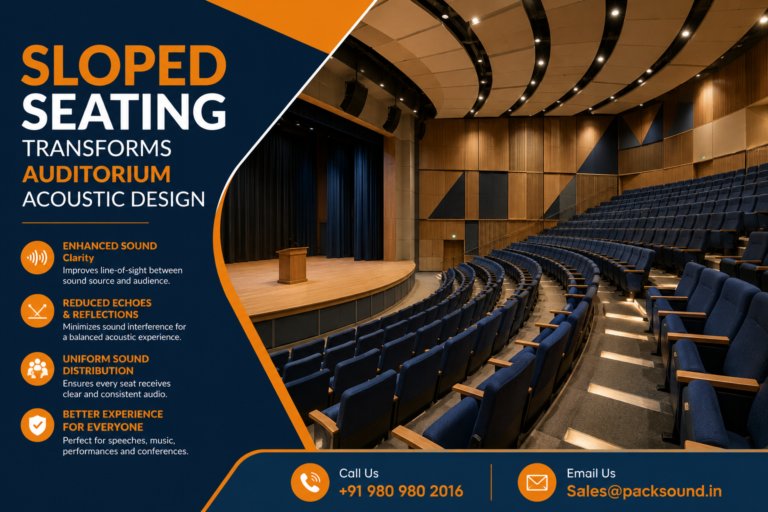
Recommendation: Wood wool panels on rear and side walls, with fabric-wrapped panels or acoustic ceiling clouds providing overhead coverage. The combination of diffusion (wood wool) and absorption (ceiling treatment) creates the acoustic balance that speech intelligibility in large halls requires. Wood wool’s durability means it survives the abuse that institutional spaces inevitably dish out.
For auditoriums with high aesthetic standards – theatre performance venues, conference centres, premium academic institutions – the Auraluxe™ 3D Ultra Luxury Acoustic Ceiling Clouds can provide both the acoustic ceiling performance and the visual impact that these spaces demand.
Hotels, Restaurants, and Hospitality Spaces
Hospitality acoustics is a balance most spaces get wrong. A completely quiet restaurant feels clinical. A restaurant with no acoustic treatment becomes an echo chamber where you can’t hear your dining companion across a table for two. The goal is controlled liveliness – energy without chaos.
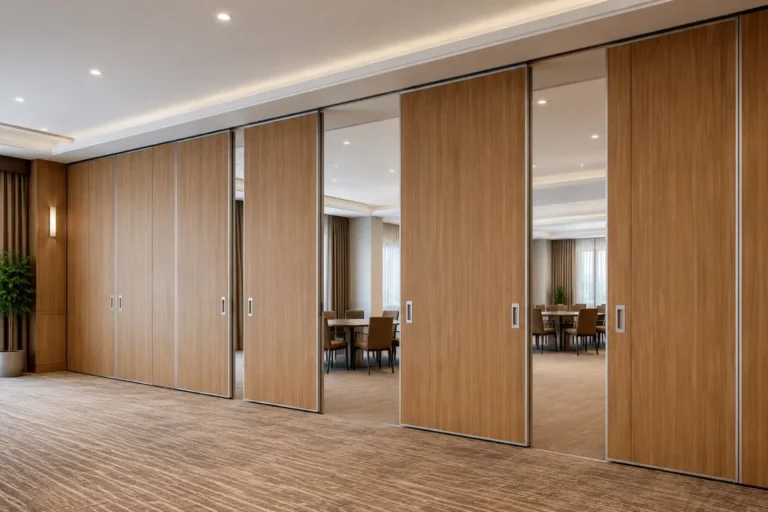
Recommendation: Wood wool panels or fabric-wrapped panels with custom finishes. In hospitality environments, the panel needs to work as hard aesthetically as it does acoustically. Wood wool panels with painted or wood-veneer finishes meet hotel brand standards. For ceiling treatment in banquet halls or event venues that need to divide spaces, the Acoustic Sliding Folding Partitions from PackSound offer flexible room division with built-in acoustic performance.
Residential: Home Theatres, Prayer Rooms, and Noisy Apartments
Residential acoustic treatment is the fastest-growing segment in India, driven by urban density, WFH culture, and the explosion of home theatre installations. The challenge is that homeowners often want panels that look like design features, not industrial sound treatment.
Recommendation: PET felt for modern, design-forward interiors; wood wool for warm, natural aesthetics. Both materials are available in finishes that integrate naturally with premium residential interiors. The Auraluxe™ Printed Wall Panels take this further – allowing custom photographic or artistic prints on acoustically functional surfaces, so the treatment becomes the interior feature.
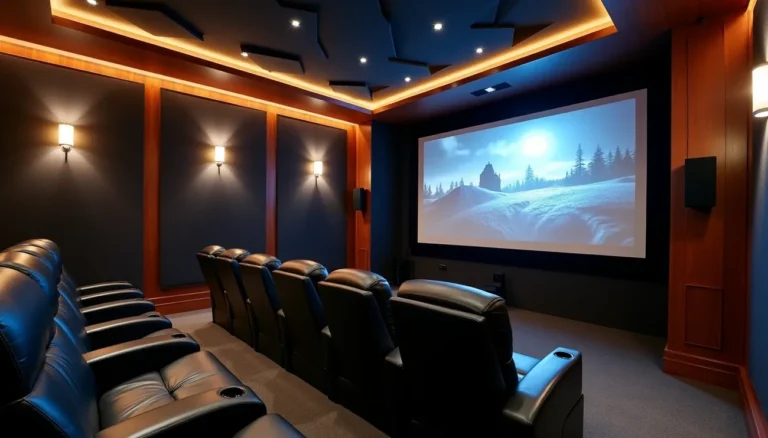
For home theatre rooms where bass performance matters, fabric-wrapped panels with heavy cores should anchor the treatment, supplemented by bass traps in corners.
Indian Climate Considerations: What Works in Mumbai vs Delhi vs Bengaluru
This is a section you won’t find in most acoustic panel guides – and it’s genuinely important for long-term performance.
India spans a massive range of climatic zones, and panel material choice should account for local conditions.
High-humidity coastal cities (Mumbai, Chennai, Kochi, Kolkata): Fabric-wrapped panels with fibreglass cores can absorb ambient moisture over time, leading to sagging and subtle changes in acoustic performance. If you’re specifying fabric-wrapped panels in these cities, ensure adequate HVAC coverage in the treated space. PET felt is a safer call here – it’s inherently moisture-resistant and won’t degrade in high-humidity conditions.
Hot, dry northern cities (Delhi NCR, Jaipur, Lucknow): All three panel types perform well here, but wood wool in exterior-adjacent walls should have adequate backing to prevent dust penetration through the panel texture in environments with high PM2.5 levels.
Temperate cities (Bengaluru, Pune, Hyderabad): India’s most forgiving acoustic climate. All panel types are appropriate, and specifiers have full freedom to choose based on aesthetics and budget without climate compromise.
PackSound’s panels are manufactured in Greater Noida and engineered specifically for Indian climatic diversity – from the coastal humidity of the south to the extremes of northern summers. This is one reason why global brands like Armstrong don’t always deliver consistent long-term performance in Indian conditions: their products are often specified for North American or European climates, not calibrated for ours.
Common Mistakes When Choosing Acoustic Panel Materials
Specifying acoustic panels sounds straightforward until you’ve seen the results of a poorly considered project. Here are the mistakes we see most often – and how to avoid them.
Choosing material based on price alone. PET felt is typically cheaper than fabric-wrapped panels. But if your space has a low-frequency echo problem (common in rooms with long parallel concrete walls), PET felt alone won’t solve it. You’d be buying the cheaper panel twice – once before you discover it doesn’t work, and once again when you add the fabric-wrapped bass absorbers your room actually needed. Match material to acoustic problem first.
Ignoring mounting depth. Every panel type performs better with an air gap behind it. A 50mm fabric-wrapped panel mounted with a 50mm air gap will outperform a 100mm panel flush-mounted to the wall. Fabric-wrapped panels show the biggest performance gains from air gaps at low frequencies. PET felt shows modest gains. Wood wool is less sensitive to air gap depth.
Over-treating the room. More panels don’t always equal better acoustics. A heavily over-treated room (NRC-average above 0.50) can feel uncomfortably dead – particularly for human speech, where some natural reverberation makes conversation feel warm and intelligible. Target RT60 (reverberation time) appropriate to your space use, not the maximum coverage your budget allows.
Buying based on product photos rather than test data. Ask your supplier for third-party lab-tested NRC data, fire rating certificates, and absorption coefficient curves by frequency. PackSound provides all of this with every product specification – because performance claims without data aren’t claims worth making. View our full product range with specifications.
A Quick How-To: Selecting the Right Panel in 4 Steps
If you’re in specification mode, here’s the decision framework we use internally at PackSound for every project brief.
Step 1: Define Your Acoustic Problem
Are you trying to reduce echo and reverberation (absorption problem)? Control noise transmission between spaces (isolation problem)? Or both? Acoustic panels handle absorption and diffusion – not isolation. If your primary problem is sound bleeding from one room to another, you need partitions, not just panels.
Step 2: Identify Your Critical Frequency Range
Speech clarity problems? Focus on 500Hz–2000Hz → PET felt or fabric-wrapped. Bass boom in a home theatre? Focus on 100Hz–250Hz → high-density fabric-wrapped with corner bass traps. General echo in a large hall? Broadband coverage → wood wool plus ceiling treatment.
Step 3: Set Your Coverage Target
For most commercial spaces, 20–30% wall coverage provides a meaningful acoustic improvement without over-treating the room. Spaces with highly reflective surfaces (all-glass offices, polished concrete floors) may need 35–45% coverage. An acoustic consultation from PackSound will calculate this precisely using your room dimensions and RT60 targets.
Step 4: Match Material to Your Durability and Aesthetic Requirements
- Design-driven, moisture-resistant, colourful: PET felt
- Maximum acoustic performance, studio-grade: Fabric-wrapped
- High-traffic, durable, large spaces: Wood wool
- Premium luxury aesthetic with performance: Auraluxe™ series
Frequently Asked Questions
Which acoustic panel has the highest NRC rating?
Fabric-wrapped panels with high-density fibreglass or rockwool cores typically achieve the highest NRC values – up to 0.95 in tested configurations with a proper air gap. PET felt panels generally range between 0.75 and 0.90, while wood wool panels typically fall between 0.55 and 0.80. That said, NRC alone doesn’t determine suitability – the shape of the absorption curve across frequencies matters just as much. Always request frequency-by-frequency absorption data alongside the NRC composite figure.
Are PET felt panels good for Indian offices?
Yes – PET felt is arguably the best material for most Indian corporate office applications. It handles humidity well, which matters in coastal cities. It’s available in design-friendly colours that interior designers can work with. It absorbs the mid and high frequencies that create the harshness of open-plan office noise. And it’s available at price points that make comprehensive coverage achievable for mid-size projects. The PackSound product range includes several PET felt options engineered for Indian office environments.
Can wood wool panels be used in outdoor or semi-outdoor spaces?
Wood wool panels with magnesite binders have reasonable moisture resistance and can be used in covered outdoor or semi-outdoor environments such as covered parking areas, verandas, or under-awning commercial spaces. However, direct water exposure will degrade performance over time. For genuinely outdoor acoustic applications, specialist noise barriers and enclosures are the correct specification – not architectural interior panels.
How do I clean different types of acoustic panels?
PET felt can be vacuumed or wiped down with a damp cloth for routine maintenance. Fabric-wrapped panels require more care – vacuuming with a soft brush attachment and spot-cleaning with mild upholstery cleaner where needed. Avoid steam cleaning, which can affect the adhesive used to attach fabric. Painted wood wool panels are the easiest to clean – a simple wipe with a damp cloth is sufficient for most surfaces.
What’s the difference between acoustic panels and soundproofing?
This confusion is extremely common. Acoustic panels (including all three types covered in this article) treat sound within a room – they reduce echo, reverberation, and reflected noise. Soundproofing refers to blocking sound from travelling between rooms or in from outside. They’re different engineering problems requiring different solutions. Acoustic partitions and drywall systems address soundproofing; panels address in-room acoustic quality. Many spaces need both.
Is there a sustainable option among these three panel types?
PET felt is the clear leader on sustainability metrics – it’s manufactured from recycled polyester fibres (typically recycled PET bottles), is free from harmful binders, and can itself be recycled at end of life. For LEED, GRIHA, and IGBC-certified projects in India, PET felt panels are the easiest acoustic material to include in sustainability documentation. Wood wool from FSC-certified sources is also a strong sustainable option, and PackSound can provide the environmental product declarations (EPDs) needed for green building certification submissions.
How many acoustic panels does a room actually need?
Coverage requirements depend on room volume, surface materials, and target RT60 (reverberation time). As a rough starting point: for a standard 10m × 8m × 3m office with concrete floor and glass partitions, you’d typically need 20–30% coverage of the total wall area to achieve a comfortable reverberation time for speech. That’s roughly 48–72 square metres of panel. For precise calculations, an acoustic site assessment is more reliable than any rule of thumb – contact PackSound for a free consultation.
Which Acoustic Panel Is Right for You?
You now have the full picture. PET felt, fabric-wrapped, and wood wool panels are not competing products – they’re complementary tools for different acoustic jobs, and many projects benefit from combining more than one.
The fastest way to a wrong specification is choosing based on what looks best in the product catalogue. The right choice starts with understanding your acoustic problem, your space conditions, and your long-term performance expectations.
PackSound has delivered acoustic solutions across 150+ projects in India – offices, studios, auditoriums, hotels, schools, and residential spaces. Every project starts with a free acoustic consultation: we assess your space, your noise challenges, and your aesthetic goals, then recommend the right materials, coverage, and installation approach.
Get a free acoustic consultation and quotation → Contact PackSound
Explore our full range of acoustic panels and soundproofing products – including fabric-wrapped, PET felt, wood wool, and our premium Auraluxe™ luxury acoustic series.
Trusted by architects, designers, and enterprises across India since 2015.