If you have been researching Rockwool acoustic panels soundproofing for your studio, office, or commercial project, you already know the market is flooded with generic advice that copies itself endlessly. This guide is different. It is built from real installation experience, project-level specification decisions, and the kind of nuanced knowledge that only surfaces after you have made a few expensive mistakes on-site.
Whether you are sourcing the best rockwool for acoustic panels for a professional recording studio in Delhi or specifying a commercial boardroom treatment in Bengaluru, this guide covers the full picture: density selection, installation realities, common myths, and the scenarios where standard advice will actively lead you wrong.
What Is Rockwool and Why Does It Dominate Acoustic Panel Cores?
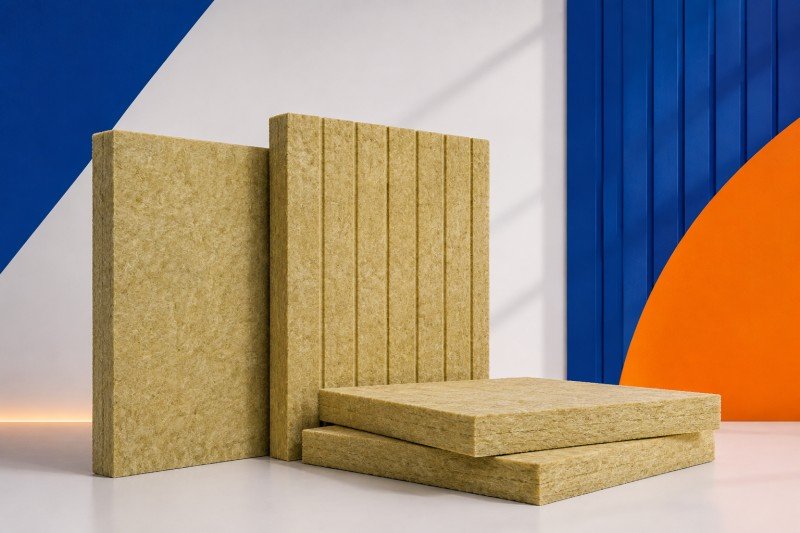
Rockwool, also called mineral wool or stone wool, is manufactured by melting basalt rock and steel slag at temperatures exceeding 1,400 degrees Celsius and spinning the molten material into fine fibers. Those fibers are then compressed into semi-rigid or rigid slabs with varying densities.
The reason soundproofing with rockwool has become the professional standard over acoustic foam is straightforward: rockwool works across a broader frequency range, lasts decades without degrading, resists moisture and mold, and is non-combustible. Acoustic foam, by contrast, yellows and crumbles within three to five years in high-humidity Indian climates and offers almost no low-frequency absorption regardless of thickness.
The open-cell fiber structure of rockwool soundproof sheets dissipates sound energy through friction as sound waves pass through the interstitial air spaces. This mechanism, called viscous flow resistance, is what makes rockwool density for acoustic panels the most important specification decision you will make.
Also Read: Best Soundproof Sheets for Walls, Ceilings, and Doors
Rockwool Density for Acoustic Panels: The Number That Changes Everything
Most articles tell you to “use high-density rockwool.” That is incomplete advice. Density is a variable, not a setting, and the right density depends entirely on your target frequency range and installation depth.
Here is how density actually maps to acoustic function:
| Density (kg/m3) | Acoustic Behavior | Best Application |
| 24 to 40 kg/m3 | Low airflow resistance, excellent low-mid absorption | Thick bass trap builds (100mm+), back-of-panel fill |
| 48 to 60 kg/m3 | Balanced broadband absorption, optimal NRC for standard depths | Recording studio panels, office treatment, auditoriums |
| 80 to 96 kg/m3 | High rigidity, mid-to-high frequency performance | Thin panels (25 to 40mm), OEM acoustic panel cores |
| Above 100 kg/m3 | Mostly structural, acoustic performance drops | Not suitable for absorption panels |
The critical insight that most guides miss: above approximately 96 to 100 kg/m3, airflow resistance becomes so high that the material starts reflecting rather than absorbing sound. Denser is not always better. This is one of the most common over-specification errors made by first-time panel builders.
For 50mm panels in a typical professional studio or commercial environment, 48 to 60 kg/m3 delivers the highest broadband NRC values. If you are building 100mm thick bass traps, dropping to 40 kg/m3 for the inner layer and using 60 kg/m3 for the outer layer improves low-frequency performance noticeably compared to using uniform high density throughout.
Best Rockwool for Acoustic Panels: Grade-by-Grade Breakdown
Rockwool for sound panels is sold under several product grades in the Indian market. Understanding which grade to specify prevents costly substitutions and performance shortfalls.
RWA 45 / RW45 equivalent (45 kg/m3): The most widely available acoustic-grade slab in India. Semi-rigid, easy to cut, suitable for 50mm and 75mm panels. This is the workhorse grade for professional studio treatments and commercial acoustic builds. Widely stocked by acoustic panel manufacturers in India including fabric-wrapped panel suppliers.
60 kg/m3 slab (IS 8183 compliant): Specified for use behind perforated metal, wood wool, and micro-perforated panels where the cavity behind the decorative surface must be filled. This grade is the standard specification for corporate offices, auditoriums, and premium commercial interiors across India.
96 kg/m3 rigid board (Conrock 60 equivalent): Used in OEM acoustic panel manufacturing where the core must be self-supporting within a frame. The rigid structure allows clean fabric wrapping without sagging. This is the grade used in high-quality fabric-wrapped panels that achieve NRC values between 0.85 and 1.0, suitable for boardrooms, broadcast studios, and high-specification commercial fit-outs.
Thermal-grade rockwool (non-acoustic): This is where many buyers go wrong. Thermal insulation rockwool with low density (below 30 kg/m3) is not suitable for acoustic panels. It has insufficient flow resistance to absorb sound effectively at standard panel thicknesses. Always verify the product is specified as acoustic-grade before purchase.
Soundproofing with Rockwool: Absorption vs. Isolation (The Distinction Most People Get Wrong)
This is the most important conceptual distinction in acoustic treatment, and the one most commonly misunderstood by first-time clients and specifiers alike.
Acoustic absorption reduces the reverberation and echo inside a room. Rockwool panels mounted on walls and ceilings absorb reflected sound energy, reducing RT60 (reverberation time) and improving speech clarity and recording quality.
Sound isolation reduces the transmission of sound through walls, floors, and ceilings from one space to another. This requires mass, decoupling, and air gaps, not absorption panels alone.
Rockwool placed inside a stud wall cavity does contribute to isolation by damping cavity resonance. But rockwool panels mounted on the surface of an existing wall will not meaningfully reduce how much sound travels to an adjacent space. If the goal is to prevent sound from leaving or entering a studio or commercial facility, structural isolation is required: double-leaf walls, resilient channel mounting, and mass-loaded vinyl, in addition to treatment panels.
The practical implication: many studios and offices invest in surface-mounted rockwool panels expecting to solve a sound transmission problem, then feel disappointed when sound still bleeds between spaces. The panels are performing correctly (improving the acoustic environment inside the room) but they were never going to resolve a structural isolation deficiency.
Myth vs. Reality: What the Internet Gets Wrong About Rockwool Acoustic Panels Soundproofing
| Myth | Reality |
|---|---|
| More panels means better sound. | Over-treatment kills natural reverb. Most studios target RT60 of 0.2 to 0.4 seconds, not zero. Strategic placement beats blanket coverage. |
| Thicker panels always absorb more bass. | An air gap matters more than thickness. A 50mm panel with 100mm air gap outperforms a 100mm panel mounted flush. |
| Any rockwool works the same. | Thermal-grade (25 kg/m3) and acoustic-grade (48 to 60 kg/m3) are not interchangeable. NRC shortfall can reach 0.35 points. |
| Acoustic foam is cheaper and performs equally. | Foam degrades in 3 to 5 years in Indian humidity and absorbs almost nothing below 500 Hz. Rockwool lasts 15 to 20 years. |
| Fire-rated panels are only for institutions. | Any commercial or rented space requires fire compliance. Rockwool is Euroclass A1 non-combustible by default. |
The “It Depends” Situations: When Standard Rockwool Advice Backfires
Situation 1: High-Humidity Coastal Environments
Standard rockwool is marketed as moisture resistant, and in most conditions it is. However, in coastal locations with sustained humidity above 85 percent (Mumbai, Chennai, Visakhapatnam, Kochi), the binder holding the fibers together can weaken over time if panels are not properly faced or sealed. In these environments, specify panels with factory-applied acoustic tissue facing on all exposed sides, or ensure fabric-wrapped panels use breathable acoustic fabric rather than PVC-backed material that traps moisture against the core.
Situation 2: Rooms with Dominant Low-Frequency Problems
If the primary problem is bass buildup at room modes (the frequencies at which a room resonates, typically below 300 Hz), standard 50mm panels mounted flat on walls will have negligible impact. Bass traps require either very thick material (minimum 100mm, preferably 200mm) placed in corners where modes are strongest, or purpose-designed resonant absorbers. Installing standard panels across all walls in a bass-heavy room can actually make the acoustic problem feel worse by eliminating high-frequency reverb while leaving low-frequency modes untouched, resulting in a “boomy but dead” character that is difficult to record or mix in.
Situation 3: Panels in Air-Conditioned Spaces with High Air Velocity
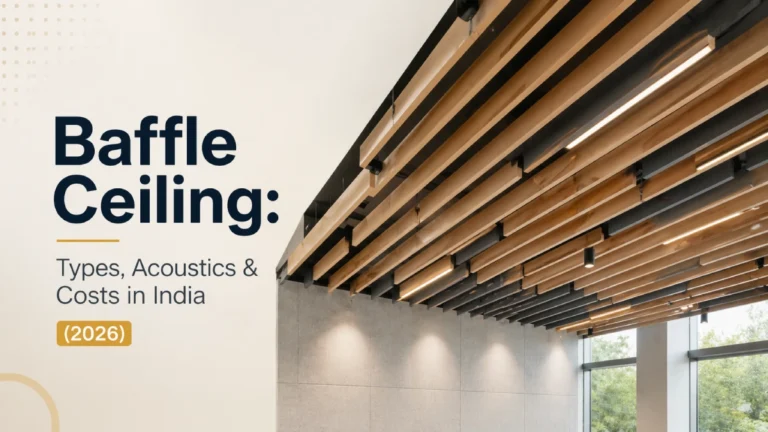
HVAC systems in commercial spaces can create surface air velocity across acoustic panels. At velocities above roughly 1.5 m/s, uncovered rockwool panels will shed fibers over time. In any space with significant air conditioning airflow directed at panel surfaces, fabric-wrapped panels or panels with tissue facing must be specified. This is especially relevant for ceiling-mounted baffles and acoustic clouds positioned near air diffusers in open-plan offices and auditoriums.
Situation 4: Thin Partition Walls in Indian Commercial Construction
The concrete and brick partition walls common in Indian commercial construction have high surface mass, which is acoustically beneficial. However, direct-mounting heavy fabric-wrapped panels to these walls with adhesive alone is a liability risk. Panels must be mechanically fixed using GI framing or Z-clip systems. Adhesive-only installations on plaster-finished walls have failed during fit-out in Indian conditions, particularly in locations where wall surface temperatures fluctuate significantly between seasons.
Industry Insider Knowledge: What Experienced Specifiers Know
NRC ratings are tested in lab conditions, not in your actual space. Published NRC values assume panels are mounted in a specific way (typically ASTM E795 method A or B) in a reverberation room. In a real space, edge diffraction effects, air gaps behind panels, and room geometry all alter performance. Treat NRC ratings as comparative guides, not absolute predictions. A 0.90 NRC panel installed incorrectly will underperform a 0.75 NRC panel installed with proper air cavity and coverage.
Coverage area matters more than individual panel NRC above a threshold. Increasing from 15 percent wall coverage to 30 percent coverage has a larger impact on RT60 than upgrading from 0.80 NRC panels to 0.95 NRC panels at the same coverage. Projects that chase the highest NRC value while keeping coverage low consistently underperform relative to their budget.
Corner placement delivers disproportionate results. Acoustic energy is most concentrated at room boundaries, particularly at tri-corners where three surfaces meet. Placing one floor-to-ceiling bass trap in a corner is acoustically more effective than placing three standard panels on a flat wall. This is well-established acoustic science but is consistently underweighted in generic guides that recommend uniform wall distribution.
Panel thickness selection is more sensitive at low frequencies. At frequencies above 1,000 Hz, the difference between a 50mm and 75mm panel is modest. Below 500 Hz, each additional 25mm of thickness (or equivalent air gap) meaningfully shifts the absorption curve downward in frequency. For spaces where vocal clarity and instrument separation at 200 to 500 Hz matters (recording studios, broadcast booths, voice-over rooms), specifying 75mm over 50mm is worth the cost differential.
Fabric selection directly affects acoustic performance. The fabric used to wrap panels must be acoustically transparent, meaning it must allow sound waves to pass through without significant reflection. Specify fabrics with airflow resistance below 200 Rayls. PVC-coated, blackout, or dense woven fabrics commonly sourced as a cheaper alternative can reduce effective NRC by 0.10 to 0.20 points, undermining the specification of a correctly graded rockwool core.
Rockwool Acoustic Panels for Different Spaces: Application Guide
Professional Recording Studio: Use 48 to 60 kg/m3 at 50mm for broadband wall panels. Use 40 to 48 kg/m3 at 100 to 150mm for corner bass traps. Install with air gap wherever possible. Target 25 to 35 percent of total wall and ceiling surface area. Fire-rated panels required for commercial studio builds.
Broadcast and Podcast Studio: Focus on early reflections at first reflection points on side walls and ceiling. 50mm panels at 60 kg/m3 at these points, with a slightly live rear wall to prevent the “in a box” sensation. Ceiling clouds above the presenter position are particularly effective.
Corporate Office and Conference Room: Ceiling clouds and wall panels targeting RT60 reduction from typical 0.8 to 1.2 seconds down to 0.4 to 0.6 seconds. Fabric-wrapped panels at 48 to 60 kg/m3 core at 50mm. Fire rating mandatory. Fabric selection should align with interior specification and brand standards.
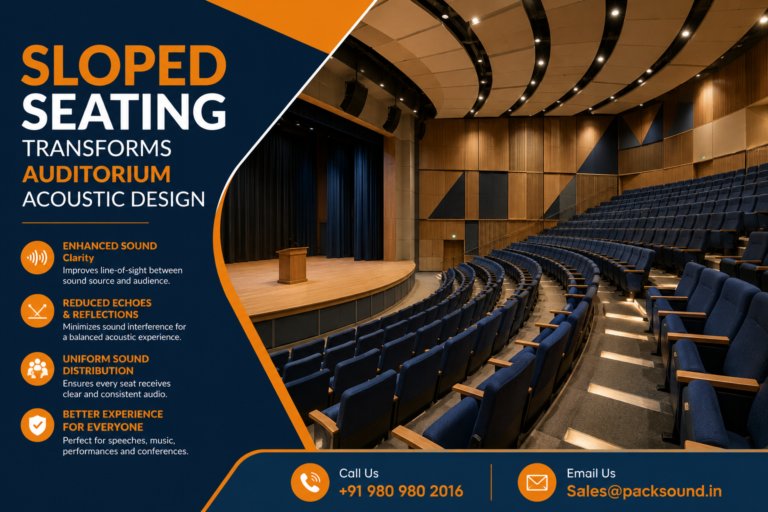
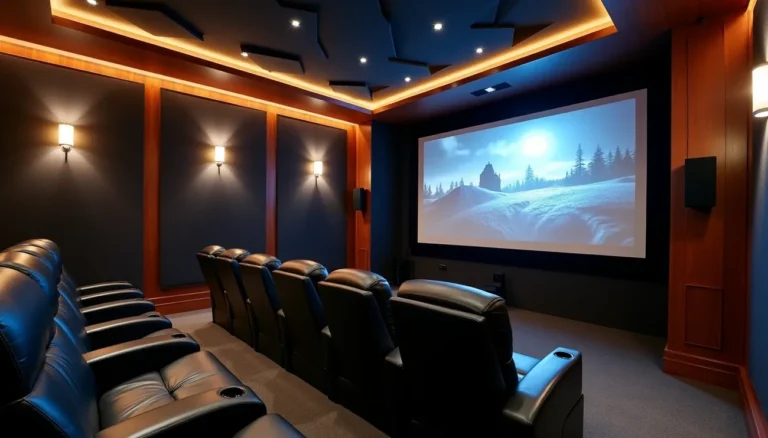
Auditorium and Multiplex Cinema: Combination of absorption and diffusion panels. Treatment density and placement governed by RT60 target for the specific use case (speech versus music). Fabric-wrapped rockwool panels at 60 kg/m3 at 75mm are the standard specification for auditorium side walls in India.
Industrial Noise Control: Higher density material (80 to 96 kg/m3) at greater thickness, typically behind perforated metal facings. Priority is reducing reverberation time in high-noise production environments. IS 8183 compliance should be verified for all industrial applications.
How to Evaluate Whether Your Rockwool Panels Are Working
One of the most practical on-site tests requires no equipment: the clap test. Stand in the center of the treated space and clap sharply once. Listen for flutter echo (a rapid fluttering decay between parallel surfaces) and for the length of the reverb tail. After treatment, a well-specified installation will show noticeably reduced flutter and a shorter, cleaner decay.
For precise measurement, room acoustic software such as REW (Room EQ Wizard) used with a calibrated measurement microphone produces RT60 measurements across the frequency spectrum. This reveals which frequency bands remain undertreated and allows targeted remediation rather than additional blanket coverage. On commercial projects, a post-installation acoustic measurement report is increasingly specified as part of the project handover documentation.
Frequently Asked Questions
Q1: What is the correct rockwool density for acoustic panels used in a professional recording studio?
For broadband wall panels at 50mm thickness, 48 to 60 kg/m3 is the correct specification range and delivers the highest NRC across the frequency spectrum. For corner bass traps at 100mm or greater thickness, 40 to 48 kg/m3 performs better at low frequencies due to lower airflow resistance at depth. Avoid specifying above 96 kg/m3 for absorption panels; at that density, the material begins to reflect rather than absorb. The IS 8183 standard governs mineral wool specification in India and should be referenced in any commercial acoustic panel procurement.
Q2: Does rockwool in acoustic panels need to be covered, or can it be left exposed?
Bare rockwool is not suitable for occupied spaces. The fibers are a mechanical irritant and will shed into the air when disturbed by airflow or contact. All rockwool used in acoustic panels must be covered with an acoustically transparent fabric or factory-applied tissue facing. The fabric must allow sound to pass through freely; dense or PVC-coated fabrics degrade panel performance. On commercial projects, fabric selection should also consider fire rating, durability, and maintenance requirements.
Q3: Can rockwool acoustic panels fully soundproof a recording studio or office space?
No, and this is a critical distinction. Surface-mounted rockwool panels absorb sound energy inside the room, improving acoustic quality and reducing reverberation. They do not provide significant structural sound isolation. Preventing sound from transmitting through walls to adjacent spaces requires structural isolation measures: double-leaf wall construction, resilient channel or floating floor systems, and acoustic sealing of all penetrations. Rockwool panels are one component of a complete studio build, not a standalone soundproofing solution.
Q4: What fire rating do rockwool acoustic panels need to meet for commercial projects in India?
Rockwool (stone wool/mineral wool) is inherently non-combustible and carries a Euroclass A1 fire rating under EN 13501-1, which is the highest possible classification. It can withstand temperatures above 1,000 degrees Celsius without igniting. For commercial projects in India, panels should comply with IS 1641 or equivalent CPWD/NBC norms as applicable to the project type. Always request fire certification documentation from the panel manufacturer before specifying for any commercial, institutional, or rented space.
Q5: Why does a fully treated room with rockwool panels still sound bad at low frequencies?
This is one of the most common issues in professional studio builds and commercial acoustic fit-outs. Standard 50mm panels mounted flat to walls have very limited absorption below approximately 250 to 300 Hz. If the room has dominant bass modes (standing waves at specific low frequencies determined by room dimensions), the panels are simply not thick enough or correctly positioned to address them. The solution is floor-to-ceiling corner treatment with 100 to 200mm of lower-density rockwool (40 kg/m3) placed at all four vertical corners, combined if necessary with purpose-designed resonant bass trap panels. A frequency-specific RT60 measurement will confirm whether this is the source of the problem before additional investment is made.
PackSound supplies fabric-wrapped acoustic panels with IS 8183 compliant rockwool cores, available in 48 kg/m3 and 60 kg/m3 densities, across 50mm, 75mm, and 100mm thicknesses. Acoustic consultation available for recording studios, broadcast facilities, corporate offices, auditoriums, and commercial spaces across India. Contact: packsound.in