
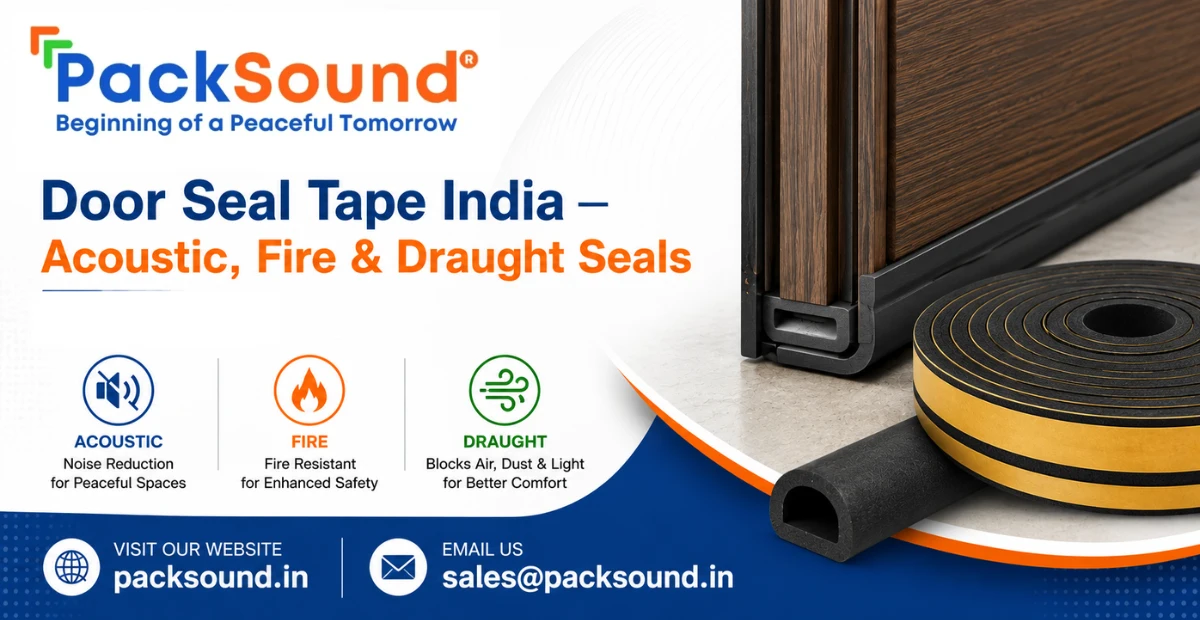
EPDM Perimeter Seals | Drop-Down Bottom Seals | Intumescent Fire Seals | Professional Acoustic Door Systems | PAN India
Here is a fact that surprises most people who have invested money in soundproofing: a 1% gap in a sealed surface — a crack under a door, a gap around a door frame — can reduce the sound isolation performance of an entire wall system by 10 STC points or more.
Put differently: you can build an STC 55 wall, install a certified acoustic door, spend lakhs on the right construction — and if there is an unsealed gap under or around that door equivalent to less than a square centimetre, you will achieve STC 35. The weakest point in any soundproofing system is always the gap. And the gap is always at the door.
Door seal tape — and the broader category of acoustic door seals including perimeter gaskets, bottom drop seals, and intumescent fire seals — is the component that closes that gap. It is also the most underspecified, most incorrectly purchased, and most frequently absent element in Indian soundproofing and fire safety projects.
This guide covers every type of door seal used in acoustic and fire safety applications in India, explains what each does and where it belongs, and helps architects, contractors, studio builders, hotel procurement teams, and homeowners make the right decision — whether they are upgrading an existing door or specifying a new one.
Packsound, manufactured by Ecotone Acoustic Limited, integrates professional-grade acoustic perimeter seals, drop-down bottom seals, and intumescent fire seals into every SonicGuard™ acoustic and fire rated door — supplied and installed across India.
📞 Talk to an Acoustic Door Specialist: +91 98098 02016 | +91 98913 20678
Why Door Seals Matter More Than Almost Any Other Acoustic Component
Sound, like water, finds every gap. Unlike water — which gravity channels downward — sound pressure radiates in all directions simultaneously, probing every interface for the path of least resistance. The gap under a standard door (typically 10–15 mm in Indian construction), the gap around the door perimeter where the rebate does not fully compress, and the gap at the frame-to-wall junction are collectively responsible for the majority of acoustic failures in otherwise well-designed spaces.
The Physics: Why Gaps Destroy STC Performance
Sound Transmission Loss (STL) follows a logarithmic relationship with mass and frequency. But the effect of gaps is catastrophic and non-logarithmic. Even a tiny gap effectively provides a direct acoustic path that bypasses all the mass, damping, and decoupling of the wall assembly.
A practical example:
- An STC 50 acoustic door assembly with full seals: well sealed, tight rebates, compressed perimeter gasket, drop-down bottom seal engaged
- The same door with a 6 mm gap under the bottom: real-world performance drops to approximately STC 30–33
- The same door with both a bottom gap and uncompressed perimeter gaskets: STC 25–28
This is why door seal tape and professional acoustic seals are not optional accessories. They are the mechanism through which the door’s rated performance is actually achieved.
Is Your Door System Fully Sealed?
A door is only as acoustic as its weakest gap. Packsound’s SonicGuard™ Acoustic Wooden Doors come with factory-fitted multi-layer perimeter seals and automatic drop-down bottom seals — achieving up to STC 55 as a complete tested assembly. No guesswork. No field-applied seal failures.
Types of Door Seal Tape and Acoustic Door Seals
Understanding the distinct types of door seal available — their materials, profiles, applications, and performance — is essential for correct specification. These are not interchangeable products.
1. EPDM Self-Adhesive Perimeter Seal Tape (Foam Gasket)
The most widely available and widely purchased “door seal tape” in India. A self-adhesive foam strip — typically made from EPDM (ethylene propylene diene monomer) rubber or polyurethane foam — applied to the door frame rebate or the door leaf edge to create a compression seal when the door is closed.
Available profiles:
- D-shape — most common; semi-circular cross-section compresses against the door face when closed
- P-shape — oval profile; slightly more compression range than D-shape
- E-shape — asymmetric profile; suited to larger and more variable gap sizes (2–8 mm)
Material grades:
| Grade | Material | Lifespan | Price Range | Best For |
|---|---|---|---|---|
| Consumer | PE/PU foam | 6–12 months | ₹50–150/m | Draught, dust, insects |
| Mid-range | EPDM rubber | 3–5 years | ₹150–400/m | Residential acoustic upgrade |
| Professional | High-density EPDM / Silicone | 5–10 years | ₹400–900/m | Hotels, offices, studios, healthcare |
What it does well: Draught exclusion, dust and insect prevention, basic noise reduction at gaps, weather sealing for external doors.
What it does not do: An EPDM foam strip does not provide a rated acoustic performance on its own — it reduces flanking through the gap, not through the door leaf. A foam strip that has permanently compressed (common after 12–18 months in Indian conditions) provides essentially no performance.
Correct application: Door frame rebate (the door stop), applied to the surface the door leaf presses against when closed. Match profile to gap size — D-shape for 2–4 mm gaps, E-shape for 4–8 mm gaps.
Indian market reality: Most products sold on Amazon and Flipkart (₹300–1,200 per roll) are PE foam strips marketed as “soundproof” or “acoustic.” They are draught seals. They are not acoustic seals in any meaningful professional sense. Buyers expecting STC improvement from a foam strip will be disappointed.
Need More Than a Foam Strip?
If you are specifying for an office, hotel, hospital, or studio — consumer foam tape will not meet your acoustic target. Packsound’s acoustic wooden doors use engineered high-density neoprene perimeter seals factory-fitted and tested as part of the STC-rated assembly
2. Drop-Down Automatic Bottom Door Seal
The automatic drop-down bottom seal is the most acoustically critical single component on any door — because the bottom gap is typically the largest and least addressed gap on an Indian door installation.
How it works: A spring-loaded or cam-activated mechanism is housed in a rebate or surface-mounted channel at the base of the door leaf. When the door opens, the sealing element (neoprene or silicone blade or brush) retracts automatically. When the door closes, a cam or latch mechanism drives the sealing blade down onto the floor surface, creating a full-width compressed seal that eliminates the bottom gap completely.
Why it matters more than perimeter tape: The bottom gap is where the most sound passes. A door with excellent perimeter seals but a 10 mm bottom gap will perform at the level of the gap — STC 28–32 — regardless of the door leaf’s rated performance.
Types:
- Surface-mounted drop seal — fitted to the face of the door leaf; easiest to retrofit; slight visual presence on the door face
- Mortised/rebated drop seal — fitted into a routed rebate in the door bottom; invisible when installed; requires factory preparation of the door leaf
- Threshold-activated — seal deploys by contact with a door threshold or sill; requires a compatible threshold system
Professional standard: In SonicGuard™ acoustic doors from Packsound, mortised drop-down bottom seals are a standard factory-fitted component — aligned to the door threshold and tested as part of the complete door assembly.
Retrofit ROI: A ₹3,000–8,000 drop seal investment retrofitted to an existing solid-core door can improve its practical STC performance by 8–12 points — one of the highest acoustic return-on-investment improvements available on an existing installation.
Retrofit Drop-Down Seal or Full Acoustic Door?
For existing solid-core doors: A surface-mounted automatic drop-down acoustic door seal is your highest-ROI upgrade — 8–12 STC points for ₹3,000–8,000.
For new builds or hollow-core doors: Seal retrofits have a ceiling. The SonicGuard™ Wooden Acoustic Door — with mortised drop-down seal, multi-layer perimeter gaskets, and multi-layer acoustic core — delivers STC 45–55 as a certified, factory-assembled system
3. Compression Perimeter Acoustic Seal (Engineered Gasket)
Distinct from consumer EPDM foam tape, engineered acoustic gaskets are precision-manufactured from high-density neoprene, silicone, or cellular rubber — designed to compress uniformly across the full door perimeter to a defined compression depth and pressure. They maintain consistent sealing force across the full service life of the door, unlike foam tapes that compress permanently.
These are the seals used in professional acoustic door assemblies — recording studios, hotels, hospitals, corporate conference rooms, home theatres.
Key specifications:
- Material: Neoprene or silicone (not PE foam)
- Shore hardness: 40–60 Shore A for optimal compression-to-acoustic-performance ratio
- Compression set: Low compression set means the seal recovers its thickness after each door closure — critical for maintaining long-term acoustic performance
- Temperature range: Silicone gaskets (−60°C to +200°C) significantly outperform EPDM foam in the temperature extremes of Indian summer and HVAC-adjacent locations
In SonicGuard™ doors: Multi-layer perimeter seals are factory-fitted around the complete door frame rebate, engineered and tested as part of the full acoustic assembly. The seal specification is integral to the STC rating — not an add-on.
Specifying for a Hotel, Hospital, or Office?
Consumer seals will not maintain performance through thousands of daily door cycles. SonicGuard™ acoustic wooden doors use professional-grade neoprene compression perimeter seals rated for the full service life of the door — factory-fitted, tested, and covered by manufacturer warranty
4. Acoustic Door Threshold Seal
The threshold — the floor-level interface at the door base — must allow the drop-down seal to engage correctly. In professional acoustic door installations, an aluminium or stainless steel threshold strip is installed flush with the finished floor level, providing a consistent flat surface for the bottom seal to compress against.
Without a threshold, a drop-down seal pressing onto carpet, uneven stone, or a floor-level transition achieves inconsistent engagement and degraded acoustic performance — the seal may work perfectly in testing and fail along half its width in normal use.
Threshold specification points:
- Flush with finished floor — no trip hazard
- Full-width contact with drop-down seal blade
- Compatible with the specific drop-down seal model
- Material: Anodised aluminium standard; stainless steel for healthcare and high-traffic
Complete Door Assembly — Not Just the Leaf
The SonicGuard™ system includes the threshold as a standard component. Every element — frame, leaf, perimeter seal, drop-down seal, threshold strip, and closer — is specified and supplied as a tested unit. No field sourcing. No compatibility guesswork.
See the complete SonicGuard™ system → | Get a project quote →
5. Intumescent Fire Seal (For Fire Rated Doors)
An intumescent seal is a passive fire protection component installed on or in fire rated door assemblies — typically within the door frame rebate or let into the door leaf edge. It is the seal that keeps fire rated doors compliant with IS 3614 and BS 476 Part 22.
How it works: Intumescent material (typically graphite-based) is stable at ambient temperature. When exposed to fire temperatures — typically above 150–200°C — it expands rapidly by a factor of 5–10 times its original volume, filling the gap between door leaf and frame with a solid, fire-resistant foam that resists the passage of flames, hot gases, and smoke.
Critical distinction:
- Intumescent seals = fire seals — protect against flame and hot gas penetration during a fire event
- Cold smoke seals (brush or fin) = smoke seals — prevent the passage of cool smoke before temperatures are high enough to activate intumescent material
- Both are mandatory on fire rated doors under IS 3614 Part 2
Non-negotiable rule: Replacing the intumescent seal on a fire rated door with any other seal type — or simply removing it — voids the fire certification of the door assembly. Intumescent seals must be replaced with the exact specification called out in the IS 3614 test report for that door.
🔥 IS 3614 Fire Door Compliance — Seals Included
Every Wooden Fire Rated Door from Ecotone / Packsound is supplied with IS 3614 Part 2 and BS 476 Part 22 compliant intumescent and cold smoke seals factory-fitted as part of the certified door assembly. Fire ratings from FD 30 to FD 120 — supply and installation PAN India.
View IS 3614 Certified Fire Doors → | 📞 +91 98098 02016 | +91 98913 20678
Compliance guidance for NBC 2016 fire door requirements also available — book a free consultation.
6. Cold Smoke Seal (Brush Seal or Fin Seal)
Cold smoke seals — a flexible polypropylene fin or nylon bristle brush — are fitted at the door base and perimeter to prevent the passage of cold smoke at ambient temperatures, before intumescent material has activated. Under IS 3614 Part 2, cold smoke seals are tested at 200°C to confirm performance before full fire conditions develop.
Cold smoke seals are mandatory on all fire rated door assemblies. They are also used on acoustic doors in healthcare and hospitality applications to prevent the passage of odours, pollutants, and air pressure differentials through door gaps.
🏥 Fire-Rated AND Acoustic — Both in One Door
Hospitals, hotels, and institutional buildings need doors that pass both fire compliance and acoustic performance tests. SonicGuard® Acoustic Fire Rated Doors deliver STC up to 55 and fire ratings to FD 120 — certified to IS 3614 Part 2 and BS 476 Part 22 — with intumescent seals, cold smoke seals, and acoustic perimeter gaskets all factory-fitted.
Explore SonicGuard® Acoustic Fire Doors → | Download Technical Datasheet →
Door Seal Tape vs. A Complete Acoustic Door: Understanding the Hierarchy
This is the most important practical decision buyers face: when is door seal tape the right solution, and when do you need a complete acoustic door?
| Requirement | Door Seal Tape / Seals | Complete Acoustic Door (SonicGuard™) |
|---|---|---|
| Draught exclusion only | ✅ EPDM perimeter tape sufficient | Not required |
| Basic noise reduction (corridor) | ✅ Perimeter tape + bottom seal retrofit | Optional upgrade |
| Speech privacy (offices, meeting rooms) | ✅ Engineered gaskets + drop-down seal | ✅ Recommended for consistent STC |
| Studio / home theatre (STC 40+) | ❌ Seals alone insufficient — leaf STC limits total | ✅ SonicGuard™ STC 45–55 required |
| Hotel guest room (STC 40+) | ❌ Seals alone insufficient | ✅ SonicGuard™ recommended |
| Hospital / healthcare privacy | ❌ Seals alone insufficient | ✅ SonicGuard™ with neoprene seals |
| IS 3614 / NBC 2016 fire compliance | ❌ Standard tapes are not intumescent | ✅ Intumescent + cold smoke seals in certified fire door |
| Conference room (STC 35–45) | ✅ Quality seals on solid door may suffice | ✅ SonicGuard™ for reliable performance |
The practical rule: Seals improve the performance of whatever door they are fitted to. If the door leaf itself has STC 20 (a standard hollow-core door), seals bring it to STC 25–28 maximum. You cannot seal your way to STC 45. For STC 40 and above, the door leaf construction must be correct — and the seals are the essential complement, not the substitute.
Not Sure Which You Need — Seals or a New Door?
Our acoustic team will assess your existing door and tell you honestly: does a seal retrofit achieve your target, or do you need a SonicGuard™ acoustic door system?
We have 25+ years of experience and 1,900+ completed acoustic projects. We will not oversell.
Where Door Seals Are Critical: Application by Sector
Recording Studios and Podcast Studios
Studio acoustic isolation lives and dies by its seals. A 100 mm thick acoustic door with a multi-layer mineral wool core achieving STC 52 as an assembly will perform at STC 30 if the bottom gap is not sealed. Every professional studio door specification includes:
- Factory-mortised drop-down bottom seal (automatic, neoprene blade, full width)
- Engineered neoprene perimeter gasket on all four sides
- Acoustic threshold strip flush with finished floor
- Double-compression seal on the frame rebate for high-performance applications
For home recording studios and podcast studios in India, the door is consistently the point of failure in otherwise well-built rooms. The investment in correct door seals — whether as part of a SonicGuard™ door or as a retrofit — delivers the highest acoustic return of any single component.
🎙️ Building a Recording Studio or Podcast Room?
The door is your highest-risk acoustic component. SonicGuard™ Wooden Acoustic Doors — factory-sealed, STC 45–55 certified — eliminate the most common studio acoustic failure point.
For the walls: AcoFascia™ Drywall Partition (STC 55, 120-min fire rated) is the complete wall system for studio builds.
View SonicGuard™ Studio Door →
Hotels and Hospitality
Hotel guest room corridor doors are among the most seal-critical acoustic applications in commercial construction. In a typical 5-star hotel corridor, ambient noise levels of 45–55 dB(A) must be reduced to below 35 dB(A) within the guest room. The door and its seals are responsible for a significant portion of this reduction.
International hotel brand acoustic standards (Marriott, Hyatt, IHG) all specify minimum STC ratings for guest room doors — typically STC 38–45. Meeting these standards requires not just a rated door leaf, but correctly specified and maintained seals. Drop-down seals in hotel applications must be low-profile, reliable after thousands of daily cycles, and compatible with carpet and hard floor finishes without adjustment.
Packsound has delivered SonicGuard™ acoustic door systems for hotel projects including Hyatt Regency Bhikaji Cama Place, New Delhi — complete door assemblies with factory-fitted seals meeting the brand’s acoustic standards.
Specifying Acoustic Doors for a Hotel or Serviced Apartment?
SonicGuard™ Acoustic Wooden Doors are specified at Hyatt Regency properties and delivered to international brand acoustic standards — STC 45–55, premium timber veneer finishes, mortised drop-down bottom seals, heavy-duty closer.
For ballrooms and conference rooms: AcoFascia™ Sliding Folding Partition — STC 55 operable wall, 250+ finishes.
Read: Hotel Acoustic Treatment Guide →
Hospitals and Healthcare Facilities
Healthcare acoustic design requires door seals that satisfy both acoustic and infection control requirements simultaneously. Brush seals — common as cold smoke seals on fire doors — can trap dust and microorganisms in clinical environments. Healthcare specifications typically require wipeable neoprene or silicone blade seals rather than brush seals in patient-facing areas.
For hospitals, fire rated doors with intumescent seals are mandatory in stairwell enclosures, theatre lobbies, and ward compartment boundaries under NBC 2016. NABH accreditation guidelines additionally specify acoustic performance for consulting rooms and patient privacy areas.
Fire and Acoustic Compliance for Hospitals
SonicGuard® Acoustic Fire Rated Doors and Wooden Fire Rated Doors from Packsound / Ecotone provide IS 3614-compliant fire performance and acoustic isolation in a single certified door set — with wipeable neoprene seals suitable for clinical environments.
Our team provides NBC 2016 compliance guidance for hospital fire door schedules as part of the supply service.
Corporate Offices and Meeting Rooms
Open-plan offices with glass-walled meeting rooms face a persistent problem: frameless glass sliding doors with no bottom seal — a 10 mm gap under a glass panel that makes the glazing’s acoustic performance irrelevant.
For meeting rooms requiring genuine speech privacy (STC 40+), every door — timber, glass, or aluminium framed — must have a continuous perimeter compression seal, an automatic drop-down bottom seal, and a door closer adjusted to ensure consistent seal engagement on every single closure.
Need Speech Privacy in Meeting Rooms?
AcoFascia™ Acoustic Screen for individual workstation privacy. AcoFascia™ Acoustic Divider Partition for flexible space zoning. ThinkPod™ Office Sound Pods for self-contained privacy without construction.
For meeting rooms needing genuine STC 40–55 isolation: SonicGuard™ Acoustic Wooden Doors with factory-fitted seals, or AcoFascia™ Drywall Partition for the complete wall system.
Home Theatres and Media Rooms
Residential home theatre door seals are the most common retrofit application for door seal tape in India. A standard bedroom-to-corridor door with a 12 mm bottom gap allows film audio and bass to travel freely through the home.
A practical home theatre door seal upgrade sequence:
- Replace existing draught strip (if any) with high-density EPDM perimeter tape — D-shape, 4–6 mm gap profile
- Fit a surface-mounted automatic drop-down bottom seal (neoprene blade type, not brush)
- Install an aluminium threshold strip at the door base for consistent seal engagement
- Adjust the door closer tension to ensure full compression on every closure
This retrofit — typically ₹4,000–12,000 for materials and installation — can improve an existing solid-core door by 8–14 STC points. For new home theatre builds, a SonicGuard™ acoustic door with factory-fitted seals delivers consistent, certified performance.
Building a Home Theatre?
The door is where most home theatre acoustic budgets get wasted — either sealed incorrectly or not at all. SonicGuard™ Wooden Acoustic Doors deliver STC 45–55 with factory-fitted drop-down bottom seal and perimeter gaskets — ready to install.
For the walls and ceiling: AcoFascia™ Drywall Partition + Acoustic Wall Panels + Acoustic Hanging Clouds — complete home theatre acoustic treatment from a single supplier.
Fire Rated Doors in Commercial Buildings
For any door carrying an IS 3614 fire rating — mandatory under NBC 2016 in stairwell enclosures, lift lobbies, electrical switch rooms, and kitchen areas — the seal specification is not a buyer’s choice. It is defined by the fire test report for that specific door assembly.
The intumescent seal and cold smoke seal must match the exact products specified in the IS 3614 test report, be fitted in exactly the position specified, and be replaced on the manufacturer’s specified schedule (typically every 3 years). Any deviation voids the fire rating of the door.
IS 3614 Fire Door Seal Compliance — Zero Compromise
Wooden Fire Rated Doors from Ecotone / Packsound are supplied only as complete certified assemblies — intumescent seals, cold smoke seals, fire-rated frame, tested hardware — everything specified in the IS 3614 test report, matched and factory-fitted.
Fire ratings: FD 30, FD 60, FD 90, FD 120. Certification: IS 3614 Part 2 + BS 476 Part 22. Supply and installation PAN India
How to Choose the Right Door Seal Tape or Seal System
Step 1: Define the requirement clearly
- Draught / dust / insect exclusion only → Standard EPDM foam tape is adequate
- Acoustic improvement on an existing door → Measure bottom gap and perimeter gap; select drop-down seal + EPDM perimeter tape
- New acoustic door specification → Specify a complete SonicGuard™ door set with factory-fitted seals
- Fire rated door → Only use seals specified in the IS 3614 test report — contact Packsound or Ecotone
Step 2: Measure the gaps accurately
- Bottom gap: Clearance between door base and finished floor when closed. Standard Indian doors: 10–15 mm. Target: 0 mm (fully compressed seal)
- Perimeter gap: Gap between door face and frame stop. Standard: 2–6 mm. Target: 1–2 mm consistent compression throughout
Step 3: Match profile to gap size
| Gap Size | Recommended Profile |
|---|---|
| 1–3 mm | D-shape EPDM, 6 mm width |
| 3–5 mm | P-shape or D-shape, 9 mm |
| 5–8 mm | E-shape, 12 mm |
| 8 mm+ | Engineered neoprene compression seal or door replacement |
| Bottom gap (any size) | Automatic drop-down seal — not foam tape |
Step 4: Verify material quality
For professional applications: specify EPDM or neoprene, not PE foam. Request Shore hardness specification (40–60 Shore A). Ask for compression set data — a seal that permanently deforms stops working.
Step 5: Complete all six surfaces
A perimeter seal without a bottom seal, or a bottom seal without a perimeter seal, addresses only part of the problem. Sound flanks through whichever gap remains. Complete sealing of all four sides plus the bottom is the minimum for consistent acoustic performance.
Not Sure What You Need?
Our acoustic team will walk through your door situation — existing or new, residential or commercial — and give you a straight answer on whether a seal retrofit achieves your target or whether a complete SonicGuard™ acoustic door is the right call.
Common Mistakes When Buying Door Seal Tape in India
1. Buying Foam Tape and Expecting Acoustic Performance
The ₹395–1,200 EPDM foam strips widely available on Flipkart, Amazon, and IndiaMart are draught seals. For acoustic applications, engineered gaskets and drop-down seals are required.
2. Ignoring the Bottom Gap
Perimeter tape on three sides with an open bottom: performance of the bottom gap. The bottom seal is more important than any other seal on the door.
3. Over-Compressing the Seal
A seal compressed beyond its designed range deforms permanently within months. Match the profile to the actual gap size.
4. Applying Tape to a Dirty Surface
Self-adhesive EPDM tape requires a clean, dry, oil-free surface. Application to dusty or silicone-contaminated frames results in adhesive failure within weeks. Clean with isopropyl alcohol first.
5. Not Replacing Seals on Schedule
Acoustic seals on professional door assemblies: inspect annually, replace every 3–5 years. Intumescent seals on fire doors: replace every 3 years regardless of visible condition.
6. Upgrading Seals on a Hollow-Core Door
Seals on a hollow-core flush door deliver 4–6 STC improvement maximum. If the door leaf STC is 18–22, no seal achieves STC 40. Correct the door first.
Already Made One of These Mistakes?
If your current door seals are not working — either because the foam has flattened, the bottom gap is open, or you bought a consumer strip for a professional application — Packsound can assess your situation and recommend the correct fix.
Talk to our acoustic team → | 📞 +91 98098 02016
Pricing Guide: Door Seal Tape and Acoustic Seals in India (2026)
| Product | Specification | Indicative Price |
|---|---|---|
| PE foam self-adhesive tape (consumer) | D-shape, 18 ft roll | ₹150–400/roll |
| EPDM rubber perimeter seal tape | D/P/E-shape, 5 m roll | ₹400–900/roll |
| High-density neoprene compression seal | Professional, per metre | ₹600–1,500/m |
| Surface-mounted automatic drop-down seal | Aluminium housing, neoprene blade | ₹2,500–6,000 per door |
| Mortised automatic drop-down seal | Factory-fitted, rebated | ₹4,000–10,000 per door |
| Acoustic threshold strip | Aluminium, per metre | ₹800–2,500/m |
| Cold smoke seal (brush/fin type) | Per metre | ₹300–800/m |
| Intumescent fire seal | IS 3614 compliant, per metre | ₹800–2,500/m |
| Complete SonicGuard™ acoustic door set (all seals included) | STC 45–55, supply + install | ₹45,000–80,000 per set |
| Complete fire rated door set (IS 3614, all seals included) | FD 60–FD 120, supply + install | ₹30,000–70,000 per set |
Get a Project-Specific Quotation
Prices vary with door size, STC target, fire rating, finish, and installation scope. Contact Packsound for an accurate quotation — we will assess your full door schedule and recommend the most cost-effective specification.
Download Packsound Master Catalogue → for complete product specifications and pricing guidance.
📞 +91 98098 02016 | +91 98913 20678
The Packsound Approach: Seals as Part of a Complete Door System
Packsound does not sell door seal tape as a standalone product. This is a deliberate position: acoustic seals are a component of a complete acoustic door assembly, and their performance is only meaningful in the context of the door they seal.
Every SonicGuard™ Acoustic Wooden Door from Packsound is supplied as a complete assembly including:
- Multi-layer acoustic wooden core (engineered wood + mineral wool + acoustic composites, 45–100 mm)
- Factory-fitted multi-layer neoprene perimeter seals (all four sides, tested as part of the assembly)
- Factory-fitted mortised drop-down bottom seal (automatic, full door width, neoprene blade)
- Acoustic threshold strip compatible with the bottom seal
- Intumescent seal + cold smoke seal on IS 3614-certified fire door variants
- Heavy-duty rated hinges, latch, door closer — all tested as part of the complete assembly
The result is a door set that achieves its rated STC performance (up to STC 55) in actual installation — not just in a laboratory test under ideal conditions.
Our Complete Range
| Product | What It Solves | URL |
|---|---|---|
| SonicGuard™ Wooden Acoustic Doors | STC 45–55, acoustic-only applications | packsound.in/sonicguard/wooden-acoustic-doors/ |
| SonicGuard® Acoustic Fire Rated Door | STC 55 + IS 3614 fire compliance | packsound.in/sonicguard/ |
| Wooden Fire Rated Doors (Ecotone) | FD 30–FD 120, IS 3614 certified | ecotone.co.in/wooden-fire-door/ |
| Acoustic Wooden Doors (Ecotone) | Acoustic-only, wide finish range | ecotone.co.in/acoustic-wooden-doors/ |
| AcoFascia™ Drywall Partition | STC 55 wall system for studios, theatres, offices | packsound.in/acofascia/drywall-partition/ |
| AcoFascia™ Sliding Folding Partition | STC 55 operable wall for hotels, conference rooms | packsound.in/acofascia/sliding-folding-acoustic-partition/ |
| Soundproof Fixed Partition / Drywall | High-STC fixed wall with acoustic + fire options | ecotone.co.in/soundproof-fixed-partition-drywall/ |
| Acoustic Wall Panels | In-room absorption, NRC 0.60–0.95 | ecotone.co.in/acoustic-wall-panels/ |
| ThinkPod™ Office Sound Pods | Self-contained office privacy pods | packsound.in/thinkpod/ |
| Acoustic Design & Consultancy | End-to-end acoustic design + specification | ecotone.co.in/acoustic-design-consultancy/ |
📋 Specifying a Full Project?
Packsound supplies the complete acoustic and fire rated building product ecosystem — doors, walls, ceilings, partitions, noise barriers, and consultancy — from a single manufacturer with a single point of accountability.
Download Packsound Master Catalogue → | View Completed Projects →
Q1: What is the best door seal tape for soundproofing in India?
For soundproofing, the door seal tape alone is not the complete solution. For the perimeter, use high-density EPDM or neoprene compression gasket — not standard PE foam strips. For the bottom gap, an automatic drop-down seal is essential — foam tape on the bottom is not effective. For a complete acoustic solution, a SonicGuard™ acoustic door with factory-fitted seals delivers consistent, certified STC performance.
Q2: Can door seal tape soundproof a room?
Door seal tape reduces sound that passes through gaps around a door — not through the door leaf itself. If your door leaf has STC 20 (a hollow-core flush door), the maximum practical improvement from sealing all gaps is STC 25–28. For genuine acoustic privacy (STC 40+), the door leaf construction must also be correct. For a complete solution, see SonicGuard™ Wooden Acoustic Doors.
Q3: What is the difference between EPDM door seal tape and a drop-down seal?
EPDM tape is a self-adhesive foam or rubber strip applied to the frame rebate to create a perimeter seal when the door is closed. A drop-down seal is a mechanical device fitted to the door base that automatically deploys a sealing blade onto the floor surface when the door closes, eliminating the bottom gap. Both are required for a complete acoustic seal.
Q4: What is an intumescent seal and do I need one?
An intumescent seal is a fire-activated seal used on fire rated doors under IS 3614 and NBC 2016. It expands when exposed to temperatures above 150–200°C to seal the door perimeter against flames, hot gases, and smoke. Every IS 3614-certified fire door must have certified intumescent seals — standard EPDM tape cannot substitute.
Q5: How long do door seals last?
Consumer-grade PE foam strips: 6–18 months. High-density EPDM: 3–5 years. Professional neoprene/silicone seals: 5–10 years. Intumescent fire seals must be replaced every 3 years regardless of visible condition, per IS 3614 maintenance requirements.
Q6: What is the price of door seal tape in India?
Consumer EPDM foam tape starts at ₹150–400 per roll (18 feet). Professional EPDM perimeter seals: ₹400–900 per 5 m roll. Automatic drop-down bottom seals: ₹2,500–6,000 for supply only. A complete SonicGuard™ acoustic door set with all seals factory-fitted: ₹45,000–80,000 per set including installation. Contact Packsound for project quotations: +91 98098 02016.
Q7: Can I retrofit door seals to improve an existing door?
Yes. Retrofitting a drop-down bottom seal and high-density perimeter gasket tape to an existing solid-core door can improve acoustic performance by 8–14 STC points. For hollow-core flush doors, improvement is limited by the door leaf. Contact Packsound’s acoustic team for retrofit advice.
Q8: Does Packsound supply door seals separately?
Packsound supplies acoustic door seals as part of complete SonicGuard™ door assemblies. For retrofit seal advice, contact our acoustic team — we will assess your requirement and recommend whether a seal upgrade or complete door replacement is the right solution.
Q9: What type of door seal is needed for a fire rated door?
Fire rated doors under IS 3614 require intumescent seals and cold smoke seals matching the specific fire test report for that door assembly. They cannot be substituted with standard EPDM or foam tape. See Wooden Fire Rated Doors — IS 3614 certified for compliant complete door sets.
Q10: How do I know if my existing door seals are working?
Simple test: switch off lights, close the door, check for light passing under or around it. Any visible light is a gap that sound exploits. For measurement: compare ambient noise inside the room with the door open versus closed using a phone sound level app. An improvement of less than 10 dB indicates seal failure or inadequate door leaf performance. Contact Packsound for a professional assessment.
Conclusion: Seals Are Not an Afterthought — They Are the System
Every acoustic and fire safety engineer knows that the gap is the enemy. The most sophisticated wall system, the most carefully specified door leaf, and the most precisely installed frame deliver their rated performance only when the seal system closes every gap correctly, consistently, and durably.
Door seal tape — in its professional forms — is not a simple product. The choice between an EPDM foam strip and an engineered neoprene gasket, between a surface-mounted and a mortised drop seal, between a cold smoke seal and an intumescent fire seal, requires understanding the acoustic target, the fire compliance requirement, and the door assembly as a complete system.
Three actions that make a real difference:
- Never leave the bottom gap open — a drop-down seal is the single highest-return acoustic investment on any door
- Specify seals with the door, not after it — factory-fitted seals in a SonicGuard™ complete assembly deliver the STC rating reliably; field-applied seals are inconsistent
- For fire rated doors, use only IS 3614-compliant intumescent seals — no substitutes; see Wooden Fire Rated Doors
Talk to Packsound’s Acoustic Door Team
Whether you need seal advice for an existing door, a complete SonicGuard™ acoustic door specification, or IS 3614 fire door compliance support — we are the right team.
📱 +91 98098 02016 | +91 98913 20678
🚪 SonicGuard™ Acoustic Wooden Doors — STC up to 55
🔥 Wooden Fire Rated Doors — IS 3614 Certified — FD 30 to FD 120
🏢 AcoFascia™ Drywall Partition System — STC 55 wall system
🎯 Acoustic Design & Consultancy — free project consultation