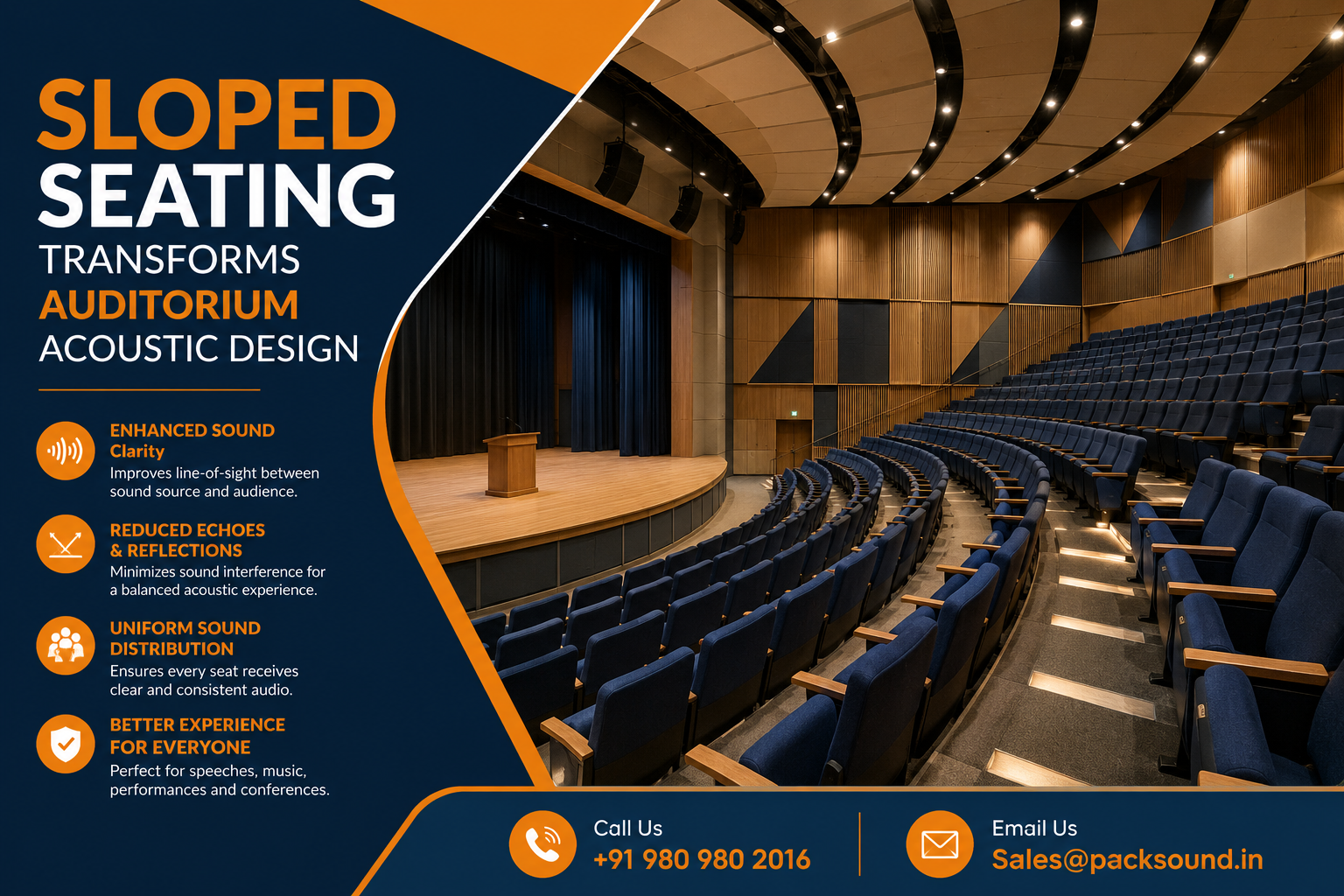
Sloped seating is not merely a comfort or sightline decision. In professional auditorium acoustic design, the rake angle of the seating bowl is one of the most powerful levers an acoustic consultancy team has at its disposal. It influences how sound waves travel, how early reflections arrive at each listener, and how reverberation decays across the room. This article explores that relationship in depth, and also explains how the right combination of acoustic treatment products transforms a well-designed rake into a room that genuinely performs.
Why Auditorium Acoustics Begin With the Floor Slope
Most discussions about auditorium acoustics begin with wall panels, ceiling shapes, and RT60 targets. What gets skipped far too often is that the seating rake itself is an acoustic variable before a single panel is installed.
When seating is flat, sound from a stage source travels horizontally across the audience. The first few rows absorb a significant portion of the energy before it reaches the rear. This effect, known as seat-dip attenuation, causes a measurable loss of low-mid frequencies at seats beyond roughly the fourth or fifth row. The audience at the back receives degraded speech intelligibility and reduced musical warmth.
When seating is sloped, the geometry changes substantially. Each successive row is elevated. The direct sound path from stage to listener is no longer obstructed by the heads and shoulders of those seated in front. The acoustic shadow that creates seat-dip attenuation is either eliminated or shifted to a frequency range that matters less perceptually. The result is more consistent sound energy distribution from the first row to the last.
This is why any serious acoustic consultancy engagement for an auditorium treats rake design as a first-principles decision, not a finishing detail.
The Physics Behind Sloped Seating and Sound Distribution
Direct Sound, Early Reflections and RT60 Optimization
In auditorium acoustics materials, the three most critical parameters for listener experience are direct sound level, early reflections arriving within 50 milliseconds, and reverberation time (RT60). Sloped seating influences all three simultaneously.
Direct sound level benefits are straightforward: elevation removes obstructions. But the early reflection picture is more nuanced. In a raked seating bowl, the floor between rows is angled. Sound reflecting off this angled floor arrives at the listener from a slightly different angle than in a flat room. When properly calculated, these floor reflections can actually reinforce the direct sound usefully, arriving within the 50-millisecond integration window that the human ear perceives as part of the original signal rather than as an echo.
RT60 optimization in raked spaces also behaves differently from flat rooms. Because the audience itself is a major absorptive surface, the distributed elevation in a raked bowl means that sound reaches more of the audience simultaneously rather than cascading from front to rear. This shortens the effective decay path and gives the acoustic consultant more precise control over reverberation time targets without needing to compensate with excessive wall treatment.
For lecture halls, the target RT60 typically sits between 0.6 and 0.9 seconds. For music performance spaces, it ranges from 1.4 to 2.2 seconds depending on repertoire. Theatre falls between these, usually targeting 0.9 to 1.3 seconds. Sloped seating helps hit these windows more consistently across the seating area.
Speech Intelligibility Across Every Row
Speech intelligibility is quantified using metrics like Speech Transmission Index (STI) and Clarity (C50 or C80 for music). Both metrics improve when the direct-to-reverberant ratio is favourable at the listener’s ear.
In a flat-floored hall, the direct-to-reverberant ratio typically falls by 6 to 10 dB from front to rear. In a properly raked bowl with matched treatment, this variation can be brought below 3 dB across the full seating depth. The practical outcome is that a speaker using a microphone at 75 dB SPL at the first row is heard with comparable intelligibility at the last row, without the sound system working harder to compensate.
This matters enormously in educational institutions where a lecturer addresses 300 to 1,000 students. It also matters in corporate conference centres, law courts, and houses of worship where clarity of the spoken word is the primary requirement.
Rake Angle Variables: When Standard Advice Does Not Apply
This is where most generic articles fall short. The relationship between rake angle and acoustic quality is not linear, and standard recommendations can backfire depending on context.
Shallow Rake Angles in Small Auditoria
The commonly cited ideal rake for auditoriums is between 8 and 15 degrees. In small venues seating under 200 people, this advice often leads consultants to under-slope the floor because it seems adequate on paper. In reality, a 200-seat hall with an 8-degree rake and a shallow ceiling can develop a strong flutter echo between the rear wall and the flat section near the stage. The reflective path length is short enough that the flutter arrives outside the useful early reflection window, registering as coloration or interference.
The fix is rarely a steeper rake alone. It involves combining the rake geometry with diffusive rear wall treatment and absorptive material on the upper rear ceiling. PackSound’s grooved wooden panels for walls perform particularly well in this scenario. The variable-depth grooves scatter sound across multiple frequencies rather than sending a coherent specular reflection back to the stage, breaking the flutter path without over-deadening the room.
Steep Rakes and Low-Frequency Build-Up
At the other extreme, steeply raked auditoria (beyond 18 to 20 degrees) often develop low-frequency anomalies in the rear upper seating. The elevated rear rows create a quasi-parallel relationship with the stage soffit or ceiling above the stage opening. If both surfaces are hard and reflective, they form an acoustic resonator that reinforces bass frequencies selectively at those seats. The audience at the back hears speech that sounds boomy or the organ/bass instruments appear too prominent.
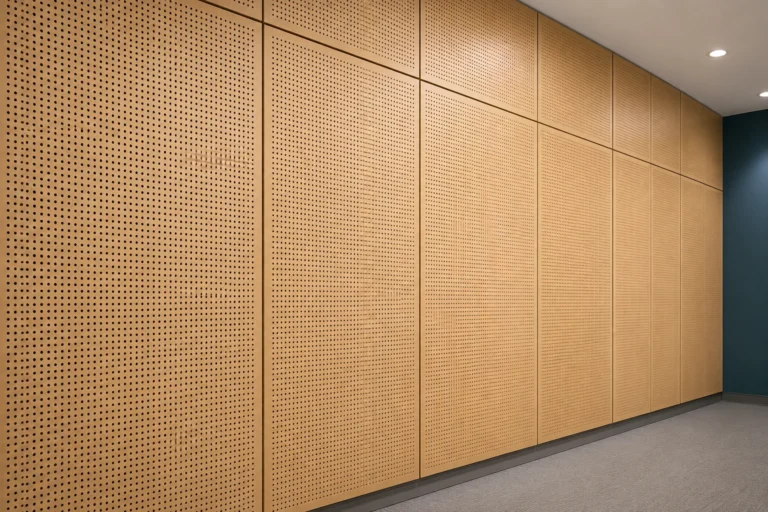
PackSound’s micro-perforated acoustic panels address this precisely. Unlike conventional absorbers that need significant depth to tackle low frequencies, micro-perforated panels achieve broadband absorption through a panel-cavity resonance mechanism. Positioned at the rear ceiling or upper side wall sections of a steeply raked hall, they absorb the problematic resonant frequencies without visually dominating the interior.
Myth vs Reality in Auditorium Acoustic Design
Experienced acoustic practitioners encounter the same misconceptions on project after project. These deserve direct treatment.
Myth: More absorption always improves clarity.
Reality: Over-absorption kills the natural warmth of a room and makes it acoustically “dead.” In music halls, excessive absorption reduces RT60 below the target and strips the fullness from orchestral or choral sound. The goal is controlled reverberation, not its elimination. Auditoriums that rely entirely on thick foam panels without diffusion end up sounding like large closets.
Myth: A high NRC rating means the panel is ideal for an auditorium.
Reality: NRC is a single-number average across mid-frequencies. An auditorium requires spectrally balanced absorption. A panel with NRC 0.85 that absorbs almost nothing below 250 Hz creates a room with too much bass relative to mid and treble. PackSound’s fabric wrapped panels for walls are engineered to provide balanced absorption across 125 Hz to 4000 Hz, which is the critical range for both speech intelligibility and musical fidelity.
Myth: Carpeted floors are optional in raked auditoria.
Reality: Auditorium carpets perform a function that goes beyond footfall noise. The carpet on the seating rake, particularly on aisle runners and riser faces, absorbs grazing-incidence sound travelling along the floor surface. Without this, the floor-level reflection from hard riser faces creates a second arrival at listener ears that is coherent enough to cause comb filtering, subtly degrading speech clarity without listeners being able to identify the cause. It is one of the most frequently overlooked acoustic elements in budget-conscious projects.
Myth: Acoustic clouds are only for flat-ceiling venues.
Reality: Suspended acoustic clouds are among the most effective tools in raked auditoria precisely because the sloped floor and varied ceiling height create zones where direct reflections from the primary ceiling arrive at very different delay times across the seating. Carefully positioned acoustic clouds from PackSound’s ceiling range provide controlled first reflections from a closer surface, normalising delay times across the audience and improving the STI consistency discussed earlier.
Myth: Wooden panels are decorative, not functional.
Reality: PackSound’s grooved wooden panels and micro-perforated acoustic panels provide meaningful acoustic control. Precision-milled grooves and perforations, backed by appropriate cavity depth and absorptive infill, deliver measurable absorption and diffusion. In several of PackSound’s completed auditorium projects, wooden panel systems have met the acoustic brief while simultaneously satisfying the architect’s material specification.
The Product Stack: What Actually Goes Into a High-Performance Raked Auditorium
An effective auditorium acoustic design integrates multiple product categories across different surfaces and frequencies. Here is how each element fits the raked-seating context specifically.
Fabric Wrapped Panels for Walls
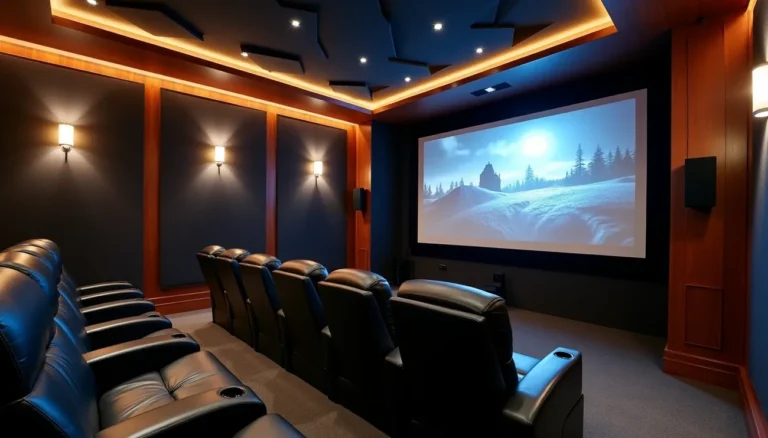
The side walls of a raked auditorium are the primary location for controlled absorption. Because sound travels across the audience at multiple angles in a raked bowl, the side walls receive both direct stage energy and audience-scattered reflections. Fabric wrapped panels installed at mid-height on side walls absorb the mid-high frequency energy that would otherwise build up into late-arriving reflections. PackSound’s fabric wrapped panels are available in over 20 fabric options, allowing the acoustic requirement to be met without sacrificing the premium interior finish expected in institutional and commercial auditoria.
Auditorium Carpets
As noted above, carpets on raked risers and aisles are not a soft-furnishing decision. They are an acoustic specification. PackSound supplies auditorium-grade carpet with acoustic performance documentation, allowing the carpet’s contribution to overall room absorption to be included in the RT60 calculation from the early design stage.
Acoustic Clouds
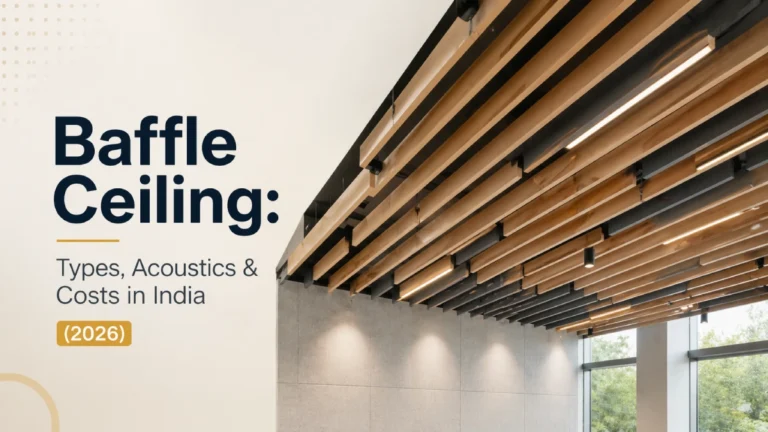
In large raked auditoria, the ceiling over the mid and rear seating sections is often too distant to provide useful early reflections. Acoustic clouds suspended at calculated heights and angles bring the effective reflection surface closer to the audience, providing the 20 to 50 ms reflections that reinforce speech intelligibility and musical envelopment. PackSound’s Auraluxe range includes 3D ultra-luxury ceiling clouds that combine acoustic function with architectural design quality appropriate for flagship venues.
Grooved Wooden Panels for Walls
Stage surrounds, proscenium reveals, and the rear wall are ideal locations for grooved wooden panel systems. The geometry of the grooves provides acoustic diffusion rather than pure absorption, maintaining room liveliness while scattering problematic reflections. In theatre contexts particularly, diffusion behind and around the stage opening keeps the room feeling live for performers while controlling late reflections for the audience.
Micro-Perforated Acoustic Panels
Micro-perforated panels occupy a niche that standard products cannot fill: broadband absorption in a slim, rigid, visually clean panel. In raked auditoria where the upper rear walls and ceiling sections need treatment but cannot accommodate deep panel systems due to structural or fire clearance constraints, micro-perforated panels are the practical solution.
PET Panels
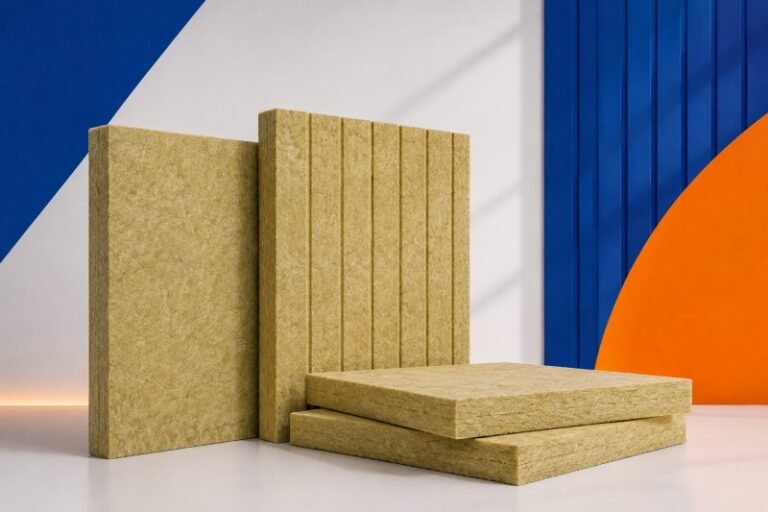
PET (Polyethylene Terephthalate ) address the coupling between the room and the cavities behind wall construction, particularly relevant in auditorium acoustic panels where stud-cavity wall systems are used for construction economy. Without PRT treatment, these cavities can resonate sympathetically with room modes, adding a coloured low-frequency character to the room that is difficult to identify by ear but visible on a room acoustic measurement.
3D Panels
PackSound’s 3D panels from the Auraluxe range serve a dual function in premium auditorium projects. The three-dimensional surface geometry provides diffusion across mid and high frequencies, while the panel depth and infill provide absorption. In foyers, entrance halls, and pre-function spaces associated with auditoriums, 3D panels deliver acoustic control and a distinctive aesthetic identity simultaneously.
Advanced Section: Acoustic Zoning Across a Raked Bowl
For practitioners who already understand the fundamentals, the real optimisation challenge in a raked auditorium is not treating the room as a uniform space, but designing it as a set of acoustic zones that each receive different treatment intensities.
A raked seating bowl can be divided into three primary acoustic zones: the front third (rows 1 to approximately 8), the mid zone (rows 8 to 20), and the rear zone (rows 20 and beyond). Each zone has a different balance of direct sound, early reflection, and late reverberation at the listener’s position.
In the front zone, the direct sound dominates and the risk is over-absorption reducing the sense of room size and envelopment. Treatment here should be predominantly diffusive, using grooved wooden panels on the walls flanking the stage and fabric wrapped panels used sparingly.
In the mid zone, the treatment balance shifts. Early reflections from the ceiling are now further away and arrive later. This is the ideal zone for acoustic cloud placement and moderate side-wall absorption. The goal is to reinforce the direct sound with a first ceiling reflection arriving 25 to 40 ms after the direct signal.
In the rear zone, late reverberation dominates and speech intelligibility is most at risk. Absorption here should be highest, with fabric wrapped panels or micro-perforated panels on the upper rear wall and ceiling. The rear wall itself is best treated with diffusion rather than pure absorption to avoid a “dead” sensation at the back of the room.
This zoned approach allows the acoustic consultant to hit a consistent STI value of 0.65 or above across the entire seating area, which is the threshold for good to excellent intelligibility under both unamplified and amplified speech conditions.
The challenge in practice is co-ordinating the acoustic zoning with the interior design specification. In PackSound’s project workflow, the acoustic zoning plan is translated into a product placement schedule at the concept design stage, ensuring that the product selection for each zone is confirmed before the interior finishes are frozen by the architect.
Conclusion
Sloped seating is the structural foundation on which all other auditorium acoustic design decisions rest. It distributes direct sound, shapes early reflection arrival, and creates the conditions in which RT60 optimization and speech intelligibility targets can be met across every seat in the house. Without the right rake geometry, even the best acoustic treatment products are fighting against the room.
But geometry alone is not enough. The combination of fabric wrapped panels for walls, auditorium carpets, acoustic clouds, grooved wooden panels, micro-perforated panels, PRT panels, and 3D panels forms the complete treatment palette that a raked auditorium requires. Each product addresses a specific acoustic mechanism at a specific frequency range. Together, engineered and positioned by a knowledgeable acoustic consultancy team, they produce spaces where a lecturer is understood by every student, where a soloist is heard with full musical richness, and where a theatre performance creates the immersive presence that audiences expect.
PackSound brings this complete understanding to every auditorium project, from school halls and conference centres to performing arts facilities and multiplex auditoria across India.
Frequently Asked Questions
Q1: What is the ideal RT60 for a multipurpose auditorium that hosts both lectures and music?
There is no single ideal figure for a multipurpose room, which is why acoustic consultants often recommend variable acoustics. A practical target for a room that cannot be tuned is 1.0 to 1.2 seconds at mid frequencies (500 Hz to 1 kHz). This is a compromise: slightly longer than ideal for speech but shorter than ideal for orchestral music. The gap can be partially closed by using acoustic clouds on rigging that allows them to be raised or lowered, or by installing retractable absorptive banners on rear walls. If the budget does not allow variable acoustics, biasing toward 1.0 seconds and using a quality audio system to reinforce music is the more pragmatic path.
Q2: How much does sloped seating actually affect speech intelligibility compared to speaker placement?
Both matter significantly, but they address different mechanisms. Speaker placement controls the direct sound level and direction. Seating rake controls the direct-to-reverberant ratio by reducing obstruction and reflection path length. In auditoria where speech intelligibility is the primary function, a well-raked floor can improve STI by 0.1 to 0.15 across the rear seats compared to a flat-floored equivalent with the same speaker system. That is the difference between a room that scores “fair” and one that scores “good” on the STI scale.
Q3: Can acoustic panels be retrofitted to an existing flat-floored auditorium to fix intelligibility problems?
Panels alone cannot fully compensate for a flat floor, but they can make a meaningful difference. The most impactful retrofit interventions are: installing acoustic clouds above the mid and rear seating to provide earlier ceiling reflections; adding fabric wrapped panels to the rear wall to reduce late reflections; and fitting carpet on aisles and under seat areas to reduce floor-level reflections. These measures will not replicate a properly raked hall but can bring STI from poor to acceptable in many existing spaces.
Q4: Why does my school auditorium sound fine for drama but terrible for choir and orchestra?
This is a classic RT60 mismatch. Drama relies on short, direct speech where intelligibility requires low reverberation. Choir and orchestra benefit from a longer, enveloping reverberation. If your hall was designed primarily for speech, the RT60 is probably below 1.0 second and it sounds dry and unsupported for music. The solution is selectively reducing absorption in the room, often by replacing heavily absorptive panels in the upper walls with diffusive grooved wooden panels, and by raising acoustic clouds to increase the effective room volume that contributes to reverberation.
Q5: How do I know whether my auditorium needs diffusion or absorption on the rear wall?
The test is simple in practice. Stand at the rear of the hall and ask a colleague to speak from the stage position. If the sound from the stage is clearly intelligible, you likely need diffusion to maintain liveliness without causing flutter echo. If speech is muddy or you hear a distinct echo 80 to 120 milliseconds after the direct sound, you need absorption. In most auditoria above 500 seats, a combination of both works best: an absorptive lower rear wall to kill the primary echo path and a diffusive upper rear wall to scatter residual energy without creating a dead zone.
Planning an Auditorium Acoustic Design Project?
PackSound’s acoustic consultancy team has delivered RT60-verified auditorium treatments across India – from 200-seat school halls to 1,200-seat institutional performance centres. Get a free site assessment and acoustic brief for your project.
Request Free Acoustic Consultation →