When an architect or facility manager sends us a baffle enquiry, two questions usually come first. What NRC do acoustic baffles have, and which material should we choose? Both answers depend on each other. The material decides the NRC, and the NRC decides how many baffles the space will need.
This guide explains how baffle NRC works, what each common material delivers, and which one fits which commercial space. All figures are based on the acoustic baffles we manufacture and install across India.
Short Answer: Most commercial acoustic baffles have an NRC between 0.70 and 0.95. PET felt, fiberglass and mineral wool baffles usually sit at the top of that range. Wooden baffles with an acoustic felt backing sit between 0.70 and 0.90. Thickness, density and how far the baffle hangs below the slab all move the final number.
Because a baffle hangs vertically, sound reaches both faces and the bottom edge. That is why baffles often absorb more sound per square metre of ceiling than flat acoustic ceiling tiles with a similar rating.
What NRC Means for a Baffle
NRC (Noise Reduction Coefficient) is the average sound absorption of a material across four speech frequencies: 250, 500, 1000 and 2000 Hz. It runs from 0.00, which reflects all sound, to 1.00, which absorbs almost all of it. It is measured in a reverberation room under ASTM C423 or ISO 354. You can read more in our guide to NRC ratings.
There is one catch with baffles. A flat panel is tested lying on the floor of the test room, so only one face is exposed. A baffle hangs in open air, so both faces work. Many manufacturers therefore also quote absorption in Sabins per baffle, which tells you how much absorption one complete unit adds to a room. When you compare suppliers, ask for both figures and check how the sample was mounted for the test.
Acoustic Baffle Materials Compared
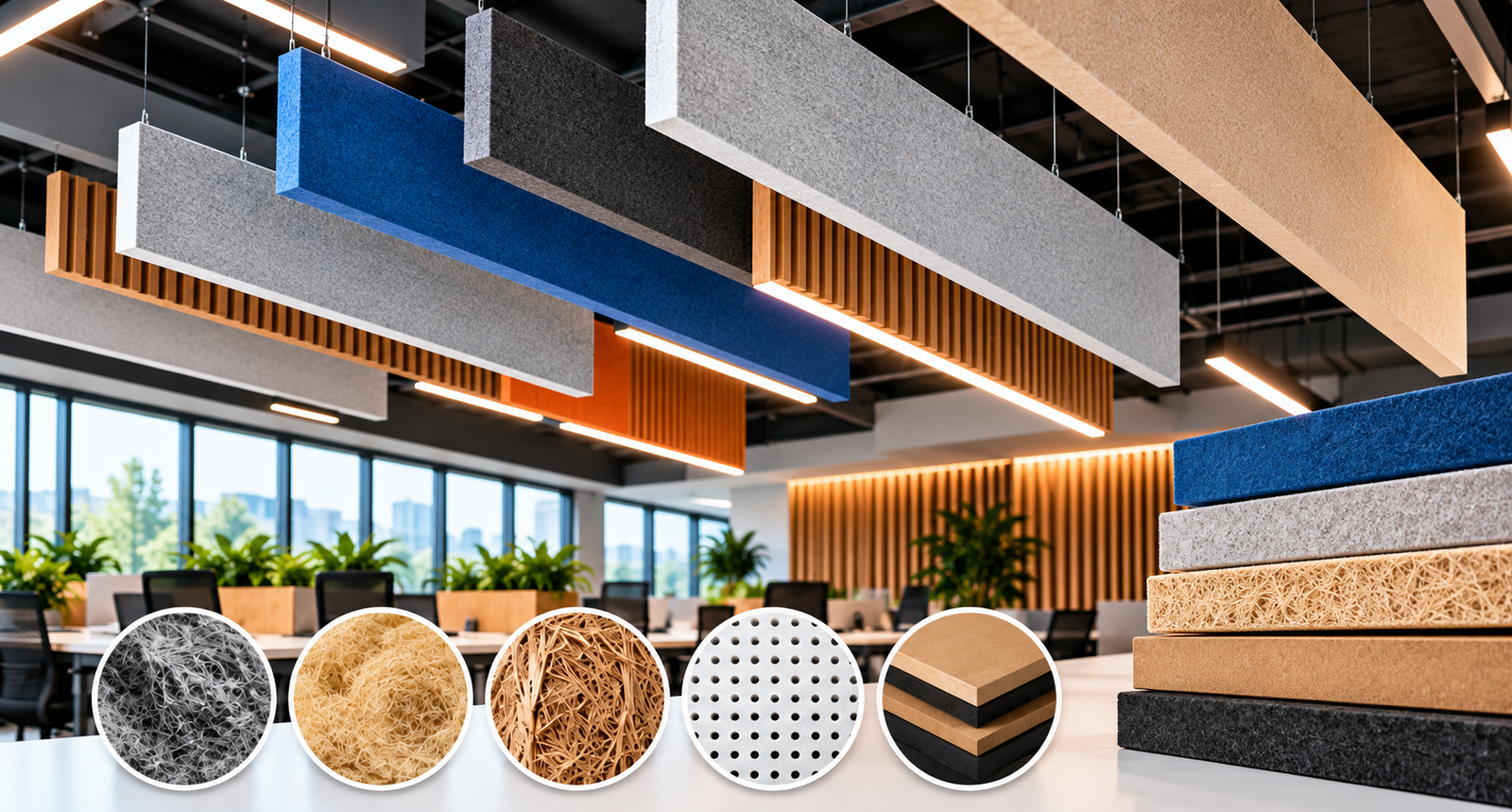
Here is how the main baffle materials compare in commercial projects.
| Material | Typical NRC | Fire Performance | Best For |
|---|---|---|---|
| PET felt (polyester) | 0.70 to 0.95 | Fire retardant grades available | Offices, schools, call centres, colourful interiors |
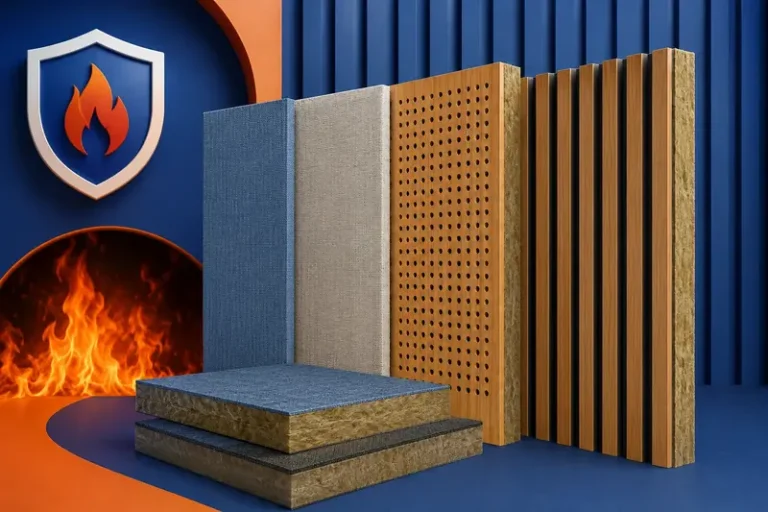
| Mineral wool (fabric or fleece faced) | 0.85 to 0.95 | Non combustible core | Airports, hospitals, fire sensitive and humid areas |
| Fiberglass / glass wool (fabric wrapped) | 0.85 to 0.95 | Class A options | Auditoriums, conference halls, premium offices |
| Melamine foam | 0.80 to 0.95 | Class B options | Very large spans, sports halls, industrial ceilings |
| Wood or MDF (felt backed) | 0.70 to 0.90 | Fire retardant boards available | Lobbies, boardrooms, hotels, auditoriums |
PET Felt Acoustic Baffles
PET (polyethylene terephthalate) felt is made from recycled polyester fibre. It is the most popular baffle material in Indian offices today, and for good reason. It is light, it does not shed fibres, it does not absorb moisture and it comes in a wide range of colours.
- NRC:70 to 0.95, depending on thickness and density
- Thickness: 12 to 50 mm
- Why choose it: colour options, recycled content, easy handling and low weight on the ceiling
- Watch out for: fire performance varies by grade, so always ask for the test certificate
We cover the material in more detail in our guide to polyester acoustic panels.
Mineral Wool Acoustic Baffles
Mineral wool (also called rock wool or stone wool) is one of the best performing sound absorbers available. Its dense, fibrous core traps sound across a wide frequency range, and it naturally resists fire.
- NRC: usually 0.85 to 0.95
- Why choose it: high absorption, non combustible core and good stability in humid conditions
- Watch out for: it needs a fabric or fleece facing to protect the core and give a clean finish
Mineral wool baffles are the safer choice for airports, hospitals, metro stations and any building where fire safety rules are strict.
Fiberglass Acoustic Baffles
Fiberglass (glass wool) baffles have a soft, porous core wrapped in acoustically transparent fabric. They offer high absorption with very little weight, which is useful when the ceiling structure has limited load capacity.
- NRC:85 to 0.95 with fabric wrap
- Why choose it: strong mid and high frequency absorption, which is what speech clarity depends on
- Watch out for: the fabric finish must be durable, as the core itself should not be exposed
Melamine Foam Baffles
Melamine foam is extremely light, so it suits very large ceilings where hundreds of baffles may be hung. It is common in sports halls, warehouses and industrial buildings with exposed roofs.
- NRC:80 to 0.95 at 50 mm and above
- Why choose it: very low weight and fast installation over large spans
- Watch out for: the surface is softer and can mark more easily than PET or fabric faces
Wooden Acoustic Baffles
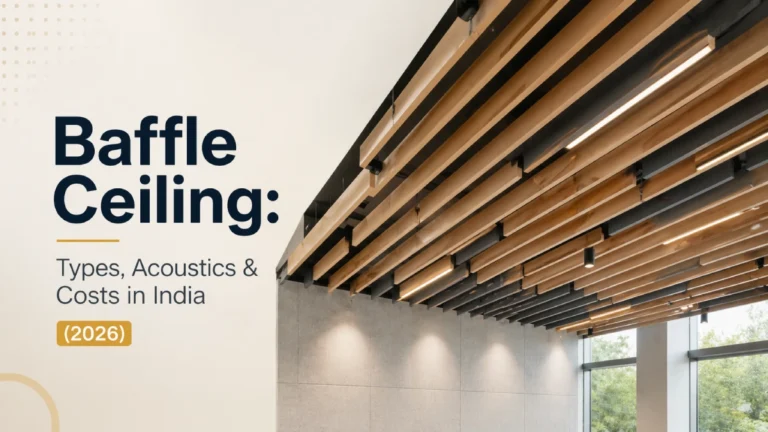
Wood baffles are chosen when the ceiling is a design feature. Solid or perforated wood veneer on an MDF or HDF core, backed with acoustic felt, gives a warm finish that suits lobbies, boardrooms, hotels and auditoriums. Our wooden acoustic baffle ceilings are tested to NRC 0.70 to 0.90 with felt backing.
- NRC:70 to 0.90 (felt backed or perforated)
- Thickness: 12 to 18 mm, with depths of 100 to 300 mm
- Why choose it: premium natural look, many veneer and stain options
- Watch out for: solid wood alone absorbs very little sound, so the acoustic backing or perforation does the real work
What Changes the NRC of a Baffle
Two baffles made from the same material can still perform differently. These are the factors that matter most.
- Thickness and density. Thicker baffles absorb more of the lower frequencies. A 50 mm baffle will outperform a 12 mm baffle made from the same felt.
- Deeper baffles (400 to 600 mm) expose more surface and add more absorption per running metre.
- Baffles spaced closer together give more total absorption, up to the point where they start to shield each other. Our guide to baffle ceiling design covers spacing patterns in detail.
- Drop height. Hanging baffles some distance below the slab lets sound reach the top edge and the slab behind them, which improves performance.
- Fabric, fleece or PET surfaces are acoustically open. Paint or solid laminates can seal the surface and lower the NRC.
Which Material Should You Choose?
Here is how we usually guide clients on commercial projects.
- Open offices and call centres: PET felt baffles for colour, value and easy maintenance. See our guide to acoustic panels for call centres.
- Airports, hospitals and public buildings: mineral wool baffles for fire safety and humidity resistance.
- Auditoriums and conference halls: fiberglass or mineral wool for maximum speech clarity. Our article on reverberation time in auditoriums explains the targets.
- Hotel lobbies and premium offices: wooden baffles, sometimes combined with PET baffles above work zones.
- Sports halls and large spans: melamine or PET baffles to keep the weight down.
If you are still deciding between baffles and other ceiling systems, read our comparison of acoustic baffles vs ceiling panels, or look at acoustic clouds for rooms with lower ceilings. For a deeper look at office specifications, see our guide to baffle ceiling materials.
Common Mistakes When Comparing Baffles
- Comparing NRC without checking the test method. Ask how the sample was mounted. A baffle test and a flat panel test are not directly comparable.
- Ignoring the fire certificate. Public and commercial buildings need fire rated or fire retardant materials. Always ask for test reports.
- Choosing the thinnest option to save cost. Thin baffles can look the same but deliver much less absorption, so you end up hanging more of them.
- Forgetting the rest of the room. Baffles fix the ceiling, but bare glass walls and hard floors may still need acoustic wall panels.
Frequently Asked Questions
For offices, classrooms and conference spaces, aim for baffles with an NRC of 0.80 or higher. For auditoriums and large halls, 0.85 to 0.95 gives the best speech clarity.
Mineral wool and fabric wrapped fiberglass baffles usually reach the highest NRC, around 0.90 to 0.95. Thick, high density PET felt baffles can reach similar values.
Fire retardant PET grades are available, but performance varies between products. Always request the fire test certificate before specifying baffles for a commercial building.
Only when they are perforated or backed with acoustic felt. Solid wood on its own reflects most sound. Felt backed wooden baffles typically reach NRC 0.70 to 0.90.
A suspended baffle absorbs sound on both faces and its bottom edge, while a flat tile only absorbs on one face. This gives baffles more absorption per square metre of ceiling, especially in high ceilings.
Get the Right Baffles for Your Project
The right material depends on your ceiling height, fire requirements, design and budget. Our team can survey your space, calculate the absorption you need and recommend the material, size and spacing.
PackSound manufactures PET, polyester, fiberglass, mineral wool and wooden acoustic baffles at our Greater Noida facility in lengths of 1200 to 2400 mm, with custom sizes on request. With more than 1,900 projects delivered across 15+ states, we have treated offices, auditoriums, airports and hospitals. Contact our team for a free quote and we will reply within one working day.