Summary: Reverberation time establishes whether or not a speaker’s voice echos or is heard clearly. It is the most important measurement in auditorium acoustics. However, most venue owners discover the importance of reverberation time in auditoriums after they receive multiple complaints regarding unclear or muffled speech.
Intro: Have you ever been in a large room, like an auditorium, where people talking seem to all speak at the same time? That is an example of extremely poor auditorium treatment design. It is not a luxury for an auditorium’s acoustics to have proper RT60 reverberation time. It is the basis for functional auditorium acoustics.
What Is Reverberation Time (RT60) and Why Does It Matter in Auditorium Acoustics?
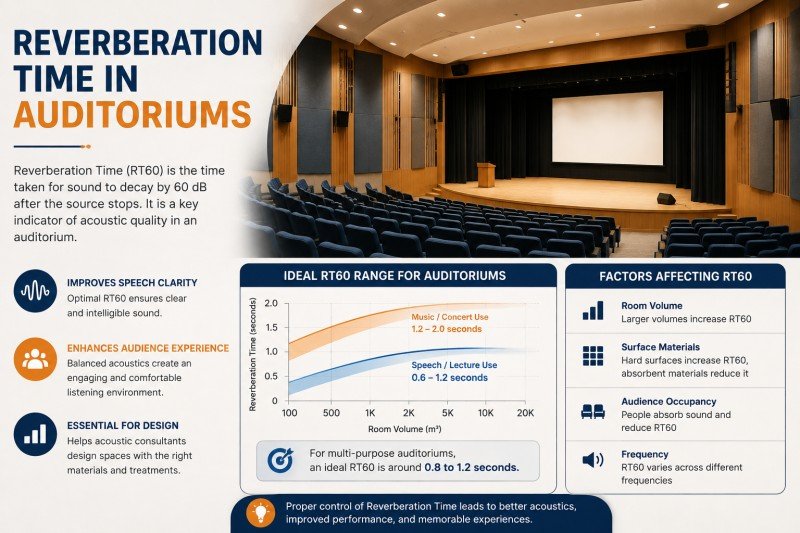
Reverberation Time (RT60) is an acoustical measurement that describes how long it takes for a sound to drop to a level of 60 dB after the source of that sound ceases to exist. In auditorium acoustics, RT60 is an important measurement for balancing audience comfort and warmth of the music. An RT60 of too long a measurement will mean that sound is intelligible. An RT60 of too short a measurement will deaden the sound in the acoustics of the auditorium.
What Is the Ideal Reverberation Time for Auditorium Spaces?
For many multipurpose auditoriums, the ideal unoccupied reverberation time for auditorium use is from 0.8 to 1.2 seconds for the mid-frequency range. This RT60 for auditorium use range provides a good balance between clear speech with adequate natural liveliness to support some music or performances.
How Does RT60 for Auditorium Affect Speech Intelligibility?
The average optimal reverberation time for speech should be around 0.8 to 1.0 seconds. Meeting or exceeding longer decay time causes pronunciation loss of consonant and trailing vowel sounds to the audience. This pattern decreases clarity of speech and further complicates things for those who are seated far from the stage and for those who rely on hearing aids.
What Is the Ideal Reverberation Time for Speech vs Music?
Auditoriums, lecture halls, and classrooms that utilize speech as the primary method of communication, have an optimal RT of 1.0 second. Halls that are multipurpose and host both speeches and musical events commonly range around 1.2 to 1.6 seconds. 1.8 seconds and above is the standard for concert halls, as longer, sustained reverberation enriches the tone of both the orchestral and choral arrangements.
How Can You Achieve the Right Reverberation Time in Auditorium Acoustics?
Achieving desired reverberation time in an auditorium space requires absorption and diffusion, including acoustic panels, perforated ceilings, upholstered seating, and diffusers. Conducting a professional RT60 calculation, then selecting materials according to their NRC ratings, guarantees that the auditorium reaches its objectives across all frequencies.
Conclusion
For auditorium design, RT60 (the reverberation time of sound) is a measurement that is purposely designed based on the function of the space, rather than a specific number. In most cases, an RT60 range of 0.8 to 1.2 seconds will provide the right level of speech clarity, as well as musical warmth, for most auditoriums. Achieving this level of RT60 is difficult without the proper measurement and material absorption and design, which is exactly what Packsound.in provides on every auditorium project.
Frequently Asked Questions:
What is a good RT60 for a school auditorium?
Most school auditoriums perform best between 0.8 and 1.0 seconds. This keeps announcements and speeches intelligible for students seated at the back.
Can one auditorium have different RT60 for speech and music events?
Yes, many venues use retractable curtains, movable panels, or adjustable acoustic banners. This lets the same room shift between a shorter RT60 for speech and a longer one for performances.
Why does my auditorium sound muffled even after adding carpets?
Carpets absorb high frequencies but do little for low-frequency rumble or large open volumes. A full RT60 assessment usually reveals gaps in wall and ceiling treatment.
Does an empty auditorium have a different RT60 than a full one?
Yes, occupied rooms typically measure lower RT60 than empty ones. Bodies and clothing add natural absorption, sometimes lowering reverberation by 0.2 to 0.4 seconds.
Is a lower reverberation time always better for auditoriums?
Not necessarily. Extremely low RT60, under 0.5 seconds, can make a large auditorium feel acoustically dead and unnatural for any live performance.