Summary: Every school leader eventually asks the same question: why can’t the back rows hear the principal clearly during assembly? The answer almost always comes down to School Auditorium Acoustic Design. Poor sound planning turns speeches into echoes, music into noise, and events into a struggle for teachers and students alike. This guide breaks down practical, budget-aware ways to fix that, from panel placement to layout choices, so your auditorium finally sounds as good as it looks.
What Makes School Auditorium Acoustic Design So Important?
A school auditorium hosts assemblies, exams, plays, and concerts, each with different sound needs. Without deliberate acoustic planning, hard surfaces like tile floors, glass windows, and plaster ceilings bounce sound around uncontrolled, causing excessive reverberation. Research on classroom and auditorium acoustics generally recommends a reverberation time between 1.0 and 1.8 seconds for clear speech and balanced music playback. Beyond comfort, this affects real learning outcomes, since students who cannot hear instructions clearly tend to disengage faster. Also check: Acoustic Ceiling Clouds for Auditoriums.
What Are the Common Acoustic Problems in School Auditorium Design?
Most schools face a familiar set of issues:
- Echo and slap-back reflections between parallel walls
- Muffled speech at the back rows due to poor sound distribution
- High background noise from HVAC systems or hallway traffic
- Uneven sound decay caused by mismatched flooring and ceiling materials
These problems rarely have a single cause, which is why an effective School Auditorium Acoustic Design plan looks at the whole room, not just one wall or one fix.
How Can Auditorium Acoustic Panels Improve Sound Quality?
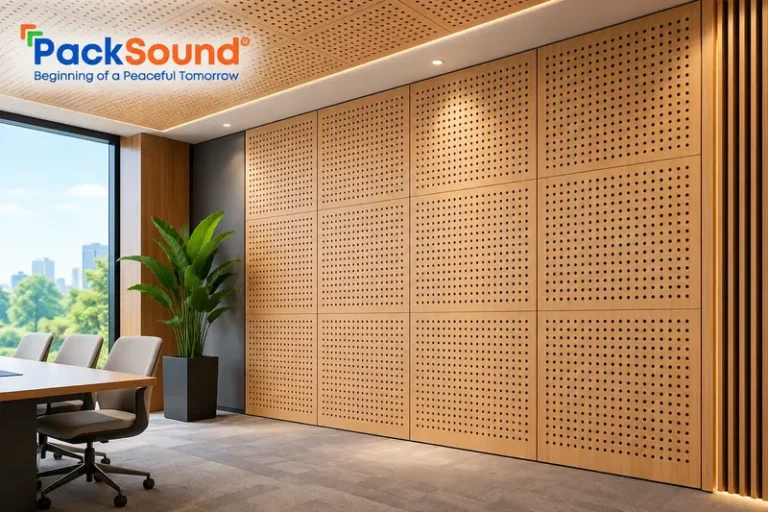
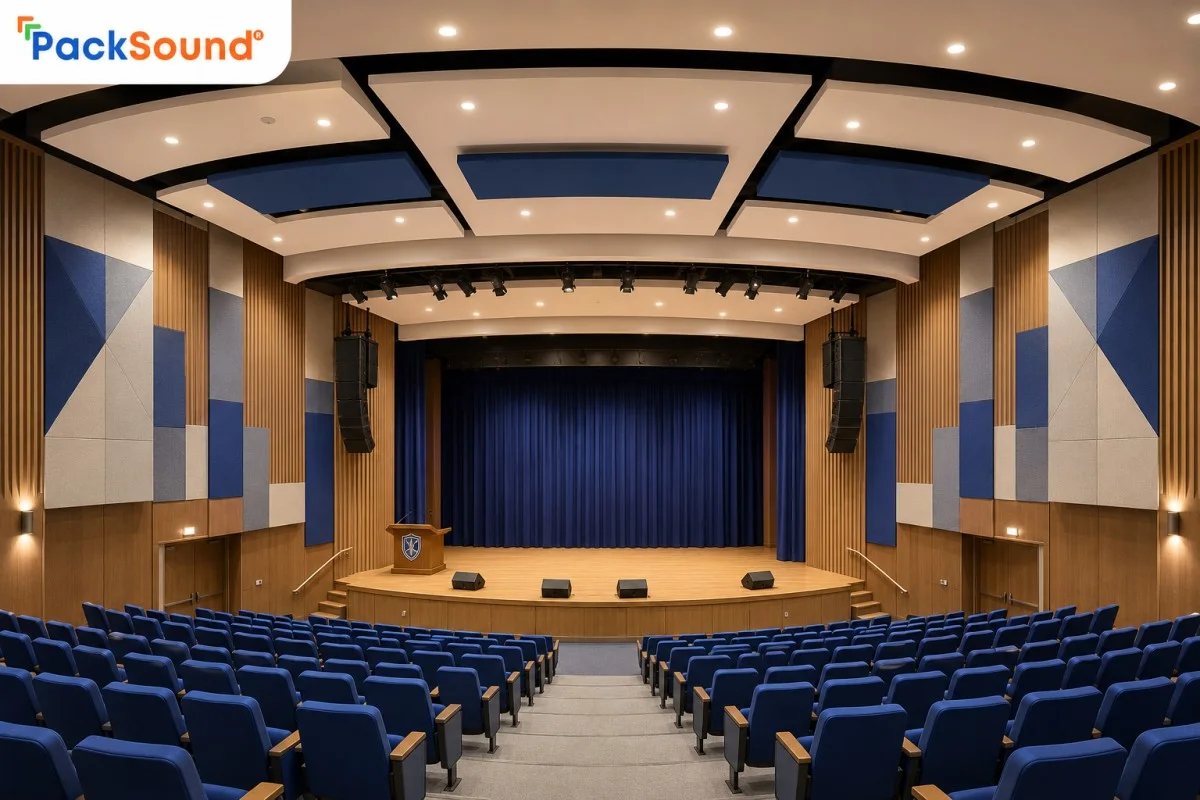
Auditorium acoustic panels are one of the most direct ways to control reverberation. Placed at first-reflection points on side walls and the rear wall, they absorb excess sound energy before it bounces back into the audience. A mix of absorptive and diffusive panels works best: absorption tames harsh echo, while diffusion spreads remaining sound evenly so the room does not feel acoustically dead. For most school settings, a combination of fabric-wrapped panels and perforated wood panels balances performance with classroom-friendly aesthetics.
What Role Do Auditorium Sound Panels and Interior Design Play Together?
Acoustic performance and auditorium interior design should never be separated. Ceiling clouds, wall-mounted auditorium sound panels, and seating upholstery all contribute to how sound behaves. A well-planned auditorium interior uses stage-side diffusers to project the speaker’s voice, absorptive rear panels to prevent echo, and carpeted aisles to soften footstep and movement noise. When acoustics and interiors are designed together from the start, schools avoid costly retrofits later.
How Should You Approach School Auditorium Acoustic Design Step by Step?
- Measure current conditions: Get a baseline reverberation time reading before choosing materials.
- Identify reflection points: Mark where sound hits walls and ceilings first.
- Select the right materials: Combine absorption panels, diffusers, and sound-friendly flooring.
- Balance speech and music needs: If the auditorium hosts both, aim for adjustable or mid-range treatment.
- Test and fine-tune: Reassess after installation, since real occupancy changes how sound travels.
Following this sequence keeps improvements targeted instead of guesswork-driven, saving both budget and installation time.
Conclusion
Good acoustics are not a luxury add-on, they are core to how well a school auditorium functions. By addressing reflection points, choosing the right acoustic panels, and treating interior design as part of the acoustic plan, schools can turn a noisy, echo-prone hall into a space where every voice is heard clearly. Thoughtful School Auditorium Acoustic Design pays off in better assemblies, better performances, and better learning experiences for years to come.
Frequently Asked Questions:
1. How much does auditorium acoustic treatment usually cost?
Costs vary widely based on room size and material choice. Basic panel treatment for reflection points is far more affordable than a full acoustic renovation.
2. Can we improve acoustics without major construction work?
Yes, wall-mounted acoustic panels, ceiling clouds, and heavy stage curtains can noticeably reduce echo without structural changes.
3. Why does the auditorium sound fine empty but bad when full?
An occupied room absorbs more sound through clothing and bodies, which actually shortens reverberation, so uneven results usually point to reflection points that were missed during planning.
4. Do carpets alone fix auditorium echo problems?
Carpets help with floor-level noise but rarely solve wall and ceiling reflections, so they should be paired with panels for real improvement.
5. Is there a standard reverberation time schools should follow?
Many acoustic guidelines suggest keeping reverberation between 1.0 and 1.5 seconds for combined speech and performance use, though pure lecture spaces often aim lower.