By PackSound | Acoustic Solutions Manufactured in Greater Noida, India
If you have ever walked into a room and felt the sound bouncing off every wall – muddy conversations, echoing footsteps, a constant low hum that makes everyone speak louder – you have experienced what happens when a space has no acoustic treatment and, specifically, no ceiling treatment.
The ceiling is the single largest uninterrupted reflective surface in most rooms. Yet it is also the most ignored. When buyers and architects ask us about acoustic ceiling panels in India, the first question they usually ask is: “What NRC rating do I need?”
This guide answers that question fully. It explains what NRC actually measures, how it is tested, what the numbers mean in real Indian spaces, which ceiling panel types achieve which NRC ranges, what different spaces genuinely require, and how to avoid the most common – and expensive – mistakes buyers make in India.
What Is NRC? A Plain-Language Explanation
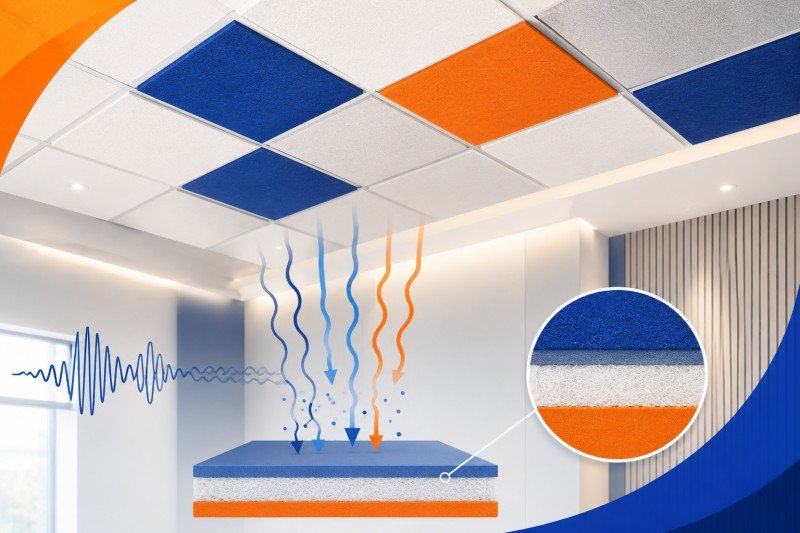
NRC stands for Noise Reduction Coefficient. It is a single number between 0.00 and 1.00 that tells you how much sound energy a material absorbs rather than reflecting back into the room.
- NRC 0.00 = the material absorbs nothing. All sound reflects back. Think bare concrete, glass, or polished marble.
- NRC 1.00 = the material absorbs 100% of the sound energy that hits it. Nothing reflects back.
- NRC 0.85 = the material absorbs 85% of incident sound energy and reflects only 15%.
The number is not invented by manufacturers. It is the result of standardised laboratory testing. In India, this testing follows IS 8225 (equivalent to the international ASTM C423 standard). In the test, a measured quantity of the panel material is placed inside a reverberation chamber. Acoustic engineers measure the reverberation time (how long it takes for sound to decay by 60 decibels – known as RT60) with and without the material present. The difference tells them precisely how much sound the material absorbed.
The NRC number you see on a product datasheet is the arithmetic average of the material’s absorption coefficients at four specific frequencies: 250 Hz, 500 Hz, 1000 Hz, and 2000 Hz. These four frequencies cover the core range of human speech.
This is why NRC is the most relevant rating for ceiling panels in offices, conference rooms, classrooms, auditoriums, and any space where speech intelligibility matters.
Why the Ceiling Matters More Than Any Other Surface
Most people treat their walls first and their ceiling last – or not at all. This is acoustically backwards.
Sound travels from a speaker’s mouth outward in all directions. In a room with a standard ceiling height of 3 to 4.5 metres (typical of Indian commercial construction), the ceiling is often the first hard surface a sound wave reaches. It then reflects downward, strikes the floor, bounces back up, and creates a cascade of reflections that fill the room with reverberation – the acoustic muddiness that exhausts listeners and makes voices hard to understand.
Ceiling treatment is effective for three reasons:
1. Maximum coverage, minimum obstruction. A ceiling panel installation covers the largest uninterrupted area in any room without touching the walls that clients want kept visible for branding, glazing, or aesthetics.
2. First-reflection control. Placing absorptive material where first reflections occur (the ceiling directly above the primary speaking or listening area) provides the greatest per-square-foot improvement in RT60.
3. HVAC and diffused noise. In Indian commercial buildings, ceiling-level mechanical systems – air conditioning ducts, fan coil units, VAV boxes – generate broadband noise that accumulates in the ceiling space and radiates downward. Ceiling panels with good low-frequency absorption address this noise at its source.
The Five Types of Acoustic Ceiling Panels Available in India – With NRC Ranges
Understanding NRC ratings is only useful if you know which product types achieve which ranges. Here is a practical reference for the ceiling panel types currently available in the Indian market.
1. Fabric-Wrapped Fiberglass or Rockwool Ceiling Panels
NRC Range: 0.80 – 1.00
These panels consist of a rigid or semi-rigid mineral fibre core (fiberglass or rockwool) wrapped in an acoustically transparent fabric. The porous core converts sound energy into a small amount of heat through viscous flow – air molecules forced through microscopic fibres lose energy with each pass through the material.
Thickness is the dominant variable: 25mm panels typically achieve NRC 0.70–0.80, 50mm panels achieve NRC 0.85–1.00, and 75–100mm panels (used in critical listening environments) can exceed NRC 0.95 consistently.
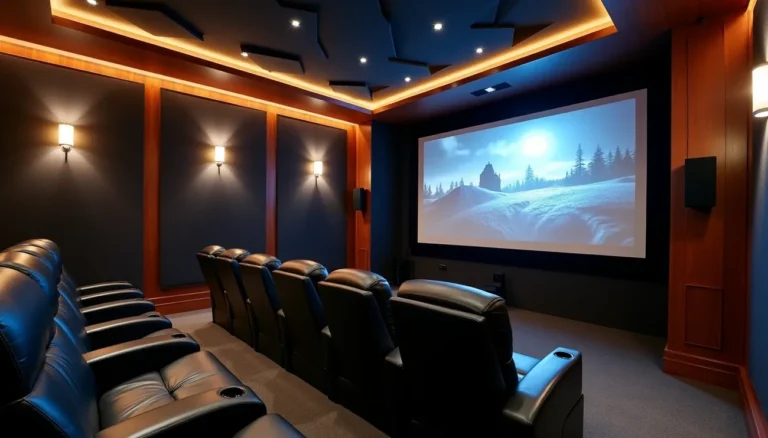
Best for: Recording studios, broadcast facilities, boardrooms, conference rooms, home theatres, prayer halls, auditoriums.
PackSound’s EchoStop® Fabric Series ceiling panels are manufactured in this category, with core options in 25mm, 50mm, and 75mm thickness using LEED-compliant glass wool cores.
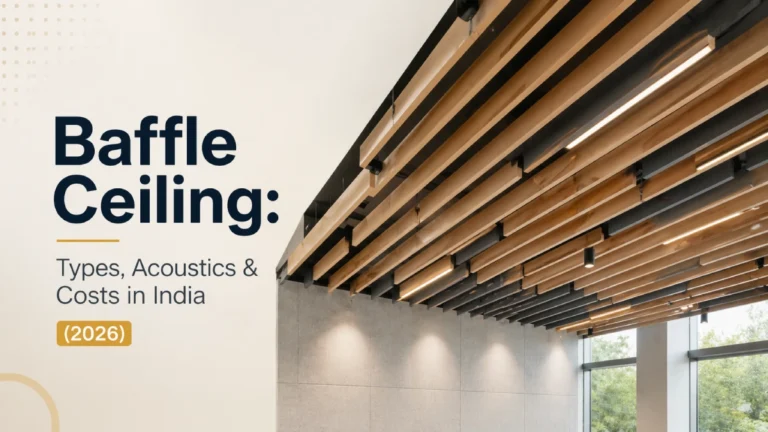
2. Acoustic Ceiling Baffles (Vertical Hanging)
NRC Range: 0.70 – 0.95 (effective)
Baffles are panels suspended vertically from the ceiling structure, oriented perpendicular to the floor. Because sound strikes both faces of a baffle – the front and the back – their effective absorption is nearly double what the raw NRC number suggests. A baffle rated NRC 0.70 per face can deliver an effective NRC of 0.90–0.95 when suspended with adequate airspace between units.
Baffles are particularly effective in large-volume Indian spaces: warehouses converted to workplaces, sports halls, large open-plan floors in tech parks, school gyms, and multiplex lobbies. They treat the ceiling without requiring a suspended ceiling grid.
Best for: Industrial facilities, large open offices, sports halls, school cafeterias, airport concourses, warehouses.
PackSound’s CloudLift™ Baffle Series is available in standard dimensions from 300mm × 1200mm to fully custom sizes, with fabric-wrapped fiberglass and PET felt core options.
3. Acoustic Ceiling Clouds (Horizontal Hanging)
NRC Range: 0.75 – 0.95
Ceiling clouds are horizontal acoustic panels suspended below the structural ceiling, typically clustered above the primary activity zone in a space – the conference table, the teacher’s desk, the recording console, the restaurant seating area. Unlike full ceiling tile systems, clouds leave portions of the ceiling open, preserving sightlines and the aesthetic character of the structural ceiling while treating the acoustically critical zone.
The airspace between the cloud and the structural ceiling above it acts as an additional absorber at low and mid frequencies, which is why clouds often outperform their raw NRC rating in real installation.
Best for: Premium offices, restaurants, hotel lobbies, recording studios, home theatres, meeting rooms, executive boardrooms.
PackSound’s Auraluxe™ 3D Ultra Luxury Acoustic Ceiling Clouds are available in custom shapes, sizes, and finishes – including backlit LED-integrated options – for premium commercial and hospitality environments.
4. Mineral Fibre and Armstrong-Style Ceiling Tiles
NRC Range: 0.55 – 0.85
The classic suspended ceiling tile – a 600mm × 600mm or 600mm × 1200mm tile dropped into a standard T-grid system – is the most widely installed acoustic ceiling treatment in Indian commercial construction. These tiles are manufactured from mineral fibre (a composite of natural and synthetic fibres with a binder) and typically achieve NRC 0.55 to 0.75 in standard grades, with high-performance variants reaching NRC 0.85.
They are cost-effective, widely available, and accepted by Indian MEP contractors. Their primary limitation is low aesthetic differentiation – they look the same in every corporate office, hotel corridor, and school hallway in India.
Best for: Budget-conscious commercial fit-outs, hospitals, schools, government offices, retail stores, standard office grids.
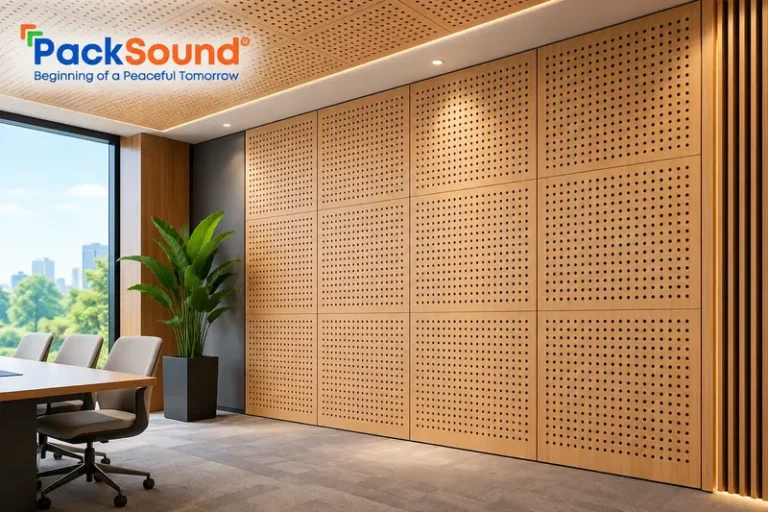
5. Grooved Wooden Slat Acoustic Ceiling Panels
NRC Range: 0.55 – 0.80
Grooved wooden slat panels – a pattern of parallel routed channels across a wood or MDF surface, typically with an acoustic felt or glasswool backing – are currently the most fashionable ceiling treatment in premium Indian commercial interiors. The grooves allow sound to penetrate through the solid-looking surface and reach the absorptive backing material. The deeper the groove and the more open the surface area, the higher the NRC.
Natural wood versions (teak, walnut, white oak) achieve NRC 0.55–0.70. Panels with a more open groove pattern and heavier backing reach NRC 0.75–0.80.
They offer something no other ceiling panel can: the visual warmth of natural wood combined with meaningful acoustic performance. Used in premium offices, luxury hospitality, and high-end residential.
Best for: Premium offices, hotel lobbies, restaurants, home theatres, boardrooms, high-end retail, boutique workspaces.
PackSound’s EchoStop® Wooden Slat Ceiling Series is engineered for NRC up to 0.80, with options in natural teak, walnut, and custom stained MDF.
NRC Targets by Space Type: What Indian Projects Actually Need
The right NRC target depends on the room’s volume, occupancy, intended use, and the surfaces already present. Here is a practical reference based on Indian building types.
Open-Plan Offices
Target NRC: 0.70 – 0.85
India’s rapidly expanding tech parks, co-working spaces, and corporate offices face a specific acoustic problem: very large floor plates (often 3,000–10,000 sq. ft. per floor), high occupancy density, hard flooring (polished concrete or vinyl tile is standard), and substantial ambient HVAC noise. The result is a noisy, cognitively exhausting environment.
Ceiling treatment is the single highest-impact intervention in an open office because it directly addresses the primary reflection path. A combination of acoustic ceiling clouds above workstation clusters and fabric-wrapped baffles in circulation areas achieves the NRC 0.75–0.85 range needed to bring RT60 within the recommended 0.4–0.6 seconds for open office work.
India’s National Building Code 2016 (NBC 2016, Part 8) specifies a target of NC 35–40 for open-plan offices. This is achievable with composite NRC 0.75+ on at least 40% of the ceiling area combined with some wall treatment.
Conference Rooms and Boardrooms
Target NRC: 0.80 – 1.00
Conference rooms are where acoustic failure is most commercially damaging. Poor speech intelligibility in a 10-person boardroom does not just cause discomfort – it causes decisions to be misheard, video calls to fail, and professionals to walk out of meetings exhausted rather than informed.
The recommended RT60 for conference rooms under 200 m³ is 0.3–0.5 seconds. Achieving this in a typical Indian conference room (hard plaster ceiling, glass partition on one side, polished floor) requires NRC 0.85+ over 50–70% of the ceiling, combined with wall panels on at least two surfaces.
For NBC 2016 compliance in boardrooms and private offices (NC 30–35 target), composite NRC 0.85–1.00 ceiling panels are the standard specification.
Classrooms and Educational Facilities
Target NRC: 0.75 – 0.90
The Indian school and university sector is building at enormous scale – tens of thousands of new classrooms every year – and almost universally under-treating acoustics. A reverberant classroom is a learning handicap. Research consistently demonstrates that speech intelligibility drops sharply when RT60 exceeds 0.6 seconds in a classroom, with disproportionate impact on children with hearing difficulties, non-native language learners, and students with attention challenges.
LEED India (v4.1) specifies composite NRC ≥ 0.90 for classroom ceilings. The NBC 2016 specifies NC ≤ 35 for classrooms. Standard mineral fibre ceiling tiles at NRC 0.65–0.70 do not meet these targets in rooms with hard floors – a high-performance ceiling tile at NRC 0.80–0.90 or a combination of ceiling tiles and hanging baffles is required.
Recording Studios and Broadcast Facilities
Target NRC: 0.90 – 1.00
Professional recording studios in India – from commercial mixing rooms in Mumbai and Chennai to podcast studios in Bengaluru and Delhi – require near-zero reverberation in control rooms and precisely calibrated, low-reflective environments in live rooms. This means NRC 0.90–1.00 on ceiling treatment, achieved with 50–100mm fabric-wrapped fiberglass or rockwool panels and corner bass traps (which address low-frequency energy below the NRC test range).
For voice-over and podcast studios, NRC 0.85–0.95 on the ceiling combined with NRC 0.80+ wall panels typically achieves the desired dead, clean sound.
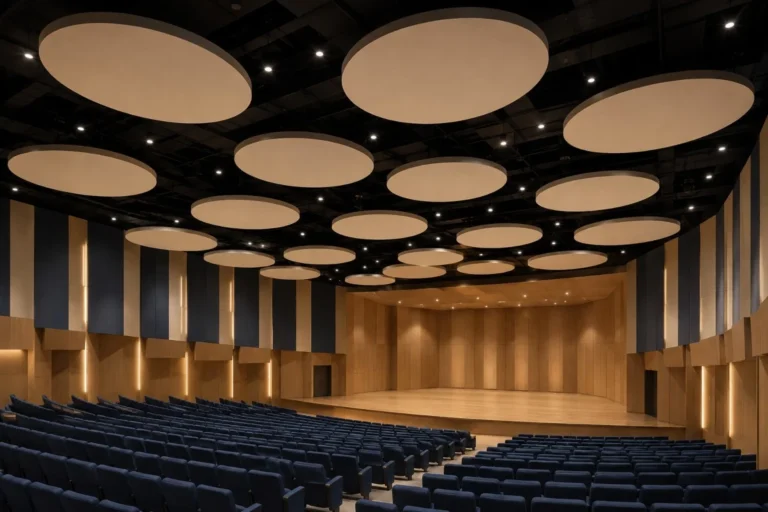
Auditoriums and Multiplexes
Target NRC: 0.80 – 0.95 (audience zone)
Indian auditoriums and cinema halls present a unique challenge: they need significant absorption in the audience zone (to prevent reverberation and echo) while maintaining some reflectivity above the stage or screen (to support natural amplification). The ceiling directly above the seating area typically targets NRC 0.80–0.90, while stage ceiling reflectors may be kept at NRC 0.20–0.40.
PackSound has installed complete acoustic systems achieving NRC 0.90+ within auditorium seating zones and STC 60+ isolation between cinema screens in multiplex projects across India.
Restaurants and Hospitality Spaces
Target NRC: 0.60 – 0.80
The hospitality sector has learned – often painfully – that an acoustically dead restaurant feels sterile, while an acoustically live restaurant becomes unbearable at full occupancy. The target is controlled liveliness: enough energy in the room to feel warm and buzzing, but not so much that guests strain to hear each other across the table.
This typically means NRC 0.60–0.75 on ceiling treatment, with strategic placement over dense seating areas and intentional bare surfaces above the bar or entrance. Grooved wooden slat ceiling panels (NRC 0.55–0.80) are the preferred choice because they deliver the required performance with the warm, premium aesthetic that hospitality brands demand.
How to Read an NRC Datasheet: What Indian Buyers Get Wrong
When a supplier hands you a product datasheet with an NRC figure, here is what you need to look at before accepting the number at face value.
1. Check the thickness tested. NRC is not a fixed property of a material – it is a property of a specific assembly at a specific thickness. A 25mm glasswool panel and a 50mm glasswool panel of identical density have very different NRC values. Always confirm the tested thickness matches what you are specifying.
2. Check for an airspace in the test configuration. Many ceiling panels are tested with an airspace behind them – 200mm or 400mm of air between the panel and the test chamber floor. This artificially inflates the low-frequency absorption. If your installation mounts the panel directly against the structural ceiling with no airspace, the real-world NRC may be 10–20% lower than the datasheet figure.
3. Look at frequency-by-frequency absorption, not just the NRC average. NRC averages the performance at 250Hz, 500Hz, 1000Hz, and 2000Hz. But many Indian spaces – particularly those with heavy HVAC loads – have significant low-frequency noise at 125Hz and 63Hz that the NRC figure does not capture at all. Ask for the full absorption coefficient table if low-frequency noise is a concern.
4. Verify third-party test certificates. In India, accredited testing laboratories for acoustic materials include NABL-accredited facilities. Ask your supplier for the actual test report, not just the number extracted from it. Reputable manufacturers will provide this without hesitation.
5. Understand the difference between NRC and SAA. Sound Absorption Average (SAA) is a newer, slightly different averaging method that includes 200Hz as a data point. NRC and SAA for the same product are usually close but not identical. Confirm which standard the datasheet uses.
Why Indian Conditions Require Extra Attention to Material Specification
India’s climate creates acoustic panel durability conditions that buyers from temperate markets do not face. This directly affects NRC performance over time.
Humidity and moisture: India’s monsoon season and the humid climates of Chennai, Mumbai, Kochi, and Kolkata subject ceiling panels to sustained humidity levels that can damage the performance of standard Western acoustic products. Fabric-wrapped panels in humid Indian environments require moisture-resistant core materials and mould-inhibiting fabric treatments. Foam panels – common in budget installations – degrade rapidly in Indian humidity, losing structural integrity and acoustic performance within 3–5 years.
Thermal cycling: The difference between a fully air-conditioned interior and the Indian summer exterior creates significant thermal cycling stress on panel adhesives, suspension systems, and materials. Panels and fixings specified for temperate climates can fail in Indian conditions.
Construction dust and particulates: Indian construction and urban environments generate significantly higher particulate loads than most Western references assume. Fabric-faced panels should be specified with cleanable fabrics in high-dust environments – and should be included in building maintenance schedules.
PackSound manufactures all acoustic panels in Greater Noida specifically for Indian climate conditions — using humidity-resistant core materials, corrosion-resistant fixings, and fabric selections validated for Indian maintenance environments.
The NRC Coverage Formula: How Much Ceiling Panel Area Do You Actually Need?
Knowing the NRC of a panel is only the first step. The second step is calculating how many square feet of panel you need to treat a space effectively.
The simplified approach used for most commercial Indian projects works like this:
- Calculate your room’s total surface area (floor + ceiling + all four walls in square metres).
- Estimate the existing average NRC of all untreated surfaces. A typical Indian commercial room with plaster walls, glass partitions, hard ceiling, and polished floor has an average NRC of approximately 0.05–0.10.
- Determine your target RT60 for the space type (see the section above).
- Use the Sabine formula: RT60 = 0.161 × (Volume / Total Absorption), where Total Absorption = sum of (surface area × NRC) for all surfaces.
- Solve for the required total absorption, subtract existing absorption, and divide the remaining by the NRC of your chosen panel to find the required panel area.
For most Indian commercial applications, a practical rule of thumb is: treat 40–60% of the ceiling area with panels rated NRC 0.80+ and add complementary wall panels to achieve the recommended RT60 range.
PackSound’s acoustic consultants perform this calculation as part of every free site consultation – including producing a target RT60 model for the specific room dimensions, construction materials, and intended use of each project.
NRC Rating Quick Reference Table
| Space Type | Recommended Ceiling NRC | Recommended Panel Type | Target RT60 |
|---|---|---|---|
| Open-plan office | 0.70 – 0.85 | Baffles + ceiling clouds | 0.4 – 0.6 sec |
| Conference room | 0.85 – 1.00 | Fabric-wrapped panels | 0.3 – 0.5 sec |
| Classroom | 0.75 – 0.90 | High-perf tiles + baffles | 0.4 – 0.6 sec |
| Recording studio | 0.90 – 1.00 | 50–100mm fiberglass panels | 0.2 – 0.4 sec |
| Auditorium (seating) | 0.80 – 0.95 | Fabric-wrapped panels | 0.8 – 1.2 sec |
| Restaurant / café | 0.60 – 0.80 | Wooden slat panels | 0.6 – 0.9 sec |
| Hotel lobby | 0.65 – 0.80 | Clouds + 3D panels | 0.6 – 1.0 sec |
| Hospital ward | 0.70 – 0.85 | Micro-perf / mineral fibre | 0.4 – 0.6 sec |
| Home theatre | 0.85 – 1.00 | Fabric-wrapped panels | 0.2 – 0.4 sec |
| Gym / sports hall | 0.70 – 0.90 | Baffles | 1.0 – 1.5 sec |
The Most Common Mistakes When Specifying NRC for Ceiling Panels in India
Mistake 1: Choosing the panel with the highest NRC number, regardless of room requirements.
A home theatre that achieves NRC 1.00 across all surfaces becomes acoustically dead — an unpleasant, disorienting environment. Every space has an optimal RT60, and acoustic treatment is about hitting that target, not maximising absorption.
Mistake 2: Treating only the ceiling and ignoring first reflections from sidewalls.
Ceiling treatment addresses vertical reflections. But in rooms with hard parallel sidewalls – the most common condition in Indian commercial construction – lateral flutter echoes persist regardless of ceiling treatment. A complete acoustic solution combines ceiling and wall treatment.
Mistake 3: Selecting a panel based on the datasheet NRC without confirming the installation configuration.
As noted above, the NRC achieved in a laboratory test with an airspace may be 15–25% higher than the NRC you achieve when the panel is mounted flush against your concrete ceiling. Confirm the real installation NRC with your supplier before specifying.
Mistake 4: Buying on price per square foot without considering lifespan.
A fabric-wrapped rockwool ceiling panel at ₹900/sq. ft. that performs consistently for 15–20 years costs far less per year of service than a foam panel at ₹300/sq. ft. that degrades in 3–5 years and needs replacement – particularly in humid Indian climates where foam degradation is rapid. Always evaluate cost per year of performance, not cost per square foot.
Mistake 5: Omitting bass control from the ceiling treatment plan.
NRC testing covers 250Hz and above. In rooms with heavy HVAC loads, concrete structures, or audio playback systems, low-frequency buildup at 80–200Hz can be the dominant acoustic problem – and standard ceiling panels do not address it. Thick panels (75–100mm), ceiling-integrated bass trap panels, or corner treatment is required for complete low-frequency control.
Related Articles
Acoustic Ratings & Specifications
NRC vs STC Rating Explained: Indian Buyer’s Guide to Acoustic Ratings
NRC measures absorption inside a room. STC measures blocking between rooms. Confusing the two leads to expensive specification errors — this guide explains both from first principles, with NBC 2016 compliance targets for every space type.
Fiberglass Acoustic Insulation: NRC Performance, Applications & Costs
Fiberglass cores are the material behind NRC 0.85–1.00 ceiling panels. A complete guide to density, thickness, and what the numbers mean for Indian projects.
Best Rockwool Acoustic Panels for Soundproofing: Benefits, Installation & Costs
Rockwool is the most humidity-resistant core material available — critical for ceiling panels in coastal India and monsoon-belt cities. Full specification and pricing guide.
Ceiling Systems & Design
Acoustic Ceiling Design: Types, Benefits & Applications in India
From suspended grid tiles to floating clouds — a complete breakdown of every acoustic ceiling system available in India, with NRC benchmarks and space-type guidance for each.
Acoustic Baffles vs Ceiling Panels: What Works Best for Large Halls?
Baffles absorb on both faces; flat tiles cover area. Learn which system — or which combination — delivers the target NRC in large-volume Indian spaces like gyms, auditoriums, and open offices.
Baffle Ceiling Design: Complete Guide for Architects & Commercial Buyers in India
Five baffle ceiling design styles, material comparisons, spacing rules, and 2026 pricing — everything architects and PMC teams need before specifying a baffle ceiling system.
Acoustic Tiles by PackSound: High-Performance Sound-Absorbing Tiles in India
Product-level detail on PackSound’s full acoustic tile range — suspended grid tiles, direct-mount ceiling tiles, and specialty formats — with NRC data and installation guidance.
Space-Specific Guides
Best Acoustic Panels for Recording Studios in India (2026)
Studios require NRC 0.90+ on ceilings. This guide covers panel types, thickness, ceiling cloud placement, and the treatment setup that works in most Indian recording rooms.
Acoustic Panels for Home Theater: Cinema-Quality Sound in India
Ceiling panels are the first thing to get right in a home theatre. Covers NRC targets, ceiling cloud positioning, and complete room treatment budgets for Indian setups.
How to Soundproof a Home Theater in India: Step-by-Step Guide (2026)
The India-specific guide covering both acoustic treatment (NRC) and soundproofing (STC) for home cinema rooms — written for Indian concrete construction, not Western timber-frame assumptions.
Buying Guides
Best Acoustic Panel Supplier in India: Wall & Ceiling Panels Guide
How to read NRC claims, verify third-party test certificates, and separate genuine acoustic manufacturers from traders — essential reading before committing to any ceiling panel purchase.
Armstrong Acoustic Wall Panels vs PackSound India (2026)
A detailed comparison of an imported global brand against a Made-in-India manufacturer — covering acoustic performance, customisation, lead times, pricing, and after-sales support.
PackSound Acoustic Ceiling Panel Products: NRC Performance Summary
| Product Line | Panel Type | NRC Range | Thickness Options | Key Application |
|---|---|---|---|---|
| EchoStop® Fabric Series | Fabric-wrapped fiberglass | 0.75 – 1.00 | 25mm, 50mm, 75mm | Studios, boardrooms, theatres |
| CloudLift™ Baffle Series | Fabric-wrapped fiberglass baffles | 0.70 – 0.95 (effective) | 25mm, 50mm | Open offices, halls, gyms |
| Auraluxe™ Ceiling Clouds | 3D luxury ceiling clouds | 0.75 – 0.95 | Custom | Premium commercial, hospitality |
| EchoStop® Wooden Slat | Grooved wood + backing | 0.55 – 0.80 | 18mm, 25mm | Premium offices, restaurants |
| CNC PET Felt Panels | Recycled PET felt | 0.65 – 0.85 | 9mm, 12mm | Co-working, schools, retail |
| EchoGlow® Acoustic Lights | LED + acoustic panel | 0.65 – 0.80 | Custom | Offices, hospitality |
All products are manufactured at PackSound’s facility in Greater Noida, Uttar Pradesh, and are available with test certificates from NABL-accredited laboratories on request.
Frequently Asked Questions: NRC Rating for Acoustic Ceiling Panels in India
Q: What NRC rating should I specify for a conference room ceiling in India?
A: Target NRC 0.85–1.00 for conference room ceiling treatment. Combined with NRC 0.70+ on at least two walls, this achieves the recommended RT60 of 0.3–0.5 seconds in most Indian conference room volumes. PackSound’s 50mm fabric-wrapped fiberglass ceiling panels achieve NRC 0.90–0.95 in this application.
Q: Is NRC 0.70 good enough for an open-plan office ceiling?
A: NRC 0.70 is a minimum threshold, not a target. Achieving meaningful speech privacy and acceptable noise levels in a dense Indian open office typically requires NRC 0.75–0.85 on the ceiling combined with wall-mounted panels, acoustic desk partitions, and carpet or soft flooring. NRC 0.70 ceiling treatment alone in a concrete-floored, glass-partitioned open office will underperform.
Q: Can I achieve NRC 0.90 with wooden slat ceiling panels?
A: Standard grooved wooden slat panels achieve NRC 0.55–0.80 depending on the groove pattern and backing. NRC 0.90 requires a high-performance mineral fibre or glass wool core with acoustically transparent surface treatment. If you need both the aesthetic of natural wood and NRC 0.90+, the practical solution is to use wooden slat panels as the feature surface on one or two walls and high-performance fabric-wrapped panels on the ceiling.
Q: Do PackSound ceiling panels comply with Indian building codes?
A: Yes. PackSound ceiling panels comply with NBC 2016 acoustic performance requirements and are available with fire rating certificates (Class A, IS 1644 compliant), humidity resistance test reports, and NRC test certificates from NABL-accredited facilities. LEED India credit documentation is available on request.
Q: How do I get NRC performance data for a specific product?
A: Contact PackSound directly. All manufactured products are tested at accredited facilities and we provide the complete absorption coefficient table (not just the averaged NRC number) on request. We also offer free acoustic modelling for your specific room to confirm the performance outcome before you purchase.
Q: What is the lifespan of acoustic ceiling panels in Indian conditions?
A: Quality fabric-wrapped fiberglass or rockwool panels maintain consistent acoustic performance for 15–20 years in Indian conditions when properly installed and maintained. PET felt panels last 10–15 years. Foam panels degrade in 3–5 years in humid Indian environments and are not recommended for permanent installations.
Get a Free Acoustic Consultation for Your Space
PackSound provides free acoustic consultations for commercial and institutional projects across India. Our team of acoustic engineers will assess your space dimensions, construction type, occupancy, and acoustic goals — and produce a specific NRC specification and coverage area recommendation before you commit to any product.
We serve projects across Delhi NCR, Mumbai, Bengaluru, Hyderabad, Chennai, Pune, and across India.
📞 Call / WhatsApp: 980 980 2016
📧 Email: sales@packsound.in
🌐 Website: packsound.in
PackSound is a Made-in-India acoustic solutions company. All products are manufactured at our facility in Greater Noida, Uttar Pradesh.
Last updated: 2026. This guide reflects current Indian building standards (NBC 2016), LEED India v4.1 requirements, and PackSound’s current product range. Technical specifications are subject to change; contact our team for the most current product data.