Two Numbers That Determine Whether Your Acoustic Project Succeeds or Fails
Every acoustic product sold in India carries at least one of two ratings — NRC or STC. Every architect’s specification, every acoustic consultant’s report, and every contractor’s BOQ references these numbers. And yet, in over 1,900 completed acoustic projects across India, Ecotone’s design team encounters the same confusion again and again: clients, contractors, and sometimes even designers use NRC and STC as though they are interchangeable.
They are not. They measure completely different things. Specifying an NRC product when the problem requires STC — or vice versa — produces an installation that looks correct on paper and completely fails in practice. It is the single most common and most expensive acoustic specification mistake made in Indian construction.
This guide explains both ratings from first principles: what they measure, how they are tested, what the numbers mean in practice, how they relate to Indian building standards and NBC 2016, how they apply to different space types, and which Ecotone and Packsound products achieve specific ratings for both NRC and STC requirements. By the end, you will never confuse these two ratings again — and you will know exactly which one your project needs.
The Fundamental Distinction: Absorption vs. Isolation
Before getting into numbers, test methods, or products, there is one distinction that everything else rests on:
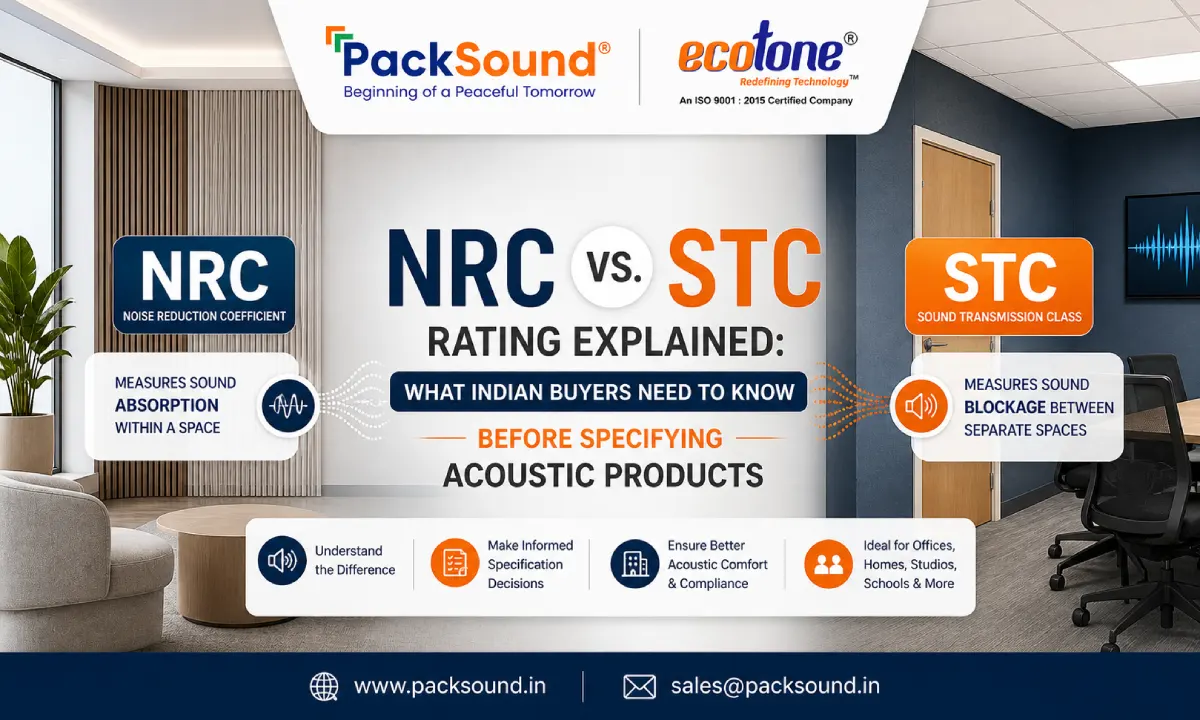
NRC measures how much sound a material absorbs within a room.
STC measures how much sound a construction assembly blocks between rooms.
Read those two sentences again. They describe two entirely different acoustic problems that require two entirely different categories of solution.
- If your problem is echo, reverberation, excessive noise buildup, or poor speech clarity inside a space — that is an absorption problem. NRC is your rating. Acoustic wall panels, ceiling baffles, acoustic clouds, and grooved wooden slats are your products.
- If your problem is sound travelling from one room to an adjacent room, or from outside into a space — that is a transmission problem. STC is your rating. Walls, partitions, doors, windows, and floor-ceiling assemblies are your products.
Many spaces need both. A boardroom needs STC-rated partitions to keep conversations private from the open-plan office outside, and NRC-rated acoustic wall panels inside to ensure that the conversation can be heard clearly by everyone at the table. Solving only one problem leaves the other unaddressed. Ecotone and Packsound supply both categories of solution — and our acoustic consultants assess both requirements before specifying any product.
Part 1: NRC — Noise Reduction Coefficient
What NRC Measures
The Noise Reduction Coefficient (NRC) is a single number between 0.0 and 1.0 that describes how much sound energy a surface material absorbs when sound strikes it. An NRC of 0.0 means the material reflects all sound — nothing is absorbed. An NRC of 1.0 means the material absorbs all sound — nothing is reflected back into the room.
In practice, very few real-world materials sit at either extreme. A smooth concrete wall typically has an NRC of 0.02–0.05, meaning it reflects more than 95% of the sound that hits it — which is why untreated concrete rooms sound so echoey. A high-quality fabric-wrapped acoustic panel from Ecotone’s EchoStop™ range achieves NRC 0.95–1.0, meaning it absorbs 95–100% of the sound energy across the tested frequency range.
How NRC Is Tested
NRC is tested in a specialised reverberation test chamber to either ASTM C423 or ISO 354 standards. A sample of the material is placed in the chamber. A broadband sound signal is introduced. The decay time of the sound — how long it takes to diminish by 60 dB — is measured both with and without the test sample. The ratio of the two measurements gives the absorption coefficient of the material.
This test is repeated at four standard octave-band frequencies: 250 Hz, 500 Hz, 1000 Hz, and 2000 Hz. The NRC is the simple arithmetic average of the absorption coefficients measured at these four frequencies, rounded to the nearest 0.05.
This is a critical fact that many buyers miss: NRC is an average across four frequencies, not a statement about performance at any individual frequency. A material could absorb very well at 500 Hz and 1000 Hz but poorly at 250 Hz, and still report a respectable average NRC. For spaces with known low-frequency problems — bass buildup in recording studios, low-frequency machinery noise in industrial canteens — the individual octave-band absorption coefficients are more informative than the single NRC figure. Always ask for the full octave-band data when specifying for frequency-sensitive applications.
What NRC Values Mean in Practice
| NRC Range | What It Means | Example Materials |
|---|---|---|
| 0.00–0.10 | Highly reflective — absorbs almost nothing | Concrete, glass, ceramic tile, marble |
| 0.10–0.30 | Slightly absorptive — minimal acoustic effect | Standard gypsum drywall, bare plaster |
| 0.30–0.55 | Moderately absorptive | Carpet, some ceiling tiles, curtains |
| 0.55–0.75 | Good absorption | Acoustic ceiling tiles, grooved wooden slat panels (without infill) |
| 0.75–0.90 | High absorption — commercial acoustic grade | EchoStop™ Grooved Slats (with rockwool), Groovphonic™ panels, wood wool |
| 0.90–1.0+ | Excellent absorption — professional / critical grade | EchoStop™ Fabric-Wrapped Panels, EchoStop™ Echo Stop tiles |
NRC values above 1.0 occasionally appear in test certificates and cause confusion. This is not a physical impossibility — it is an artefact of the testing method. When the panel absorbs energy not only from the sound directly incident on it but also from the edges of the panel (edge diffraction), the measured coefficient can slightly exceed 1.0. This is technically correct for the test conditions, though in real-world installation the absorption coefficient will be ≤ 1.0.
What NRC Does NOT Tell You
NRC does not tell you:
- How the material performs at frequencies below 250 Hz or above 2000 Hz
- How much sound the material blocks between rooms (that is STC)
- How the panel will perform if installed differently from the test conditions (mounting method matters significantly — a panel tested flush against a wall performs differently from the same panel with a 50 mm air gap behind it)
- Whether the material is fire rated (NRC and fire classification are independent parameters)
Ecotone’s NRC-Rated Products
Ecotone and Packsound offer the full spectrum of NRC-rated acoustic treatments:
EchoStop™ Grooved Wooden Slat Panels: NRC 0.75–0.95 with acoustic fleece backing; up to NRC 1.0 with 50 mm UL-certified rockwool cavity infill (60 kg/m³, IS 8183). Ideal for offices, hotels, auditoriums, and premium residential.
EchoStop™ Fabric-Wrapped (Echo Stop) Panels: NRC 0.95 at 25 mm; up to NRC 1.0 with thicker core. Tested to ASTM E1050 / ISO 10534-2. Impact resistant, fungi-resistant, stain-resistant, VOC-free. 100+ fabric colours. Ideal for boardrooms, recording studios, home theatres.
WFF Wood Wool Panels: NRC 0.90 tested to ISO 354:1985 and ASTM C423-90a, with 50 mm rockwool backing at 48 kg/m³. Broadband absorption from low to high frequencies. ASTM D-876 Class A fire rated. Ideal for auditoriums, schools, gymnasiums, airports.
Groovphonic™ Composite Acoustic Panels: NRC up to 0.86 with UL-certified rockwool cavity (60 kg/m³). Impact resistant. Ideal for auditoriums, school halls, and high-traffic commercial spaces.
Acoustic Hanging Baffles and Clouds: NRC up to 1.0 (both faces exposed). Ideal for industrial facilities, warehouses, sports halls, and large-volume commercial spaces.
Part 2: STC — Sound Transmission Class
What STC Measures
The Sound Transmission Class (STC) is a single-number rating that measures how effectively a building assembly — a wall, floor, door, window, or partition — blocks airborne sound from passing from one space to another. Unlike NRC, which is a ratio between 0 and 1, STC is expressed in decibels (dB) and typically ranges from below 25 (very poor isolation) to above 60 (excellent isolation for demanding commercial applications).
The STC number represents approximately the reduction in sound level (in dB) that the assembly provides between a source room and a receiving room. An STC 40 partition reduces the sound level by approximately 40 dB — meaning sound that is 40 dB louder on one side is reduced to an imperceptible level on the other. In practice, the correlation between STC and perceived dB reduction is approximate, because STC does not cover low-frequency performance and different frequencies are weighted differently in the rating system.
How STC Is Tested
STC is tested in accordance with ASTM E90 (laboratory testing) and rated using ASTM E413. The assembly is installed as a partition between two adjacent test rooms — a source room and a receiving room. A broadband noise signal is played in the source room at standardised levels. Sound pressure levels are measured in both rooms across 16 one-third octave frequency bands between 125 Hz and 4000 Hz. The difference between the two measurements at each frequency gives the Transmission Loss (TL) of the assembly at that frequency.
The resulting TL curve is then compared to a set of standardised reference curves. The STC rating is the reference curve that most closely matches the test data without exceeding the allowed deficiency limits. A higher STC = better sound blocking.
What STC Values Mean in Practice
| STC Rating | What It Means | Typical Applications |
|---|---|---|
| Below 25 | Very poor — all sounds clearly audible | Single-glazed window, hollow-core door |
| 25–35 | Poor — speech clearly intelligible through partition | Basic stud wall, no insulation |
| 35–45 | Moderate — loud speech audible but not fully intelligible | Standard drywall with insulation |
| 45–50 | Good — raised voices barely audible | Code minimum for residential in many countries |
| 50–55 | Very good — only very loud sounds audible | Conference rooms, hotel rooms, commercial offices |
| 55–60 | Excellent — near-complete privacy | Premium boardrooms, medical consultation rooms |
| 60+ | Superior — virtually no audible transmission | Recording studios, cinemas, NVH test chambers |
A critical distinction: Laboratory STC vs. Field STC (FSTC)
STC ratings are measured under ideal laboratory conditions. In real buildings, performance can fall 5–10 STC points below the laboratory rating due to flanking transmission — sound that bypasses the partition through the ceiling void, floor structure, electrical outlets, pipe penetrations, and other weak points. Specifying an STC 50 partition does not guarantee STC 50 field performance unless the full assembly is designed and installed to minimise flanking. This is one of the most important reasons to engage a qualified acoustic consultant for partition specifications in sound-sensitive buildings.
What STC Does NOT Tell You
STC does not measure:
- Sound absorption within a room (that is NRC)
- Impact or structure-borne sound transmission — footfall, machinery vibration (that is IIC — see below)
- Low-frequency sound transmission below 125 Hz — which is why bass from subwoofers in a cinema can penetrate walls rated STC 50+
- Real-world field performance, which is typically lower than the laboratory STC rating due to flanking
Ecotone’s STC-Rated Products
Packsound’s STC product range addresses the full spectrum of room-to-room isolation requirements in Indian commercial and institutional construction:
AcoFascia™ Sliding Folding Acoustic Partitions: STC 40–45 (85 mm panels), STC 45–50 (100 mm panels), up to STC 50–55 with full acoustic specification. The AcoFascia™ system is one of the highest-rated acoustic partition systems manufactured in India, achieving STC 55 with multi-layered damping technology and precision perimeter seals. Deployed at Hyatt Regency Bhikaji Cama Place, Crowne Plaza Gurgaon, Disha Unitech Guwahati, and 250+ commercial projects across India.
Soundproof Fixed Partition / Drywall Systems: STC up to 55 or higher, using multi-layer drywall construction with acoustic core infill. Ideal for permanent partition walls in offices, recording studios, conference rooms, and healthcare facilities.
PACKSOUND™ Soundproofing Membrane / MLV Sheets: Density 2,200 kg/m³, STC 42.7. Blocks 28–32 dB of noise through walls, ceilings, floors, and enclosures. Temperature range –10°C to 60°C. Used in industrial enclosures, floor assemblies, and partition upgrades.
SonicGuard™ Fire Rated Acoustic Doors: STC 45, with simultaneous fire resistance up to 120 minutes (BS 476 Part 22 / IS 3614 Part 2). 55–72 mm thick sandwich composite construction. For server rooms, cinema projection rooms, fire compartment boundaries, and hospital consultation rooms.
Multiplex / Cinema Hall Systems: Complete acoustic systems achieving STC 60+ between adjacent screens and NRC 0.90+ within each auditorium — combining both STC and NRC products in a single integrated design. Delivered across six cinema halls with full acoustic engineering support.
Part 3: IIC — The Third Rating Indian Buyers Often Miss
While NRC and STC are the two ratings most commonly encountered in acoustic product specifications, there is a third rating that becomes critical in multi-storey construction: IIC — Impact Insulation Class.
IIC measures how well a floor-ceiling assembly reduces structure-borne impact noise — footfall, furniture dragging, dropped objects, and mechanical vibration — from the floor above to the space below. Where STC addresses airborne sound passing horizontally through walls, IIC addresses impact sound passing vertically through floor slabs.
IIC is tested using a standardised tapping machine (ASTM E492) placed on the floor above, with sound pressure measurements taken in the room below. Results are rated using ASTM E989. Like STC, higher IIC = better isolation.
Why IIC matters in India specifically: Indian multi-storey construction — including IT parks, commercial office towers, residential high-rises, and mixed-use developments — almost universally uses reinforced concrete slab construction. An 8-inch solid concrete slab achieves an IIC of approximately 32 without additional treatment — well below the minimum of 50 typically required for occupant comfort. Hard flooring finishes (granite, marble, vitrified tile, hardwood) — all dominant in Indian interiors — worsen the IIC further. This is why footfall noise between floors is one of the most common acoustic complaints in Indian commercial buildings, and why IIC treatment is essential in multi-occupancy buildings.
Target IIC values for India:
- Minimum acceptable (commercial offices, retail): IIC 45–50
- Recommended (corporate headquarters, hospitality): IIC 50–55
- Premium (luxury residential, high-end hotels): IIC 55–65
- Special requirement (hospitals, recording studios): IIC 65+
Ecotone and Packsound supply acoustic underlayments, resilient flooring systems, and suspended ceiling assemblies that improve IIC performance in both new construction and retrofit projects. Contact our acoustic consulting team for a project-specific IIC assessment.
Part 4: How NRC and STC Relate to Indian Building Standards
NBC 2016 and Acoustic Requirements
India’s National Building Code 2016 (NBC 2016) is the primary regulatory framework governing building acoustics in India. Part 8 of NBC 2016 covers environmental performance requirements including noise control. Key requirements relevant to NRC and STC specification include:
Office buildings: NBC 2016 specifies maximum permissible interior noise levels (NC levels) for different occupancy types. Open-plan offices are targeted at NC 35–40, private offices at NC 30–35, and boardrooms/conference rooms at NC 25–30. Achieving these NC targets requires a combination of STC-rated partition walls, STC-rated acoustic doors, and NRC-rated interior acoustic treatment (wall panels, ceiling tiles, hanging baffles).
Educational institutions: Classrooms are targeted at NC 30–35 with RT60 (reverberation time) of 0.4–0.6 seconds for spaces under 200 m³. Achieving these targets requires NRC-rated ceiling tiles or hanging baffles plus NRC-rated acoustic wall panels, and STC-rated external walls and partition doors to block external traffic noise.
Healthcare facilities: Hospital wards target NC 25–30; critical care at NC 20–25. Both STC isolation (between patient areas, between clinical rooms) and NRC absorption (within waiting areas, corridors, and treatment rooms) are required.
Hospitality: Hotel guest rooms require STC-rated demising walls (typically STC 50+ between units, STC 45+ for corridor walls) and NRC-rated interior treatment to control reverberation within rooms.
Auditoriums and assembly spaces: NBC 2016 references RT60 targets by room volume and use type. Large auditoriums (above 3,000 m³) performing arts use targets RT60 of 1.5–2.0 seconds; lecture rooms target 0.6–0.8 seconds; multipurpose halls 0.8–1.2 seconds. Achieving RT60 targets requires NRC-rated wall and ceiling treatment sized by the acoustic consultant based on room volume and existing surface absorption.
LEED India and WELL Building Standard
Both LEED India and the WELL Building Standard v2 — increasingly specified for premium Indian commercial projects — include acoustic performance credits that reference NRC, STC, and background noise criteria:
LEED v4.1 Acoustic Performance credit (BD+C): Requires composite NRC ≥ 0.90 for classroom ceilings; STC ≥ 50 for walls between classrooms; background noise NC ≤ 35 for offices and ≤ 40 for learning spaces.
WELL Building Standard v2, Sound Concept: Requires minimum STC 50 for demising walls between tenancies; minimum NRC 0.70 for ceiling systems in open-plan offices; and reverberation time targets (RT60 ≤ 0.5 seconds in open offices).
Ecotone’s acoustic products — EchoStop™ panels, AcoFascia™ partitions, WFF wood wool boards, and acoustic hanging baffles — are documented with the test certifications, NRC data, and STC ratings required for LEED and WELL credit documentation. Our project team provides the acoustic performance documentation package at the specification stage.
Part 5: The 5 Most Common NRC/STC Mistakes Indian Buyers Make
Mistake 1: Buying acoustic panels when the problem is STC
The most common and most costly confusion. A client installs NRC 0.90 acoustic panels throughout a meeting room and is disappointed that conversations can still be heard in the adjacent open-plan office. The panels are performing perfectly — they are reducing reverberation inside the meeting room. But the sound transmission problem — speech passing through the partition wall — requires STC-rated construction, not NRC-rated panels.
Rule: If the noise source is in an adjacent space, the solution is STC. If the problem is echo or reverb in your own space, the solution is NRC.
Mistake 2: Assuming high NRC panels also provide soundproofing
Acoustic panels — even those rated NRC 1.0 — provide no meaningful STC performance. A fabric-wrapped panel mounted on a standard drywall partition does not make that partition soundproof. The NRC panel absorbs sound within the room; the STC of the partition wall determines how much passes through. These are two independent parameters. A room can have perfect NRC treatment inside and still have terrible STC performance at the boundary. Both must be addressed.
Mistake 3: Not asking for field STC data
Many partition systems marketed in India quote laboratory STC ratings. In real buildings, field performance (FSTC) is typically 5–10 points lower due to flanking. A partition marketed at STC 45 may deliver FSTC 35–38 in your building — barely above the threshold for audible speech privacy. Always ask: “What is the expected field STC in my building configuration, accounting for flanking paths?” PackSound’s acoustic consultants assess flanking risk as part of every partition specification.
Mistake 4: Ignoring the mounting method effect on NRC
The NRC rating printed on a product data sheet is measured under specific test conditions including a defined mounting method. The same panel mounted flush against a solid wall performs differently from the same panel mounted with a 50 mm air cavity. Specifically, mounting with an air gap improves low-frequency absorption significantly — which is why Ecotone’s installation system specifies a GI grid creating a 25–50 mm cavity, not a flush-fix method. Always specify the mounting method and confirm the NRC rating applies to that mounting configuration.
Mistake 5: Treating NRC or STC as the only relevant metric
Both NRC and STC are averaged, single-number ratings that simplify complex frequency-dependent performance into a single number for ease of comparison. For most commercial applications, this simplification is acceptable. But for critical acoustic environments — recording studios, cinemas, auditoriums, hospitals — the full octave-band data for both NRC and STC should be reviewed to ensure the specification addresses the actual frequency content of the noise problem. A cinema with deep bass from its sound system needs a wall with strong low-frequency transmission loss, which the STC rating alone does not guarantee.
Part 6: Choosing the Right Rating for Your Project — A Space-by-Space Guide
| Space Type | Primary Need | Rating to Specify | Target Value | Ecotone Products |
|---|---|---|---|---|
| Open-plan office | Reverberation control | NRC | ≥ 0.70 ceiling; ≥ 0.70 wall panels | Acoustic baffles, EchoStop™ panels, ceiling tiles |
| Conference room (walls) | Speech privacy | STC | ≥ 50 partitions; ≥ 45 doors | AcoFascia™ partitions, SonicGuard™ doors |
| Conference room (interior) | Speech clarity | NRC | ≥ 0.85 rear wall | Fabric-wrapped panels, EchoStop™ slats |
| Hotel guest rooms | Privacy from corridor | STC | ≥ 50 demising, ≥ 45 corridor | Fixed drywall partitions, SonicGuard™ doors |
| Hotel lobby | Ambience control | NRC | 0.70–0.85 | EchoStop™ grooved slats, acoustic ceiling clouds |
| Auditorium | Controlled RT60 | NRC | 0.75–0.90 walls + ceiling | WFF panels, Groovphonic™, acoustic baffles |
| Recording studio (walls) | Complete isolation | STC | ≥ 60 | Double-stud partitions + PACKSOUND™ MLV |
| Recording studio (interior) | Critical listening | NRC | ≥ 0.90 | Fabric-wrapped panels (75 mm core) |
| Multiplex cinema | Both | STC ≥ 60 between screens; NRC ≥ 0.90 within | Complete system | Full Packsound cinema acoustic system |
| School classroom (walls) | External noise block | STC | ≥ 45 (≥ 50 NBC 2016 LEED) | Fixed drywall + acoustic doors |
| School classroom (interior) | RT60 ≤ 0.6 s | NRC | ≥ 0.70 | WFF panels, EchoStop™ ceiling tiles |
| Multi-storey office (floors) | Footfall isolation | IIC | ≥ 50 | Acoustic underlayment + suspended ceiling |
| Industrial factory | Noise level reduction | NRC | ≥ 0.85 ceiling | Industrial acoustic hanging baffles |
Frequently Asked Questions
Can one product provide both NRC and STC performance?
Some composite systems — such as heavy drywall partitions with internal acoustic insulation — deliver both meaningful STC isolation at the boundary and NRC absorption from the surface treatment. However, these are fundamentally different physical mechanisms: mass and decoupling provide STC, while porosity and surface area provide NRC. Products optimised for one rarely optimise the other. For most projects, STC products (partitions, doors) and NRC products (panels, baffles) are specified separately and used together.
Is there an Indian standard equivalent to ASTM C423 (NRC) or ASTM E90 (STC)?
India uses Bureau of Indian Standards (BIS) standards for acoustic testing. IS 8225 covers sound absorption and IS 1950 covers airborne sound transmission. However, most premium acoustic products sold in India — including Ecotone and Packsound products — are tested to international ASTM and ISO standards, which are the standards referenced by LEED India, WELL, and most international architectural specifications. NBC 2016 references both BIS and equivalent international standards.
What NRC rating should I target for an open-plan office in India?
For a standard open-plan office, targeting NRC ≥ 0.70 for the ceiling system and NRC ≥ 0.75 for primary wall panel surfaces will typically reduce RT60 from above 1.0 second (untreated) to 0.4–0.6 seconds — the range recommended for speech clarity in offices by NBC 2016 and WELL v2. For offices with higher occupancy density or harder finishes (glass, concrete, terrazzo), NRC ≥ 0.85 wall panels may be required. Always confirm with an RT60 calculation for your specific space.
Does NBC 2016 specify NRC or STC minimums directly?
NBC 2016 Part 8 specifies performance outcomes — maximum NC noise levels, RT60 reverberation targets, and minimum outdoor-indoor noise attenuation — rather than prescribing specific NRC or STC product ratings. The NRC and STC values needed to meet NBC 2016 outcomes must be calculated by an acoustic consultant based on the specific room geometry, occupancy, and existing construction. Ecotone’s acoustic consulting team provides NBC 2016 compliance assessments.
What is the difference between STC and OITC?
STC (Sound Transmission Class) is weighted toward speech frequencies (125 Hz–4000 Hz) and does not adequately represent low-frequency sound sources like traffic, aircraft, and subwoofer music systems. OITC (Outdoor-Indoor Transmission Class) weights lower frequencies more heavily and is more accurate for evaluating external façade performance against road traffic, railway, and airport noise — common requirements for buildings near Indian highways, metro corridors, and airports. For external façade specifications in noisy urban Indian locations, specify OITC in addition to STC.
Why does my partition rated STC 45 not seem to block sound effectively?
Several factors can reduce real-world performance well below the laboratory STC rating. Flanking transmission — sound bypassing the partition through the ceiling void, floor, or side walls — is the most common cause, typically reducing effective field STC by 5–10 points. Air gaps around electrical outlets, pipe penetrations, or poorly sealed door frames reduce performance dramatically: a 5% gap in an STC 40 partition can reduce its effective performance to STC 13. Always verify that the complete installation — panel seals, perimeter details, penetrations, and flanking paths — has been properly addressed. Packsound’s installation methodology includes assessment of all flanking paths before installation begins.
Conclusion: Specify the Right Rating — Not Just Any Rating
NRC and STC are not interchangeable. They address different acoustic problems with different physical mechanisms requiring different products. Understanding which rating applies to your specific problem is the single most important step in any acoustic specification — and it is the step that most often goes wrong in Indian construction projects.
The correct approach is:
- Define the acoustic problem clearly — is it reverberation inside the space (NRC) or sound transmission between spaces (STC)?
- Establish the performance target — what NRC value or STC rating does your project need, referenced to NBC 2016 requirements, LEED/WELL credits, or client expectations?
- Specify products by rating — not by appearance, brand recognition, or price alone.
- Engage an acoustic consultant — for any project above a single meeting room, an acoustic model is the only reliable way to confirm that the specified products will achieve the desired outcome.
Ecotone Systems and Packsound supply both NRC-rated acoustic panels and STC-rated partition and isolation systems — covering the complete acoustic specification for any commercial, institutional, or industrial project in India. Our acoustic consulting team provides NBC 2016 compliance assessments, LEED/WELL acoustic documentation, product specification, and turnkey installation from our manufacturing and project base in Greater Noida.
Browse the full range:
- NRC Products: Acoustic Wall Panels
- NRC Products: Acoustic Ceiling Baffles and Clouds
- STC Products: AcoFascia™ Sliding Folding Partitions
- STC Products: Soundproof Fixed Partition / Drywall
- STC Products: Soundproof Sheets and MLV Barriers
- STC Products: Fire Rated Acoustic Doors
Or request a free acoustic consultation — tell us your space, your noise problem, and your project timeline, and our team will provide the correct NRC and STC specifications, with test certifications, for your project.
Related reading: Sound Absorbing Materials for Walls — Complete Guide 2026 | Wooden Slat Panels vs Fabric-Wrapped Panels: Which Should You Choose? | Acoustic Baffles vs Acoustic Panels — Understanding the Difference | How to Make a Room Soundproof — Complete India Guide 2026