The Question Every Architect and Specifier Eventually Faces
You have decided the space needs acoustic treatment. The room modelling confirms it. The acoustic consultant agrees. And then comes the question that splits every design team into two camps: wooden slat panels or fabric-wrapped panels?
Both are specified constantly. Both deliver genuine acoustic performance. Both look good — though in entirely different ways. And both are available from Ecotone’s Packsound acoustic wall panel range in a variety of configurations suited to Indian commercial and institutional projects.
But they are not interchangeable. They work differently, absorb sound differently, suit different spaces, perform differently under Indian climatic conditions, and carry different lifecycle costs. Choosing the wrong one for your project doesn’t just waste budget — it may leave the acoustic problem partially unsolved even after a complete installation.
This guide gives you a rigorous, honest comparison of both panel types across every dimension that matters: acoustic physics, NRC performance, aesthetics, installation, durability, cost, sustainability, and best-fit applications. By the end, you will know precisely which panel — or which combination of both — your project needs.
Understanding the Two Contenders
Before comparing performance, it is worth establishing exactly what each panel type is — because marketing language has blurred the lines between genuinely different products.
What Are Wooden Slat Acoustic Panels?
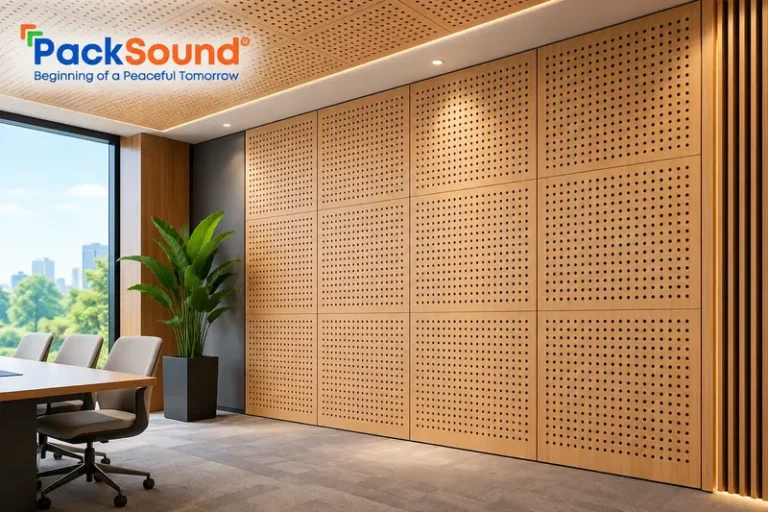
Wooden slat acoustic panels — also called grooved wooden slats, acoustic slat wall panels, sound slats, or linear wood panels — consist of a high-density pre-laminated MDF or HDF board with precision-machined grooves or slots running across the face. These slots are the critical acoustic feature: sound enters through the grooves, passes into the air cavity and backing material behind the panel, and is absorbed before it can return to the room.
Ecotone’s EchoStop™ Grooved Wooden Slat panels are manufactured from 16 mm thick high-density MDF at 700–750 kg/m³ density, conforming to IS-14587:1998. They are installed on a GI ‘Z’ clamp and ‘U’ channel grid system that creates a 25–50 mm air cavity behind the panel — a cavity that can be infilled with UL-certified compressed rockwool (60 kg/m³, IS 8183) to push NRC values to 1.0.
Available in 50+ pre-laminated finishes — Natural Teak, Khaya Mahogany, Thansau Maple, Bavarian Beech, Oxford Cherry, and more — the EchoStop™ panel is fundamentally a timber architectural panel that also performs acoustically. The wood grain aesthetic is authentic and premium. To most observers, it reads as a design feature first and an acoustic treatment second.
What Are Fabric-Wrapped Acoustic Panels?
Fabric-wrapped acoustic panels consist of a rigid core of high-density sound-absorbing material — typically glass wool (minimum 48 kg/m³) or rockwool, sometimes high-density polyester fibre — wrapped in an acoustically transparent fabric stretched over a rigid timber or aluminium frame. The fabric is purely a finish: it allows sound to pass through freely while protecting the absorptive core. The performance comes entirely from the core material and its thickness.
Ecotone’s EchoStop™ Echo Stop fabric-laminated acoustic wall panels achieve NRC 0.95 at 25 mm thickness and up to NRC 1.0 tested to ASTM E1050 / ISO 10534-2 — among the highest absorption values available from any wall panel format. They are impact-resistant, fungi-resistant, stain-resistant, non-radioactive, and VOC-free. Available in 100+ fabric colours with custom full-colour graphic printing, they offer essentially limitless design customisation.
Where the wooden slat panel prioritises the visual impression of premium timber, the fabric-wrapped panel prioritises maximum acoustic absorption in a clean, customisable finish.
Head-to-Head: 10 Dimensions That Matter
1. Acoustic Mechanism: Absorption vs. Absorption + Diffusion
This is the fundamental acoustic difference between the two panel types, and it is frequently misunderstood.
Fabric-wrapped panels are pure absorbers. Sound strikes the panel, passes through the fabric, and is converted into negligible heat by the dense fibrous core. Very little energy is reflected back. This is exactly what you want when the goal is maximum reverberation reduction — getting RT60 down to a specific target as efficiently as possible.
Wooden slat panels combine absorption with diffusion. The grooves scatter sound waves in multiple directions (diffusion) while the backing material absorbs a portion of the energy that penetrates the slots. The diffusion effect prevents the space from feeling acoustically “dead” — it retains a sense of natural liveliness while still controlling reverberation. This is why wooden slat panels are preferred for spaces like hotel lobbies, restaurants, and corporate reception areas where some acoustic warmth is desirable.
The practical implication: If your acoustic consultant’s model shows an RT60 target of 0.4 seconds or below — a recording studio, broadcast room, or NVH test environment — fabric-wrapped panels are the correct choice. If the target is 0.6–1.0 seconds in a space where the acoustic character matters as much as the control level — a restaurant, a hotel lobby, a corporate headquarters — wooden slat panels deliver a more balanced result.
2. NRC Performance: The Numbers Compared
| Panel Type | Ecotone Product | Core / Backing | NRC Range |
|---|---|---|---|
| Grooved Wooden Slats | EchoStop™ | Black fleece + air gap | 0.55–0.80 |
| Grooved Wooden Slats | EchoStop™ | Rockwool 50 mm infill (UL certified) | Up to 1.0 |
| Fabric-Wrapped Panel | EchoStop™ Echo Stop | 25 mm fibre core, fabric face | 0.95 |
| Fabric-Wrapped Panel | EchoStop™ Echo Stop | 50–75 mm rockwool core | Up to 1.0 |
| Composite Panel | Groovphonic™ | Polyester pad + rockwool cavity | Up to 0.86 |
What this means in practice:
Without a specified acoustic backing and air gap infill, grooved wooden slat panels typically achieve NRC 0.55–0.80 — solid commercial performance but not at the top of the range. Specifying 50 mm UL-certified rockwool infill in the cavity pushes EchoStop™ slat panels to NRC 1.0 — equivalent to the best fabric-wrapped configurations.
Fabric-wrapped panels, by contrast, achieve NRC 0.95 at 25 mm thickness without any additional cavity treatment. This makes them the more efficient absorber on a thickness-for-NRC basis — achieving high performance with less build-out depth from the wall.
Critical specification warning: Wooden slat panels installed without acoustic backing against a solid wall deliver NRC values of 0.10–0.20 — comparable to a plain timber wall. The backing is not decorative — it is a structural acoustic component. Always specify backing material and cavity depth explicitly in the BOQ, and verify its presence during installation.
3. Frequency Response: Where Each Panel Performs Best
Both panel types absorb sound across the frequency spectrum, but their profiles differ in ways that matter for specific applications.
Fabric-wrapped panels with dense glass wool or rockwool cores are exceptionally effective across the mid and high frequency range (500 Hz–4000 Hz) — the range that includes speech, music vocals, and most everyday workplace noise. At 50–75 mm thickness, they begin addressing the lower mid frequencies (250–500 Hz) meaningfully. For frequencies below 250 Hz (bass), both panel types require specialised bass trap construction or very deep cavity treatment.
Wooden slat panels are somewhat more frequency-selective depending on groove geometry. Narrow slots (3.2 mm) with a deeper air cavity absorb lower frequencies more effectively than wide slots with a shallow cavity. This tunability — the ability to adjust frequency response by varying groove pattern and cavity depth — is a genuine advantage for acoustic consultants designing spaces with known frequency-specific problems. Ecotone’s EchoStop™ Micro Perforated Panels take this even further, using Helmholtz resonator principles to target specific frequency bands with precision.
For broadband absorption across the full spectrum, fabric-wrapped panels at 50 mm + thickness consistently outperform grooved slat panels at equivalent installation depth.
4. Aesthetics: Warmth and Character vs. Colour and Flexibility
This is where the two panel types serve completely different design briefs.
EchoStop™ Grooved Wooden Slat panels project a premium, biophilic, warmly contemporary aesthetic. The linear wood grain — available in natural teak, dark walnut, light maple, and 50+ other finishes — creates a sense of material richness that no synthetic panel can fully replicate. In India’s premium commercial market, this natural warmth is increasingly specified for its alignment with wellness-forward design trends, corporate prestige aesthetics, and the biophilic design frameworks becoming standard in LEED and GRIHA-rated buildings. The panel reads as architecture, not as acoustic treatment.
Fabric-Wrapped Acoustic Panels prioritise colour, texture, and graphic customisation over material authenticity. With 100+ fabric options ranging from corporate neutrals to bold accent colours, and full-colour graphic image printing capabilities, they offer designers near-total visual control. A fabric-wrapped panel can be a brand wall, a photographic art installation, or a precisely matched accent that disappears into the design. They are also available in custom shapes — rectangular, square, circular — for more dynamic wall compositions.
Neither aesthetic is superior — they are designed for different interior vocabularies. The question is which one serves your client’s brief.
5. Durability and Impact Resistance
In high-traffic environments, durability matters as much as initial specification.
Wooden slat panels have excellent structural durability — the 16 mm pre-laminated MDF core at 700–750 kg/m³ is robust, dimensionally stable, and resistant to seasonal moisture variation. However, the pre-laminated surface can be susceptible to impact damage in very high-traffic zones (school corridors, sports hall walls, industrial canteens). Ecotone’s Groovphonic™ Composite Acoustic Panels — which bond a polyester fibre acoustic pad to the perforated wooden face using rubber-based adhesive — are the right specification when a timber aesthetic is required but the wall will be subject to physical contact or impact.
Fabric-wrapped panels are described by Ecotone as impact-resistant and rigid, with resistance to seasonal temperature and humidity variation. However, the fabric face is vulnerable to abrasion, scuffing, and staining in high-traffic environments. In spaces where walls will regularly come into contact with furniture, equipment, bags, or people — school corridors, gymnasium walls, healthcare reception areas — fabric-wrapped panels require either protective edge guards or an alternative specification.
Durability verdict: For premium, lower-traffic commercial spaces — boardrooms, recording studios, executive offices, hotel corridors — fabric-wrapped panels are durable and appropriate. For higher-traffic applications, grooved wooden slat panels (standard or Groovphonic™ composite) are the more robust choice.
6. Maintenance Requirements
EchoStop™ Grooved Wooden Slat panels are cleaned with a soft dry cloth or very low-suction vacuum brush attachment. The pre-laminated MDF surface can be wiped with a lightly damp cloth for routine cleaning — no specialist products required. The sealed surface resists most common stains. Annual inspection of the suspension system and panel edges is recommended.
Fabric-wrapped panels require gentle vacuuming with a soft brush attachment for routine maintenance. Spot stains should be treated immediately with a barely damp cloth and mild soap — do not saturate the fabric or apply solvent-based cleaners. In hospitality and healthcare environments where spills are frequent, fabric selection should prioritise stain-resistant, wipeable materials. Ecotone’s Echo Stop panels are rated fungi-resistant and stain-resistant, which helps in these applications.
In Indian conditions specifically: Both panel types perform well in air-conditioned commercial environments. In humid coastal cities (Mumbai, Chennai, Kochi, Visakhapatnam), wooden slat panels specified with moisture-resistant MDF substrates and sealed laminate finishes maintain performance without issue. Fabric-wrapped panels should be specified with non-hygroscopic glass wool cores in high-humidity environments to prevent the core from absorbing moisture and sagging over time.
7. Cost Comparison: What to Expect in India
Based on current market rates from Ecotone’s Packsound manufacturing facility and broader Indian market data:
| Panel Type | Typical Cost Range (India) | Lifecycle (with maintenance) |
|---|---|---|
| EchoStop™ Grooved Wooden Slats | ₹700–₹1,400 per sq ft (supply + install) | 10+ years |
| EchoStop™ Fabric-Wrapped Panels | ₹800–₹2,500 per sq ft (supply + install) | 10–15 years |
| Groovphonic™ Composite Panels | ₹900–₹1,600 per sq ft (supply + install) | 15+ years |
These ranges reflect significant variation based on panel size, custom finishes, fabric choice, installation complexity (ceiling height, access), and project scale. Large-volume commercial projects attract substantial price advantages through Ecotone’s direct manufacturing capability.
Important cost context: The higher end of the fabric-wrapped panel range reflects custom graphic printing, specialised fabric types (velvet, acoustic mesh, custom prints), and complex installation requirements. Standard fabric-wrapped panels in neutral corporate colours are cost-competitive with premium grooved slat installations.
For cost-conscious projects where acoustic performance is the primary driver and aesthetics are secondary, fabric-wrapped panels with standard fabric finishes represent excellent value — very high NRC performance at a moderate price point. For projects where the panel is also expected to be a design feature and design investment matters, grooved wooden slat panels provide a return that fabric panels cannot replicate.
8. Installation Complexity
Both panel types use a GI grid and Z-clamp suspension system, creating a comparable installation process for a trained installer. However, there are meaningful differences:
Wooden slat panels require precise alignment of groove lines across adjacent panels to maintain the visual continuity of the linear pattern. Panel layout must be carefully planned, particularly around corners, door frames, and service penetrations. Dowel connections between panel joints prevent sagging but require accurate positioning during installation. Tapered V-joint edge cuts require specialist tooling. Overall, grooved slat installations demand a higher skill level from the installation team.
Fabric-wrapped panels are more forgiving in layout since the fabric face has no linear pattern requiring continuous alignment. Standard rectangular or square panels can be positioned, spaced, or mixed more freely. However, fabric face panels must be handled carefully to prevent fabric damage during installation — abrasion, adhesive contact, and dirty hands all leave marks. Custom-shaped panels require specialist CNC cutting and more complex site templating.
Both systems are suitable for ceiling as well as wall installation. Ecotone’s installation teams manage both panel types across India from their Greater Noida base, and provide turnkey project delivery including acoustic assessment, material supply, installation, and post-installation verification.
9. Sustainability and Green Building Credentials
Wooden slat panels (EchoStop™):
- Manufactured from FSC-certified timber sources where specified
- Acoustic panel boards carry certified average recycled content of at least 35% recycled glass (9% post-consumer + 26% pre-consumer materials)
- VOC-free construction
- Biodegradable and recyclable at end of life
- Made in India (Greater Noida), reducing transport carbon vs. imported alternatives
- Design life of 10+ years reduces replacement frequency
- Applicable to LEED India and GRIHA Materials credits and Indoor Environmental Quality credits
Fabric-wrapped panels (EchoStop™ Echo Stop):
- VOC-free, fungi-resistant, no harmful substances — classified as a green building material
- Recyclable construction
- Non-radioactive materials
- Fabric options include recycled content fabrics for premium LEED/GRIHA applications
- Also Made in India
- Design life of 10–15 years
Both panel types support Indian green building certification pathways. For projects specifically targeting LEED v4 Materials and Resources credits, discuss the specific recycled content documentation requirements with Ecotone’s project team at specification stage.
10. Fire Safety
Fire safety is a non-negotiable specification parameter for any commercial or public building in India.
EchoStop™ Grooved Wooden Slat panels are chemically treated for fire retardancy. Rockwool cavity infill is UL-certified fire retardant. Composite panels (Groovphonic™) are also chemically fire-treated. All materials conform to applicable IS/ASTM fire rating classifications.
Fabric-wrapped panels (EchoStop™ Echo Stop) carry ASTM D-876 Self-Extinguishing (Class A) certification. The core materials (glass wool, rockwool) are inherently non-combustible. The fire rating of the complete panel system depends on the fabric specification — always confirm FR-rated fabric is specified for public assembly, healthcare, and educational applications.
For auditoriums, hospitals, schools, and public buildings — spaces where NBC 2016 fire safety requirements are most stringent — both panel types are available in fire-rated configurations. Specify the fire rating requirement explicitly in the BOQ and confirm the test certification applies to the complete panel assembly, not just the core material.
Applications: Which Panel Wins in Each Space?
Rather than a generic recommendation, here is a space-by-space verdict based on Ecotone’s project experience across 1,900+ completed installations in India and internationally:
Corporate open-plan office: The primary goal is reverberation control and speech privacy. Fabric-wrapped panels at first-reflection points deliver the highest NRC fastest. Grooved wooden slats on a feature wall or perimeter add design warmth. Best solution: Combination — fabric-wrapped for performance walls, EchoStop™ slats for the design-prominent feature wall.
Boardroom / Conference room: Critical listening environment. Maximum NRC on rear and side walls. Premium visual finish expected. Best solution: Fabric-wrapped panels (NRC 0.95–1.0) on rear and side walls, with EchoStop™ grooved slats on the feature wall behind the presentation screen if visual warmth is part of the brief.
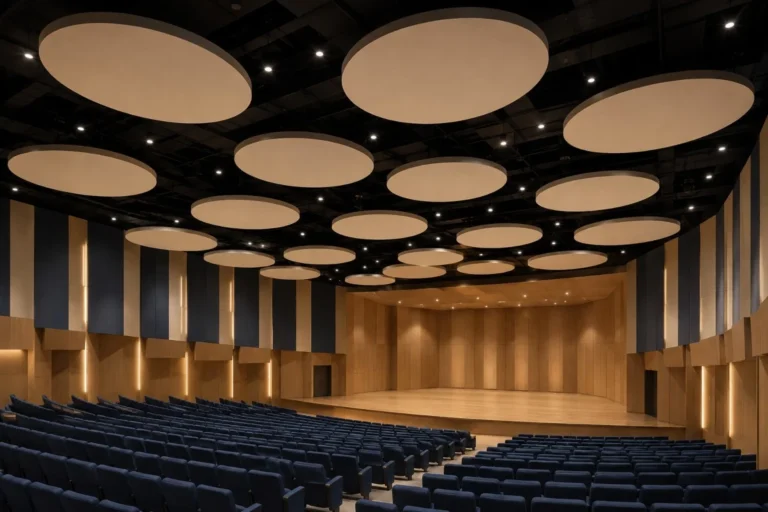
Auditorium / Performing arts venue: Full-spectrum absorption required; fire Class A mandatory; visual character matters. Best solution: Groovphonic™ Composite panels or EchoStop™ Perforated panels on side walls and rear for controlled absorption with diffusion; fabric-wrapped bass absorbers at first and second order reflection points.
Recording studio / Broadcast room: Maximum NRC across mid-high frequencies; low-frequency treatment essential; fire rating may not apply in non-public spaces. Best solution: Fabric-wrapped panels (NRC 1.0, 50–75 mm core) at all primary surfaces; EchoStop™ grooved slats only as a decorative element behind the mixing position if the visual is important to the client.
Hotel lobby / Hospitality reception: Premium aesthetic is as important as acoustic control; moderate RT60 target; wipeable surface needed in high-traffic areas. Best solution: EchoStop™ Grooved Wooden Slat panels as the primary treatment. The timber aesthetic aligns with hospitality design briefs. Proven at Hyatt Regency Bhikaji Cama Place, New Delhi and Crowne Plaza Gurgaon.
Restaurant / Bar: Noise reduction without acoustic over-damping; warm ambiance essential; fabric risk from food and drink. Best solution: EchoStop™ Grooved Wooden Slat panels — easy to wipe, premium aesthetic, natural reverb character suits hospitality.
Classroom / Lecture hall: RT60 target of 0.4–0.6 seconds; FR rating mandatory; budget sensitivity. Best solution: Fabric-wrapped panels (budget-friendly standard fabric, FR-rated core) for highest NRC per rupee spent. EchoStop™ grooved slats appropriate for premium educational institutions where design matters.
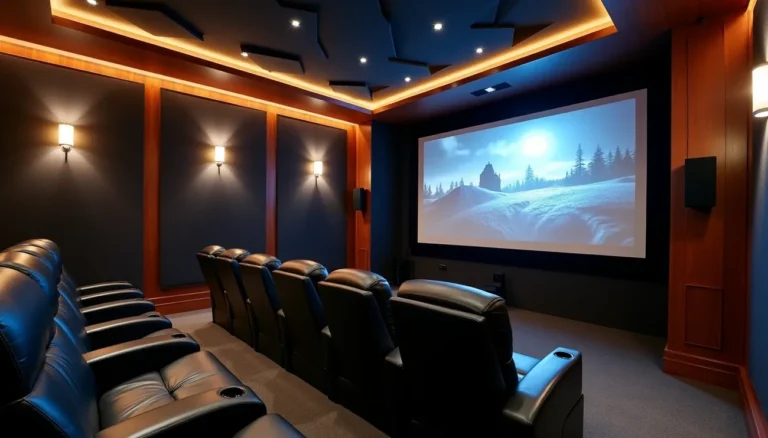
Home theatre / Media room: Maximum NRC on rear wall; aesthetic integration with premium interior; no fire rating requirement for private residential. Best solution: Fabric-wrapped panels on rear wall and side walls for maximum control; EchoStop™ grooved slats on the front wall framing the screen for visual warmth.
Industrial canteen / Factory: High noise levels; budget pressure; impact and moisture exposure. Best solution: Groovphonic™ Composite panels — impact resistant, robust construction, lower cost per unit area than premium fabric systems, food-safe surface.
The Third Option: Use Both
The most acoustically sophisticated — and increasingly common — specification combines both panel types strategically within a single space. This approach uses each panel’s strengths where they are most needed:
- Fabric-wrapped panels on primary reflection surfaces where maximum absorption is required (rear walls, first-reflection side wall zones, ceiling clouds above critical listening positions)
- EchoStop™ Grooved Wooden Slat panels on secondary surfaces and feature walls where the visual impression is most prominent and some diffusion is desirable
This combination delivers the highest possible acoustic control while maintaining a warm, naturally premium aesthetic. It is the approach Ecotone’s acoustic consultants most frequently recommend for premium corporate headquarters, performing arts venues, and luxury hospitality spaces.
Ecotone’s Architect’s Guide to Acoustic Wall Panels in India covers this combination approach in detail, with specification checklists and common mistakes to avoid.
The 5 Most Common Specification Mistakes
Across 1,900+ projects in India, Ecotone’s acoustic design team has seen the same errors repeated. Here are the five most costly:
Mistake 1: Choosing panel type based on aesthetics alone. Grooved wooden slats are currently the most popular choice in premium Indian interiors — and with good reason, they look exceptional. But if your acoustic model requires NRC 0.85+ across a large surface, wooden slats without rockwool infill may fall short. Specify the acoustic target first; then find the panel that meets it aesthetically.
Mistake 2: Not specifying the acoustic backing on grooved slat panels. A grooved wooden slat panel installed without acoustic backing delivers NRC 0.10–0.20 — comparable to a plain timber wall. The backing is not optional. Always specify the backing material, cavity depth, and infill density explicitly in the BOQ.
Mistake 3: Specifying fabric-wrapped panels that are too thin. A 25 mm fabric-wrapped panel absorbs mid and high frequencies well but makes minimal impact below 500 Hz. If low-frequency control is important — as it is in most recording studios, multiplex cinemas, and bass-heavy auditoriums — specify 50 mm minimum, preferably 75 mm, and consider corner bass trap treatment in addition.
Mistake 4: Positioning panels too high on the wall. Both panel types perform best when installed at ear level — the zone between 1.2 m and 2.4 m from the floor. Panels installed above 2.5 m have minimal impact on the primary reflection paths that affect listeners and speakers at normal room occupancy. Always confirm positioning with an acoustic model before installation.
Mistake 5: Under-covering the wall area. As a minimum, treat 20–30% of total wall area with NRC 0.70+ panels to make a meaningful acoustic difference in most commercial spaces. Under-coverage is the single most common reason a client feels the acoustic treatment “didn’t work” — not because the wrong panel was specified, but because too little of it was used.
Frequently Asked Questions
Can I install both wooden slat panels and fabric-wrapped panels in the same room?
Yes, and this is often the optimal approach. Use fabric-wrapped panels at primary acoustic reflection points for maximum NRC, and EchoStop™ grooved slat panels on the feature walls or design-prominent surfaces. The two panel types are complementary — they do not conflict acoustically or visually when specified together.
Which panel type is better for Indian humidity conditions?
Both perform well in standard air-conditioned commercial environments across India. For high-humidity coastal environments or non-air-conditioned spaces, specify moisture-resistant MDF for grooved slat panels and confirm the glass wool core in fabric-wrapped panels is non-hygroscopic (some lower-quality cores absorb moisture and sag). Contact Ecotone for humidity-specific product recommendations.
Do wooden slat panels provide any soundproofing between rooms?
No. Neither wooden slat panels nor fabric-wrapped panels provide meaningful room-to-room sound isolation. They are acoustic treatment products — they reduce reverberation and echo inside a room. For room-to-room isolation (STC performance), a different set of solutions is required. Ecotone’s soundproof enclosure systems and acoustic partition systems address isolation requirements separately.
Are both panel types available in fire-rated versions for auditoriums and public buildings?
Yes. Both EchoStop™ Grooved Wooden Slat panels (with chemically treated fire retardancy and UL-certified rockwool infill) and EchoStop™ Fabric-Wrapped Panels (ASTM D-876 Class A, with FR-rated fabric) are available in fire-rated configurations suitable for auditoriums, schools, healthcare facilities, and other public assembly buildings under NBC 2016.
How long does installation take?
For a standard conference room (30–50 sq m of panel area), installation typically takes 2–3 days. Large commercial fit-outs (corporate offices above 1,000 sq m) typically take 2–4 weeks depending on ceiling height, panel layout complexity, and site access conditions. Ecotone’s project team provides a detailed installation timeline at the quotation stage.
What is the minimum order quantity for custom finishes?
Contact Ecotone’s project team for current MOQ information on custom fabric colours, printed panels, and non-standard finishes. Standard finishes from the EchoStop™ and Packsound ranges are available for projects of all scales.
How to Decide: A Simple Decision Framework
If you are still uncertain after reading this guide, use this five-question framework:
- What is your NRC target? If NRC 0.85+ is required across primary surfaces → fabric-wrapped panels. If NRC 0.70–0.85 with some diffusion is acceptable → grooved wooden slats with backing.
- Is the panel expected to be a design feature? If the timber aesthetic is part of the brief → EchoStop™ grooved slats. If colour customisation and brand alignment matter more → fabric-wrapped panels.
- What is the traffic level? High-traffic or impact-risk environment → Groovphonic™ Composite or grooved slats. Low-traffic premium environment → fabric-wrapped or grooved slats equally suitable.
- Is a fire rating mandatory? Both panel types are available fire-rated. Confirm the specific rating required (IS/ASTM class) and specify FR-rated backing materials and fabric for fabric-wrapped panels.
- What is the budget? Standard fabric-wrapped panels in stock fabrics offer excellent value-for-NRC. Premium grooved slat panels in custom finishes represent a higher design investment. Combination approaches can be optimised to balance both.
If after applying this framework you are still uncertain, the right step is an acoustic consultation — not a guess.
Talk to Ecotone’s Acoustic Consultants
Ecotone Systems and Packsound have delivered acoustic wall panel solutions across 1,900+ projects in India — corporate offices in Gurugram and Mumbai, auditoriums at Nalanda University and BAPS Swaminarayan Mandir in Ahmedabad, hospitality spaces at Hyatt Regency and Crowne Plaza, cinemas achieving NRC 0.90+ across all screens, and recording studios achieving professional-grade performance from Bollywood to podcasting.
Our acoustic consulting service begins with a measurement of your space, digital RT60 modelling, and a panel specification that tells you exactly which panel, how much of it, where to place it, and what backing to specify — before a single panel is ordered. This is the only way to guarantee the acoustic outcome rather than hope for it.
Browse the complete range:
- EchoStop™ Grooved Wooden Slat Panels
- Fabric Wrapped Acoustic Panels
- Groovphonic™ Composite Acoustic Panels
- Perforated Wooden Slat Panels
- Full Acoustic Wall Panel Range
Or request a free acoustic consultation and let our team assess your specific space, confirm the right panel specification, and provide a project quotation — no obligation, no jargon.
Related reading: Wood Wall Paneling — Complete Guide | Acoustic Baffles vs Acoustic Panels — Understanding the Difference | Architect’s Guide to Acoustic Wall Panels in India | Sound Absorbing Materials for Walls — Complete Guide 2026