
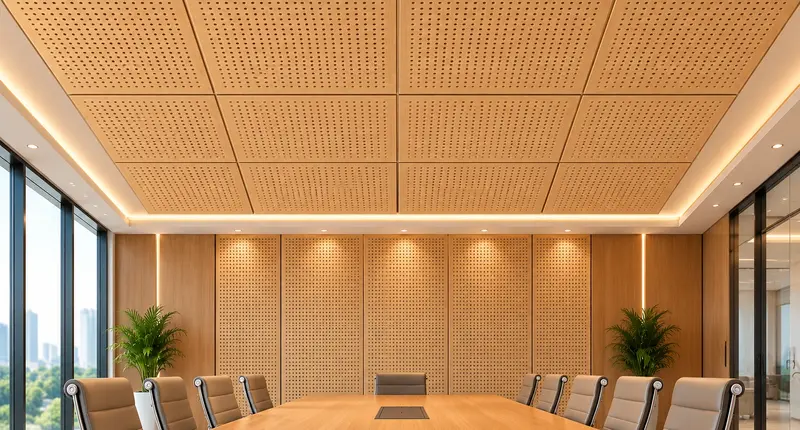
Perforated MDF Panels are medium density fiberboard sheets with precisely drilled or routed holes that let sound waves pass through the surface into an absorbing layer behind it. Modern homes with hard floors, glass, and bare walls often have echo, boomy voices, and noisy living rooms. Perforated MDF controls this reverberation while giving walls a clean, designed look.
How Do Perforated MDF Panels Absorb Sound?
Holes let mid and high frequency sound travel inward.
Acoustic fleece, mineral wool, or PET felt turns sound energy into small amounts of heat.
A gap behind the panel improves absorption of lower frequencies.
What Makes Decorative Perforated MDF Panels Different From Plain Acoustic Boards?
What Affects Perforated MDF Board Price?
Buyers often search for perforated mdf board price before understanding what drives it. Cost depends on:
Board thickness and grade
Hole pattern, size, and open area
Surface finish (raw, painted, laminate, or veneer)
Acoustic backing type
Order quantity and custom cutting
Because each project differs, request a quote based on your room size and pattern instead of comparing flat rates. Packsound.in can help you match specifications to your budget.
Is Perforated MDF Better Than Other Acoustic Materials?
How Do You Choose the Right Perforated MDF Panels for Your Space?
Start with the problem you want to solve. Clap in the room: if you hear a sharp ringing echo, you need broadband absorption. Then check:
Conclusion:
Perforated MDF Panels
Perforated MDF Panels improve room acoustics by combining a sound-transparent surface with an absorbing core and air cavity. They reduce echo, improve speech clarity, and add a refined look to modern homes. Success depends on the complete build: perforation pattern, backing, cavity depth, and placement. Plan these properly and you get a quieter, clearer, better-looking room.
Frequently Asked Questions:
Yes, when paired with acoustic backing and an air gap. Without backing, the effect is minimal.
Yes. It softens room echo, though it will not block outside noise. Soundproofing needs mass and sealing.
No. It absorbs sound inside a room but does not stop it from passing through walls.
Yes. Use light coats of paint so the holes do not clog and block sound.
Around 20 to 30 percent of wall surface is a practical starting point for most rooms.



One Comment