
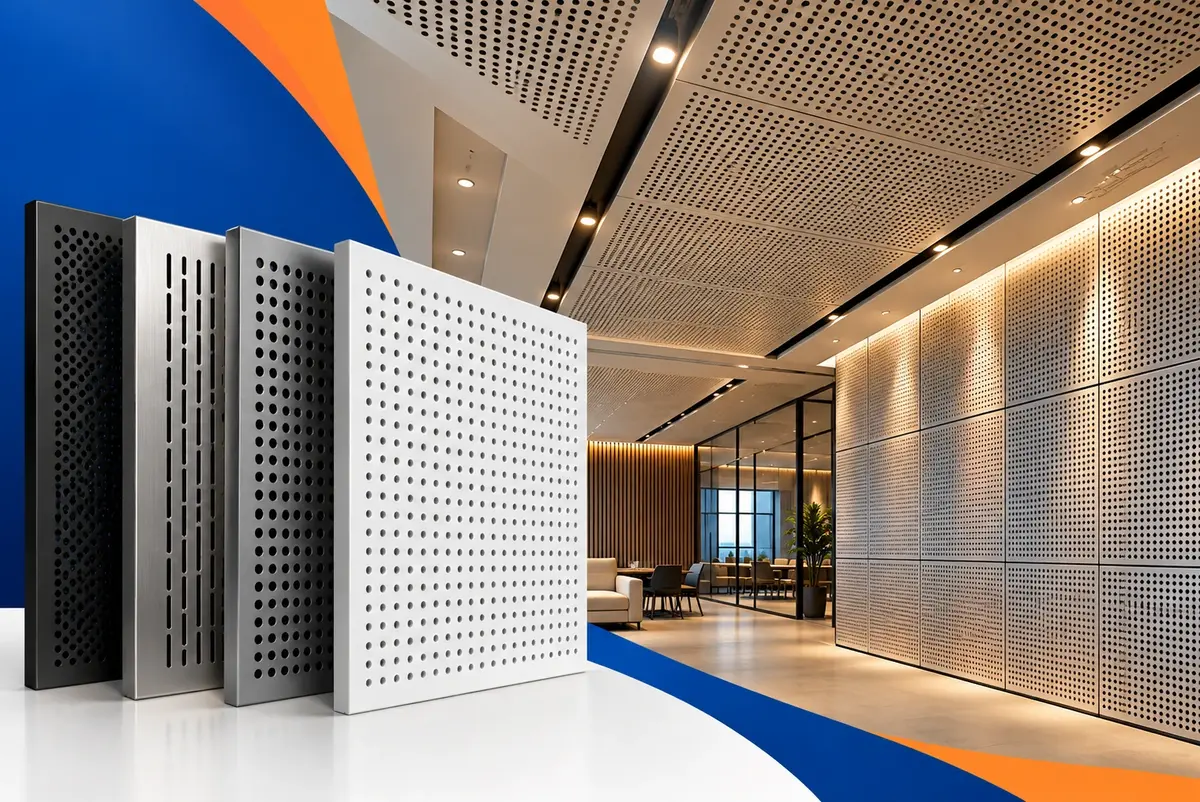
Intro: Choosing between aluminium and steel changes how your Perforated Metal Acoustic Panels perform, install, and last. This guide compares both materials across sound absorption, durability, weight, and cost, helping architects and facility owners specify the right Perforated Metal Acoustical Panels for offices, auditoriums, and industrial spaces.
What Are Perforated Metal Acoustic Panels?
Perforated Metal Acoustic Panels are metal sheets punched with evenly spaced holes and backed by an absorptive core, usually mineral wool, polyester fibre, or foam. Sound waves pass through the perforations, strike the core, and convert into heat instead of bouncing back. This is the working principle behind Acoustical Panel Absorbers and Sound Absorbing Panels used in modern interiors, producing a measurable drop in reverberation time and clearer speech.
Why Does Material Choice Matter for Sound Absorption Panels?
The base metal does not absorb sound on its own. Absorption comes from perforation ratio, hole size, and backing material. However, the metal affects rigidity and how consistently the panel performs over years of use. A thin, poorly supported sheet can flex and colour the sound, while a well-engineered panel, aluminium or steel, maintains stable Noise Reduction Coefficient (NRC) performance, often 0.75 to 0.95, with the right core thickness and air gap.
Aluminium Acoustic Panels: What Are the Core Benefits?
Aluminium Acoustic Panels are valued for being lightweight, corrosion resistant, and easy to fabricate into curved or custom shapes. Key advantages:
- Lower weight – easier handling, less load on ceiling grids and framing.
- Natural corrosion resistance – suits humid interiors and coastal buildings.
- Better formability – ideal for custom perforation patterns and curved designs.
- Recyclability – widely recycled, supporting green building goals.
Aluminium suits offices, hospitality interiors, healthcare facilities, and auditoriums where aesthetics and corrosion resistance matter most. Also Read: Perforated vs Non-Perforated Acoustic Panels.
Galvanized Steel Acoustic Panels: Where Do They Perform Better?
Galvanized Steel Acoustic Panels bring higher tensile strength at similar thickness, making them a preferred choice as Impact Resistant Acoustic Panels. Benefits:
- Higher mechanical strength – better resistance to dents and impacts.
- Cost efficiency – generally lower material cost per square metre.
- Stability at larger spans – resists warping in bigger panel formats.
- Structural durability – suited to factories and heavy-use zones needing robust Noise Control Panels.
Aluminium vs Steel: How Do They Compare Side by Side?
Aluminium vs Galvanized Steel
Material Comparison
Which Panels Suit Ceilings vs Walls?
Acoustic Ceiling Panels usually favour aluminium because of reduced load on suspension grids, especially across large open-plan offices. Acoustic Wall Panels work well in either material, though steel is chosen more in corridors and industrial walls prone to impact. Both function as Reverberation Control Panels when perforation percentage and core density match the room’s volume and use.
How Do Industrial Acoustic Panels Differ From Standard Panels?
Industrial Acoustic Panels prioritise durability over decorative finish, so steel dominates due to strength under vibration and mechanical stress. Aluminium is reserved for lighter industrial zones needing corrosion resistance, such as food processing plants. A technical resource on architectural metal ceilings notes that perforated aluminium panels are increasingly favoured for sustainability and recyclable content, while steel remains standard where impact resistance is the priority
Conclusion
Both Aluminium Acoustic Panels and Galvanized Steel Acoustic Panels deliver strong sound absorption when engineered correctly. Choose aluminium for lightweight, corrosion-resistant, design-flexible installations, and steel when impact resistance and cost efficiency are the priority. Packsound.in offers both options across its Metal Acoustic Panels range, helping specifiers match the right panel to each project’s needs.
Frequently Asked Questions
Perforated Metal Acoustic Panels
Q1. Do perforated metal acoustic panels actually reduce noise, or just look good?
Yes. The perforations let sound reach the absorptive core behind the metal, reducing reverberation rather than just reflecting noise elsewhere.
Q2. Is aluminium or steel better for a home studio?
Aluminium is usually preferred since it is lighter, easier to mount, and resists moisture-related corrosion over time.
Q3. Can perforated metal panels be used outdoors?
Yes, but aluminium performs better outdoors due to natural corrosion resistance, while steel needs proper galvanizing to avoid rust.
Q4. What perforation percentage gives the best sound absorption?
Higher open area, typically 15 to 25 percent, generally improves absorption, but the ideal ratio depends on hole size, core material, and cavity depth.
Q5. Are perforated metal panels more expensive than foam acoustic panels?
Metal panels cost more upfront than foam but last significantly longer and need far less replacement over a building’s lifetime.
Summary:
Perforated Metal Acoustic Panels
Perforated Metal Acoustic Panels remain the go-to solution for controlling reverberation in commercial and industrial spaces. Aluminium suits lightweight, corrosion-resistant, design-driven projects, while galvanized steel suits high-impact, cost-sensitive, industrial environments.


One Comment