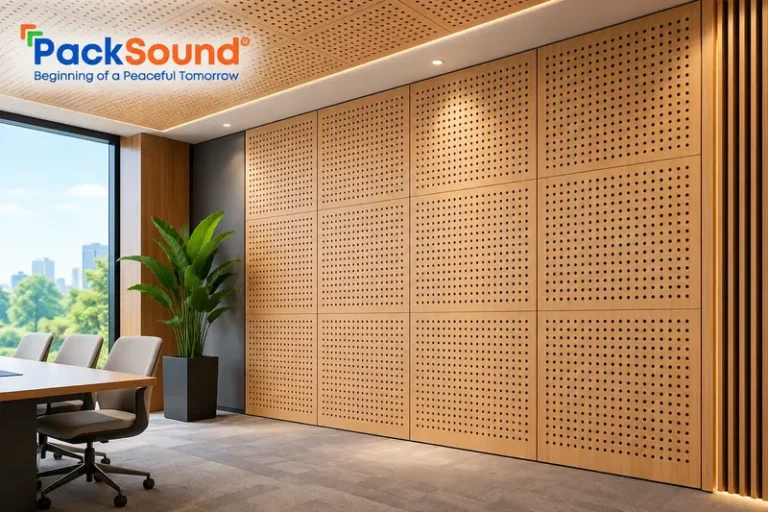
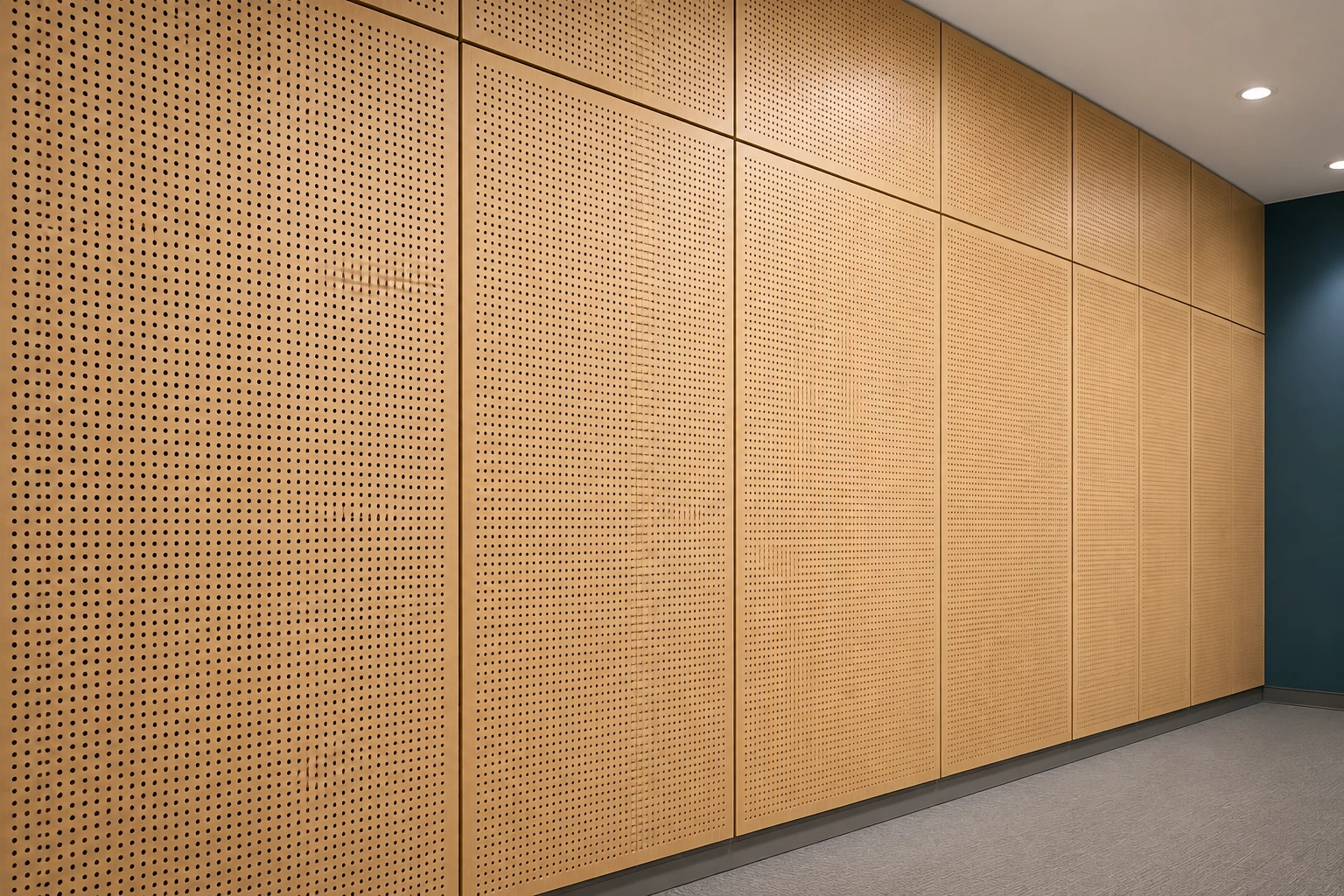
Perforated acoustic panels have a face punched with evenly spaced holes, usually 3 mm to 10 mm in diameter, that let sound waves pass through to an absorptive backing (mineral wool, glass wool, or polyester fibre) sitting behind the board. Each hole behaves like a tiny Helmholtz resonator. The air inside oscillates against the air cavity behind the panel, and that motion, combined with the fibrous backing, converts sound energy into a small amount of heat instead of letting it bounce back into the room.
Depending on the hole pattern and backing, perforated panels can reach an NRC (Noise Reduction Coefficient of roughly 0.60 to 1.00 – a wide range, because performance depends heavily on the open area ratio (the percentage of the face that’s actually holes):
- Below 5% open area: narrow absorption, tuned to specific frequencies
- 5–15% open area: the most common range, NRC around 0.60 – 0.80
- 15–25% open area: wider bandwidth, NRC around 0.80 – 0.95
- Above 25% open area – the facing becomes almost acoustically transparent
Common materials include perforated MDF or wood veneer, cement board, metal, and micro-perforated acrylic for spaces that want the acoustic benefit without a visibly “perforated” look. If you want a closer look at hole patterns, thickness options, and finishes, our perforated acoustic panels guide covers the full range.
What Are Non-Perforated (Solid) Acoustic Panels?
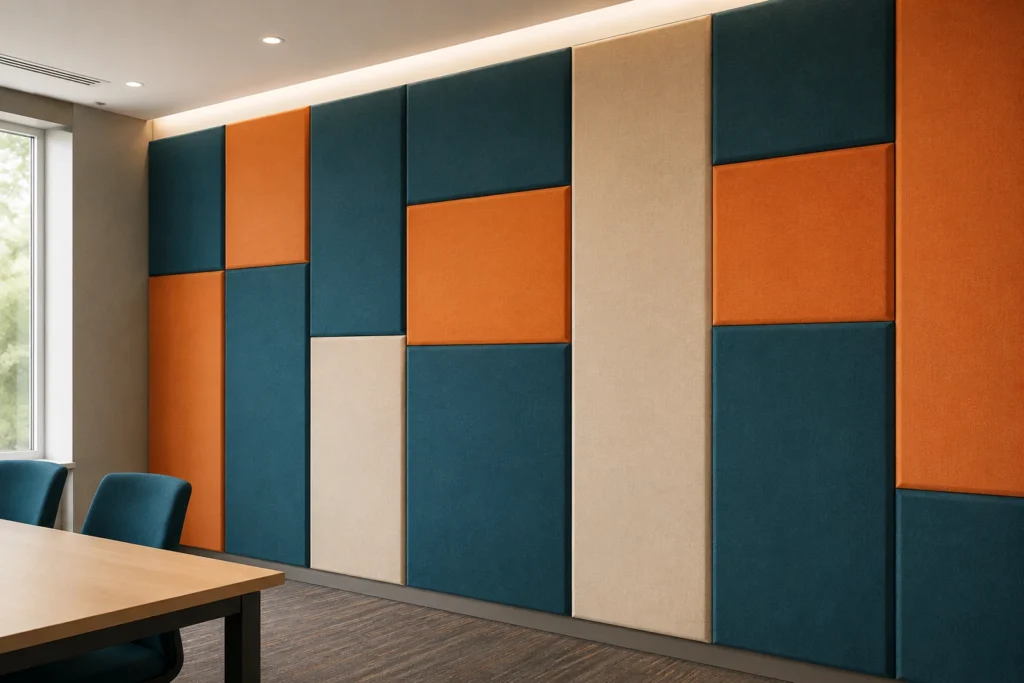
Non-perforated panels, also called solid acoustic panels, have a continuous, unbroken face. There are no holes for sound to travel through; instead, the entire surface is porous or fabric-covered, so sound is absorbed the moment it hits the panel rather than after passing through a perforation. Fabric-wrapped panels over glass wool or mineral wool, PET-fibre boards, acoustic foam, and grooved wooden slats over an acoustic backing all fall into this category.
Because the whole face is absorptive rather than a percentage of it, solid panels tend to deliver more consistent, broad-spectrum absorption across low, mid, and high frequencies. Typical NRC ranges look like this:
- Fabric-wrapped glass wool/mineral wool NRC 0.75–0.95
- PET fibre (recycled polyester) panels: NRC 0.60–0.85
- Acoustic foam NRC 0.50–0.75
Perforated vs Non-Perforated Acoustic Panels: Sound Absorption Compared
This is where the real decision usually gets made. Perforated panels are tuned instruments: the hole size, spacing, and cavity depth behind the panel determine exactly which frequency range gets absorbed best, which makes them excellent for controlling specific echo or flutter problems (common in boardrooms, lecture halls, and cinemas) while keeping a clean architectural face.
Non-perforated panels don’t need tuning to work; the entire surface absorbs across a broad range as soon as sound reaches it, which is why recording studios, podcast rooms, and industrial spaces that need blanket noise reduction usually default to solid, fabric-wrapped, or foam panels.
Neither type blocks sound between rooms; that requires mass, sealed assemblies, and decoupling, which is a soundproofing job, not an absorption job. Both perforated and non-perforated panels only clean up the sound within the room they’re installed in.
Solid vs Perforated Panels: Looks, Cost and Durability
Appearance, budget, and upkeep usually settle the debate once absorption needs are similar:
- Aesthetics – Perforated panels read as modern and architectural, with a visible hole pattern that works well in corporate lobbies and premium interiors. Solid panels feel more minimalist and are easier to finish in custom fabrics, prints, or a natural wood grain.
- Cost – Perforated panels are generally the pricier option because of the CNC-cutting or punching process involved. Solid, fabric-wrapped panels are typically more affordable to produce at scale.
- Maintenance and durability – Holes can trap dust over time and need occasional vacuuming, especially in Indian conditions with higher ambient dust. Solid panels, particularly fabric-wrapped ones, are more robust day-to-day but can show wear or staining on the fabric face faster than a hard perforated surface.
- Fire and moisture performance – Both types are available in fire-rated and moisture-resistant variants; this depends more on the core material (mineral wool, PET fibre, MDF) than on whether the face is perforated.
Best Acoustic Panel Type for Offices
For most Indian offices, the honest answer is: both, used in the right place. Open-plan work areas and boardrooms benefit from perforated wood or MDF panels on feature walls — they control speech reflections and reverberation while looking deliberately designed rather than “acoustically treated.” Meeting rooms and phone booths, where speech clarity matters more than décor, often do better with fabric-wrapped solid panels because of their stronger broadband absorption.
A well-planned office rarely uses just one panel type. A common approach is perforated wood panels on visible walls near reception and boardrooms, paired with solid fabric-wrapped panels inside enclosed meeting rooms and near HVAC or equipment noise sources where broad-spectrum absorption matters more than the finish.
Where Should You Use Each Panel Type?
Perforated acoustic panels work well in:
- Corporate offices, boardrooms, and reception areas
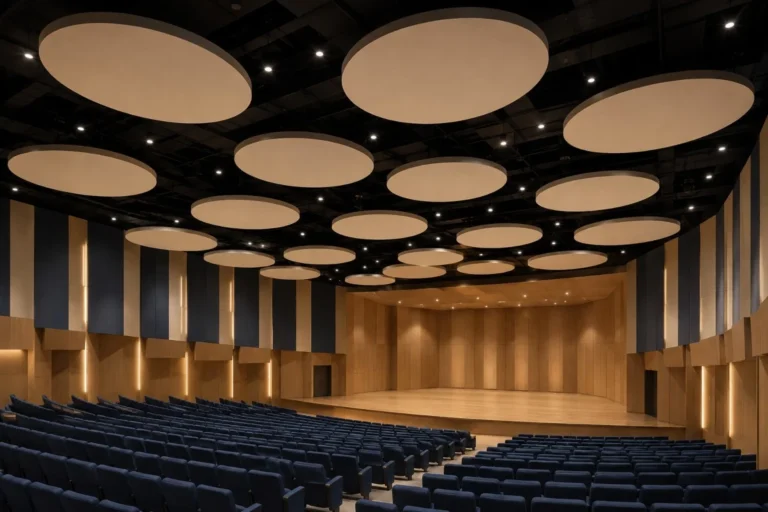
- Auditoriums, lecture halls, and cinemas
- Restaurants, hotel lobbies, and hospitality interiors
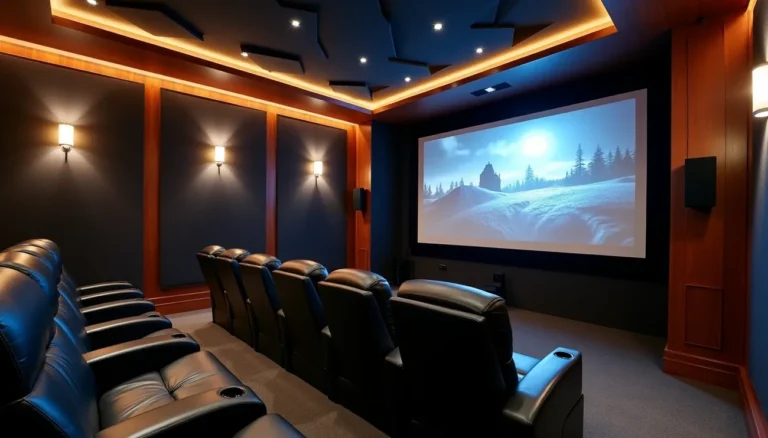
- Home theatres that also need a polished, architectural finish
Non-perforated (solid) acoustic panels work well in:
- Recording studios, podcast rooms, and home studios
- Open-plan offices and classrooms needing broad noise control
- Industrial spaces and plant rooms
- Budget-sensitive projects that still need strong absorption
How to Choose Between Perforated and Non-Perforated Panels
Run through these questions before finalising a panel type:
- What frequency is the problem? Speech and mid-range echo often respond well to perforated panels; broadband rumble or general noise usually needs a solid, fabric-wrapped panel.
- How important is the finish? If the panel needs to look architectural and blend into the design, perforated wood or micro-perforated options usually win.
- What’s the dust and cleaning environment? Dusty, high-footfall spaces favour solid or easily wipeable faces over exposed perforations.
- What’s the budget per square metre? Solid, fabric-wrapped panels generally stretch further on large-area projects.
- Is fire rating mandatory? Confirm the core material’s fire certification regardless of which face you choose — this is a core-material question, not a perforated-vs-solid one.
Conclusion
Perforated vs non-perforated acoustic panels isn’t really a contest with one winner — it’s a match between the acoustic problem in front of you and the finish you want on the wall. Perforated panels give you tuned, architectural sound control that looks deliberate. Non-perforated, solid panels give you dependable, broad-spectrum absorption at a friendlier price point. Most well-treated spaces, from corporate offices to home theatres, end up using a mix of both rather than picking a single type for the entire room.
FAQ
Which absorbs sound better perforated or non-perforated acoustic panels?
Neither is universally "better." Perforated panels are tuned to specific frequencies through their hole pattern and can match or exceed solid panels in that range; non-perforated panels absorb more consistently across the full frequency spectrum. The right choice depends on whether you're solving a specific echo problem or general noise.
Are perforated acoustic panels more expensive than solid ones?
Usually, yes. The perforation process adds manufacturing cost, so perforated panels tend to sit above solid, fabric-wrapped panels of similar size and core material.
What is the best acoustic panel type for offices?
Most offices benefit from a mix: perforated wood panels on visible feature walls and boardrooms for a polished look, and solid fabric-wrapped panels in enclosed meeting rooms where broadband absorption matters more than the finish.
Do perforated panels collect dust over time?
Yes, more than solid panels, since the holes can trap dust. Periodic vacuuming keeps performance and appearance consistent, especially in higher-dust environments.
Can perforated and non-perforated panels be used together in the same room?
Yes, and it's common practice. Many projects use perforated panels on visible architectural surfaces and solid panels where broadband absorption or budget matters more than the finish.