
Micro Perforated Panel Manufacturer in India | Packsound
Quick summary: A micro perforated panel (MPP) is a rigid acoustic panel with sub-millimeter holes, usually 0.2 mm to 1 mm, that absorbs sound through friction inside each hole combined with resonance from an air cavity behind it, without fibrous infill. Packsound manufactures MPP acoustic panels in India for offices, auditoriums, studios, and hospitals. With NRC ratings from 0.70 to 0.95 depending on hole density, panel thickness, and cavity depth.
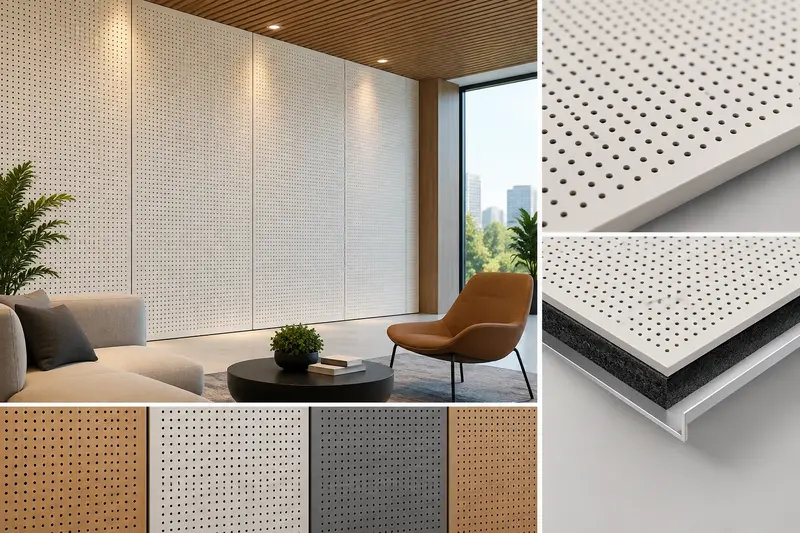
What Is a Micro Perforated Panel?
A micro-perforated panel, also written as microperforated panel or MPP, is a rigid acoustic panel perforated with holes typically 0.2 mm to 1 mm in diameter, at an open area ratio of 0.5% to 2%, mounted over a sealed air gap in front of a rigid backing wall. It functions as a sound absorber without foam, mineral wool or fabric, which makes it suitable where hygiene, dust control or a minimal finish is required.
How Does a Micro Perforated Panel Actually Work?
Sound waves push air back and forth through each micro hole. The narrow hole diameter creates viscous resistance (acoustic impedance), converting sound energy into a tiny amount of heat, while the air cavity behind the panel acts as a spring that tunes the system to resonate at a specific frequency, boosting absorption at that range.
This is not a marketing simplification. The underlying physics was formalized by acoustician D.Y. Maa in a widely cited 1998 paper in the Journal of the Acoustical Society of America, which modeled the specific acoustic impedance of narrow perforations backed by an air cavity. This model is still the base reference used across MPP engineering research today, including studies on finely perforated wooden and metal panels published in peer-reviewed acoustics journals (source: NCBI PMC). In practice, this means three variables decide performance long before installation:
- Hole diameter and perforation density control acoustic resistance.
- Air cavity depth controls the resonance frequency, deeper cavity, lower frequency.
- Panel thickness and mass influence stability and the acoustic mass reactance of the system.
Get any one of these wrong on site and the panel looks identical but performs 20 to 40% below its rated sound absorption coefficient. This is the single most common quality issue we see in MPP installations across India, and it is invisible until an acoustic test is run.
Myth vs Reality: Micro Perforated Panels
Myth
Reality
Invisible holes mean the panel has no real acoustic value or performance.
Sub-millimeter holes still generate friction-based absorption; visibility has no bearing on acoustic performance.
More holes always give better sound absorption in any micro perforated panel.
Too many holes lower resistance, weakening absorption; open area ratio must stay near 0.5 to 2%.
MPP absorbs bass frequencies as well as thick porous foam or mineral wool.
MPP needs a deep tuned air cavity for low frequency sound absorption; foam is not required for this.
A micro perforated panel works the same with or without an air cavity.
Air cavity depth directly sets the resonance frequency; without it, absorption drops sharply.
Any manufacturer can hit NRC 0.9 by simply drilling smaller holes.
NRC 0.9 needs precise hole diameter, cavity depth and open area ratio, verified by impedance tube testing.
Perforated panels and micro perforated panels are functionally identical products.
Perforated panels use visible larger holes; MPP uses sub-millimeter holes for a seamless finish and broadband absorption.
EchoStop™ Micro Perforated Acoustic Panels
Parameter
Typical Value
Core material
MDF, HDF, plywood, metal or composite panel
Panel thickness
12 mm to 18 mm
Hole diameter
0.2 mm to 1 mm
Open area ratio
0.5% to 2%
Panel size
2440 mm × 1220 mm, custom sizes available
Sound absorption coefficient (NRC)
0.70 to 0.95
Emission standard
E1 grade low emission board
Benefit
Why It Matters
Broadband sound absorption
Covers mid to high frequency noise, extendable to low frequency with cavity tuning
Seamless aesthetic finish
Near-invisible perforation keeps interiors clean and premium
No fibrous backing required
Reduces dust exposure, suited to hospitals and labs
High acoustic impedance control
Absorption is tunable, not fixed, for the exact NRC target
Fire-retardant grades available
Meets stricter commercial and public-space fire codes
Low maintenance
Dusting or light wiping keeps performance stable for years
Design flexibility
Available in veneer, laminate, metal or painted finish.
Space
Use Case
Corporate offices
Boardrooms and meeting rooms needing speech clarity, not visible acoustic clutter
Auditoriums and lecture halls
Controlled reverberation without heavy visible panel design
Hospitals and laboratories
Hygienic sound absorber where fibrous material is restricted
Metro stations and transit hubs
Durable noise control panel able to handle heavy footfall areas
Hospitality interiors
Hotels and restaurants needing subtle, premium acoustic treatment
Recording studios
Precise, tunable acoustic performance without altering room aesthetics
Home theatres
Discreet sound attenuation for high-end residential interiors
Step
Action
1. Surface check
Confirm the wall or ceiling is clean, dry and level
2. Framework setup
Fix metal channel or wooden batten support at defined spacing
3. Cavity planning
Set air cavity depth per the target frequency range
4. Panel mounting
Fix panels with concealed clips or screws, aligned precisely
5. Joint finishing
Close joints and edges for a seamless surface look
6. Acoustic check
Verify no gaps exist that would leak sound reflections
7. Final inspection
Confirm alignment, finish quality and secure fixing
Why Most Micro Perforated Panel Installations Underperform Their Rated NRC
On paper, an MPP absorber rated NRC 0.85 should perform identically on every project. In practice, we have measured a 15 to 30% drop in real-world absorption across otherwise identical panels, and the cause is almost never the panel itself. It is the installation.
The three failure points we see most often on Indian sites:
- Sealed instead of open cavities. Contractors sometimes seal the back of the panel airtight against the wall to “make it sturdier.” This kills the tuned resonance the cavity was designed for, because the air cavity needs to behave as a controlled spring, not a sealed void.
- Wrong cavity depth for the frequency target. A 25 mm air gap behind an MPP tuned for speech clarity will not touch low frequency HVAC hum. Cavity depth has to match the actual noise complaint, not a generic default.
- Rigid backing wall assumptions. MPP performance data assumes a genuinely rigid backing wall. Drywall partitions that flex slightly under sound pressure absorb some energy themselves, which throws off the panel’s expected acoustic impedance and skews on-site test results versus lab data.
This is also why we run acoustic material characterization and RT60 reverberation time testing as a standard step on larger commercial projects, rather than shipping panels off a generic NRC number. A panel is only as good as the cavity and wall it is mounted against.
Customization Options
Customization Area
Details
Perforation Design and Density
The size, spacing and density of micro perforations can be customized to achieve the desired acoustic response. Smaller holes with higher density provide more controlled absorption while maintaining a clean surface appearance.
Open Area Ratio
The percentage of perforated surface can be adjusted to fine-tune sound absorption. Lower open area maintains a more solid look, while higher ratios improve acoustic performance.
Material Selection
Panels can be manufactured using MDF, HDF, plywood, metal or composite materials based on application requirements. Fire-retardant and moisture-resistant variants are also available.
Surface Finishes
A wide range of finishes can be applied, including natural wood veneer, laminate, melamine, paint or powder coating. This allows seamless integration with modern and high-end interior designs.
Panel Size and Thickness
Custom panel dimensions and thicknesses can be specified to match wall or ceiling layouts, ensuring efficient installation and minimal wastage.
Cavity Depth and Acoustic Design
The depth of the air gap behind the panel can be customized to target specific frequency ranges, especially for improved low-frequency absorption.
Edge Detailing and Joint Design
Panels can be designed with precise edge profiles for nearly invisible joints, creating a smooth and continuous surface finish.
Color and Design Integration
Custom colors and finishes allow panels to blend into interiors or stand out as a design feature, depending on the project requirement.
Overall Customization
This level of customization enables micro perforated panels to meet strict acoustic targets while maintaining a refined, minimal and high-quality architectural finish.
Technical Data Sheet (TDS)
Property
Value
Product name
Packsound EchoStop Micro Perforated Panel
Core material options
MDF / HDF / Plywood / Metal / Composite
Standard panel size
2440 mm × 1220 mm (custom on request)
Panel thickness
12 mm to 18 mm
Perforation hole diameter
0.2 mm to 1 mm
Open area ratio
0.5% to 2%
Recommended air cavity depth
25 mm to 150 mm (application dependent)
Sound absorption coefficient (NRC)
0.70 to 0.95
Effective frequency range
Mid to high, extendable to low with cavity tuning
Surface finish
Veneer, laminate, melamine, paint, powder coat
Fire performance
Fire-retardant grade available on request
Emission standard
E1 grade or equivalent low-emission board
Backing requirement
Optional acoustic infill, not mandatory
Recommended test reference
ISO 354 (random incidence) / ASTM C423
Micro Perforated Acoustic Panels FAQs
Do micro perforated panels actually work for soundproofing a room?
They absorb sound within a room (echo, reverberation); they do not block sound transfer between rooms like insulation does.
Is MPP better than acoustic foam for a home studio?
MPP gives a cleaner finish and durability; foam is cheaper and often stronger for pure high frequency absorption.
Can I install micro perforated panels myself?
Basic wall mounting is DIY-possible, but cavity depth and framework spacing need acoustic knowledge to perform correctly.
Do MPP panels stop bass or low frequency noise?
Only with a properly tuned, deeper air cavity; shallow cavities mainly target mid and high frequency sound.
What is the difference between perforated and micro perforated panels?
Perforated panels have larger visible holes; micro perforated panels use sub-millimeter holes for a near-invisible finish.
Do micro perforated panels need fabric or foam backing?
Not always; many MPP systems work with just a tuned air cavity and no fibrous backing at all.
How much does an MPP acoustic panel cost in India?
Cost varies by material, finish, hole density and project size; request a quote based on your NRC target.
Will MPP panels work in humid Indian climates?
Moisture-resistant and metal variants are available for humid or coastal regions; standard MDF needs climate-controlled interiors.
Can micro perforated panels be painted after installation?
Pre-finished panels are recommended; on-site painting risks clogging the micro perforations and reducing sound absorption performance.
Are micro perforated panels good for open office noise control?
Yes, especially combined with ceiling baffles or clouds, since MPP alone will not fix distance-based speech privacy issues.