Choosing between a sliding partition vs folding partition is a common dilemma for offices, hotels, and banquet spaces that need flexible room division. This guide compares both systems so you can pick the right movable partition wall for your space.
The decision usually comes down to floor space, acoustic needs, and how often the wall gets reconfigured. Knowing these differences helps you invest in a solution built for daily use, not just a showroom demo.
What Is a Sliding Folding Wall Partition and How Does It Work?
A sliding folding wall partition combines two motions: panels glide along an overhead track and fold inward for compact stacking. This hybrid suits large halls where full-height panels must disappear quickly.
What Makes a Folding Partition Wall Different From a Sliding One?
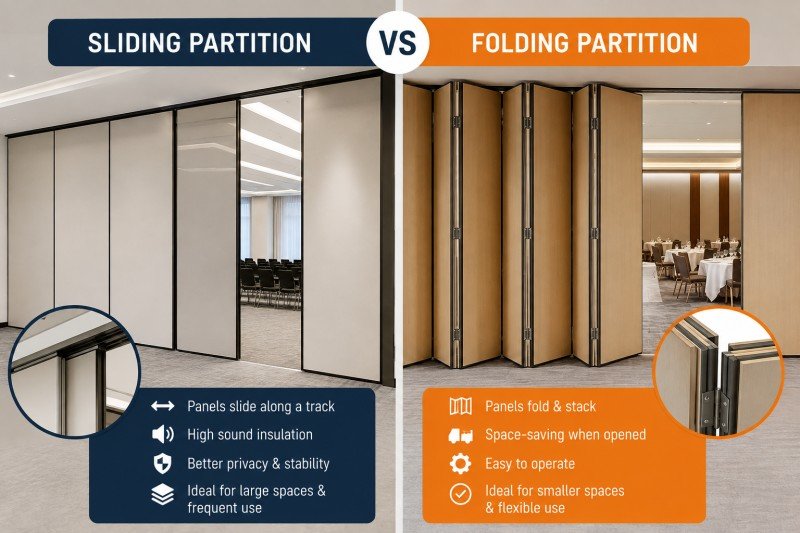
A folding partition wall uses hinged panels that concertina together, ideal for narrower openings. A sliding partition moves panels laterally on tracks without folding. A well-built sliding foldable partition wall often blends both for tighter storage.
Which Offers Better Soundproofing for Meeting Spaces?
Acoustic performance is measured by the Sound Transmission Class (STC) rating, tested under the ASTM E413 standard. A soundproof sliding partition wall with sealed edges and dense cores performs closer to drywall than lightweight folding screens, suiting conference rooms.
What Are the Common Movable Partition Wall Types Used in India?
Indian commercial spaces generally use four movable partition wall types: track-mounted sliding panels, accordion-style folding walls, glass sliding partitions, and hybrid systems. Each varies in acoustic rating and weight, so the right pick depends on room usage
For Indian offices and hospitality venues, a Sliding Folding Room Partition suits rooms needing frequent reconfiguration, while a fixed folding wall suits occasional use. Packsound designs both configurations with sound-dampening cores for reliable performance.
Conclusion
Both systems solve the same problem differently. A sliding partition suits wide, frequently changing layouts, while a folding partition wall fits narrower spaces needing compact storage. Match your choice to room size, sound needs, and usage frequency.
Frequently Asked Questions:
1. Is a sliding partition better than a folding partition for soundproofing?
Generally, yes, sealed sliding panels reduce sound leaks better. Folding walls match this only with dense panels.
2. Which partition type needs less maintenance over time?
Sliding systems need less upkeep, having fewer hinge points. Folding partitions require regular seal checks.
3. Can a folding partition wall fit into small rooms?
Yes, folding walls suit tight spaces since they stack compactly. Sliding partitions need extra wall space.
4. Do sliding folding wall partitions handle humid Indian climates?
Panels with moisture-resistant cores handle humidity well. Confirm core material before coastal installations.
5. Are movable partition wall types expensive to install in offices?
Costs vary with size and mechanism. Basic folding walls cost less than motorized sliding systems.