Open floor plans solved one workplace problem and created another.
Teams got collaboration, but they lost quiet. That gap is exactly why Meeting Pods for Offices have become one of the fastest-adopted furniture categories in modern workplace design, offering a private, soundproof space inside an otherwise open environment without the cost or construction time of a permanent room.
What Exactly Are Meeting Pods for Offices?
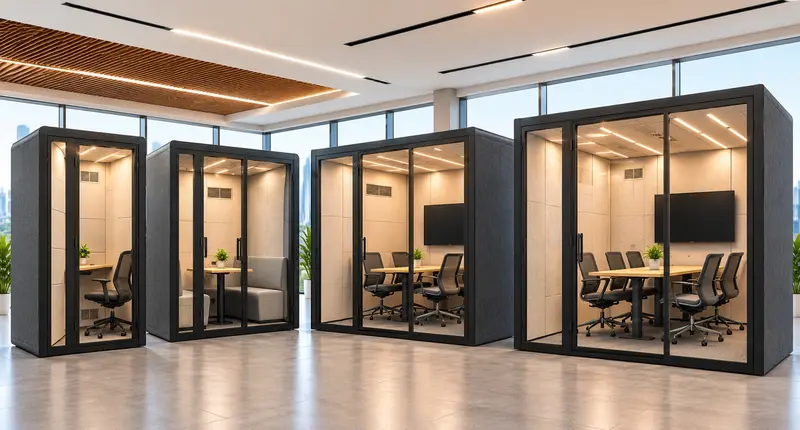
Meeting pods are prefabricated, enclosed units installed directly on an office floor. Unlike Office Phone Booth, which are built for one person taking a call, meeting pods are sized for two to eight people and function as self-contained meeting booths with seating, power outlets, ventilation, and acoustic insulation.
They are modular, so they can be moved, resized, or relocated as a team grows, which makes them very different from fixed-wall construction.
Why Are Companies Opting for Meeting Pods Over Traditional Rooms?
Traditional meeting rooms require architectural planning, electrical work, and weeks of downtime. Office booths and pods skip that entirely. A unit can be delivered, assembled, and made usable within days.
Companies also like that workplace pods can be redeployed if the office layout changes, protecting the investment even through a relocation or redesign.
Do Meeting Room Pods Actually Solve the Noise Problem?
Noise is consistently named the top complaint in open offices. A widely cited 2019 Harvard Business Review study found that open-plan layouts reduced face-to-face interaction and pushed employees toward messaging instead, while separate workplace research has linked open floors to measurable productivity loss from noise distraction.
A soundproof office phone booth or pod addresses this directly by physically isolating sound, which protects both the person inside and the people working nearby.
Are Office Phone Booths Different from Meeting Pods?
Yes. Office phone booths are single-occupant units meant for calls, video meetings, or quiet focus work. Meeting pods are built for group discussions, brainstorming, or client calls where several people need privacy at once.
Many offices now use both, placing smaller booths near desks and larger meeting booths closer to collaborative zones.
How Do Meeting Pods Support Hybrid Work?
Hybrid teams rely heavily on video calls, and background noise is one of the biggest complaints in virtual meetings. A pod gives employees a controlled acoustic environment for video calls regardless of how busy the floor is outside.
This is one of the primary reasons workplace pods have moved from a “nice to have” to a standard line item in office fit-outs.
What Should Businesses Check Before Buying Meeting Pods for Offices?
Before purchasing, companies should evaluate acoustic rating, ventilation capacity, power and data access, size relative to available floor space, and ease of assembly.
Furniture and interior solutions providers such as Packsound.in work with businesses to match pod specifications to actual floor plans rather than offering a one-size-fits-all unit, which avoids costly mismatches later.
Conclusion
Meeting pods for offices exist because open floor plans, while good for collaboration, are poor at protecting focus and privacy. Rather than reverting to closed-door offices, companies are adding modular, soundproof meeting booths that give employees a quiet space on demand.
This single shift addresses noise complaints, supports hybrid video calls, and keeps the office flexible for future changes, which is why adoption continues to rise across corporate, co-working, and tech office environments.
Frequently Asked Questions
1. Are meeting pods really soundproof or just sound-dampening?
Most office pods reduce noise significantly rather than block it completely. Look for an acoustic rating sheet before buying.
2. How much office space does a meeting pod need?
A single-person booth needs roughly 1.5 to 2 square meters, while 4 to 6 person pods typically need 4 to 6 square meters.
3. Can meeting pods be moved once installed?
Yes, most modular pods can be disassembled and relocated, which is a key advantage over permanent walled rooms.
4. Do meeting pods need separate ventilation or AC?
Quality pods include built-in ventilation fans; larger units for extended use often need an added air circulation or cooling unit.
5. Are meeting pods worth it for small offices?
For small offices with limited private space, even one or two pods can meaningfully reduce noise complaints and improve call quality.
Summary
Meeting pods for offices are modular, soundproof enclosures that give employees private space for calls and meetings inside open-plan layouts. They solve the well-documented noise and privacy problems of open offices, install faster than built rooms, support hybrid video work, and stay flexible as teams and layouts change, which is why more companies are adopting them as standard office infrastructure.