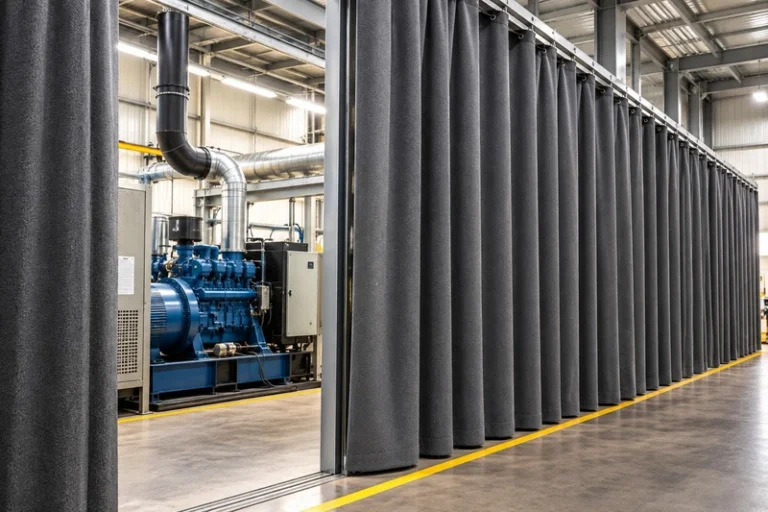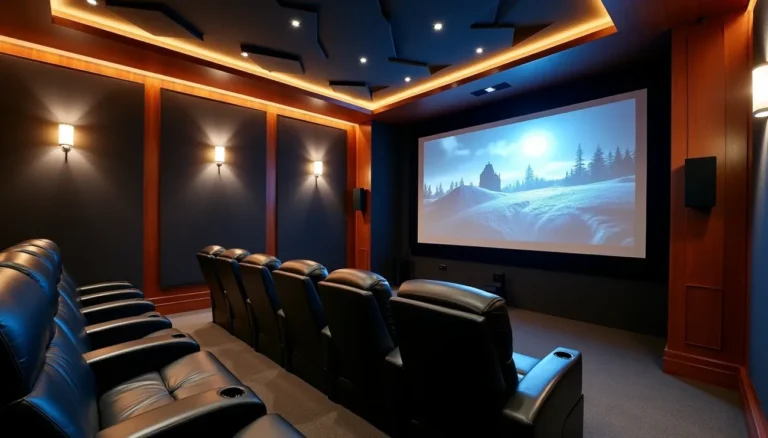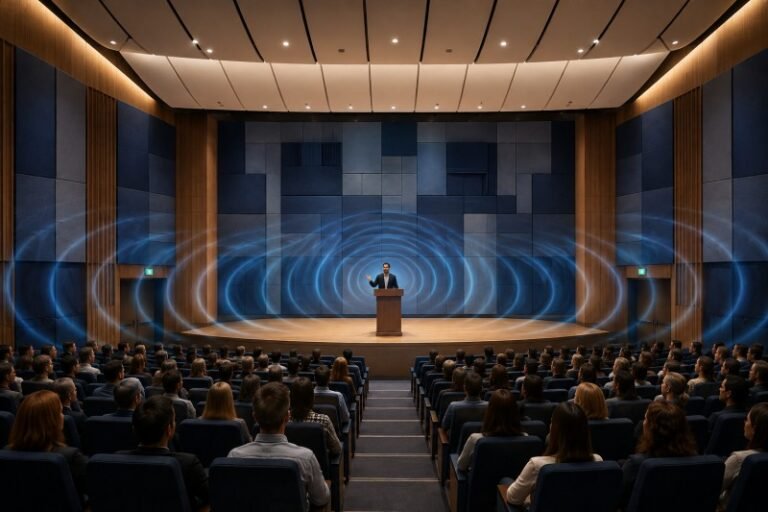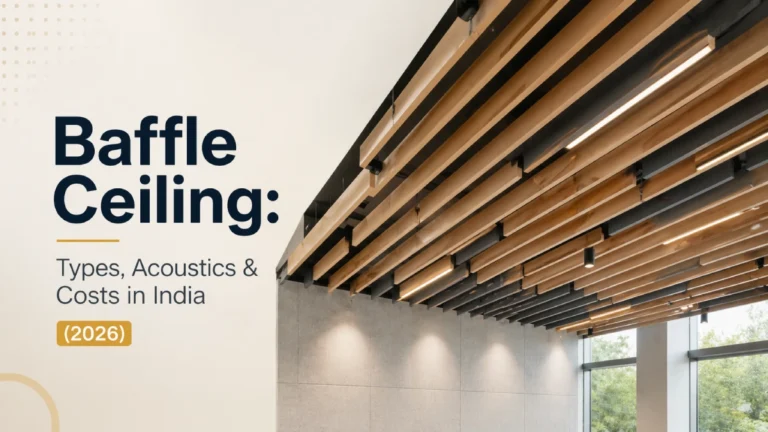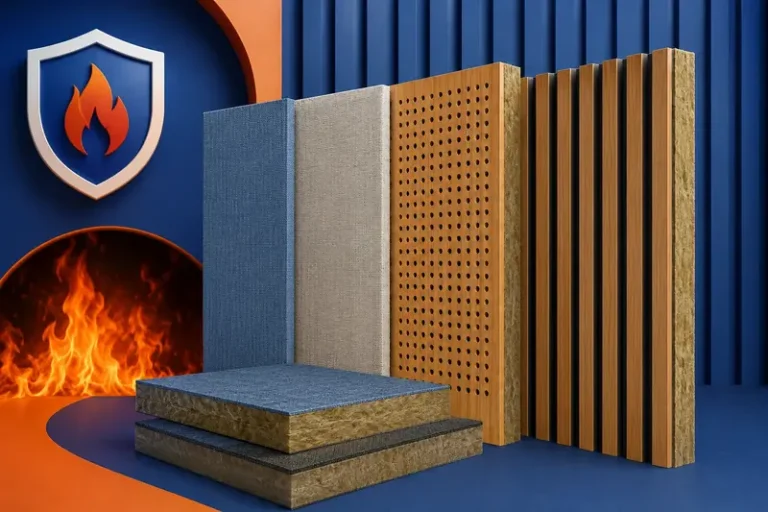
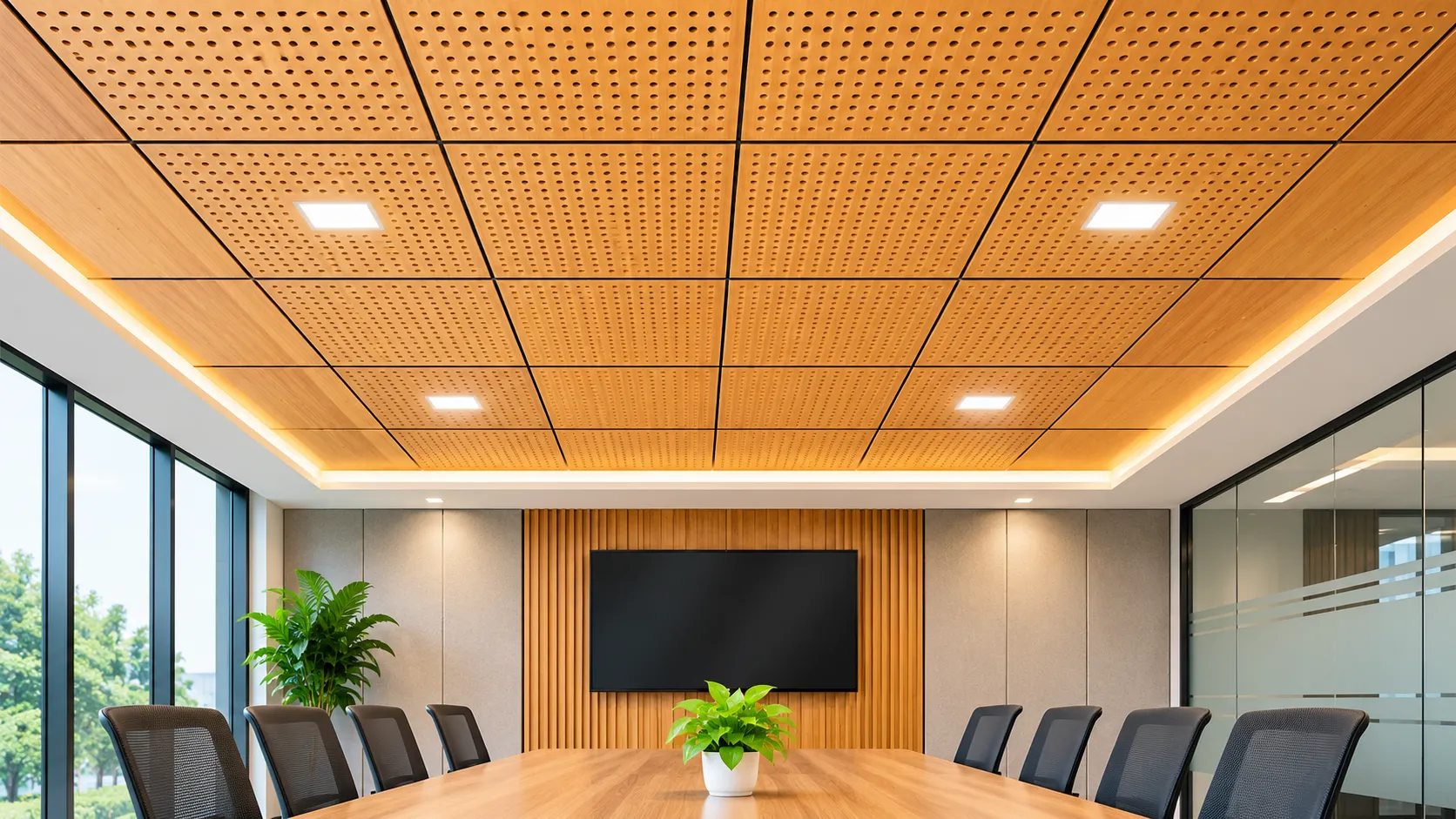
A hard, reflective ceiling is one of the most common causes of echo in Indian offices, auditoriums, hotels and hospitals. PackSound PerfoAudile™ acoustic ceiling tiles deal with that problem at the source. The range covers perforated, micro perforated, lightweight, metal, soft fiber and cement fibre tiles, along with suspended baffles and clouds for open ceilings. NRC runs from 0.70 to 0.95, tested as per IS 8225, ISO 354 and ASTM C423, and most tiles drop into a standard T-grid. Every ceiling is designed, manufactured and installed by PackSound. Share your drawings and request a quotation for acoustic ceiling tiles matched to your project.
What Are Acoustic Ceiling Tiles?
Acoustic ceiling tiles are modular ceiling boards built to absorb sound instead of bouncing it back into the room. They use a perforated face, a porous core or an acoustic backing layer. Sound energy enters the tile, loses energy inside the porous material and returns to the room much weaker.
The ceiling is usually the largest uninterrupted surface in a space, so it has a major effect on reverberation time (RT60). Shorter reverberation means less echo, clearer speech and lower overall noise build-up. Treating a ceiling is often the most efficient first step in fixing a noisy room, and it works even better when combined with wall treatment.
It helps to separate two ideas. Acoustic treatment absorbs sound inside a room. Soundproofing blocks sound travelling between rooms and needs mass, sealed joints and decoupled construction. Acoustic ceiling tiles belong to the first group. They improve speech clarity, but they will not turn a thin partition into a sound barrier.
Types of Acoustic Ceiling Tiles Available at PackSound
PackSound PerfoAudile™ is a made-to-order range, so face, core, backing and edge can be matched to the project. These are the seven tile systems.
PerfoAudile™ Perforated Ceiling Tiles
These wooden perforated ceiling tiles use an 11 mm MDF or HDHMR board with 4, 6, 8 or 10 mm holes in square or diamond patterns. With black acoustic fleece or mineral wool behind them they reach NRC 0.95, and they are Class-1 fire rated to BS 476 Part 7. Finishes are natural wood veneer or melamine, and the tiles come in 595 x 595 mm and 595 x 1195 mm modules for lay-in or clip-in T-grid. They suit auditoriums, conference rooms, offices, hotel lobbies and studios.
PerfoAudile™ MicroPerforated Ceiling Tiles
The micro perforated ceiling tile has 1 to 1.8 mm front holes over 10 mm base perforations, so the face looks almost plain. It is an 11 mm MDF or HDHMR tile with black acoustic fleece, rated NRC 0.9 with backing and Class-1 fire rated to BS 476 Part 7. Laminate and digital printed finishes are available. It is a good fit for boardrooms, executive cabins, auditoriums and premium hospitality interiors.
PerfoAudile™ FeatherLite Ceiling Tiles
FeatherLite is the lightweight option, built from 25 mm UHAVC with a mica laminate face and weighing under 4 kg/m². PackSound lists NRC 0.85 without backing. Because of the low weight, it suits large grid ceilings in offices, classrooms and commercial buildings where load on the suspension matters.
PerfoAudile™ AirLite Ceiling Tiles
AirLite is rated NRC 0.85 at 2.74 kg/m². PackSound lists it for humidity up to 95% RH and for Class A and B-s1, d0 fire performance, which makes it a practical choice where moisture and fire requirements both matter.
PerfoAudile™ Soft Fiber Ceiling Tiles
Soft fiber ceiling tiles use glass wool or mineral fiber and are listed at NRC 0.70 to 0.85 with Class A fire rating. They are a cost-conscious pick for offices, schools and other large grid ceilings.
PerfoAudile™ Metal Ceiling Tiles
Metal ceiling tiles use GI or aluminium sheet with acoustic backing, giving NRC 0.70 to 0.85 with backing. They are non-combustible (A1) and finished in RAL powder coat colours, which suits airports, metro stations, corridors and other busy public areas.
PerfoAudile™ Sleek Ceiling Tiles
Sleek acoustic tiles are made from cement fibre board in any RAL colour, with a system NRC up to 0.90. They are non-combustible and water resistant, so they work in damp or demanding environments.
Acoustic Baffles and Acoustic Clouds
Acoustic baffles and acoustic clouds are related suspended systems, not conventional grid tiles. Baffles hang vertically, up to 2400 mm long, and suit open or exposed ceilings. Clouds are horizontal suspended panels of 12 to 50 mm in any shape. Both are listed at NRC 0.70 to 0.95 and avoid the need for a full false ceiling.
Acoustic Ceiling Tiles Technical Specifications
The table below consolidates the figures PackSound publishes for each system. Entries marked [verify] should be confirmed against the product page before publishing.
| System | Material | NRC | Thickness | Dimensions | Fire Classification | Installation |
|---|---|---|---|---|---|---|
| Perforated | MDF / HDHMR, fleece or mineral wool | 0.95 with backing | 11 mm | 595 x 595, 595 x 1195 mm, custom | Class-1, BS 476 Part 7 | T-grid lay-in, clip-in, concealed |
| MicroPerforated | MDF / HDHMR, black fleece | 0.9 with backing | 11 mm | 595 x 595, 595 x 1195 mm, custom | Class-1, BS 476 Part 7 | T-grid lay-in, clip-in |
| FeatherLite | UHAVC, mica laminate face | 0.85 without backing | 25 mm | To be verified | To be verified | T-grid |
| AirLite | To be verified | 0.85 | To be verified | To be verified | Class A, B-s1, d0 | T-grid |
| Soft Fiber | Glass wool / mineral fiber | 0.70 to 0.85 | To be verified | To be verified | Class A | T-grid |
| Metal | GI / aluminium | 0.70 to 0.85 with backing | 0.5 mm sheet | To be verified | A1 non-combustible | T-grid, clip-in |
| Sleek | Cement fibre board | Up to 0.90 (system) | To be verified | To be verified | Non-combustible | To be verified |
| Baffles | To be verified | 0.70 to 0.95 | To be verified | Up to 2400 mm long | To be verified | Suspended |
| Clouds | To be verified | 0.70 to 0.95 | 12 to 50 mm | Any shape | To be verified | Suspended |
Key Benefits of Acoustic Ceiling Tiles
Well chosen acoustic ceiling tiles deliver the following gains.
Reverberation control. A treated ceiling shortens RT60 across the whole room, which is the biggest single gain for most commercial spaces.
Speech clarity. Less reflected sound means voices stay intelligible in meetings, classrooms and video calls.
Acoustic comfort. Lower background noise reduces fatigue in open offices, call areas and hospital wards.
Appearance. Wood veneer, laminate, printed, metal and RAL finishes let the ceiling match the interior instead of looking like treatment.
T-grid compatibility. Most tiles fit standard grids, and tiles lift out for access to services above.
Easy maintenance. Hard faces need only light dusting or vacuuming.
Customisation. Hole size, pattern, size, edge profile and finish are made to order.
Applications of Acoustic Ceiling Tiles
In corporate offices and conference rooms, acoustic ceiling tiles keep open floors calm and meeting voices clear. In classrooms and lecture halls they help every word reach the back row. Hotels use them in lobbies, lounges and banquet halls, while hospitals and laboratories choose hygienic, easy-to-clean faces for wards and corridors.
Large public buildings such as airports and metro stations rely on metal or cement fibre systems and clouds to handle high ceilings and crowds. For halls with complex sound requirements, PackSound also offers dedicated auditorium acoustic treatment. Recording and broadcast studios use precise perforated or micro perforated ceilings for reflection control.
How to Choose the Right Acoustic Ceiling Tiles
Start with the NRC target. For offices, classrooms and meeting rooms, NRC 0.70 or higher works well. Then check the following:
- Room volume and ceiling height. Tall or large rooms need more absorption or suspended clouds and baffles.
- Frequency response. A 50 to 100 mm cavity with mineral wool backing extends absorption into lower frequencies.
- Fire requirements. Match Class-1, Class A or A1 to the applicable fire code.
- Metal, Sleek and AirLite suit humid conditions.
- Choose between visible wood perforation and near-invisible micro holes.
- Confirm grid type, ceiling void and service layout.
- Soft fiber and FeatherLite suit large areas; premium wood suits feature spaces.
Acoustic Ceiling Tiles vs Acoustic Baffles vs Acoustic Clouds
| Feature | Ceiling Tiles | Baffles | Clouds |
|---|---|---|---|
| Installation | T-grid lay-in, clip-in or concealed | Suspended vertically | Suspended horizontally |
| Best for | Closed grid ceilings | Open, exposed ceilings | Feature areas, high ceilings |
| Treatment approach | Covers the full ceiling | Absorbs from both faces, large exposed area | Targets zones overhead |
| Advantage | Clean, continuous look | Works with exposed services | Any shape, no false ceiling |
| Limitation | Needs a grid and ceiling void | Orientation affects look | Does not cover full ceiling |
Our guide on acoustic baffles vs ceiling panels explains the choice in more depth.
Acoustic Ceiling Tile Sizes and Installation Methods
PackSound lists standard modules of 595 x 595 mm, 595 x 1195 mm and 600 x 1200 mm, plus custom sizes. The 595 mm figure is the actual size, made to sit inside a nominal 600 mm grid opening with a small clearance, so always confirm dimensions against your grid.
For acoustic ceiling tiles, lay-in systems rest the tile on the grid flanges and allow easy removal. Clip-in systems hold the tile more firmly, and concealed fixing gives a seamless look. A typical sequence is a site survey, perimeter angle and grid with runners at 1200 mm, services coordination, acoustic backing, tile placement and final inspection. Keep the backing above the tile and leave a 50 to 100 mm cavity where low-frequency absorption matters.
NRC Ratings and Acoustic Testing Standards
NRC, the Noise Reduction Coefficient, is the average sound absorption coefficient at 250, 500, 1000 and 2000 Hz. A value of 0.90 means the material absorbs roughly 90 percent of the sound energy at those frequencies in laboratory conditions. RT60 is the time sound takes to decay by 60 dB in a room.
ISO 354 and ASTM C423 describe how absorption is measured in a reverberation room, and IS 8225 is the Indian standard for the same measurement. PackSound states that its tiles are tested as per all three. Laboratory figures use ideal, diffuse conditions, so installed results depend on coverage, cavity depth, room shape and furnishings. For a project target, a RT60 test after installation confirms the real result. Our explainer on NRC ratings for acoustic ceiling panels in India covers this in detail.
Acoustic Ceiling Tiles Price in India
Prices vary by project, so PackSound quotes against drawings. The main drivers are:
- Core material and finish, from laminate to wood veneer or metal.
- Thickness and the acoustic rating required.
- Backing type, such as fleece or mineral wool.
- Quantity and total ceiling area.
- Customisation, including perforation pattern, size and printing.
- Installation scope, transport and project location.
A drawing with the ceiling area, grid type and finish preference is enough to get an accurate figure for acoustic ceiling tiles.
Why Choose PackSound for Acoustic Ceiling Tiles?
PackSound has engineered and installed acoustic panels, ceilings and soundproofing across India since 2015. The PerfoAudile™ range spans nine ceiling systems, with NRC 0.70 to 0.95 tested as per IS 8225, ISO 354 and ASTM C423 and fire options from Class-1 to A1 non-combustible. Every ceiling is made to order, and the same team handles design, manufacturing and installation. Reply to enquiries is promised within one working day. You can see completed work on the PackSound projects page.
Frequently Asked Questions
What are acoustic ceiling tiles?
They are ceiling tiles with a perforated, porous or fibrous build that absorb sound and cut echo and background noise.
How do acoustic ceiling tiles reduce echo?
Sound enters the tile and is absorbed in the core or backing, so less reflects off the ceiling and reverberation time falls.
Are acoustic ceiling tiles soundproof?
No. They absorb sound inside a room. Blocking sound between rooms needs mass and sealed construction.
What NRC rating is suitable for offices?
NRC 0.70 or higher works well for offices, classrooms and meeting rooms.
Which types are available?
Perforated, micro perforated, FeatherLite, AirLite, soft fiber, metal and Sleek tiles, plus baffles and clouds.
What sizes are available?
Standard modules are 595 x 595 mm, 595 x 1195 mm and 600 x 1200 mm, with custom sizes on request.
Can they fit existing T-grid ceilings?
Yes. Most tiles are made for standard T-grid systems. Confirm your grid size first.
Are they suitable for auditoriums?
Yes. Controlled reverberation helps speech and music, and clouds or baffles can supplement tiles in tall halls.
What is the difference between gypsum and acoustic tiles?
Plain gypsum is hard and reflective. Acoustic tiles are built with perforation, porous cores or backing so they absorb sound.
Are fire-rated options available?
Yes. Options include Class-1 to BS 476 Part 7, Class A to ASTM E84 and A1 non-combustible.
Are moisture-resistant options available?
Yes. Metal, Sleek cement fibre and AirLite tiles suit humid conditions.
How are they installed?
Most drop or clip into a T-grid, and baffles and clouds are suspended from the slab.
How much do they cost in India?
Cost depends on material, thickness, NRC, quantity, finish and location, so PackSound quotes from your drawings.
Can PackSound customize ceiling tiles?
Yes. Size, finish, perforation, edge profile and backing are all made to order.
Request a Quote for Acoustic Ceiling Tiles
Tell us the project location, ceiling area, preferred material, acoustic requirements, quantity and installation needs, and our team will recommend the right system. Contact PackSound or call +91 98098 02016 to get started.