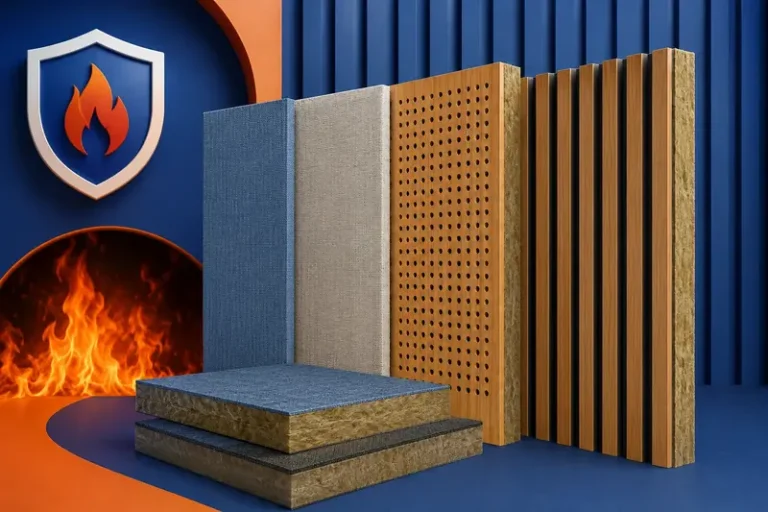
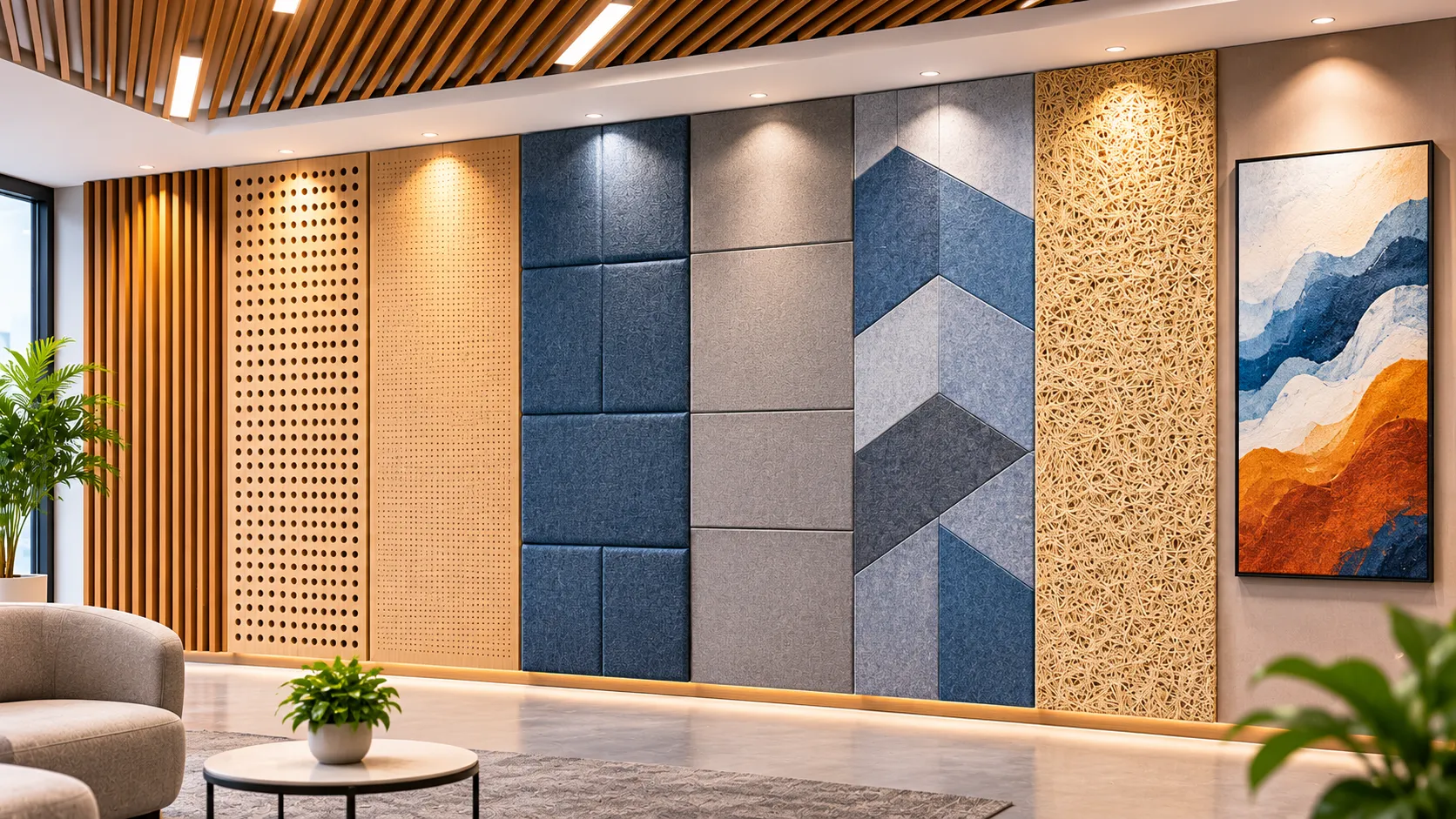
Summary: Acoustic wall panels are wall mounted boards that absorb sound instead of reflecting it, cutting echo and reverberation time in a room. Their performance is measured by NRC (Noise Reduction Coefficient, tested under ASTM C423 and ISO 354), where 0.60 or above is considered strong absorption for offices and meeting rooms. The PackSound EchoStop™ range covers grooved wooden slat, perforated, micro perforated, fabric wrapped, composite, CNC PET, wood fiber and acoustic art panels, with specified NRC from 0.75 up to 0.95 depending on type, thickness and backing.
Key Takeaways
- Panels absorb sound inside a room. They do not block noise from the next room; that needs mass and sealing.
- Grooved wooden slat, perforated, micro perforated and composite panels are specified at NRC 0.95 with backing, and fabric wrapped panels at 0.95 depending on thickness.
- CNC PET and acoustic art panels reach NRC 0.75 to 0.90; wood fiber panels reach up to 0.85 with an air gap or extra insulation.
- Micro perforated panels have 1 mm to 1.8 mm front holes and a smooth laminate or printed face, a good fit for hospitals and clean areas.
- PET panels use recycled polyester fibre (60%+ post-consumer PET in the CNC range); wood fiber panels are rated B-s1, d0 under EN 13501-1.
- Covering about 15 to 30 percent of wall area is a common starting point for offices; auditoriums and studios need more.
- Always ask for the test report (NRC, alpha values, fire rating), not just the headline number.
Walk into a modern office, a hotel conference hall or a corporate training centre, and the first thing you notice is not the furniture. It is how the room sounds. Hard concrete, glass and gypsum surfaces bounce speech around until a simple conversation turns into noise. The fix is not louder microphones or quieter people. The fix is surface treatment, and the most practical way to do it is with acoustic wall panels.
At PackSound, a division of Ecotone Acoustic Limited, we manufacture acoustic wall panels India relies on for offices, studios, auditoriums, hospitals and hospitality projects. This guide explains what our panels are, how they work, where they are used, what their benefits are, and how to read specifications such as NRC so you can choose the right product with confidence.
What Are Acoustic Wall Panels?
Acoustic wall panels are engineered boards or wrapped modules fixed on walls to absorb sound energy instead of reflecting it back into the room. When sound hits a bare wall, most of it returns as echo. When it hits a sound absorbing wall panel, the porous or perforated structure converts a large part of that energy into tiny amounts of heat, which reduces reverberation and improves speech clarity.
The terms acoustic wall, acoustic panels for walls and acoustic walls panels are often used interchangeably in the market. All of them point to the same idea: a decorative, functional wall finish that makes a room sound better. Our full range sits under the EchoStop™ acoustic wall panels family, and you can also browse the complete catalogue on our acoustic panels (all types) page.
One important point: absorption and soundproofing are different jobs. Acoustic panels for walls control echo inside a room. Blocking noise between rooms needs mass and sealing, such as sound damping sheets or acoustic partitions. Most commercial projects use a combination of both.
Understanding NRC: The Number That Matters
NRC stands for Noise Reduction Coefficient. It is a single number between 0 and 1 that shows how much sound a material absorbs across the speech frequency range.
- NRC 0.00 to 0.20: mostly reflective, like bare concrete or glass.
- NRC 0.40 to 0.60: moderate absorption, useful for light correction.
- NRC 0.60 to 0.80: strong absorption, ideal for offices and meeting rooms.
- NRC 0.80 to 0.95: very high absorption, used in studios, auditoriums and cinemas.
NRC depends on thickness, core, backing and mounting method. The values in this guide are the specified values for PackSound EchoStop™ panels, tested to IS 8225, ISO 354 and ASTM C423. Figures for wooden slat, perforated, micro perforated and composite panels apply with backing, so confirm the build up for your project.
Our Range of Sound Absorbing Wall Panels
1. Grooved Wooden Slat Panels
Grooved wooden slat panels are the most popular choice for premium interiors. They are also known as wooden acoustic panels or grooved acoustic panels. Real wood or veneer slats are mounted on a black acoustic felt or mineral wool backing, and the gaps between the slats let sound pass through and get absorbed behind.
Best for: reception areas, boardrooms, auditoriums, hotel lobbies and executive cabins.
How it works: sound enters through the open grooves between slats and is absorbed by the felt or mineral wool layer behind. Wider gaps and a deeper cavity improve absorption at lower frequencies.
Installation: two systems are available. D&B panels (575 x 2420 mm) are fixed on a GI framework with Z clamps on the wall. T&G planks (2440 x 192 mm) are fixed with an aluminium channel and clip.
Care: dry dusting or a vacuum brush; avoid wet cleaning on veneer finishes.
Limitation: wood slats absorb mainly mid and high frequencies. For bass heavy rooms, add a deeper air gap or combine with thicker absorbers.
2. Perforated Panels
Perforated panels have precisely drilled holes through a wooden or MDF board. They are sold as perforated acoustic panels, perforated wooden acoustic panels and perforated wall panels. The holes act as small openings that guide sound into an absorbing layer behind the face.
Best for: auditoriums, seminar halls, cinemas, courtrooms and large conference rooms.
How it works: sound passes through the perforations and is trapped in the absorbing layer behind. The open area percentage (the share of the face that is holes) and the cavity depth set which frequencies are absorbed best.
Installation: D&B panels (575 x 2420 mm) use a GI framework and Z clamps on the wall; T&G planks (2440 x 192 mm) use an aluminium channel and clip. The perforation pattern (square or diamond) can be customised.
Care: wipe with a dry or slightly damp cloth; compressed air removes dust from holes.
Limitation: the NRC of 0.95 is stated with backing, so confirm the backing and cavity in your build up. Perforation size and pattern should be matched to the target RT60.
Our school auditorium project in Bengaluru used perforated wooden acoustic panels to bring the RT60 in line with IS:4954 guidelines for both speech and music.
3. Micro Perforated Panels
A micro perforated panel has front holes of 1 mm to 1.8 mm over a 10 mm perforated base board. This micro perforated acoustic panel absorbs sound as air moves through the tiny openings into the backing behind, which gives high absorption with a clean, almost seamless face.
Best for: hospitals, clinics, laboratories, corporate offices and spaces that need a clean, printed or laminate finish.
How it works: sound loses energy as it moves through the 1 mm to 1.8 mm front holes into the perforated base and the backing behind. The air cavity and backing together give the NRC of 0.95.
Installation: D&B panels use a GI framework and Z clamps on the wall; T&G planks use an aluminium channel and clip.
Care: the laminate or digitally printed face is easy to wipe clean, which suits healthcare and clean environments.
Limitation: absorption is tuned to a narrower frequency band than thick porous panels, so it works best when designed for the room.
4. Fabric Wrapped Panels
Fabric wrapped panels are a high performing choice for offices and studios. Also called fabric wrapped acoustic panels, fabric acoustic panels or fabric wall panels, they use a rigid core of resin bonded fibreglass, mineral wool or high density foam covered with an acoustically transparent fabric. If you are searching for fabric wrapped panels India suppliers can customise, ours come in 20+ fabric colours.
Best for: open offices, conference rooms, recording and podcast studios, call centres and training rooms.
How it works: sound passes through the acoustically transparent fabric and is absorbed deep inside the porous core. Thickness matters most: a 50 mm panel absorbs noticeably more low and mid frequency sound than a 25 mm panel.
Installation: mounted with impalers, Z clips or adhesive; panels come in 600 x 600, 600 x 1200 and 1200 x 1200 mm, plus custom sizes.
Care: vacuum with a soft brush; stain resistant fabrics are available for high traffic areas.
Limitation: fabric panels need a protective edge or a higher fixing height in areas where they may be knocked, such as corridors.
Our Gurugram project combined fabric wall panels with suspended baffles across 12,000 sq ft and achieved around 8 dB reduction in ambient noise.
5. Composite Panels
Composite panels combine layers of different materials, for example a decorative face, an absorbing core and a rigid backer, into one board. A composite acoustic panel gives designers a balanced mix of strength, finish options and absorption.
Best for: corporate corridors, cafeterias, training halls and busy commercial areas that need a durable, colourful surface.
How it works: a perforated MDF or HDHMR base is faced with a 9 mm or 12 mm PET acoustic panel. Sound passes through the perforations into the PET and backing, giving look and absorption in one board.
Installation: fixed on a GI framework with Z clamps on the wall; panels are 575 x 2420 mm and can be customised.
Care: wipe clean; resistant to everyday wear compared with soft fabric faces.
Limitation: the 0.95 NRC is with backing, and the fire class depends on the build up (Class B or Class A is optional), so confirm the rating you need at order stage.
6. PET Panels
PET acoustic panels are made from recycled polyester fibre, which makes them lightweight, sustainable and easy to cut. CNC acoustic panels are PET panels that are routed or engraved with patterns, giving a 3D designer surface while still absorbing sound.
Best for: creative offices, co-working spaces, cafeterias, meeting pods, retail and hospitality.
How it works: dense polyester fibres trap sound as it moves through the felt like board. CNC routing adds grooves and patterns that increase surface area and give a 3D look.
Installation: adhesive, Z clips, screw fastened or modular frame systems, in 1200 x 2400 mm boards that can be cut to custom sizes.
Care: vacuum or brush; many colours are stain resistant.
Limitation: NRC ranges from 0.75 to 0.90 depending on thickness, so check the thickness (9, 12, 25 or 50 mm) against the absorption you need.
7. Wood Wool Panels
Wood wool acoustic panels, also known as wood fiber acoustic panels, are made from long wood strands bonded with cement or magnesite. They have a natural, textured look and are a strong choice for industrial style interiors.
Best for: gyms, sports halls, canteens, atriums, lobbies and exhibition areas.
How it works: the open, irregular structure of wood strands creates many tiny air pockets that absorb sound. A thicker board and an air gap behind the panel increase low frequency absorption.
Installation: GI framework with direct screw fixing, a T-grid system or concealed mounting, in 1200 x 600 mm or 600 x 600 mm panels, or custom sizes.
Care: dust with a brush or low pressure air; can be repainted.
Limitation: the raw texture is a design choice that suits industrial and natural interiors but not every brand style.
8. Acoustic Paintings
Acoustic paintings turn a sound absorbing panel into a piece of art. Also called acoustic wall painting or acoustic art panels, they print high resolution artwork, brand graphics or photographs onto an acoustically transparent surface over an absorbing core.
Best for: reception areas, brand experience centres, meeting rooms, hotels and waiting lounges.
How it works: artwork is printed on an acoustically transparent fabric stretched over an absorbing core, so the picture looks like framed art while absorbing sound behind it.
Installation: wall mounted with concealed fixings, installed by the PackSound team; panels can be grouped into a full feature wall.
Care: dust with a soft cloth or vacuum brush; avoid direct harsh sunlight for long periods.
Limitation: each custom artwork needs approval before printing, so plan lead time into the project schedule.
Quick Comparison Table
| Panel Type | NRC (as specified) | Fire Resistance | Key Strength | Common Use |
|---|---|---|---|---|
| Grooved Wooden Slat | 0.95 (with backing) | Class 1, BS 476 Part 7 | Premium wood look | Boardrooms, lobbies |
| Perforated | 0.95 (with backing) | Class 1, BS 476 Part 7 | Tuned absorption, square or diamond patterns | Auditoriums, halls |
| Micro Perforated | 0.95 (with backing) | Class 1, BS 476 Part 7 | 1 to 1.8 mm holes, printed or laminate face | Hospitals, offices |
| Fabric Wrapped | 0.95 (depending on thickness) | Class 1, BS 476 Part 7 (FR fabric and core) | 25, 50 or 75 mm cores, custom fabrics | Offices, studios |
| Composite | 0.95 (with backing) | Optional Class B or A | PET face over MDF/HDHMR, 30+ colours | Corridors, cafeterias |
| CNC PET | 0.75 to 0.90 | B1 (EN 13501-1), ASTM E84 Class B | Recycled PET, 3D CNC designs | Co-working, retail |
| Wood Fiber | Up to 0.85 (with air gap) | B-s1, d0 (EN 13501-1) | Natural, cement bonded, LEED compatible | Gyms, atriums |
| Acoustic Art Panels | 0.75 to 0.90 | Class B | Custom printed artwork | Reception, brand spaces |
Key Specifications to Check Before You Buy
When you compare acoustic panels for walls, look beyond the colour. These specifications decide real performance:
- NRC and frequency wise absorption (alpha values): ask for the test report, not just the headline number.
- Thickness and core density: thicker, denser cores generally absorb more at low frequencies.
- Fire rating: commercial buildings need Class A or Class 1 flame spread materials; confirm certification.
- Mounting system: direct fix, battens, Z clips or a suspended frame change the air gap and the result.
- Panel size and edge detail: affects layout, joints and installation speed.
- Material safety: low formaldehyde boards and non-itchy fibre are important for staff comfort.
- Customisation: size, colour, finish and logo options for your design brief.
You can also see how panels pair with other materials in our wall combination guide.
Benefits of Acoustic Wall Panels
Well chosen acoustic wall panels deliver benefits you can measure and feel:
- Better speech clarity. Shorter reverberation time means people hear each other the first time, which matters in meeting rooms, classrooms and call centres.
- Lower stress and fatigue. Constant echo and background noise raise stress levels and reduce concentration. Quieter rooms support focus.
- Higher productivity. Open offices with proper acoustic treatment see fewer interruptions and better collaboration.
- Premium design. Wood, fabric and printed finishes look like architecture, not like an add-on.
- Compliance and standards. Auditoriums, cinemas and studios need controlled RT60 values, which our RT60 testing service can verify.
- Long service life. Engineered panels hold their finish and performance for years with minimal maintenance.
- PET and wood based panels use recycled or renewable content.
Where Are Acoustic Wall Panels Used?
The right panel depends on the space and the sound problem. Here are common commercial applications:
- Corporate offices and open plan workspaces: fabric wrapped and PET panels reduce chatter and improve privacy.
- Conference and meeting rooms: wooden and fabric panels improve speech intelligibility for video calls.
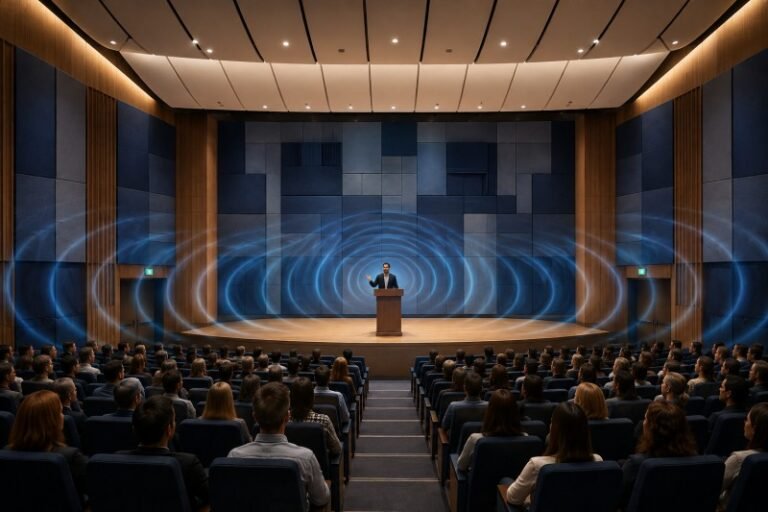
- Auditoriums and seminar halls: perforated and slat panels tune reverberation for speech and music.
- Recording, podcast and broadcast studios: high NRC fabric panels give near controlled, dry sound.
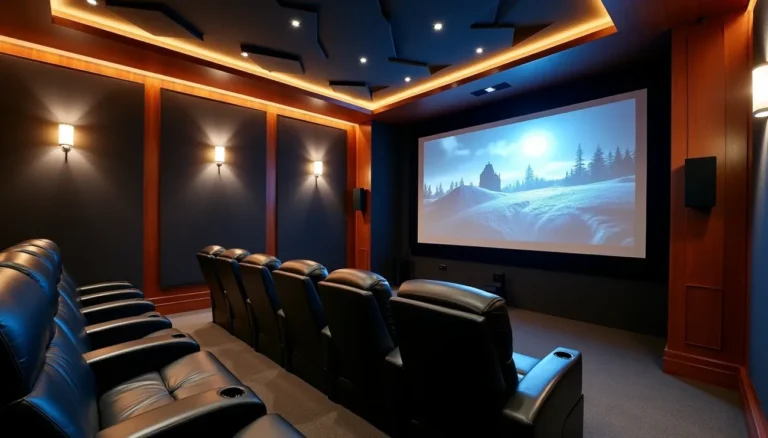
- Cinemas and multiplexes: a mix of absorbing panels and isolation, as in our Pune project with NRC 0.90+ absorption inside each hall.
- Hotels and banquet halls: decorative wooden panels and acoustic paintings balance looks and comfort. Pair them with sliding folding partitions to divide large halls.
- Hospitals and clinics: micro perforated panels offer clean, hygienic absorption.
- Schools, colleges and training centres: panels cut classroom echo and improve learning.
- Gyms, canteens and industrial areas: wood wool panels handle large hard surfaces with durable material.
For tall or very open spaces where wall area is not enough, combine wall panels with acoustic ceiling tiles, baffles and clouds.
How to Choose the Right Panel
Start with the problem, not the product.
- Identify the use. Speech rooms need strong mid frequency absorption; music and cinema spaces need a wider range.
- Measure the room. Volume, ceiling height and surface materials decide how many square metres of treatment you need. As a thumb rule, covering 15 to 30 percent of total wall area is common for offices, while studios and auditoriums need more.
- Match the finish to the interior. Wood slats for warmth, fabric for softness, PET for a modern look, wood wool for an industrial feel.
- Check budget against performance. The most decorative panel is not always the best absorber.
- Plan installation early. Wiring, lighting and HVAC should be coordinated with the panel layout.
If you are unsure, our team can run a site visit, simulation and recommendation through our building acoustics simulation service.
Why Choose PackSound for Acoustic Wall Panels India
- In house manufacturing at our Greater Noida factory, so size, colour and finish are fully customisable.
- 1900+ projects delivered across 15+ states with 11+ years of experience.
- Trusted by leading names including Hyatt, Deutsche Bank, Havells, Hitachi and Rashtrapati Bhavan installations.
- One stop service covering consultation, design, supply, installation and testing.
- Pan India reach through regional pages such as Delhi NCR, Haryana, Maharashtra and Telangana.
See our work on the projects page to understand the scale and quality we deliver.
Best Acoustic Wall Panel by Space
| Space | Main Problem | Recommended Panels |
|---|---|---|
| Open Plan Office | Chatter, low privacy | Fabric wrapped, PET |
| Boardroom or Conference Room | Echo on calls, poor speech clarity | Grooved wooden slat, fabric wrapped, acoustic paintings |
| Auditorium or Seminar Hall | Long reverberation time | Perforated wooden, grooved slat |
| Recording or Podcast Studio | Reflections, flutter echo | Fabric wrapped (50 mm or thicker) |
| Hospital or Clinic | Hygiene, dust control | Micro perforated |
| Gym, Canteen, Atrium | Large hard surfaces | Wood wool, composite |
| Hotel Lobby or Reception | Look plus comfort | Grooved slat, acoustic paintings |
Standards and Testing We Follow
Trust in acoustic claims comes from test data. PackSound panels are specified against recognised methods, and we recommend that any supplier shares the same documents:
- IS 8225, ISO 354 and ASTM C423: the NRC test standards listed for the EchoStop™ wall panels; ISO 354 and ASTM C423 are laboratory methods for sound absorption in a reverberation room.
- ISO 11654: gives the weighted absorption coefficient (alpha w) and absorption class, useful for comparing products.
- Fire performance: Class 1 as per BS 476 (Part 7):1997 for grooved, perforated, micro perforated and fabric wrapped panels (fabric with FR rated fabric and core); B1 (EN 13501-1) and ASTM E84 Class B for CNC PET; B-s1, d0 (EN 13501-1) for wood fiber; Class B for acoustic art panels; optional Class B or A for composite panels.
- Material safety: E2 formaldehyde class (8 < FC ≤ 30) on the grooved and perforated MDF/HDHMR panels, and low VOC, formaldehyde-free claims on the range as listed on each product page.
- On site verification: our RT60 testing and STI testing services confirm the result after installation, so performance is measured, not assumed.
Real Project Experience
PackSound has delivered 1900+ projects across 15+ states since 2015. A few examples relevant to wall panels:
- Corporate office, Gurugram (12,000 sq ft): fabric wall panels with suspended baffles reduced ambient noise by about 8 dB and improved speech clarity at workstations.
- School auditorium, Bengaluru (450 seats): perforated wooden acoustic panels with baffles brought reverberation time to the targeted RT60 for speech and music.
- Multiplex cinema, Pune (6 halls): absorption of NRC 0.90+ inside each hall, with STC 60+ isolation between screens.
These results come from combining the right panel type with the right mounting and a measured design, which is why we start every project with a site assessment. See more on our projects page.
Acoustic Terms Explained
- NRC (Noise Reduction Coefficient): average sound absorption of a material at 250, 500, 1000 and 2000 Hz, from 0 to 1.
- Alpha (absorption coefficient): absorption at a single frequency; a full curve shows how a panel behaves across low, mid and high sounds.
- RT60 (reverberation time): time in seconds for sound to fall by 60 dB after the source stops. Lower RT60 means less echo.
- STC (Sound Transmission Class): rating of how well a wall or partition blocks sound between rooms. It is a different measure from NRC.
- Air gap or cavity: space between the panel and the wall; a deeper gap improves low frequency absorption.
Frequently Asked Questions
What is the difference between an acoustic wall panel and a soundproof panel?
An acoustic wall panel absorbs sound inside a room to reduce echo. A soundproof system blocks sound from passing into the next room, usually using dense, sealed layers.
Which acoustic wall panel has the highest NRC?
Grooved wooden slat, perforated, micro perforated and composite panels are specified at NRC 0.95 with backing, and fabric wrapped panels at 0.95 depending on thickness. CNC PET and acoustic art panels reach 0.75 to 0.90, and wood fiber panels up to 0.85.
Are wooden acoustic panels as effective as fabric panels?
Yes, when installed with backing. Grooved wooden slat and perforated panels are specified at NRC 0.95 with backing, the same figure as fabric wrapped panels, so the choice comes down to look, durability and budget.
Can acoustic wall panels be customised?
Yes. Size, colour, finish, fabric, perforation pattern and printed artwork can all be customised for your project.
How long does installation take?
It depends on the area and the panel type. A typical meeting room can be done in a couple of days, while large auditoriums need a planned schedule.
Do you supply across India?
Yes. We supply and install across India from our Greater Noida factory with regional dealer support.
What NRC is good for an office?
An NRC of 0.60 or above is a good target for panels in offices and meeting rooms. Studios, auditoriums and cinemas often need 0.80 or higher in the treated areas.
How many acoustic panels do I need for a room?
A common starting point is to cover 15 to 30 percent of wall area in offices and more in studios or halls. The exact quantity depends on room volume, finishes and the target RT60, which is why a site assessment is recommended.
Do acoustic wall panels reduce noise from outside?
Not by themselves. They reduce echo and reverberation inside the room. To reduce noise entering from outside, you need soundproofing such as mass loaded sound damping sheets and sealed partitions.
Which panel is best for a conference room?
Grooved wooden slats, fabric wrapped panels and acoustic paintings are popular because they improve speech clarity on video calls and look professional.
Are PET acoustic panels eco friendly?
Yes. PET panels are made from recycled polyester fibre and are lightweight, which lowers material waste and transport load.
Are acoustic wall panels fire safe?
Fire safety depends on the face material and core. Always ask for the fire test report that matches your building requirement before ordering.
How do I clean acoustic wall panels?
Use a vacuum with a soft brush for fabric, felt, PET and wood wool panels, and a dry or slightly damp cloth for wood and laminate faces.
Get the Right Acoustic Wall Panels for Your Space
Choosing between grooved slats, perforated, micro perforated, fabric wrapped, composite, PET, wood wool and acoustic paintings is easier when an acoustic specialist looks at your room. Share your drawings, space type and budget, and our team will recommend the right panel with tested NRC values.
Request a quote or site consultation or call +91 9809802016 or email Sales@packsound.in.
Explore the full EchoStop™ acoustic wall panels range and bring clarity, comfort and style to your commercial space.