
Acoustic Baffles for Ceilings - Sound Absorbing Baffles
Quick Answer: Acoustic baffles are sound-absorbing panels suspended from a ceiling that reduce echo, reverberation and noise in large or high-ceiling rooms. PackSound manufactures PET, polyester, fiberglass and mineral wool acoustic ceiling baffles in India. They suit architects, interior designers, facility managers and business owners treating offices, schools, auditoriums, restaurants and exposed-ceiling commercial spaces.
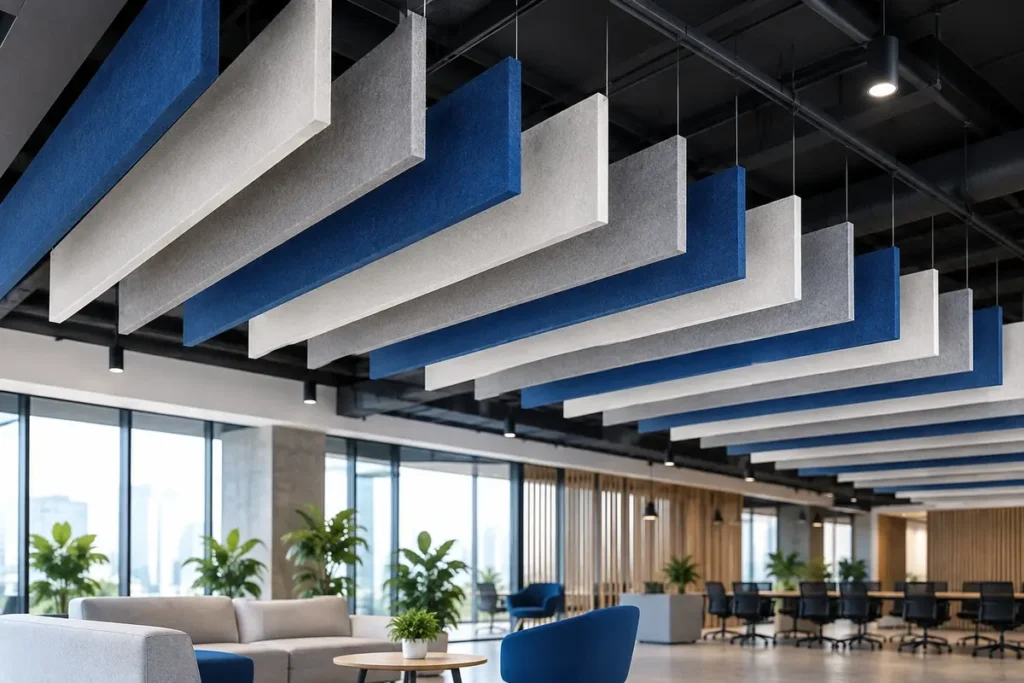
What Are Acoustic Ceiling Baffles?
In plain language, acoustic ceiling baffles are fins of sound-absorbing material hung in rows from the ceiling. Sound bouncing between the floor and the slab passes through these rows and loses energy on every pass. A flat ceiling tile has one exposed face. Suspended acoustic baffles expose two faces and their edges, which is why a baffle ceiling can outperform the same area of flat panels. Linear acoustic baffles, vertical acoustic baffles and horizontal acoustic baffles are all variations of this idea.
Why Choose Hanging Acoustic Baffles Over Other Ceiling Treatments?
- High or exposed ceilings: the ceiling is above 3.5 m, or you want to keep the exposed slab and services visible.
- Too few treatable walls: walls are glass, full of storage, or too few to treat.
- Echo problems: the space echoes, speech is hard to follow, or people raise their voices to be heard.
For lower ceilings under about 3 m, acoustic ceiling clouds or hanging ceiling panels laid horizontally often work better.
Types of Acoustic Baffles: Which Design Fits Your Space?
| Acoustic Baffle Type | Description & Application |
|---|---|
| Linear and Vertical Acoustic Baffles | The workhorse option for open offices, canteens and sports halls. |
| Horizontal Acoustic Baffles and Acoustic Ceiling Clouds | Best for meeting rooms and restaurants with lower ceilings. |
| Decorative Acoustic Baffles | Hexagon acoustic ceiling baffles, round acoustic ceiling clouds and cylindrical acoustic baffles for lobbies, retail and hospitality. |
| Cell Grid Acoustic Baffles | A modular grid that screens services while absorbing sound. |
| Custom Acoustic Ceiling Baffles | Printed, branded, curved or wave-profiled shapes to a given acoustic ceiling baffles design. |
Which Material Is Best for Acoustic Baffles?
| Material | Best For |
|---|---|
| PET / polyester acoustic baffles (PET felt ceiling baffles) | Offices, schools, colourful interiors, recycled content |
| Melamine acoustic baffles | Very lightweight, large-span industrial ceilings |
| Fiberglass / glasswool acoustic baffles | High NRC, fabric-wrapped premium finish |
| Mineral wool acoustic baffles | Fire-sensitive areas, high-humidity spaces |
| Parameter | Detail |
|---|---|
| Material | PET felt, polyester, melamine, fiberglass, mineral wool |
| Length | 1200 mm to 2400 mm, custom available |
| Width / Depth | 300 mm to 600 mm |
| Thickness | 12 mm to 50 mm |
| NRC | 0.70 to 0.95 |
| Finish | PET felt, fabric wrapped, printed |
| Suspension | Steel cables, rods, adjustable hangers |
| Benefit | What It Means for You |
|---|---|
| Two-sided absorption | More sound absorbed per square metre than flat panels |
| Keeps exposed ceilings | No false ceiling required |
| Better speech clarity | Clearer meetings, lectures and calls |
| Lower noise build-up | Calmer open offices and restaurants |
| Service-friendly | Lights, sprinklers and HVAC remain accessible |
| Design flexibility | Shapes, colours and branding options |
| Fast installation | Minimal disruption to live sites. |
Space
Why Baffles Work
Acoustic baffles for offices and open offices
Reduce chatter spreading across desks
Acoustic baffles for conference rooms
Improve clarity for video calls
Acoustic baffles for schools
Help classrooms meet speech-clarity targets
Acoustic baffles for auditoriums
Control late reflections from high ceilings
Acoustic baffles for restaurants
Lower the "Lombard effect" of rising voices
Acoustic baffles for recording studios
Tame ceiling reflections in live rooms
Acoustic baffles for exposed ceilings and commercial spaces
Industrial look with real sound control.
Step
Action
1. Site survey
Measure RT60 and ceiling height
2. Acoustic design
Calculate quantity, spacing and layout
3. MEP coordination
Clear sprinklers, lights and ducts
4. Anchoring
Fix anchors to slab or structure
5. Suspension
Hang cables or rods at set drop
6. Levelling
Align rows and heights precisely
7. Testing
Re-measure RT60 and hand over.
| Space | Target RT60 |
|---|---|
| Classroom (ANSI/ASA S12.60) | 0.6 s or less |
| Conference room | 0.4 to 0.6 s |
| Open office | 0.5 to 0.8 s |
| Restaurant | 0.8 to 1.2 s |
| Auditorium (speech) | 0.8 to 1.2 s |
| Sports hall | 1.5 to 2.0 s |
TDS (Technical Data Sheet)
| Property | Value |
|---|---|
| Product | PackSound Acoustic Baffles (Sound Absorbing Ceiling Baffles) |
| Sound absorption | NRC 0.70 to 0.95; sabins per unit on request |
| Test method | ASTM C423 / ISO 354 reverberation room |
| Fire performance | Fire rated acoustic baffles available; test certificate supplied per grade |
| Weight | Typically under 5 kg per standard piece |
| Moisture resistance | Non-hygroscopic PET and mineral wool options |
| VOC | Low emission, suitable for occupied interiors |
| Colours | 20+ PET shades, custom fabrics and prints |
| Maintenance | Vacuum or dry dust; no repainting required. |
Customization Range
Customization Option
Description
Size and Shape
Available in rectangular, curved, wave-shaped or custom CNC-cut designs.
Color Selection
Wide variety of colors to match branding or interior themes.
Material Options
Choice between PET felt, fiberglass or mineral wool depending on performance needs.
Arrangement Styles
Linear, staggered or creative layouts for visual impact.
Suspension Systems
Adjustable cables, rods or custom mounting systems.
Branding and Design
Custom prints or patterns can be integrated for commercial spaces.
Acoustic Baffles: Frequently Asked Questions
01 Do acoustic baffles actually work?
Yes, correctly quantified baffles noticeably reduce echo and noise in hard, high-ceiling rooms.
02 Are acoustic baffles better than acoustic panels?
In high-ceiling rooms yes, because both faces absorb sound instead of just one.
03 Do acoustic baffles soundproof a room?
No, they reduce echo inside a room but do not block sound between rooms.
04 How far apart should ceiling baffles be spaced?
Typically one to two times baffle depth, closer spacing giving stronger sound absorption overall.
05 Can I install acoustic baffles on a low ceiling?
Below three metres, horizontal clouds usually perform better and feel less visually heavy overhead.
06 Are PET acoustic baffles fire safe?
Fire rated grades exist; always request the test certificate before specifying for projects.
07 Do baffles help with low-frequency bass noise?
Thin baffles mainly absorb speech frequencies; thicker infilled baffles are needed for bass.
08 Can acoustic baffles be cleaned easily?
Yes, PET baffles can be vacuumed or dusted; avoid soaking them with water.
09 How long does baffle installation take?
A typical 5,000 sq. ft. office is usually installed within three to five working days.
10 Can baffles be combined with lighting?
Yes, linear lights fit neatly between baffle rows or integrate into custom baffle designs.