
Acoustic Wall Panels for Soundproofing & Echo Reduction
Types of Acoustic Wall Panels
Quick answer: Acoustic wall panels are engineered, sound-absorbing boards installed on walls to cut echo and reverberation inside a room. They do not block sound between rooms (that needs mass and sealed assemblies); they clean up the sound within a space. This page is written for facility managers, architects, interior designers, and homeowners in India who are choosing a panel type, material, and NRC rating for an office, studio, auditorium, classroom, or home theatre.
Echo reductionClearer sound within your room
Custom fitPanel types, materials & NRC ratings
Versatile spacesOffices, studios & home theatres
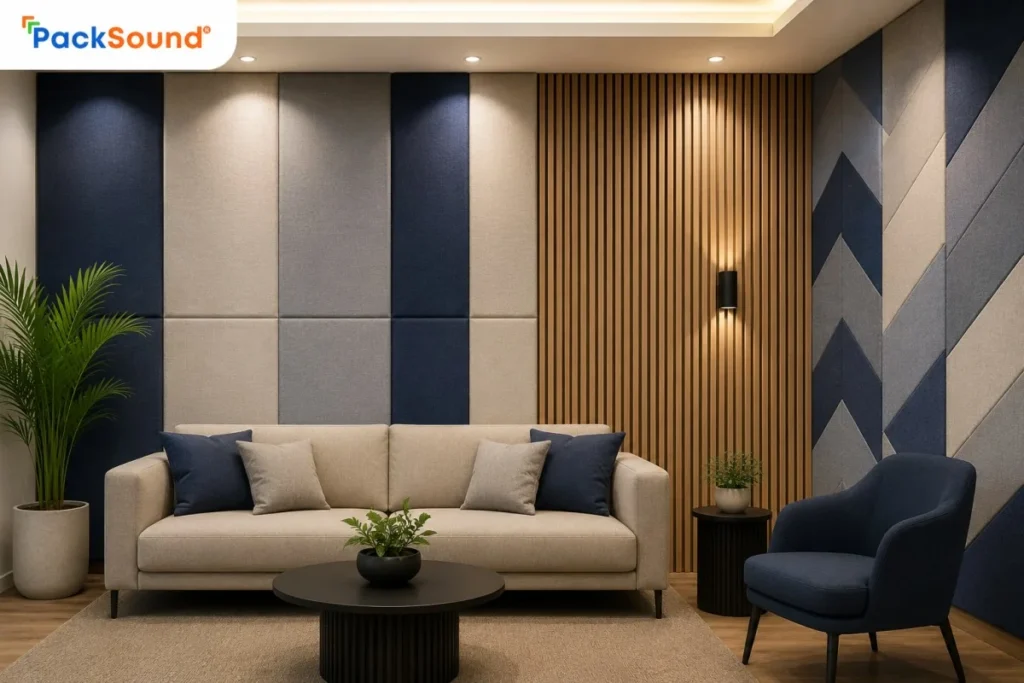
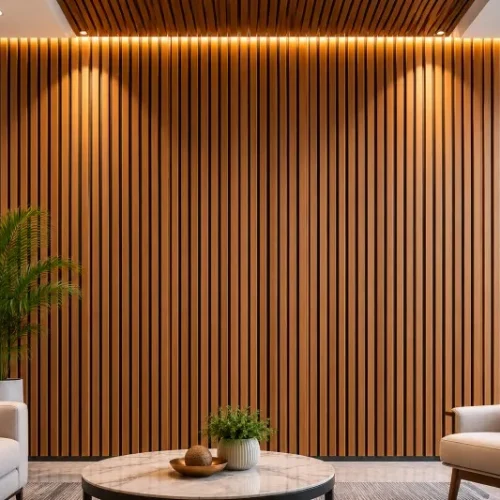
- Engineered Acoustic Absorption – Grooved surfaces channel sound into acoustic backing (mineral wool/fleece), effectively reducing echo and improving speech clarity
- Natural Wood Aesthetic – MDF/HDF core with veneer or laminate finish, offering a premium architectural look with linear design patterns
- Natural Wood Aesthetic – MDF/HDF core with veneer or laminate finish, offering a premium architectural look with linear design patterns
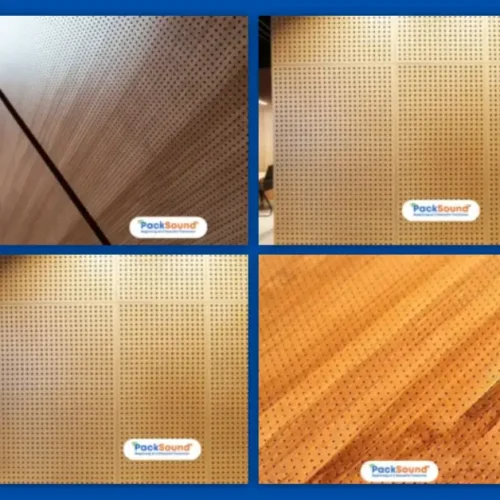
- Effective Sound Absorption System – Perforations allow sound to pass through and get absorbed by backing material, reducing reverberation and noise
- High Acoustic Performance – Can achieve NRC up to ~0.80–1.00 depending on perforation pattern and acoustic infill
- Durable & Versatile Material Options – Typically made from MDF/cement board with fire-rated, moisture-resistant, and customizable finishes
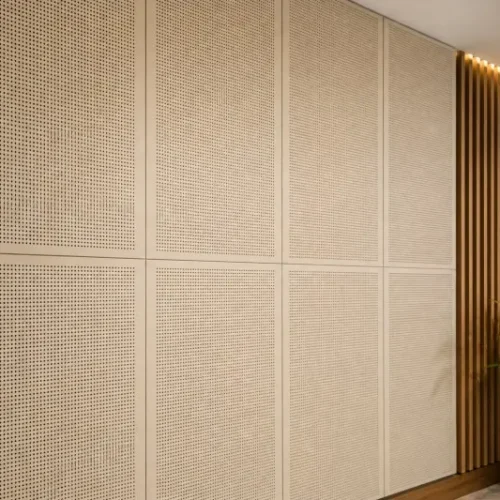
- Advanced Acoustic Technology – Uses micro holes (≈0.5–1 mm) to absorb sound across a wide frequency range while maintaining a smooth surface
- Broadband Sound Control – Highly effective for mid to high-frequency absorption, ideal for auditoriums and premium interiors
- Clean & Minimal Aesthetic – Nearly invisible perforations provide a seamless, high-end architectural finish
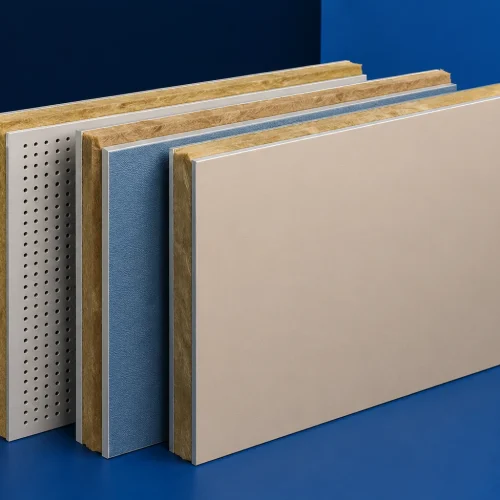
- High Acoustic Efficiency – Composite structure enhances sound absorption and reduces reverberation in commercial spaces
- Lightweight Modular System – Easy to install across walls and ceilings with multiple size and thickness options
- Sustainable & Safe Materials – Manufactured using low-VOC, recycled, and eco-friendly acoustic core materials
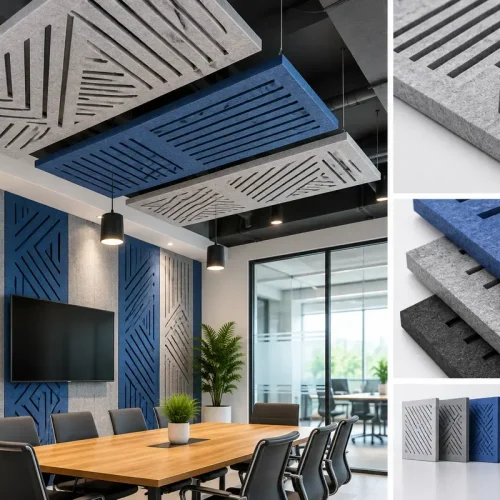
- Design + Acoustic Integration – CNC-cut PET panels combine decorative patterns with effective sound absorption
- Consistent Noise Reduction – PET fiber structure helps absorb sound energy and reduce echo in interiors
- Sustainable & Lightweight – Made from recycled polyester fibers, offering durability and easy installation
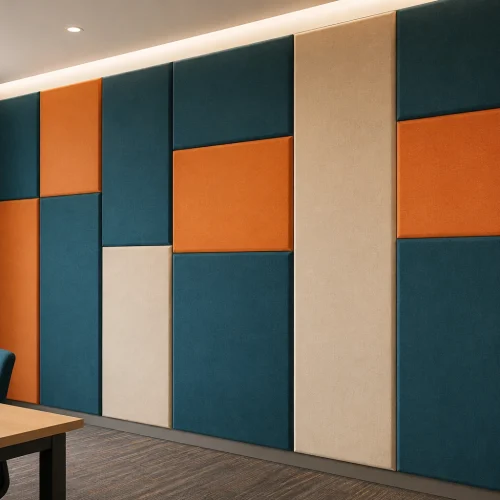
- High Sound Absorption – Fabric-wrapped panels use porous cores (glass wool/mineral wool) to absorb sound and reduce echo
- Custom Fabric Finishes – Available in a wide range of colors, textures, and printable surfaces for interior design flexibility
- Safe & High-Performance Core – Fire-retardant options, impact resistance, and excellent acoustic efficiency for walls
What Are Acoustic Wall Panels?
Acoustic wall panels are rigid or semi-rigid boards, usually built around a porous core such as mineral wool, glass wool, PET fibre, or perforated wood, wrapped or finished in fabric, veneer, or laminate. When sound waves strike the panel, the fibrous core converts the vibrating air energy into a negligible amount of heat through friction, instead of reflecting it back into the room. Less reflected sound means shorter reverberation time, clearer speech, and a calmer listening environment.
How Do Acoustic Wall Panels Actually Reduce Noise and Echo?
They absorb sound energy at the wall surface instead of letting it bounce, which shortens reverberation time (RT60) and lowers the buildup of reflected noise.
- Sound hits the panel face and enters the porous core through perforations, gaps in a slat, or the open weave of fabric.
- The core’s fibre structure resists airflow, converting sound energy into minute heat losses through friction, a mechanism documented under the ASTM C423 reverberation-room test method used industry-wide to rate absorptive materials.
- An air gap behind the panel (commonly 25 to 50 mm) extends absorption into lower frequencies, which is why mounting method changes real-world performance even when the panel itself is identical.
- Less reflected energy means shorter RT60, clearer speech intelligibility, and lower perceived background noise.
Acoustic Wall Panel Material: Which Core Actually Performs Best?
The core material inside an acoustic wall panel decides most of its real-world performance, far more than the surface finish does. Here is how the common acoustic wall panel material options compare in practice.
| Material | NRC Range | Best For | Watch-Out |
|---|---|---|---|
| Glass wool / Mineral wool (Fabric-wrapped) | 0.75 to 0.95 | Offices, Boardrooms, Studios | Needs a moisture-resistant facing in humid Indian climates. |
| PET Fibre (Recycled Polyester) | 0.60 to 0.85 | Schools, Healthcare, Eco-focused Projects | Slightly lower low-frequency absorption than mineral wool. |
| Perforated Wood / MDF over Acoustic Backing | 0.60 to 0.85 | Auditoriums, Premium Interiors | Performance depends entirely on the acoustic backing, not the wood face. |
| Acoustic Foam | 0.50 to 0.75 | Home Studios, Budget Projects | Absorbs less at low frequencies and ages faster under UV exposure and heat. |
Decorative Acoustic Wall Panels: Do They Sacrifice Performance?
No, when built correctly. Decorative acoustic wall panels (3D textured, printed, CNC-cut, or colour-matched panels) use the same absorptive cores as plain panels; the pattern only changes the face layer.
- CNC-cut PET panels combine branded or geometric patterns with a genuine PET fibre core.
- Printed fabric-wrapped panels allow full custom artwork over a mineral wool core without losing NRC performance.
- 3D sculptural panels add visual depth while the backing handles absorption, so a feature wall can still meet the same RT60 target as a plain panel.
| Specification | Detail |
|---|---|
| Panel Sizes | 600 × 600 mm to 1200 × 2400 mm, custom sizes available on request |
| Thickness | 9 mm to 50 mm depending on core material and mounting system |
| Core Options | Glass wool, mineral wool, PET fibre, MDF/HDF |
| Fire Rating | Class B with fire-retardant core options available |
| Finish | Fabric, veneer, laminate, printed graphics, and 3D textured finishes |
| Mounting | Adhesive, Z-clip, or batten-mounted with an optional air gap |
| Colour Range | 20+ fabric colours along with custom woodgrain and printed finishes |
| Benefit | Why It Matters |
|---|---|
| Cuts echo and reverberation | Shortens RT60 for clearer speech. |
| Improves speech intelligibility | Critical in offices and auditoriums. |
| Customisable finish | Matches brand and interior design. |
| Lightweight, easy retrofit | No structural changes needed. |
| Fire-retardant options | Meets commercial safety codes. |
| Low-VOC, eco-friendly cores | Suitable for LEED and green buildings. |
| Long service life | 10+ years with minimal maintenance. |
| Space | Use Case |
|---|---|
| Corporate Offices | Reduce distraction and improve call clarity. |
| Auditoriums | Optimise RT60 for speech and music. |
| Recording Studios | Control reflections around monitors. |
| Classrooms | Improve teacher-student speech clarity. |
| Restaurants & Hospitality | Lower ambient noise for greater comfort. |
| Home Theatres | Cleaner dialogue and improved bass response. |
| Healthcare Waiting Areas | Create a calmer and quieter patient environment. |
| Step | Action |
|---|---|
| 1 | Site acoustic survey and RT60 measurement |
| 2 | Panel type and coverage area selection |
| 3 | Wall surface preparation and layout marking |
| 4 | Batten or Z-clip framework fixing |
| 5 | Panel mounting with recommended air gap |
| 6 | Joint and edge finishing |
| 7 | Post-install acoustic check |
| Myth | Reality |
|---|---|
| Acoustic panels soundproof a room completely | They reduce echo only. Effective soundproofing requires mass, airtight construction, and proper sealing. |
| More panels always sound better | Over-treating a room can remove natural ambience and make it sound dull. |
| Thicker panels are always better | Greater thickness improves low-frequency absorption, while core density significantly affects mid and high frequencies. |
| Decorative panels absorb less sound | The acoustic core determines the NRC rating, not the decorative fabric, print, or textured surface. |
| Foam panels equal professional acoustic panels | Foam panels generally have lower NRC values and degrade faster than mineral wool or PET acoustic panels. |
TDS (Technical Data Sheet)
| Parameter | Value |
|---|---|
| Product Category | Acoustic Wall Panels |
| Core Density | 32 to 96 kg/m³ (mineral wool/PET, model-dependent) |
| NRC (Noise Reduction Coefficient) | 0.60 to 0.95 (tested per ASTM C423) |
| Standard Thickness | 9 mm, 12 mm, 25 mm, 50 mm |
| Standard Panel Size | 600 × 1200 mm, 1200 × 2400 mm |
| Fire Performance | Class B / Fire-retardant grade available |
| Recommended Air Gap | 25 to 50 mm for enhanced low-frequency NRC |
| Surface Finish | Fabric, Veneer, Laminate, PET Print, 3D Texture |
| Warranty | Manufacturer warranty on core and finish (project-specific) |
Wall Acoustic Panels FAQ
Do acoustic panels actually reduce noise or is it a placebo?
They measurably shorten reverberation time; independent NRC testing (ASTM C423) confirms real absorption, not marketing.
Are acoustic panels the same as soundproofing?
No. Panels absorb in-room echo; soundproofing blocks sound transfer between rooms using mass and sealing.
Can I install acoustic wall panels myself?
Yes, for small rooms with adhesive-mount panels; large or auditorium projects need professional layout planning.
Do decorative or printed panels perform worse than plain panels?
No, performance depends on the core, not the printed or textured surface finish.
How many panels do I actually need per room?
Coverage of 15 to 25 percent of wall area is a common starting point, adjusted per RT60 goal.
Is wood good for soundproofing a room?
Solid wood alone barely absorbs sound; acoustic wood panels work because of the hidden backing, not the timber.
What NRC rating should I look for?
0.70 or higher suits most offices and studios; auditoriums often blend ratings by zone.
Do acoustic panels help with neighbour noise?
Rarely much; that is airborne transmission, better solved with mass-loaded barriers and sealed walls.
Are cheap foam panels from online stores worth buying?
Usually low density and low NRC; fine for light home use, not for professional spaces.
How long do acoustic wall panels last?
Quality fabric, PET, or wood panels typically last 10+ years with minimal maintenance.