
Wood Wool Acoustic Panel Manufacturer & Installer in India (2026)
Quick Answer: Wood wool acoustic panels are rigid, cement-bonded, eco-friendly panels made from mineralised wood fibres delivering NRC up to 0.90. PackSound manufactures and installs them across India for auditoriums, schools, hospitals, offices, sports halls, and industrial spaces. This page is for architects, interior designers, project managers, and facility owners seeking a verified, LEED-compatible, fire-rated acoustic panel that outperforms foam and fabric in demanding Indian environments.
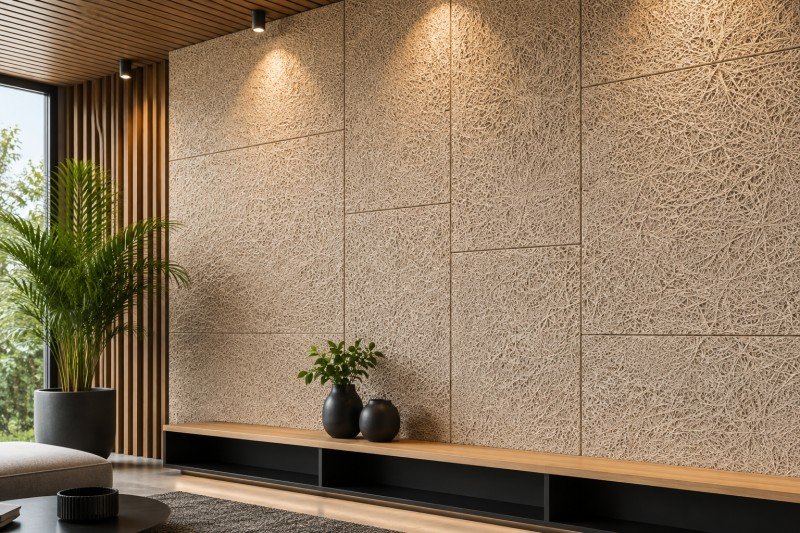
What Are Wood Wool Acoustic Sound Panels
Wood wool acoustic panels are rigid composite boards manufactured by mineralising long, fine wood fibres – typically from sustainably sourced pine or spruce – with a Portland cement or magnesite binder under pressure. The result is a panel that is an acoustic absorber, a fire-resistant surface finish, a moisture-regulating cladding material, and a structurally robust wall lining all in one product.
For Indian architects and project managers specifying acoustic treatment for commercial or institutional projects, wood wool panels address the single most common specification failure: choosing an acoustic material that performs on paper but fails within 18 months under Indian conditions of humidity, heat, physical contact, and institutional use.
PackSound, a brand of Ecotone Acoustic Limited (Greater Noida, Uttar Pradesh), manufactures and installs certified wood wool acoustic sound panels across Delhi NCR, Mumbai, Bengaluru, Hyderabad, Chennai, Pune, and all major Indian cities. With 1900+ projects delivered since 2015 – including the Nalanda University Auditorium inaugurated by the Vice President of India – PackSound brings verified, documented acoustic performance to every project.
Who Should Use Wood Wool Acoustic Panels and When
Use wood wool acoustic panels or wood fiber acoustic panels when your project brief requires two or more of the following: high NRC performance in a rigid (not fabric-wrapped) format; Class A fire resistance without added intumescent treatment; moisture and humidity stability in coastal, semi-outdoor, or high-use environments; paintability in custom brand or scheme colours; resistance to mechanical impact, cleaning, and institutional wear; zero VOC emissions for LEED IEQ credits; or a natural, eco-friendly panel made from sustainable wood fibre.
Do not specify wood wool panels when your project brief prioritises: a premium engineered timber aesthetic with visible grain and precision-machined groove profiles (specify grooved wooden acoustic panels instead); the softest possible surface finish in a premium commercial interior (specify fabric-wrapped acoustic panels); or the lowest possible per-square-foot material cost without performance documentation (standard foam tiles may suffice for residential DIY applications).
| Specification | Details |
|---|---|
| NRC (with 50mm Rock Wool Backing) | 0.90 (ISO 354-1985, ASTM C423-90a) |
| Panel Thickness | 20mm Standard; Custom options from 15mm to 25mm |
| Panel Density | 400 to 450 kg/m³ |
| Standard Sizes | 1200 × 600mm and 595 × 595mm (Grid Compatible) |
| Fire Rating | ASTM D-876 (Non-combustible Cement Matrix) |
| Moisture Resistance | IS 3308 (Stable at 90% RH, 60°C for 15 Days) |
| VOC Emissions | Zero VOC • No Formaldehyde • No Phenolic Resins |
| Benefit | Why It Matters in India |
|---|---|
| NRC 0.90 verified performance | Meets acoustic design targets for auditoriums and institutions. |
| Class A fire resistance | Compliant with NBC 2016 Part 4 commercial fire requirements. |
| Impact and abrasion resistant | Survives sports halls, schools, and industrial environments. |
| Moisture stable at 90% RH | Reliable in coastal cities and monsoon-affected climates. |
| Paintable in any colour | Custom school, hotel, or brand colour without extra cost. |
| Zero VOC – LEED compatible | Supports LEED, IGBC, and WELL IEQ credits. |
| Termite and mould resistant | Long service life (20+ years) in Indian climate zones. |
| Space / Application | Why Wood Wool Is Specified Here |
|---|---|
| School and College Auditoriums | Impact resistant, fire rated, and paintable to match school colours. |
| Sports Halls and Gymnasiums | Withstands ball impact, frequent water cleaning, and heavy physical contact. |
| Hospital Waiting Areas | Zero VOC, wipe-clean surface, mould resistant, and WELL compatible. |
| Multiplex Cinema Halls | Provides broadband sound absorption with a durable and easy-to-clean surface. |
| Hotel Ballrooms and Banquet Halls | Paintable finish, moisture stability, and excellent NRC performance. |
| Railway Stations and Airports | Highly durable for public spaces, graffiti resistant, and moisture stable. |
| Food Processing and Factory Canteens | Washable using industrial cleaners and resistant to moisture. |
| Step | Action |
|---|---|
| 1. Wall preparation | Clean and level wall or ceiling substrate; mark grid layout. |
| 2. Frame installation | Fix 18mm GI or aluminium channel framing to structure. |
| 3. Rock wool backing | Insert 50mm rock wool at 48 kg/m³ density in frame cavity. |
| 4. Panel fixing | Screw 1200 × 600mm panels through the face into the channel framing. |
| 5. Grid installation (595mm) | Drop 595 × 595mm tiles into a standard suspended grid system. |
| 6. Finishing and painting | Apply two coats of emulsion paint with a brush or roller after installation. |
| 7. Acoustic verification | Measure RT60 after installation and confirm the design target has been achieved. |
| Myth | Reality |
|---|---|
| Wood wool is fragile and will break easily. | Cement matrix makes it more robust than foam or fabric. |
| Painting wood wool reduces its acoustic performance. | Paint coats fibres only; air gaps remain; NRC stays within 10%. |
| Wood wool panels attract termites like regular wood. | Cement mineralisation process makes wood fibres termite-proof. |
| Wood wool is only for industrial or ugly spaces. | Paintable in any colour; used in hotels and Nalanda University. |
| Any wood wool panel delivers NRC 0.90. | NRC 0.90 requires 50mm rock wool backing at specified density. |
| Wood wool panels are not fire safe. | Cement binder gives inherent Class A fire resistance rating. |
| Wood wool is expensive and not worth it. | Lowest total cost of ownership due to 20+ year service life. |
Why Architects Specify Wood Wool Over Foam
The single most common specification mistake PackSound encounters is a school or institution that installed acoustic foam panels three to five years before calling for help. By the time they reach us, the foam has discoloured, delaminated from the walls in patches, lost its shape in humid monsoon conditions, and – most critically – is now a fire hazard that the facility’s NBC compliance officer wants removed.
Acoustic foam tiles are combustible. In a commercial or institutional building subject to NBC 2016 Part 4, combustible interior finish materials require fire retardant treatment that rapidly deteriorates in humid conditions and is effectively never maintained after initial installation. Wood wool panels contain no combustible organic binders. The cement matrix is inherently non-combustible. There is nothing to degrade, no treatment to maintain, no compliance risk to manage.
This is the real-world argument for wood wool in Indian institutional and commercial projects: not NRC numbers, but the 10-year cost of ownership and the zero-maintenance compliance profile. An NRC 0.90 wood wool installation that lasts 25 years costs less per unit of acoustic-year delivered than an NRC 0.85 foam installation replaced every five years, especially once you include removal, disposal, and reinstallation costs.
How Wood Wool Panels Achieve NRC 0.90
NRC 0.90 sounds like a specification claim. It is actually a testable, reproducible acoustic measurement that PackSound WFF wood wool panels consistently achieve under specific, documented installation conditions. Understanding those conditions helps buyers specify wood wool correctly and avoid the single most common installation error that prevents panels from reaching their rated performance.
NRC (Noise Reduction Coefficient) is the average of a material’s sound absorption coefficients at 250 Hz, 500 Hz, 1000 Hz, and 2000 Hz, measured in a reverberation room per ISO 354-1985 or ASTM C423-90a. A value of 0.90 means the panel absorbs 90 percent of the sound energy striking its surface at those frequencies, reflecting only 10 percent back into the room.
PackSound WFF wood wool panels achieve NRC 0.90 with a 20mm panel thickness and a 50mm rock wool backing layer at 48 kg/m3 density installed behind the panel. The rock wool backing is not optional for this performance level. It serves as the primary absorber for mid and low frequencies, while the wood wool matrix provides the open porous surface through which sound energy enters the assembly and the structural panel that makes the whole system robust enough for commercial use.
Without the 50mm rock wool backing at the specified density, the NRC of the wood wool panel alone is lower — in the range of 0.55 to 0.65 depending on installation method and air gap. For projects where NRC 0.90 is the acoustic design target, the rock wool backing is a non-negotiable element of the specification. PackSound includes rock wool backing supply in all complete installation quotations and advises clients on backing specifications during the acoustic consultation process.
Wood Wool vs Other Acoustic Panel Types: Which Is Right for Your Project?
| Criterion | Wood Wool | Fabric-Wrapped | Acoustic Foam | PET Polyester |
|---|---|---|---|---|
| Maximum NRC | 0.90 | 0.95 | 0.60–0.75 | 0.85 |
| Fire Rating | Class A (Cement Bonded) | Depends on Core | Combustible | Treated Only |
| Impact Resistance | Excellent | Poor | Very Poor | Moderate |
| Moisture Resistance | Excellent | Poor | Poor | Good |
| Paintable | Yes (Any Colour) | No | No | No |
| VOC Emissions | Zero | Low | Moderate | Low |
| LEED IEQ Compatible | Yes | Partial | No | Partial |
| Service Life (India) | 20+ Years | 5–10 Years | 3–5 Years | 8–12 Years |
| Best For | Institutions, Sports Facilities, Industrial Buildings | Offices, Studios | Residential DIY | Schools, Offices |
Frequently Asked Questions:
Commodity panels cost Rs 45 to Rs 80 per sq ft. Certified panels with NRC test documentation are priced higher and vary by project scope. Contact PackSound for a project-specific quote.
Wood wool panels control sound within a room (acoustic treatment) but do not block sound between rooms (soundproofing). For complete room isolation, combine wood wool with mass-loaded barriers and decoupled wall construction.
Yes. Wood wool panels contain zero VOC, zero formaldehyde, and no carcinogenic materials. The cement binder is inert and asbestos-free. They meet all indoor air quality requirements for educational facilities under LEED and IGBC certification.
20 or more years in most Indian climate zones, including coastal and high-humidity regions. The cement matrix maintains dimensional stability at 90% RH at 60 degrees Celsius without deterioration.
Both. The 595x595mm format installs directly into standard suspended ceiling grids. The 1200x600mm format can be installed on ceilings with GI channel framing. Ceiling installation with rock wool backing achieves the same NRC 0.90 as wall installation.
Wood wool panels use long, coarse wood fibres bound with cement. Wood fibre panels typically use finer, dry-processed wood fibres bound with organic binders (similar to MDF). Wood wool has higher fire resistance and moisture stability; wood fibre panels have a smoother surface finish.
No special primer is required. Apply one coat of standard PVA diluted 1:1 as a sealer if the surface is very porous, then two coats of standard emulsion paint. Avoid gloss or satin paint finishes that may partially seal the acoustic pores between fibres.
Wood wool, without question. Foam panels are combustible, degrade under physical impact, and cannot be cleaned. Wood wool panels withstand ball impact, water cleaning, and the physical environment of sports use for 20+ years. Foam in a sports hall is a compliance and durability risk.
Yes. PackSound provides end-to-end supply and installation across Delhi NCR, Mumbai, Bengaluru, Hyderabad, Chennai, Pune, Kolkata, and all major Indian cities. Contact +91 980 980 2016 or Sales@packsound.in for a free project consultation.
Get a Free Quote: 📞 Call +91 980 980 2016 | ✉️ Sales@packsound.in | 🌐 Visit https://packsound.in/products/