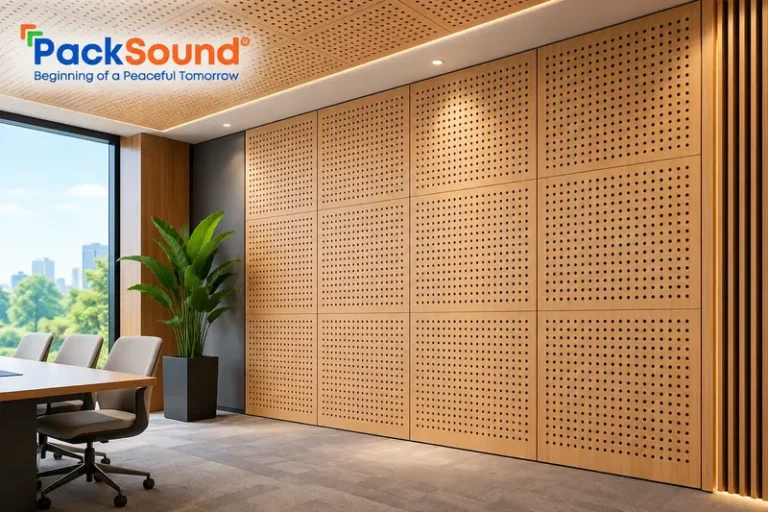
The ceiling is arguably the most underutilised surface in commercial interior design. While floors, walls, and furniture receive considerable specification attention, the ceiling a largest uninterrupted surface in most rooms is often left as a plain plasterboard expanse that actively works against acoustic comfort and visual interest.
Baffle ceiling design changes this equation. Suspended vertically from the ceiling structure in ordered rows or custom configurations, baffle panels serve simultaneously as architectural features, acoustic treatment tools, and interior design statements.
In 2026, baffle ceilings have moved firmly into the mainstream of commercial interior specification in India — present in corporate offices, hotel lobbies, auditoriums, educational institutions, restaurants, and co-working spaces across every major city.
This guide covers everything a buyer, architect, or facilities manager needs to understand before specifying a baffle ceiling system: what baffle ceilings are, how they perform acoustically, the five most influential baffle ceiling design styles available today, the materials used, the applications they serve best, and the buying considerations that determine whether a specification delivers genuine value.
What Is a Baffle Ceiling?

A baffle ceiling is a ceiling treatment system in which panels — called baffles — are suspended vertically from the ceiling structure, hanging downward into the room as a series of parallel fins, blades, or strips. Unlike a full drop ceiling that closes off the space above, baffle panels hang in open rows with gaps between them, leaving the ceiling structure, mechanical services, and spatial volume visible above.
This open geometry is the defining characteristic of the baffle ceiling and the source of both its acoustic effectiveness and its visual appeal. Sound waves traveling horizontally through the room must pass between the baffle panels, and each time they do, energy is absorbed by the panel surfaces on both sides. Because each panel exposes two faces to the room simultaneously, baffles deliver more absorptive surface area per unit of ceiling coverage than horizontally mounted acoustic tiles or clouds.
Baffle Ceiling vs. Acoustic Cloud: What Is the Difference?

The two products are frequently specified together, and understanding their distinction is essential for correct specification:
Acoustic baffles hang vertically. Their geometry is effective at intercepting horizontally traveling sound in large, tall spaces — open offices, sports halls, airports, canteens, auditoriums. They are also easily accommodated around ceiling-mounted services such as lighting rigs, HVAC ductwork, and fire suppression pipework because their narrow profile and open gaps do not obstruct these systems.
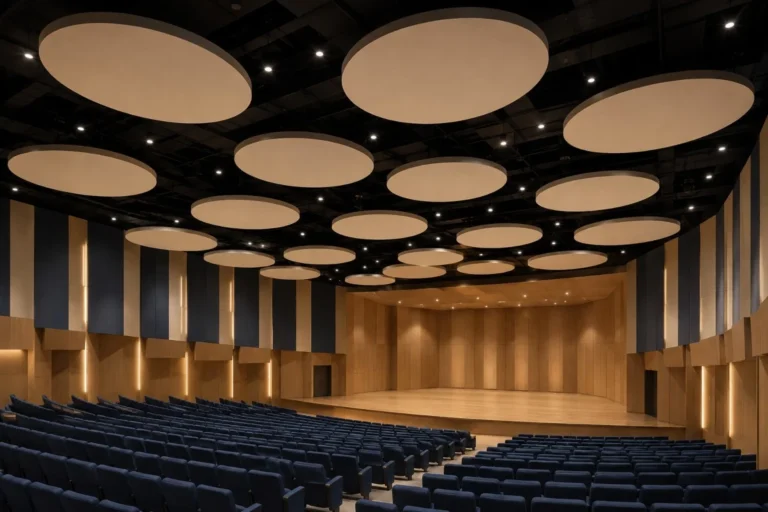
Acoustic clouds hang horizontally, suspended parallel to the ceiling. Their geometry is effective at intercepting the vertical reflection path — sound bouncing off the ceiling back down into the room — and is particularly effective in medium-height rooms such as conference rooms, restaurants, and reception areas. Clouds often serve as primary design features, with custom shapes, finishes, and integrated lighting.
Both address reverberation and echo control. The correct choice depends on ceiling height, room geometry, intended use, and design objectives. PackSound manufactures both — acoustic hanging baffles and the PerfoAudile™ Acoustic Clouds range — and its technical team can advise on the appropriate specification for any space.
How Baffle Ceilings Work: Acoustic Performance Explained
Understanding acoustic performance terminology allows buyers to evaluate product claims intelligently and specify confidently.
Noise Reduction Coefficient (NRC)
NRC is the primary metric used to quantify a panel’s sound absorption performance. It is expressed as a value between 0 and 1:
| NRC Value | Absorption Performance |
|---|---|
| 0.00–0.20 | Highly reflective (glass, concrete, plaster) |
| 0.25–0.50 | Moderate absorption |
| 0.55–0.75 | Good absorption (most fabric-wrapped panels) |
| 0.80–0.95 | High absorption (dense acoustic baffles, thick PET felt) |
| 0.95–1.00+ | Exceptional absorption (thick fibrous baffles) |
PackSound’s acoustic hanging baffles are engineered to achieve NRC values ranging from 0.75 to 0.95 depending on product specification, thickness, and installation configuration — placing them firmly in the high-performance absorption category.
Reverberation Time (RT60)
Reverberation time — the duration for sound to decay by 60 dB after its source stops — is the metric used to characterise how a complete room sounds. A high RT60 means the room is excessively reverberant: speech becomes unclear, music sounds muddy, and ambient noise levels accumulate. A correctly specified baffle ceiling installation brings RT60 within the recommended range for the room’s primary use: typically 0.4–0.6 seconds for a conference room, 0.8–1.2 seconds for a classroom, and 1.2–2.0 seconds for a concert auditorium.
The distinction matters for buyers: the correct specification question is not “how many baffles do I need?” but “what RT60 do I need to achieve, and how much absorptive surface — of what NRC — does that require?” PackSound’s technical team conducts RT60 modelling as part of its free acoustic consultation service, ensuring that the quantity and specification of baffle panels is derived from the acoustic target, not from guesswork.
Why Baffle Geometry Outperforms Flat Tiles in Tall Spaces
In a room with a ceiling height above 4 metres, horizontally mounted acoustic tiles address only the ceiling plane. Sound traveling through the room’s volume — between the ceiling and the occupants — passes through untreated space and builds up reverberant energy faster than the tiles can absorb it. Vertical baffles address this by intercepting sound at every height throughout the room’s volume. Each pass of a sound wave between two baffle panels results in absorption. This is why baffle ceilings consistently outperform flat tile systems in large-volume commercial spaces.
5 Best Baffle Ceiling Designs for Commercial Spaces in 2026
The following five design styles represent the most specified, most visually distinctive, and most acoustically effective baffle ceiling configurations currently in use across Indian commercial interiors. Each can be executed using PackSound’s acoustic baffle product range, customised to the specific dimensional and finish requirements of a project.
1. Linear Wooden Baffle Ceiling

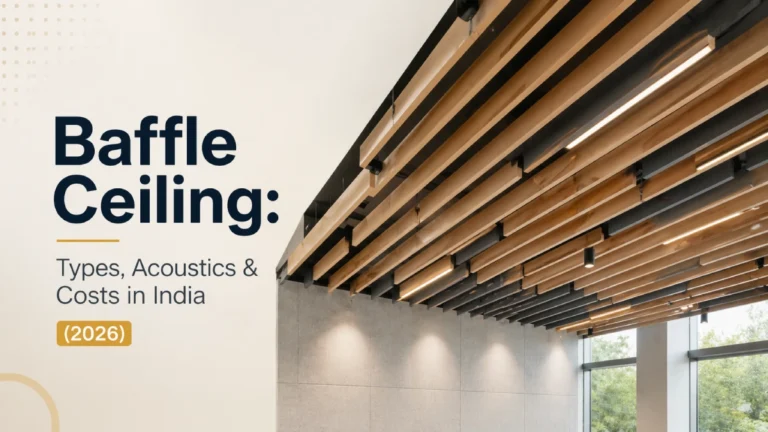
The design: Parallel rows of timber-finish baffle fins, evenly spaced, running the length of a room in a single direction. Panel profiles are typically narrow (40 mm–80 mm wide) and deep (200 mm–500 mm drop), creating a strong linear directionality that draws the eye through the space.
Why it works: Wood introduces warmth and biophilic quality to commercial interiors that metal and synthetic finishes cannot replicate. The linear arrangement creates visual order and a sense of architectural intentionality. In restaurants, hotel lobbies, reception areas, and premium corporate offices, a linear wooden baffle ceiling signals design investment and quality.
Acoustic contribution: Timber baffles with acoustic backing or infill typically achieve NRC values of 0.40–0.70. The gap between panels allows sound to reach the ceiling void above, where additional absorptive material — mineral wool laid on top of the baffles — can significantly enhance total absorption. For spaces where wood aesthetics and meaningful acoustic performance are both required, this combination is the standard specification approach.
Best suited for: Restaurant dining rooms, hotel lobbies, corporate reception areas, premium co-working spaces, lounge areas in educational institutions.
PackSound specification: PackSound’s wooden acoustic hanging baffles are available in natural wood veneer and high-quality wood-effect finishes, customisable in width, depth, length, and spacing to achieve the intended visual density and acoustic performance
2. Acoustic PET Felt Baffle Ceiling

The design: Softly textured panels in coloured or neutral felt material, suspended in rows or mixed orientations. PET felt baffles are available in standard rectangular profiles and in custom die-cut shapes — geometric, organic, wave-form — that give the ceiling strong visual character.
Why it works: PET (Polyethylene Terephthalate) felt offers the highest NRC values of any commonly specified baffle material — typically 0.85 to 0.95 — making it the acoustic specification choice when reverberation control is the primary objective. Its soft texture and wide colour palette also make it the most versatile design material in the baffle ceiling category: felt baffles can be specified in brand colours, used to define zones within an open-plan office, or configured in multi-colour patterns that double as ceiling artwork.
Acoustic contribution: With NRC values regularly above 0.85, a correctly spaced PET felt baffle installation delivers some of the most effective reverberation control achievable without full ceiling coverage. In extremely reverberant spaces — sports halls, canteens, school dining rooms, airport terminals — PET felt baffles are routinely the material of choice among acoustic consultants.
Best suited for: Open-plan offices, school gymnasiums, canteens, co-working spaces, creative studios, sports facilities, libraries, any space requiring maximum absorption at a controlled budget.
PackSound specification: PackSound manufactures acoustic hanging baffles in fibrous and fabric-wrapped formats that deliver comparable high-NRC performance, available in custom colours and sizes to match any design brief.
3. Metal and Aluminium Baffle Ceiling

The design: Extruded aluminium profiles — typically U-shaped, C-shaped, or square-tube cross-sections — suspended in parallel rows with consistent spacing. Finished in powder-coat or anodised colours: matte black, white, silver, gunmetal, or custom RAL colours. Often combined with exposed structural elements, concrete soffits, and black HVAC ductwork to complete an industrial-contemporary aesthetic.
Why it works: Aluminium baffles bring a precision, durability, and material quality that positions them as the correct specification for high-traffic commercial environments: airport terminals, shopping centre atria, transport hubs, large retail spaces, and corporate lobbies. The material is inherently fire-resistant and requires virtually no maintenance, making it the lowest lifecycle-cost option in the baffle category.
Acoustic contribution: Aluminium profiles without acoustic infill are reflective and provide minimal sound absorption. For acoustic performance, aluminium baffles must be specified with acoustic infill — mineral wool or acoustic foam inserted into the profile cavity. With appropriate infill, aluminium baffle ceilings achieve NRC values of 0.55–0.75, adequate for most commercial applications. Without infill, they function as a purely decorative architectural element.
Best suited for: Airports, shopping centres, hotel lobbies, modern retail, transport infrastructure, corporate headquarters, industrial facilities seeking a contemporary aesthetic.
Design tip: Integrating linear LED strip lighting within the aluminium baffle profile — either top-lit or bottom-lit — creates a dramatic ceiling plane effect and reduces the need for surface-mounted light fittings, simplifying the reflected ceiling plan considerably.
4. Geometric and Custom-Pattern Baffle Ceiling
The design: Baffles arranged in non-linear configurations — diagonal grids, honeycomb formations, wave patterns, radial layouts, or mixed-direction arrangements — to create a ceiling that functions as an architectural centrepiece rather than a background element. This category also includes curved baffles that introduce organic form to interiors.
Why it works: In spaces where visual impact is a design brief requirement — creative industry offices, premium showrooms, hospitality venues, museum foyers, luxury retail — a geometric baffle ceiling delivers differentiation that standard linear arrangements cannot. The combination of depth, shadow, pattern, and material creates a ceiling experience that visitors notice and remember.
Acoustic contribution: A multi-directional baffle arrangement provides acoustic benefits in both parallel axes simultaneously, addressing sound traveling in multiple directions through the space. This makes geometric baffle ceilings particularly effective in open, irregularly shaped rooms where a single-direction baffle row would leave significant reflection paths unaddressed.
Best suited for: Luxury retail, creative and tech offices, boutique hotels, museum galleries, high-end restaurants, event venues, co-working hubs seeking brand differentiation.
Design consideration: Custom geometric layouts require early coordination between the acoustic designer, interior designer, and structural engineer. The ceiling fixing points must be planned to support the required panel positions, and mechanical services must be routed to avoid conflicts with the intended baffle layout.
5. Integrated Acoustic Cloud and Baffle Ceiling
The design: A hybrid ceiling treatment combining vertically suspended baffles with horizontally mounted acoustic clouds, configured as a coordinated composition rather than two separate interventions. The clouds — often in custom shapes such as rectangles, irregular polygons, or organic forms — are suspended at varying heights, with baffles grouped around or between them.
Why it works: This design addresses the full acoustic brief of complex commercial spaces more completely than either product alone. Clouds intercept the primary vertical reflection path (sound bouncing off the ceiling), while baffles address horizontal propagation through the room volume. The combined installation achieves faster, more even reverberation reduction across all frequency bands. Visually, the mixed orientation and varied forms create a ceiling with three-dimensional depth and design sophistication that is appropriate for premium lobbies, executive suites, hospitality spaces, and auditoriums.
Acoustic contribution: A well-designed cloud-and-baffle combination, specified by an acoustic consultant, consistently achieves superior RT60 results compared to either product used alone at the same coverage percentage. For spaces with complex acoustic requirements — auditoriums, multipurpose halls, hotel ballrooms — this approach is the standard professional specification.
Best suited for: Hotel lobbies, restaurant dining rooms, auditoriums, multipurpose conference centres, executive boardrooms, high-end residential reception areas.
PackSound specification: PackSound supplies both acoustic hanging baffles and the PerfoAudile™ Acoustic Cloud range — including premium Auraluxe™ 3D ceiling clouds and AeroLoom clouds — enabling a single-supplier specification for complete cloud-and-baffle ceiling treatments. The Auraluxe™ range further offers EchoGlow acoustic ceiling lights, which integrate LED illumination directly into the cloud panel, combining acoustic treatment and ceiling lighting in a single suspended element.
Materials Used in Baffle Ceiling Systems
The material specification of a baffle panel determines its acoustic performance, visual character, durability, fire rating, and maintenance requirements.
Fibreglass and Mineral Wool Core: The standard acoustic infill for high-performance fabric-wrapped baffles. Fibreglass batts provide excellent mid- and high-frequency absorption. Mineral wool adds low-frequency absorption and fire resistance. These materials are typically enclosed within a fabric facing for aesthetic presentation.
PET Felt (Polyethylene Terephthalate Felt): Manufactured from recycled plastic bottles, PET felt is simultaneously the most sustainable and the highest-performing absorptive material in the baffle category. It is available in a wide colour palette, can be die-cut into custom shapes, and achieves NRC values above 0.85 in typical baffle configurations.
Aluminium Extrusion: The standard structural material for metal baffle systems. Aluminium is lightweight, dimensionally stable, corrosion-resistant, and inherently non-combustible. Acoustic infill is specified separately and inserted into the profile cavity.
Natural Wood and Wood Veneer: Used where warmth, natural texture, and premium aesthetics are the design priority. Solid wood baffles are typically heavier and require careful specification of fixing and suspension hardware. Wood-veneer profiles over MDF or aluminium substrate offer a comparable aesthetic at lower weight and cost.
MDF with Fabric or Laminate Facing: A cost-effective substrate for fabric-wrapped acoustic baffles that delivers good acoustic performance. Used in the majority of commercial acoustic baffle installations where premium material aesthetics are not the primary brief.
uPVC: A lightweight, moisture-resistant option appropriate for humid environments such as swimming pool halls, food processing areas, and certain healthcare applications. uPVC baffles are low-maintenance and resistant to termites and corrosion, though their acoustic contribution without infill is limited.
Applications: Where Baffle Ceiling Design Delivers Greatest Value
Open-Plan Corporate Offices
The open-plan office is the single largest application for acoustic baffles in India’s commercial interior market. Modern open-plan design — polished concrete floors, glass partitions, hard ceilings, minimal soft furnishing — creates environments where ambient noise levels routinely exceed 60 decibels during working hours, well above the 40–45 decibel threshold recommended for focused cognitive work. A correctly specified baffle ceiling installation, combined with wall acoustic panels where necessary, consistently reduces noise levels by 6–10 dB and measurably improves speech clarity and occupant productivity.
PackSound delivered a full acoustic treatment for a 12,000 sq. ft. open-plan office in Gurugram that combined fabric wall panels and suspended ceiling baffles, reducing ambient noise levels by over 8 dB and improving speech clarity across all workstations.
Auditoriums and Performance Venues
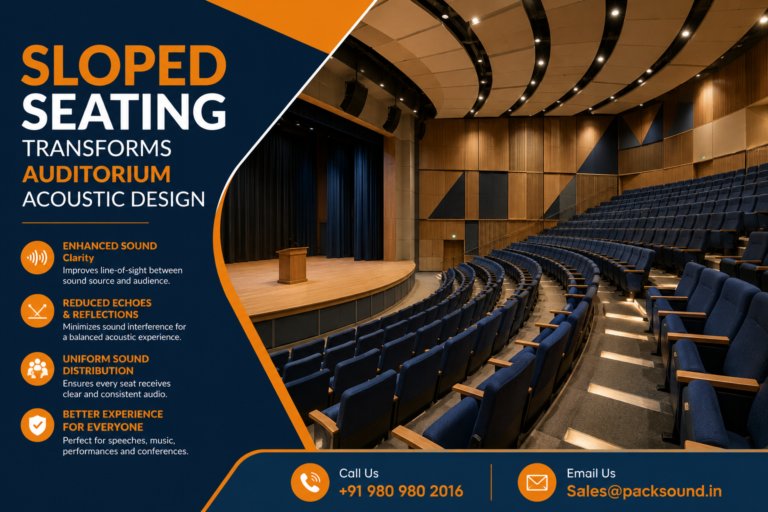
Auditorium acoustic design requires precise control of reverberation time across the frequency range used for speech and music. A ceiling too reflective produces a reverberant, muddy sound that compromises intelligibility. A ceiling over-treated with absorption produces a dry, lifeless acoustic. Baffle ceiling systems — specified at the correct NRC, coverage, and spacing — allow the acoustic designer to tune the auditorium’s RT60 to the target value. PackSound has completed auditorium acoustic treatment for institutions across India, including the Assam Rifles Auditorium in Shillong and a 450-seat school auditorium where suspended baffles and perforated wooden panels delivered optimal RT60 values for speech and music performance as per IS:4954 guidelines.
Hotels and Hospitality Interiors
Hotel lobbies, restaurant dining rooms, conference facilities, and banquet halls all present challenging acoustic environments: large volumes, hard finishes, high occupancy, and diverse noise sources. Baffle ceilings in hospitality interiors serve a dual function — acoustic treatment and primary design feature. Wooden baffle fins above a restaurant dining area warm the space visually, define the ceiling zone architecturally, and reduce the reverberant noise that makes busy restaurants uncomfortably loud. In hotel lobbies, double-height baffles create drama and spatial character while controlling the sound of the large volume.
Educational Institutions
Classrooms, lecture halls, libraries, and school gymnasiums are among the most acoustically demanding spaces in terms of speech intelligibility requirements. Research consistently demonstrates that poor classroom acoustics — characterised by high RT60 and elevated background noise — reduce speech intelligibility for all students and disproportionately affect children with hearing difficulties, second-language learners, and students with attention-related conditions. Acoustic baffle ceilings in educational spaces are not a design preference; they are a functional necessity that directly affects learning outcomes.
Healthcare Facilities
Patient dignity and confidentiality require acoustic privacy in consultation rooms, wards, and treatment areas. Beyond privacy, acoustic comfort — the absence of excessive reverberation and background noise — is increasingly recognised as a therapeutic variable in patient recovery environments. Baffle ceiling systems in healthcare settings must be specified with appropriate fire ratings, surface materials that can withstand clinical cleaning protocols, and configurations that do not obstruct clinical equipment or fire suppression systems.
Industrial and Manufacturing Facilities
Factory floors, warehouses, and production facilities generate very high levels of broadband noise. Exposure to sustained noise above 85 dB is a regulated occupational health risk. Acoustic baffles specified for industrial environments are typically constructed from high-density fibreglass or mineral wool cores with durable, cleanable fabric or perforated metal facings, suspended in dense arrays to provide the maximum absorption achievable given ceiling height and structural constraints.
Co-Working Spaces and Creative Studios
The growth of co-working in India has created significant demand for acoustic ceiling treatment in flexible, multi-use spaces. Co-working operators require backgrounds quiet enough for focused individual work, private enough for video calls, and flexible enough to accommodate event configurations. A baffle ceiling, often in PET felt with brand-specific colour specification, delivers acoustic performance and simultaneously communicates the operator’s design identity.
Key Benefits of a Baffle Ceiling System
Reverberation Control Without Full Ceiling Coverage: Because baffles present two absorptive faces to the room simultaneously, they deliver disproportionately high absorption relative to the ceiling area they occupy. A 30% ceiling coverage with correctly spaced baffles often delivers acoustic improvement equivalent to a full acoustic tile ceiling.
Integration with Building Services: The open geometry of baffle systems accommodates lighting, HVAC, fire suppression, and AV equipment without coordination conflict. Services run between and above the baffles, remaining accessible for maintenance without dismantling the ceiling finish.
Visual and Spatial Depth: A baffle ceiling introduces three-dimensional depth to a space that a flat ceiling cannot provide. Shadow, rhythm, and material texture create a ceiling that actively contributes to the interior design composition.
Design Flexibility: Baffle systems are modular and customisable in panel dimensions, spacing, material, finish, and arrangement pattern. This enables architects to execute precise design visions rather than accommodating standard product constraints.
Lighting Integration: Linear LED strips and pendant fixtures integrate naturally with baffle ceiling layouts. Top-lit baffles create a dramatic uplighting effect. Bottom-lit or side-lit baffles produce ambient, diffuse illumination. The combination of acoustic baffle and integrated lighting in a single ceiling system simplifies project coordination and reduces the number of ceiling-mounted elements that require independent fixing and wiring.
Sustainability: PET felt baffles manufactured from recycled plastic bottles, aluminium profiles with high recycled content, and timber baffles from certified sustainable sources all contribute to green building credits under LEED, IGBC, and GRIHA rating systems.
Buying Considerations: What to Evaluate Before You Specify
Define the Acoustic Objective with Precision
The specification process should begin with an acoustic target — a defined RT60 range for the space’s primary use — not with a product selection. Once the target is defined, the acoustic designer can calculate the required absorption area and determine the appropriate baffle NRC, coverage percentage, and spacing to achieve it. Specifying baffle panels without an acoustic target risks either under-treatment (the space remains reverberant) or over-treatment (the space sounds unnaturally dead).
Match Material to Environment
PET felt and fabric-wrapped panels perform excellently in conditioned commercial environments but are not appropriate for wet, humid, or high-grease environments. Metal and uPVC panels are specified for these conditions. Healthcare environments require fabric or panel materials that withstand specific disinfectant protocols. Always confirm material suitability against the environmental conditions of the installation.
Confirm Fire Rating Requirements
The National Building Code of India and applicable state fire safety regulations specify fire rating requirements for ceiling materials in public assembly, healthcare, hospitality, and educational occupancies. Confirm the applicable fire rating category for the project before finalising panel specification. Request fire testing documentation from the supplier and verify that the system as installed — including fixings and suspension hardware — meets the required fire rating.
Evaluate Suspension Hardware and Structural Capacity
Baffle panels impose point loads on the structural ceiling at each suspension wire or rod fixing. The structural ceiling must be capable of accepting these loads at the required fixing positions. In concrete slab ceilings, this is straightforward. In steel structure or suspended plasterboard ceilings, the fixing positions must be coordinated with the structural engineer. Specify a supplier who provides full technical documentation on fixing requirements and load calculations.
Assess Customisation Depth
A specification-grade baffle ceiling supplier offers customisation in panel width, depth, length, material, surface finish, colour, spacing, and arrangement. A supplier constrained to standard product sizes and a limited finish palette will force design compromises. Confirm the supplier’s customisation capability early in the specification process to avoid downstream value engineering that sacrifices design intent.
Consider Installation Experience
Baffle ceiling installation requires competent rigging, precise alignment, and coordination with mechanical and electrical trades to ensure that services are routed clear of panel positions. A supplier who provides end-to-end project management — from acoustic design through installation and commissioning — reduces coordination risk and ensures that the installed system reflects the design specification.
Verify Total Cost of Ownership
Factor in not only the panel purchase price but also suspension hardware, installation labour, ongoing maintenance, and the cost of replacement panels if panels are damaged. Locally manufactured systems — particularly those produced in India by a supplier with direct supply chain control — typically offer faster replacement turnaround and lower maintenance costs than imported systems.
Baffle Ceiling vs. Acoustic Tile Ceiling: A Comparison
| Consideration | Baffle Ceiling | Acoustic Tile Ceiling |
|---|---|---|
| Absorption geometry | Two-face vertical exposure | Single-face horizontal |
| Performance in tall spaces | Excellent | Limited |
| Service integration | Easy — open format | Coordinated grid required |
| Design flexibility | High — custom layout possible | Low — standard grid |
| Visual impact | Architectural feature | Background finish |
| Maintenance access | Easy — services visible | Requires tile removal |
| Ideal ceiling height | 3.5 m and above | 2.7 m–3.5 m |
| Cost range in India | Rs. 800–Rs. 3,500/sq. m | Rs. 300–Rs. 1,200/sq. m |
For spaces above 3.5 metres in ceiling height and for any project where the ceiling is a design feature rather than a background finish, a baffle ceiling system consistently outperforms acoustic tile on both acoustic effectiveness and visual quality.
Why PackSound for Your Baffle Ceiling Project
PackSound is a brand of Ecotone Acoustic Limited, India’s leading acoustic products manufacturer, with over 25 years of acoustic expertise and more than 1,900 completed projects spanning 1.5 crore square feet of treated area across India.
PackSound manufactures and supplies a comprehensive range of ceiling acoustic products:
Acoustic Hanging Baffles: High-NRC vertically suspended panels for open offices, sports halls, canteens, industrial facilities, and auditoriums. Available in fibrous and fabric-wrapped construction, customisable in size, shape, and colour. Explore at packsound.in/acoustic-ceiling-panels/acoustic-baffles.
PerfoAudile™ Acoustic Clouds: Horizontally suspended ceiling clouds in micro-perforated, PET felt, or fabric-wrapped formats for conference rooms, restaurants, hotel lobbies, and open commercial interiors. Customisable in shape, size, colour, and finish. Explore at packsound.in/acoustic-ceiling-panels/acoustic-clouds.
Auraluxe™ 3D Ceiling Clouds and AeroLoom Clouds: Premium decorative acoustic ceiling elements engineered for premium hospitality, reception areas, and prestige commercial projects where the ceiling cloud is the primary design centrepiece.
EchoGlow Acoustic Ceiling Lights: Integrated acoustic cloud and LED lighting panels that combine acoustic treatment and general illumination in a single suspended element — simplifying ceiling coordination for architects and mechanical consultants.
Wooden Acoustic Hanging Baffles: Natural wood veneer and wood-effect finish panels for hospitality, retail, and premium office interiors requiring the warmth and biophilic quality of timber at ceiling level.
PackSound serves clients across Delhi NCR, Mumbai, Bengaluru, Hyderabad, Chennai, Pune, and cities throughout India, providing end-to-end project management from acoustic consultation and design through manufacturing, installation, and commissioning.
Frequently Asked Questions About Baffle Ceiling Design
What is a baffle ceiling?
A baffle ceiling is a ceiling treatment system in which acoustic panels are suspended vertically from the ceiling structure in parallel rows or custom arrangements. The open geometry between panels allows sound to pass between them and be absorbed by the panel surfaces on both sides, making baffle ceilings highly effective for reverberation control in large, open, or tall spaces.
What is the NRC of a baffle ceiling?
NRC (Noise Reduction Coefficient) values for commercial acoustic baffles typically range from 0.40 for timber-only profiles to 0.95 for high-density PET felt or fibreglass baffles. PackSound’s acoustic hanging baffles achieve NRC values from 0.75 to 0.95 depending on the product specification and thickness.
What materials are used in baffle ceilings?
Common baffle ceiling materials include PET felt, fibreglass, mineral wool (for acoustic infill), aluminium extrusion, natural wood veneer, MDF with fabric or laminate facing, and uPVC. The material choice depends on the acoustic target, aesthetic brief, fire rating requirements, and environmental conditions of the installation.
What is the cost of a baffle ceiling in India?
Baffle ceiling costs in India vary by material, customisation level, acoustic specification, and installation complexity. Fabric-wrapped and fibrous acoustic baffles are priced from approximately Rs. 800 to Rs. 2,500 per square metre of panel face area. Premium decorative products such as Auraluxe™ 3D ceiling clouds and integrated lighting panels are priced at the upper end of the market. Contact PackSound for a detailed quotation based on your specific project requirements.
How is a baffle ceiling installed?
Baffle panels are suspended from the structural ceiling using steel wire, threaded rod, or purpose-designed suspension brackets. The fixing positions must be coordinated with the structural ceiling and the layout of mechanical services. PackSound provides complete installation services, including site assessment, fixing design, installation, and commissioning.
Do baffle ceilings require maintenance?
Maintenance requirements vary by material. Aluminium and uPVC baffles require periodic cleaning with appropriate cleaning agents. Fabric-wrapped and felt baffles benefit from periodic vacuuming or compressed air cleaning to remove dust accumulation. Wood veneer baffles may require occasional application of appropriate wood care products. PackSound provides maintenance guidance for all supplied systems.
Can baffle ceilings be installed in rooms with low ceilings?
Baffle ceilings are most effective and most visually appropriate in spaces with ceiling heights of 3.5 metres and above. In lower-ceiling rooms, the panel drop reduces head clearance and the visual effect can feel intrusive. For lower-ceiling applications, acoustic clouds or wall-mounted acoustic panels are typically the more appropriate specification.
What is the difference between a baffle ceiling and an acoustic cloud ceiling?
Baffles are suspended vertically and intercept horizontally traveling sound; they are most effective in tall spaces. Acoustic clouds are suspended horizontally and intercept the vertical reflection path between the ceiling and the floor; they are most effective in medium-height rooms. Many specifications combine both products to address the full range of reflection paths in a space.
Are baffle ceilings fire-rated?
PackSound’s acoustic baffle products are manufactured using materials that meet applicable fire safety standards. For specific fire rating requirements — including those applicable to public assembly, healthcare, hospitality, and educational occupancies under the NBC and state regulations — PackSound can provide product fire certification documentation. Contact the technical team to request fire safety data sheets for specific products.
Can baffle ceilings integrate lighting?
Yes. Linear LED strip lighting integrates naturally with aluminium baffle profiles. Pendant fixtures can be hung at the same level as the baffles. PackSound’s EchoGlow acoustic ceiling lights integrate LED illumination directly into acoustic cloud panels, combining acoustic treatment and general illumination in a single suspended element — an approach that significantly simplifies ceiling coordination on complex commercial projects.
Request a Free Acoustic Consultation from PackSound
If you are specifying a baffle ceiling for a commercial, institutional, hospitality, or industrial project in India, PackSound’s technical team provides a free site assessment and acoustic consultation. The consultation covers ceiling height and geometry assessment, acoustic targets for the space, material and product recommendations, fire rating requirements, coordination with mechanical services, and a fully itemised product and installation proposal.
PackSound operates across Delhi NCR, Mumbai, Bengaluru, Hyderabad, Chennai, Pune, Guwahati, Raipur, and cities throughout India — with end-to-end project capability from acoustic design through manufacturing, installation, and post-installation support.
Contact PackSound today:
Visit packsound.in to explore the full product range or request your free consultation.
Call: +91 980 980 2016 | +91 9990 858 797
Email: Sales@packsound.in
Explore acoustic hanging baffles at packsound.in/acoustic-ceiling-panels/acoustic-baffles.
Explore acoustic ceiling clouds at packsound.in/acoustic-ceiling-panels/acoustic-clouds.
PackSound is a brand of Ecotone Acoustic Limited, Greater Noida, Uttar Pradesh, India. Manufacturer and installer of acoustic panels, soundproof partitions, acoustic ceiling baffles, acoustic clouds, and complete acoustic treatment systems for commercial, institutional, and hospitality projects across India.