Everything you need to know about noise cancelling curtains, soundproof curtains, and acoustic curtains — by India’s leading acoustic manufacturer.
Why You Are Searching for Noise Cancelling Curtains
You live near a busy road and the traffic noise bleeds into your bedroom every morning. Your home office sits next to the living room and every conversation from outside kills your focus. Your recording studio has an untreated window that lets in street noise. Your school hall echoes so badly that students struggle to hear the teacher.
These are among the most common acoustic problems in Indian homes, offices, and institutions — and noise cancelling curtains are one of the most practical, affordable, and reversible solutions available.
Unlike acoustic wall panels that require fixing to walls, or soundproofing that demands structural work, noise cancelling curtains install on existing curtain tracks or rods in hours. They can be removed, relocated, and replaced without leaving a trace. They work acoustically and look like normal window treatments.
PackSound, manufactured by Ecotone Acoustic Limited, supplies acoustic and soundproof curtains across India for residential, commercial, institutional, and industrial applications. This guide explains exactly how they work, what to look for, what the real-world noise reduction numbers are, and how to choose the right product for your specific situation.
What Are Noise Cancelling Curtains?
Noise cancelling curtains — also called soundproof curtains, acoustic curtains, or noise reduction curtains — are heavy, multi-layer window treatments engineered to reduce the amount of sound that passes through a window, doorway, or open partition.
The term “noise cancelling” is borrowed from the headphone world, where electronic circuitry actively generates anti-phase sound waves to cancel noise. Curtains do not work that way. There is no electronics involved. Noise cancelling curtains work through two passive acoustic mechanisms: sound absorption and sound mass/blocking.
Understanding the difference between these two mechanisms is the most important thing to know before you buy.
Sound Absorption vs Sound Blocking: Why It Matters
Sound absorption (measured by the Noise Reduction Coefficient, or NRC) describes how much sound energy a material converts into negligible heat when a sound wave passes through it. High-NRC curtains reduce echo, reverberation, and the build-up of reflected noise inside a room. They make a room feel quieter because they stop sound from bouncing around.
Sound blocking (measured by the Sound Transmission Class, or STC) describes how much a material resists the passage of airborne sound from one side to the other. High-STC curtains reduce the amount of external noise that enters from outside — traffic, construction, neighbours.
Most curtains sold in India do one or the other. The best acoustic curtains do both.
| Curtain Type | What It Does | Key Rating | Best For |
|---|---|---|---|
| Sound-absorbing curtain | Reduces echo inside the room | NRC (0.5–0.85) | Studios, halls, offices |
| Sound-blocking curtain | Reduces noise entering from outside | STC (10–25) | Bedrooms, home offices |
| Acoustic multi-layer curtain | Does both | NRC + STC | Comprehensive noise control |
| Regular heavy drape | Minimal acoustic effect | None | Décor only |
How Noise Cancelling Curtains Work: The Science
A sound wave is a pressure wave — vibrating air molecules moving outward from a source. When that wave hits a standard glass window, the glass vibrates sympathetically and transmits most of the energy into the room. The same happens at any gap around the window frame.
A noise cancelling curtain hung in front of the window adds a series of acoustic obstacles between the sound source and your ear:
Layer 1 — Face fabric: The outer fabric layer is typically a dense woven textile (velvet, polyester, or acoustic fabric). It reflects some high-frequency energy and begins to dissipate the sound wave.
Layer 2 — Absorptive core: The middle layer — usually high-density polyester fibre fill, mass-loaded vinyl (MLV), or mineral wool — does the primary work. It absorbs mid and high frequencies as sound waves are forced to travel through a porous, energy-dissipating material. MLV-core curtains add mass that resists the passage of low-frequency energy.
Layer 3 — Backing fabric: A rear layer of blackout fabric or acoustic lining adds additional mass and prevents sound that passed through the core from reflecting back out.
Air gap: When a curtain hangs away from the window surface — even 4–8 cm — the trapped air layer acts as an additional decoupling buffer. This is why curtains hung in a full pleat on a rod that projects well from the wall perform better than curtains pressed flat against the glass.
Edge sealing: Gaps around the edges of the curtain — at the sides, top, and bottom — are the primary weak points. Sound follows the path of least resistance. A curtain that overlaps the wall by 10–15 cm on each side, and reaches the floor or windowsill, dramatically outperforms a curtain that fits only the window opening.
The combined effect of all these layers can reduce perceived noise levels by 5–22 dB depending on product quality, installation method, and frequency content of the noise.
Real Noise Reduction Numbers: What to Expect
One of the most common complaints about noise cancelling curtains is that buyers expect complete silence and receive noticeable but incomplete noise reduction. Setting correct expectations is essential.
A 10 dB reduction is substantial — it is perceived by the human ear as roughly halving the apparent loudness of a sound. A 20 dB reduction is dramatic — it drops a sound that was clearly audible to barely noticeable in the background. These are the ranges achievable with quality acoustic curtains properly installed.
| Noise Source | Without Curtains | With Quality Acoustic Curtains | Reduction |
|---|---|---|---|
| Heavy road traffic | 70–80 dB inside | 58–68 dB | 10–15 dB |
| Neighbour conversation | 55–60 dB | 40–48 dB | 10–18 dB |
| Construction noise | 75–85 dB | 60–70 dB | 12–18 dB |
| Room echo / reverberation | High RT60 | Noticeably reduced | NRC dependent |
Important: These figures apply to curtains covering the full window opening with edge overlap and appropriate installation. A curtain that covers only the glass area with no overlap at sides or floor will deliver 30–50% less performance than these numbers suggest.
Types of Noise Cancelling Curtains: Which One Do You Need?
1. Residential Noise Reduction Curtains
Designed for home installation — bedrooms, living rooms, home offices, and kitchen areas near noisy streets. These curtains prioritise three things: adequate noise reduction, blackout performance (most buyers want both), and an aesthetic that fits a residential interior.
Residential noise cancelling curtains in India are typically 2–3 layers: a decorative face fabric in a wide range of colours, a dense polyester fill core, and a blackout backing. NRC values range from 0.45 to 0.75. STC improvement of 8–14 dB over a single-glazed window is typical.
Best for: Bedrooms near arterial roads or railways, home offices, children’s rooms, apartments in high-density urban areas.
2. Industrial and Commercial Acoustic Curtains
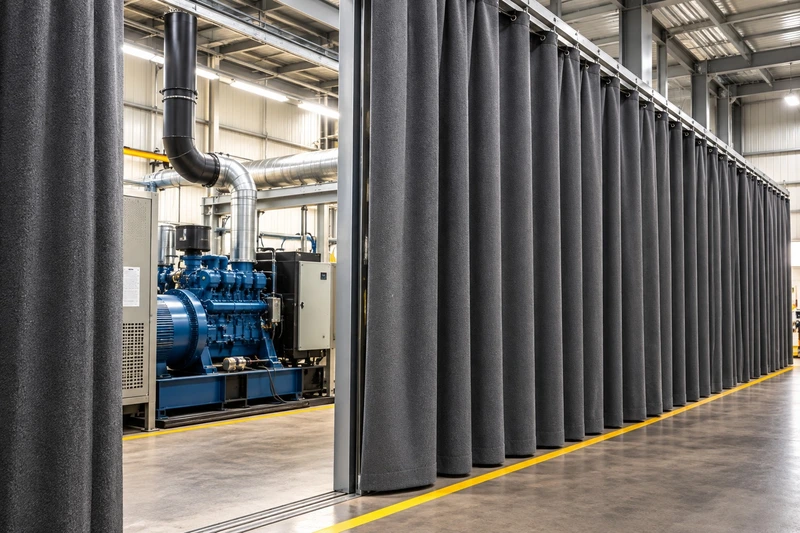
Heavy-duty acoustic curtains for machinery enclosures, warehouse dividers, generator rooms, and industrial noise control applications. These are typically 4–6 kg/m² or heavier, with mass-loaded vinyl or mineral wool cores that target low-frequency industrial noise (generators, compressors, HVAC plant, production machinery).
Industrial acoustic curtains are not decorative — they are engineered products. They hang on heavy-duty tracks with reinforced top headers, and their primary rating is STC (sound transmission class) and NRC across a full octave band sweep. PackSound supplies industrial acoustic curtains with tested STC values from 18 to 28 and NRC values from 0.70 to 0.90.
Best for: Generator enclosures, machine rooms, factory floors, loading bays, warehouses, data centre acoustic partitions.
3. Stage and Auditorium Acoustic Curtains
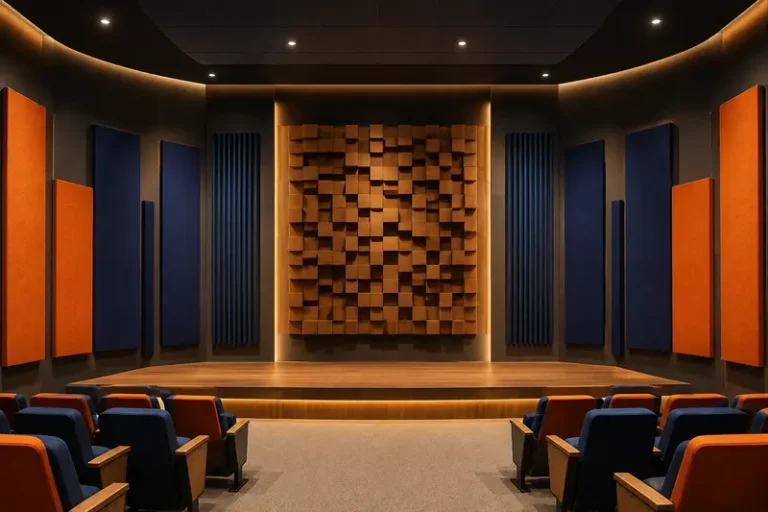
Stage and auditorium curtains serve a dual purpose: they define the performance space visually and they contribute acoustic absorption to the hall. Heavy velvet or wool-based stage curtains with deep pleating can achieve NRC values of 0.60–0.85 — making them a significant contributor to reverberation control in theatrical and performing arts spaces.
PackSound supplies motorised and manual auditorium curtains, stage drapes, and acoustic stage linings as part of its complete auditorium solution. View auditorium curtains and stage lighting →
Best for: School and college auditoriums, theatres, performing arts centres, community halls, religious assembly spaces.
4. Office and Commercial Space Curtains
Open-plan offices, co-working spaces, conference rooms, and commercial interiors increasingly use acoustic curtains as flexible room dividers or window treatments that also improve the acoustic environment. Commercial acoustic curtains combine NRC performance with design quality — they need to look appropriate in a professional environment.
Commercial acoustic curtains from PackSound are available in neutral tones with fabric options that align with corporate interior design standards. They mount on ceiling-fixed tracks for room-divider applications or on standard window rod systems for window applications.
Best for: Open-plan offices, meeting rooms with glass walls, co-working spaces, hotel rooms and lobbies, hospitality interiors.
5. Studio and Recording Environment Curtains
Recording studios, podcast booths, home studios, and broadcast rooms use acoustic curtains to add variable absorption to the recording environment, cover reflective glass windows, and provide a quick-deploy diffusion/absorption element that can be adjusted between recording sessions.
Studio curtains typically have NRC values of 0.75 or above and are available in neutral studio colours (charcoal, black, dark grey) that work in the lighting conditions of a recording environment.
Best for: Recording studios, podcast recording rooms, home theatres, broadcast booths, voice-over booths.
Key Specifications to Check Before Buying
Most curtain suppliers in India describe their products in vague marketing language (“heavy duty,” “premium quality,” “noise blocking”). Here are the specific technical specifications that determine actual performance:
NRC Rating
The Noise Reduction Coefficient runs from 0 to 1.0. A curtain with NRC 0.80 absorbs 80% of the sound energy that strikes it. For residential and commercial applications, target NRC 0.60 or above. For studio and auditorium applications, look for NRC 0.75 or above. Any supplier who cannot provide a third-party NRC test certificate should not be trusted with an acoustic brief.
STC Rating
The Sound Transmission Class measures how much sound is blocked between two spaces. Most curtains achieve STC 10–15. Multi-layer acoustic curtains with MLV cores can reach STC 20–25. For industrial applications, STC 25+ is the appropriate target. Residential noise reduction is typically felt at STC 12 and above.
Weight per Square Metre
Weight is directly correlated with mass, and mass is a primary driver of sound blocking performance. Residential acoustic curtains should weigh at least 700 g/m². Industrial acoustic curtains weigh 3–6 kg/m². If a supplier cannot state the weight per square metre of their product, ask for it.
Number of Layers
A single-layer heavy fabric is not a noise cancelling curtain — it is a heavy drape. Genuine acoustic curtains have a minimum of three layers: face fabric, core, and backing. The best industrial curtains have five or more layers.
Core Material
The core is where the acoustic work happens. Options include:
- High-density polyester fibre: Good NRC (0.55–0.80), lightweight, cost-effective for residential use
- Mass-Loaded Vinyl (MLV): Heavy, excellent for low-frequency blocking, used in industrial and premium residential curtains
- Mineral wool / fiberglass fill: Highest NRC performance (0.80–0.95), used in professional acoustic and studio curtains
- Foam core: Low performance, used in cheap consumer products, not recommended for serious acoustic applications
Fire Rating
Any curtain installed in a public or commercial space in India should meet fire rating standards. PackSound’s acoustic curtains are manufactured with flame-retardant treated fabrics that meet relevant standards. Request a fire certificate for any commercial installation.
Customisation
Standard-size curtains from general retailers almost never fit the actual dimensions of the opening they need to cover. Acoustic performance is directly tied to full coverage plus edge overlap. Custom-size curtains that are made to exact dimensions with the specified edge overlap built in outperform standard sizes in almost every installation.
How to Install Noise Cancelling Curtains for Maximum Performance
The most technically advanced acoustic curtain in the world will underperform if it is installed incorrectly. These installation principles apply to every noise cancelling curtain application:
Overlap the wall, not just the window. The curtain rod should extend at least 15 cm beyond the window frame on each side. The curtain should cover this full rod width, so its edges are against the wall rather than aligned with the glass edge. This eliminates the flanking path where sound passes around the curtain rather than through it.
Reach the floor or the sill. A curtain that hangs 10 cm short of the floor leaves a flanking gap that undermines the performance of the entire curtain. For maximum performance, curtains should either reach the floor or form a seal against the windowsill with a weighted hem.
Use maximum fullness. Flat curtains pressed against the window perform significantly worse than curtains hung with full pleating (150–200% fullness). Deep pleating creates multiple layers of fabric and trapped air pockets that dramatically increase effective NRC.
Create an air gap. Mount the curtain rod so the fully closed curtains hang 8–15 cm in front of the glass surface. This air gap is a major performance multiplier, particularly for low and mid frequencies.
Seal the top. A pelmet (box valance) above the curtain rod that fills the gap between the rod and the ceiling prevents sound from travelling over the top of the curtain. This is particularly important in rooms where the window extends close to the ceiling.
Use full-height curtains where possible. Floor-to-ceiling curtains that run from the ceiling line to the floor outperform window-height curtains even when the window itself is smaller. The greater coverage area and the elimination of multiple flanking paths produces consistently better results.
Noise Cancelling Curtains vs Acoustic Wall Panels: Which Do You Need?
This is one of the most common questions PackSound receives from clients who are trying to decide between curtain-based solutions and panel-based acoustic treatment.
The answer depends on the specific noise problem:
If your problem is echo and reverberation inside the room — sound bouncing between hard surfaces, making speech difficult to follow, creating a reverberant acoustic environment — then acoustic wall panels are the primary solution. PackSound’s acoustic wall panels deliver NRC values of 0.85–0.95 and treat the room’s acoustic response systematically. Curtains contribute to this treatment but are not a substitute for wall panel coverage.
If your problem is external noise entering through windows — traffic, construction, neighbourhood noise — then noise cancelling curtains are your primary tool for the window surfaces. Combined with acoustic doors, they address the primary weak points in a room’s envelope.
If your problem is both — a reverberant room that also suffers from external noise intrusion — the complete solution combines acoustic curtains on windows with wall and ceiling treatment elsewhere. This is the standard approach PackSound uses in studio, home theatre, and commercial office projects.
The practical summary:
| Problem | Primary Solution | Supporting Solution |
|---|---|---|
| Echo and reverb in the room | Acoustic wall panels | Add acoustic curtains |
| External noise through windows | Noise cancelling curtains | Add acoustic doors / seals |
| Both | Wall panels + acoustic curtains | Complete room treatment |
| Industrial machinery noise | Heavy industrial acoustic curtains | Acoustic enclosure panels |
Where Noise Cancelling Curtains Are Used in India
Residential Homes and Apartments
Indian urban housing near major roads, railway lines, markets, and construction sites suffers from significant noise intrusion. Noise cancelling curtains for bedrooms are the most common residential acoustic application in India. The combination of a 3-layer acoustic curtain with a blackout lining delivers noise reduction and complete light exclusion — both of which contribute to sleep quality.
High-rise apartments with large glass windows and balcony doors are particularly vulnerable to noise intrusion. Acoustic curtains covering the full window plus balcony door openings can produce substantial improvements in perceived noise levels in living spaces.
Home Offices and Study Rooms
Post-pandemic, home office acoustics are one of the fastest-growing areas of demand in India’s acoustic market. A home office near a street, below an active family living area, or adjacent to a kitchen or living room benefits from both reduced external noise intrusion (acoustic curtains) and reduced internal echo (acoustic panels or acoustic curtains on multiple walls).
Recording Studios and Podcast Setups
Home recording and podcast production is one of the largest growth categories in India’s creative economy. A window in a recording room is one of the most significant sources of acoustic leakage and noise intrusion. Acoustic studio curtains on windows, combined with acoustic foam panels on walls, form the basis of a functional home recording environment.
School and College Auditoriums and Halls
Stage and acoustic curtains in school auditoriums serve multiple functions — they define the performance space, help control reverberation, and provide visual framing for events. PackSound supplies school auditorium curtains as part of its complete auditorium acoustic solution, alongside acoustic wall panels, ceiling treatment, and auditorium seating.
Hotels and Hospitality
Guest rooms near busy streets, conference rooms with external noise intrusion, and lobby spaces with hard acoustic surfaces all benefit from acoustic curtain treatments. Hospitality-grade acoustic curtains from PackSound are designed for the demanding appearance standards of hotel interiors while delivering measurable noise reduction performance.
Industrial Facilities
Generator rooms, compressor enclosures, production areas, testing cells, and machine rooms use heavy-duty industrial acoustic curtains to contain or reduce noise. These applications require STC-rated products with documented performance data and fire-rated materials. PackSound’s industrial acoustic curtains meet these requirements and are supplied with test certificates for compliance documentation.
Noise Cancelling Curtains for Specific Indian Noise Problems
India has a distinct noise profile that differs significantly from Western markets. Traffic noise from two-wheelers and auto-rickshaws is predominantly mid-frequency. Temple, mosque, and community loudspeakers produce high-level low to mid-frequency content. Construction noise is broadband. Railway noise is low and mid-frequency dominated.
Matching curtain construction to the frequency content of your specific noise source improves performance:
Traffic and road noise (mid frequency dominant): 3-layer polyester fill curtains perform well. Full-overlap installation is critical.
Low-frequency industrial or bass noise: Mass-loaded vinyl (MLV) core curtains offer better low-frequency blocking performance than polyester fill alone. However, no curtain will eliminate significant low-frequency energy — noise barriers and structural decoupling are required for severe low-frequency problems.
Neighbour and community noise (broadband): High-NRC curtains combined with acoustic seals on doors and windows deliver the best combined result.
Airport and aircraft noise: Aircraft noise contains significant low-frequency energy that is difficult to block with curtains alone. Heavy acoustic curtains reduce perceived aircraft noise noticeably but will not eliminate it. For airport-adjacent properties with severe noise exposure, soundproof partitions and secondary glazing combined with acoustic curtains is the comprehensive approach.
Frequently Asked Questions: Noise Cancelling Curtains in India
Do noise cancelling curtains actually work?
Yes — with appropriate expectations. Quality acoustic curtains correctly installed reduce perceived noise by 10–20 dB, which is substantial and clearly audible. They will not produce silence. They will make external noise noticeably less intrusive and reduce internal echo. The combination of the two effects makes rooms significantly more comfortable.
What is the difference between noise cancelling curtains and blackout curtains?
Blackout curtains block light. Most blackout curtains have no meaningful acoustic performance — they are made from a single layer of opaque fabric. Noise cancelling curtains have multiple acoustic layers and are specifically engineered for sound reduction. PackSound supplies curtains that provide both blackout and acoustic performance, but not all blackout curtains from general retailers offer acoustic performance.
How many dB do noise cancelling curtains reduce?
Quality acoustic curtains with proper installation reduce noise by 10–22 dB depending on the product specification, the frequency of the noise, and the installation method. A 10 dB reduction is perceived as halving apparent loudness. A 20 dB reduction is substantial and transforms a noisy room into a noticeably quieter one.
Can I install noise cancelling curtains myself?
Residential acoustic curtains can be installed by the homeowner on standard curtain rods or tracks. For maximum performance, follow the installation guidelines: full wall overlap, floor-length or sill-sealed, deep pleating, and adequate air gap from the glass. Industrial and heavy commercial curtains require professional installation on specialised track systems.
Are acoustic curtains available in custom sizes?
Yes. PackSound manufactures acoustic curtains to custom dimensions. Custom sizing is strongly recommended — standard sizes almost never achieve the wall overlap and edge sealing that maximises performance.
What is the price of noise cancelling curtains in India?
Pricing depends on size, material specification, and layer construction. Entry-level residential acoustic curtains with polyester fill cores are available from approximately ₹300–500 per sq ft. Premium MLV-core or high-density acoustic curtains range from ₹500–900 per sq ft. Industrial acoustic curtains with full NRC and STC certification range from ₹600–1200+ per sq ft depending on specification. Contact PackSound for a project-specific quotation.
Do noise cancelling curtains also block light?
PackSound’s acoustic curtains include blackout lining as standard in residential and hospitality grades. They provide both noise reduction and complete light blockage.
Do curtains help with noise in an auditorium?
Yes. Heavy acoustic drapes installed with deep pleating contribute NRC 0.60–0.85 per unit area — making them a meaningful contributor to reverberation control in auditoriums and performance spaces. They also allow the acoustic response of the space to be adjusted — drawing or opening the curtains changes the RT60, giving multi-purpose spaces acoustic flexibility. See PackSound’s complete auditorium acoustic treatment services →
Are the curtains fire-rated?
PackSound’s commercial and institutional acoustic curtains are manufactured with flame-retardant treated fabrics. Fire certificates are available for commercial projects. Request fire-rating documentation when specifying for public buildings, schools, and government facilities.
The PackSound Acoustic Curtain Range
PackSound by Ecotone Acoustic Limited manufactures and supplies noise cancelling curtains across all product grades for the Indian market. Our curtains are:
- Manufactured in India — engineered for Indian climate conditions, humidity ranges, and project requirements
- Custom sized — made to your exact dimensions with the specified edge overlap and fullness
- Third-party tested — NRC and STC values backed by laboratory test certificates, not marketing claims
- Fire rated — commercial and institutional grades carry flame-retardant certification
- Aesthetically designed — available in a full range of colours and fabric finishes to match residential, commercial, and institutional interiors
Our acoustic curtains are one component of a complete acoustic solution. PackSound also manufactures and installs acoustic wall panels, acoustic ceiling systems, soundproof doors, acoustic hanging baffles, noise barriers, and complete auditorium solutions — which means every element of your acoustic project can be designed, supplied, and installed by one team.
Get a Free Consultation
Whether you need curtains for a single bedroom window or a complete noise control specification for an industrial facility — PackSound’s acoustic engineers will assess your situation and recommend the right product for your actual noise problem.
We serve clients across Delhi NCR, Mumbai, Bengaluru, Hyderabad, Chennai, Pune, Kolkata, Ahmedabad, Jaipur, and all major cities across India.
Call: +91 9809802016 | +91 9891320678
Website: packsound.in
Product range: ecotone.co.in
No generic products. No guesswork. Just the right acoustic solution for your specific noise problem.
PackSound is the acoustic brand of Ecotone Acoustic Limited, headquartered in Greater Noida West, Uttar Pradesh, India. Ecotone Acoustic Limited manufactures acoustic panels, ceiling systems, soundproof partitions, acoustic doors, noise barriers, and complete acoustic solutions for residential, commercial, institutional, and industrial applications across India.