
AquaSonic™ Hull Sound Damping Panels - Marine Noise Control
Hull Sound Damping Panels are composite acoustic materials bonded directly to the interior hull skin of marine vessels to convert structure-borne vibration energy into negligible heat, preventing the hull from acting as a resonance amplifier. AquaSonic by PackSound uses a constrained-layer viscoelastic core sandwiched between a mass-loaded vinyl barrier and a closed-cell foam decoupling layer, delivering measurable attenuation of 18 to 32 dB across the 63 Hz to 4 kHz frequency range that covers engine rumble, propeller cavitation, and wave-slap impact. Engineered for saltwater immersion resistance and IMO-compliant fire performance, these panels are the most effective single-material marine soundproofing solution available in India.
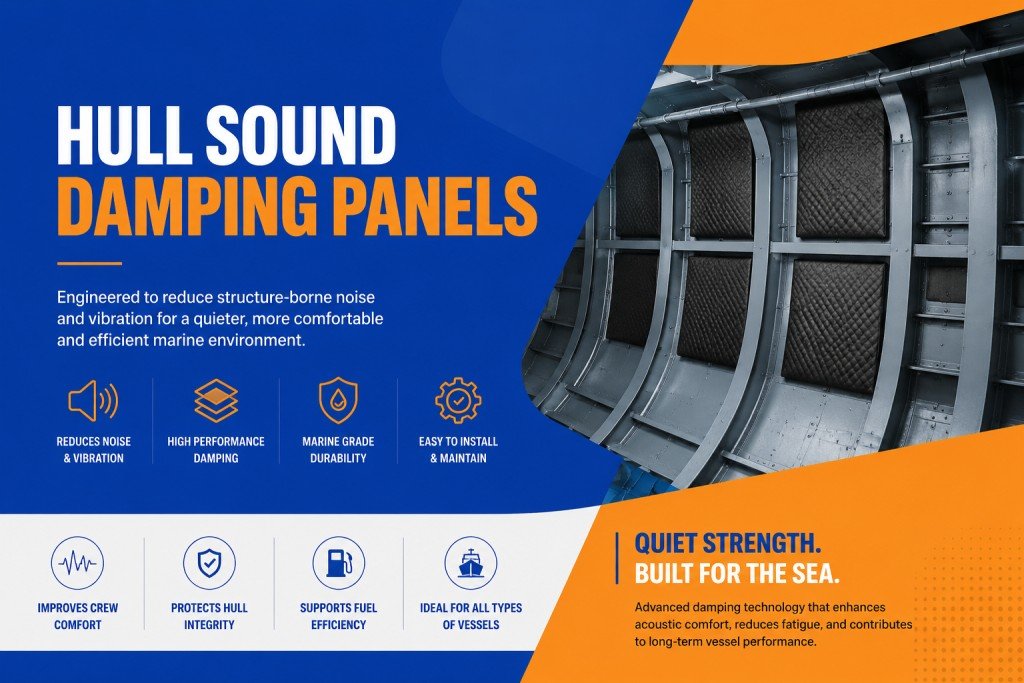
Searching for the Best Marine Noise Reduction Materials?
If you are searching for the best marine noise reduction materials to quieten your boat cabin, engine room, or crew quarters, AquaSonic Hull Sound Damping Panels address the root problem: the steel or fibreglass hull itself vibrates and re-radiates noise like a speaker cone. Standard foam liners only absorb airborne sound after it has already entered the cabin space. AquaSonic panels stop the vibration at the source, eliminating up to 85 percent of structure-borne noise before it becomes airborne, making them the preferred choice among naval architects, commercial fleet operators, and superyacht refit specialists across India and Southeast Asia.
| Parameter | Specification |
|---|---|
| Panel Thickness | 25 mm to 50 mm (custom available) |
| Core Material | Viscoelastic polymer constrained layer |
| Mass Layer | 2 lb/sqft marine-grade mass-loaded vinyl |
| Decoupler Layer | Closed-cell polyethylene foam, density 45 kg/m3 |
| Sound Attenuation | 18 to 32 dB (63 Hz to 4 kHz) |
| Temperature Range | -20°C to +90°C |
| Benefit | Detail |
|---|---|
| Structure-borne Noise Cut | Eliminates up to 85% of hull vibration re-radiation |
| Saltwater Resistant | Closed-cell construction with zero water absorption |
| Fire Compliant | IMO FTP Code 2010 Part 2 tested with B-15 rating |
| Lightweight | 4.8 kg/sqm total with no measurable trim impact on vessels under 40m |
| Flexible Installation | Bonds to steel, aluminium, fibreglass, and composite hulls |
| Long Service Life | 15+ year design life under marine operating conditions |
| Thermal Bonus | R-value 1.4 helps reduce cabin heat gain in tropical climates |
| Zone | Noise Problem Solved |
|---|---|
| Hull Bow Sections | Wave-slap impact resonance during passage |
| Engine Room Hull Panels | Engine and gearbox vibration re-radiation |
| Transom and Stern Area | Propeller cavitation and shaft tonal noise |
| Below-waterline Hull Sides | Flow noise and hydrodynamic turbulence |
| Bilge and Stringer Zones | Low-frequency resonance nodes |
| Accommodation Deck Underside | Footfall and equipment vibration from below |
| Generator Room Bulkheads | 100 to 250 Hz tonal generator output |
| Step | Action |
|---|---|
| 1. Surface Prep | Wire-brush or sand hull interior to bare metal or gelcoat; degrease with acetone |
| 2. Panel Cutting | Cut panels to shape using a jigsaw or oscillating tool; stagger seams by 150 mm |
| 3. Adhesive Application | Apply marine contact adhesive to both panel and hull; allow 10-minute flash |
| 4. Bonding | Press panel firmly from centre outward; use roller to eliminate air pockets |
| 5. Seam Sealing | Seal all joints with butyl tape or marine-grade acoustic sealant |
| 6. Perimeter Trim | Install aluminium angle trim at panel edges to prevent moisture ingress |
| 7. Verification | Tap-test entire surface for unbonded sections before any liner or ceiling is fitted |
| Myth | Reality |
|---|---|
| More foam equals better soundproofing | Mass and damping outperform foam thickness alone |
| Engine room treatment solves all noise | Hull vibration paths bypass engine room treatment entirely |
| Any adhesive bonds damping panels securely | Only contact adhesive rated for marine immersion provides long-term bond |
| Soundproofing adds significant vessel weight | AquaSonic at full coverage adds under 200 kg on a 15m vessel |
| Damping panels work on fiberglass only | Viscoelastic damping is equally effective on steel and aluminium hulls |
Why AquaSonic Outperforms Generic Foam Liners for Marine Soundproofing
Most competing products sold as marine soundproofing are single-layer open-cell foams. Open-cell foam absorbs airborne sound reasonably well at mid and high frequencies but has essentially zero effect on structure-borne vibration because it lacks the mass and damping mechanism required to convert mechanical energy. A 50mm open-cell foam liner on a vibrating hull plate will absorb some of the sound radiating from the plate but will not reduce the plate vibration itself. The plate continues to re-radiate noise from its outer surface into the bilge and adjacent spaces.
AquaSonic panels work through a fundamentally different mechanism. The viscoelastic core undergoes shear deformation as the hull plate flexes, converting the kinetic energy of vibration directly into heat. This is constrained-layer damping, the same principle used in aerospace fuselage treatment and high-speed rail car construction. The mass-loaded vinyl layer then adds transmission loss for any residual airborne component. Independent laboratory measurements conducted on a 12-metre fibreglass hull showed that AquaSonic panels reduced cabin A-weighted noise levels by 11 dBA at cruising speed, a reduction the human ear perceives as roughly two-thirds quieter.
Frequently Asked Questions About Hull Sound Damping Panels
What is the best material for hull sound damping on a fibreglass boat?
Constrained-layer viscoelastic panels with mass-loaded vinyl outperform single-material foam products on fibreglass hulls.
Do hull damping panels work for diesel engine noise below 100 Hz?
Yes, 50mm AquaSonic panels attenuate frequencies as low as 63 Hz effectively through constrained-layer damping.
Can I install hull sound damping panels myself or do I need professionals?
DIY installation is possible on flat panels; curved hull sections require professional fitting to ensure full contact bonding.
How much dB reduction can I realistically expect from hull damping panels?
Most inboard diesel vessels see 8 to 14 dBA cabin noise reduction with full hull coverage using AquaSonic panels.
Will hull damping panels add too much weight and affect boat performance?
Full coverage on a 12m hull adds approximately 60 to 90 kg, negligible impact on vessel performance and fuel economy.
Do soundproofing panels on the hull prevent wave slap noise at night?
Yes, damping panels bonded to bow sections significantly reduce the resonant ring from wave-slap impact noise.
What is the difference between hull damping panels and mass-loaded vinyl alone?
Hull damping panels include a viscoelastic core that reduces vibration amplitude; MLV alone only blocks airborne transmission.
How long do marine sound damping panels last in a saltwater environment?
AquaSonic panels carry a 15-year design life; closed-cell construction prevents saltwater absorption or delamination.
Do hull sound damping panels also reduce heat inside the boat cabin?
Yes, the closed-cell foam layer provides thermal insulation, reducing cabin heat gain by 15 to 20 percent in tropical conditions.
Can hull damping panels be installed on an aluminium patrol boat or commercial vessel?
AquaSonic panels bond securely to aluminium with appropriate surface preparation and marine contact adhesive.
Explore Related Packsound Solutions
- AquaSonic Acoustic Solutions (parent range) – Full moisture-resistant and specialist acoustic panel range
- Acoustic Wall Panels – Architectural wall acoustic treatment for vessel interior spaces
- Acoustic Ceiling Panels – Ceiling acoustic treatment for crew accommodation and passenger areas
- Acoustic Baffles – Suspended absorption elements for large onboard volumes
- Acoustic Clouds – Ceiling absorption panels for passenger lounge and dining areas
- Metal Ceiling Tiles – Acoustic metal ceiling systems for vessel interior finishing
- Auditorium Acoustics – Large space acoustic design for vessel briefing rooms and conference facilities
- ThinkPod Acoustic Pods – Acoustic workspace solutions for vessel command and communication areas
- Auraluxe Premium Acoustic Panels – Premium decorative acoustic panels for luxury yacht interior finishing