
Speech Transmission Index (STI) for Auditoriums and Halls
Quick Answer: The Speech Transmission Index (STI) is a standardized metric (0.00–1.00) that measures how clearly spoken words can be understood by an audience in an auditorium or hall. A score above 0.60 is considered acceptable; 0.75 and above is excellent. This page is for architects, acoustic consultants, school administrators, event venue managers, and AV engineers who need to evaluate, design, or certify speech intelligibility in large halls across India.
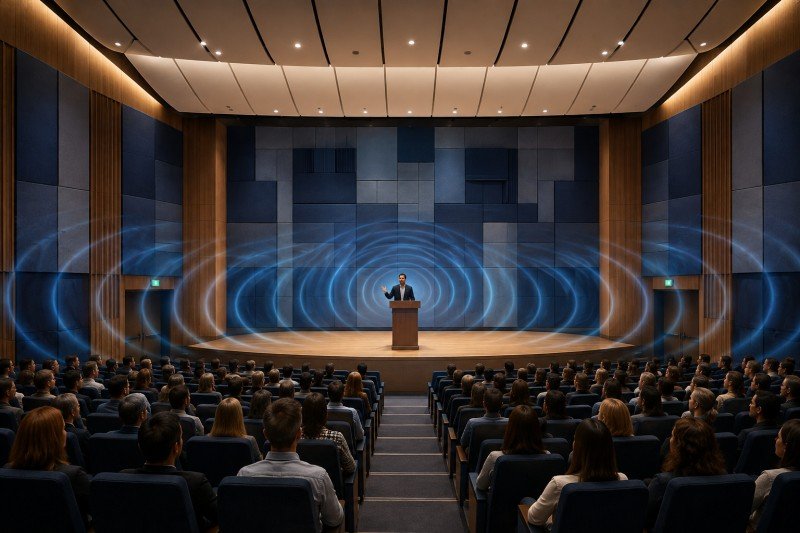
What Is the Speech Transmission Index and Why Does It Matter for Auditoriums?
The Speech Transmission Index is an internationally accepted acoustic measurement that captures how room reverberation, background noise, and loudspeaker quality combine to degrade spoken communication. It was developed by Houtgast and Steeneken in the 1970s and is now codified under IEC 60268-16, the global reference standard for sound clarity testing.
In a concert hall with beautiful hard walls and a 2.5-second reverberation time, music might sound extraordinary – but a speaker on the same stage will be incomprehensible. That is the fundamental tension auditorium designers and STI consultants must resolve. A high STI does not happen by accident; it is engineered through deliberate decisions about room geometry, surface materials, acoustic panel placement, and PA system design.
Understanding the STI Score Scale for Auditoriums
The Speech Transmission Index scale runs from 0.00 (completely unintelligible) to 1.00 (perfect transmission). IEC 60268-16 defines five performance categories:
Speech Transmission Index (STI) Ratings
| Colour Scale | STI Score | IEC 60268 Rating | Practical Meaning in an Auditorium | Action Required |
|---|---|---|---|---|
| Bad 0.00–0.30 |
0.00–0.30 | Bad | Speech is essentially unintelligible; audiences strain and fail. | Full acoustic redesign needed. |
| Poor 0.30–0.45 |
0.30–0.45 | Poor | Only loud or familiar speech is partially understood. | Major intervention required. |
| Fair 0.45–0.60 |
0.45–0.60 | Fair | Speech is mostly understood with effort; fatigue sets in during long events. | Targeted acoustic treatment and PA tuning. |
| Good 0.60–0.75 |
0.60–0.75 | Good | Clear communication for most listeners; suitable for lectures and performances. | Minor optimisation possible. |
| Excellent 0.75–1.00 |
0.75–1.00 | Excellent | Effortless speech understanding across all seating positions. | Maintain and document for compliance. |
| Parameter | Detail |
|---|---|
| Governing Standard | IEC 60268-16 (4th Ed.), STIPA protocol |
| Measurement Scale | 0.00 (bad) to 1.00 (excellent) |
| Frequency Bands Assessed | 125 Hz to 8,000 Hz (7 octave bands) |
| Minimum Test Positions | As per venue size; typically 8–20 points per hall |
| Background Noise Reference | NC curve measured per ANSI/ASA S12.2 |
| Deliverable | STI score map, RT60 data, noise floor, recommendations report |
| Typical Testing Duration | 2–6 hours per hall depending on seating capacity |
How PackSound Conducts Speech Intelligibility Testing in Auditoriums
| Benefit | What It Means in Practice |
|---|---|
| Verified Acoustic Compliance | Documented IEC 60268 compliance strengthens handover certificates and building approvals. |
| Objective Performance Baseline | Provides a measured STI score before and after treatment to quantify improvement. |
| Emergency System Reliability | Confirms voice alarm messages remain intelligible under IEC 60849 / EN 54-16 conditions. |
| Audience Satisfaction | Eliminates “I couldn’t hear anything” feedback that damages venue reputation. |
| PA System Optimization | Identifies under-performing speaker zones before costly equipment replacement. |
| Design Validation for New Builds | Pre-occupation testing catches deficiencies while contractors are still on-site. |
| Data for Acoustic Remediation | STI heat maps pinpoint exactly where to add panels, reflectors, or EQ correction. |
| Venue Type | Primary Use Case for STI Testing |
|---|---|
| School Assembly Halls | Ensuring morning assemblies and annual day events are clearly audible to all students. |
| University Lecture Theatres | Validating speech clarity for 100–500 seat rooms under IEC 60268 compliance. |
| Government / Municipal Halls | Confirming public address and emergency announcement intelligibility. |
| Performing Arts Centres | Balancing music RT60 with spoken-word STI for multi-purpose design briefs. |
| Corporate Auditoriums | Pre-handover acoustic compliance testing for investor or board presentations. |
| Religious Gathering Halls | Verifying sermon intelligibility in high-volume, reverberant stone or concrete structures. |
| Convention and Conference Centres | Multi-zone PA validation across simultaneous breakout and plenary spaces. |
| Myth | Reality |
|---|---|
| Louder PA system fixes bad STI automatically. | Volume cannot overcome reverberation; it worsens signal-to-noise ratio. |
| Only old buildings have poor speech intelligibility scores. | Newly built halls without acoustic design routinely fail STI testing. |
| Carpets and curtains alone achieve good STI scores. | Mid-frequency absorption panels, not soft furnishings, correct RT60 meaningfully. |
| High ceiling height always improves auditorium sound quality. | Excessive ceiling height increases RT60 and typically lowers STI significantly. |
| STI testing is only needed for public address systems. | Any space with a live speaker or PA system benefits from STI compliance. |
| An STI test is a one-time pass/fail certification activity. | STI should be measured before treatment, after treatment, and post-occupancy. |
How PackSound Conducts Speech Intelligibility Testing in Auditoriums
Our field process follows IEC 60268-16 STIPA methodology. Each step is documented with calibrated instrumentation, and results are verifiable by third-party review.
- Pre-visit briefing: review drawings, seating capacity, PA system specs, and known acoustic complaints
- On-site room survey: document surface materials, volume, ceiling height, HVAC noise sources, and existing treatment
- Background noise measurement: capture NC curves at all test positions with hall vacant and HVAC running
- STI source positioning: place calibrated omnidirectional loudspeaker at podium/stage talker position
- STIPA signal playback and measurement: record modulation transfer function at 8–20 positions using IEC-certified analyser
- RT60 measurement: capture reverberation time per octave band at each position to correlate with STI results
- Report generation: produce STI score map, frequency-band analysis, gap-to-target assessment, and prioritised remediation plan.
Also Check : Building Acoustics Simulation Services
How Does RT60 Affect Speech Transmission Index? A Practical Comparison
Reverberation time and STI are inversely related in speech-primary spaces. This table reflects typical STI outcomes we observe across different auditorium conditions in our field assessments:
| RT60 (Mid-Frequency) | Typical STI Range | Common Auditorium Type in India | Likely Audience Experience |
|---|---|---|---|
| < 0.6 s | 0.75–0.90 | Purpose-built lecture theatres with acoustic treatment | Effortless understanding, no fatigue |
| 0.6–1.0 s | 0.60–0.75 | Treated school auditoriums, corporate halls | Clear and comfortable for most listeners |
| 1.0–1.5 s | 0.45–0.60 | Untreated new-build halls, mid-range hotel ballrooms | Intelligible but tiring; rear seats struggle |
| 1.5–2.5 s | 0.30–0.45 | Old government halls, stone religious spaces, sports auditoria | Only loud, slow speech partially understood |
| > 2.5 s | 0.00–0.30 | Domed civic structures, unlined concrete assembly halls | Speech unintelligible; amplification alone cannot fix it |
Our field process follows IEC 60268-16 STIPA methodology. Each step is documented with calibrated instrumentation, and results are verifiable by third-party review.
- Pre-visit briefing: review drawings, seating capacity, PA system specs, and known acoustic complaints
- On-site room survey: document surface materials, volume, ceiling height, HVAC noise sources, and existing treatment
- Background noise measurement: capture NC curves at all test positions with hall vacant and HVAC running
- STI source positioning: place calibrated omnidirectional loudspeaker at podium/stage talker position
- STIPA signal playback and measurement: record modulation transfer function at 8–20 positions using IEC-certified analyser
- RT60 measurement: capture reverberation time per octave band at each position to correlate with STI results
- Report generation: produce STI score map, frequency-band analysis, gap-to-target assessment, and prioritised remediation plan
Also Check : Building Acoustics Simulation Services.
How Does RT60 Affect Speech Transmission Index? A Practical Comparison
Reverberation time and STI are inversely related in speech-primary spaces. This table reflects typical STI outcomes we observe across different auditorium conditions in our field assessments:
| RT60 (Mid-Frequency) | Typical STI Range | Common Auditorium Type in India | Likely Audience Experience |
|---|---|---|---|
| < 0.6 s | 0.75–0.90 | Purpose-built lecture theatres with acoustic treatment | Effortless understanding, no fatigue |
| 0.6–1.0 s | 0.60–0.75 | Treated school auditoriums, corporate halls | Clear and comfortable for most listeners |
| 1.0–1.5 s | 0.45–0.60 | Untreated new-build halls, mid-range hotel ballrooms | Intelligible but tiring; rear seats struggle |
| 1.5–2.5 s | 0.30–0.45 | Old government halls, stone religious spaces, sports auditoria | Only loud, slow speech partially understood |
| > 2.5 s | 0.00–0.30 | Domed civic structures, unlined concrete assembly halls | Speech unintelligible; amplification alone cannot fix it |
Frequently Asked Questions About Speech Transmission Index
What is a good Speech Transmission Index score for a school auditorium?
For school auditoriums used primarily for speech, assemblies, and lectures, a minimum STI of 0.60 is required, but 0.65–0.70 is the practical target to account for a full audience and aging HVAC systems. Below 0.55, students at the back of the hall routinely miss spoken content.
How is Speech Transmission Index different from reverberation time (RT60)?
RT60 measures how long sound takes to decay by 60 dB, while STI is the outcome metric that combines RT60, background noise, and system effects into one intelligibility score. You can have a “good” RT60 and still fail STI if background noise is high.
Can acoustic panels improve the STI score of an existing auditorium?
Yes, adding high-NRC acoustic wall and ceiling panels reduces RT60, which directly improves STI. In our projects, correctly placed panels with NRC 0.80–0.95 typically improve STI by 0.10 to 0.20 points, often moving a hall from “Fair” to “Good” category.
Is IEC 60268-16 mandatory for auditoriums in India?
IEC 60268-16 is not a mandatory building code requirement across India, but it is increasingly specified in project briefs by architects, particularly for government buildings, international schools, and large corporate campuses where acoustic performance is a contractual deliverable.
How long does a Speech Transmission Index test take for a 500-seat hall?
A 500-seat auditorium typically requires 3 to 5 hours of on-site measurement time to cover 12 to 16 measurement positions, plus background noise documentation. The written report with recommendations is usually delivered within 3 to 5 working days.
What equipment is used for speech intelligibility testing in auditoriums?
PackSound uses IEC 60268-16 certified STIPA analysers, calibrated Class 1 sound level meters, and omnidirectional loudspeakers delivering standardised STIPA test signals. Calibration certificates are provided with every report.
Does background HVAC noise really affect STI in an air-conditioned auditorium?
Significantly. HVAC systems in large Indian auditoriums often produce NC-40 to NC-50 noise levels. According to IEC 60268-16 calculations, this level of background noise alone can reduce STI by 0.12 to 0.18 points compared to a quiet room.
What is STIPA and how does it differ from full STI measurement?
STIPA (Speech Transmission Index for Public Address) is a faster, field-practical variant of the full STI test, approved under IEC 60268-16. It uses a specially designed test signal that allows measurement in under 15 seconds per position while maintaining accuracy within 0.02 STI points of the full method.
Can a multipurpose hall achieve good STI for both speech and music?
It requires careful design. Optimum RT60 for speech is 0.6–1.0 seconds; for orchestral music it is 1.5–2.0 seconds. Variable acoustic systems with motorised curtains or retractable panels are used in premium halls to switch between both modes, allowing STI ≥ 0.65 for speech and musical warmth for concerts.
How much does STI testing cost for an auditorium in India?
STI testing costs depend on hall size, number of measurement positions, travel, and whether acoustic design recommendations are included. Contact PackSound for a project-specific quote; most single-hall assessments including report are completed within a defined scope and timeline agreed in advance.
Get a Speech Transmission Index Assessment for Your Auditorium
PackSound provides certified STI testing, acoustic compliance reports, and remediation design for auditoriums across India, including Delhi NCR, Mumbai, Bengaluru, Hyderabad, Pune, Chennai, and more.