
Damping and Transmissibility Measurement Services | PackSound
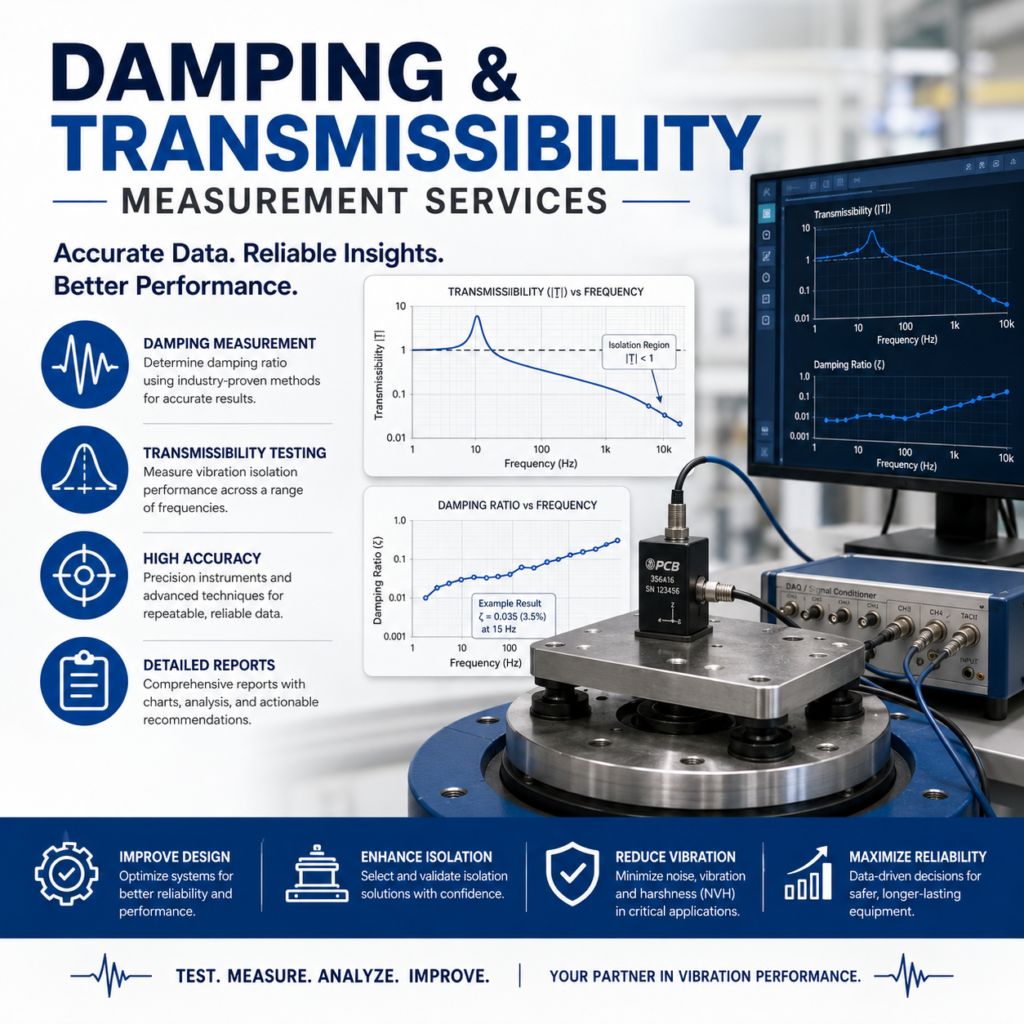
Damping and transmissibility measurement tells you exactly how much vibration energy your isolator, mount, or structural material absorbs before it reaches sensitive equipment, flooring, or hull structure. If you are specifying isolators without this data, you are guessing. PackSound’s Damping & Transmissibility Measurement Services give engineers, architects, and facility teams a tested, documented basis for every isolation decision, backed by IS, ISO 10846, and ASTM E756 aligned protocols.
Why Damping Measurement Methods Matter Before You Specify a Mount
Two materials can look identical on a datasheet and behave completely differently once installed. Our damping measurement methods combine narrow-band sine sweep testing near resonance with broadband validation, so the damping ratio we report reflects how your material performs at the frequencies your equipment actually generates, not just a lab average.
Damping & Transmissibility Measurement Service Details
| Parameter | Detail |
|---|---|
| Test Standards | IS, ISO 10846, ASTM E756 aligned |
| Frequency Range Tested | 2 Hz to 2000 Hz |
| Measurement Method | Sine sweep plus broadband random vibration |
| Damping Ratio Range Detected | 0.01 to 0.5 |
| Sensors Used | Accelerometers, laser displacement, force transducers |
| Report Format | Curve plus raw data plus summary sheet |
| Turnaround Time | 5 to 7 working days |
Benefits of Damping & Transmissibility Measurement Services
| Key Benefit | Impact |
|---|---|
| Verified isolator selection before purchase | Ensures correct product selection and prevents wrong investment |
| Reduced equipment failure from resonance coupling | Minimizes vibration-related mechanical damage |
| Compliance-ready documentation for audits | Helps meet industrial compliance and reporting requirements |
| Site-specific accuracy, not generic datasheet values | Real-world testing for accurate performance validation |
| Early detection of structural resonance conflicts | Identifies hidden vibration risks before installation |
| Faster troubleshooting of existing noise complaints | Speeds up diagnosis and corrective action |
| Lower long-term maintenance cost on isolated equipment | Reduces recurring repair and service expenses |
Applications of Damping & Transmissibility Solutions
| Application |
|---|
| Marine hull and deck damping panels |
| Rooftop HVAC and chiller isolation |
| Genset and industrial skid mounts |
| Precision lab and manufacturing equipment |
| Auditorium and studio floor isolation |
| Data center vibration-sensitive racks |
| Building floor and slab isolation systems |
Damping & Transmissibility Measurement Process
| Step | Process Details |
|---|---|
| Step 1 | Site assessment and frequency profiling |
| Step 2 | Sample collection or in-situ test setup |
| Step 3 | Shaker table or in-situ excitation testing |
| Step 4 | Damping ratio and transmissibility calculation |
| Step 5 | Comparison against structural resonance data |
| Step 6 | Report delivery with isolator recommendation |
| Step 7 | Optional post-installation validation test |
Common Myths vs Reality in Damping & Transmissibility
| Myth | Reality |
|---|---|
| Higher damping always reduces vibration | Above frequency ratio √2, more damping raises transmissibility |
| One lab test covers all conditions | Temperature and aging shift damping ratio significantly |
| Datasheet values match installed performance | Real foundations change resonance behavior versus lab base |
Transmissibility and Damping Ratio: What Our Reports Actually Tell You
Every report includes a full transmissibility and damping ratio curve plotted against frequency ratio, not just a single number. This matters because transmissibility behaves differently above and below the critical frequency ratio of root two. Below it, more damping helps. Above it, the wrong damping choice can raise transmissibility instead of lowering it. Our reports flag exactly where your operating frequency sits relative to that threshold.
How We Run Displacement Transmissibility in Vibration Testing
For displacement transmissibility in vibration testing, we mount your sample on a calibrated shaker table, apply controlled base excitation across your specified frequency range, and measure output displacement at the isolated mass using accelerometers and laser displacement sensors. Results are cross-validated against your actual installation structure wherever possible, since lab-rigid bases and real foundations rarely behave the same way.
Built for Real Installed Performance, Not Just Lab Numbers
We have marine hull damping panels, MLV Sound Damping Sheet, HVAC isolators, genset mounts, and precision equipment platforms. Every engagement includes raw data, the calculated damping ratio, a transmissibility curve, and a plain-language summary your procurement or compliance team can actually use.
Request a damping measurement consultation and get a testing plan matched to your equipment, frequency range, and compliance requirement.
Frequently Asked Questions
It measures how fast vibration energy dies out after disturbance.
Transmissibility shows transmitted vibration ratio; damping shows energy dissipation rate.
Real foundations shift resonance versus controlled lab base conditions.
Yes, elastomeric isolators shift stiffness and damping with temperature.
No, above frequency ratio root two it can increase transmissibility.
ISO 10846 and ASTM E756 are commonly referenced standards.
Use half-power bandwidth or peak-substitution methods depending on damping level.
Yes, coarse sweeps near resonance under-report true damping ratio.
Shaker tables, accelerometers, and laser displacement sensors are standard.
Typically five to seven working days depending on test scope.