
AquaSonic™ Underwater Acoustic Panels
AquaSonic underwater acoustic panels control how sound reflects and radiates underwater, for marine vessels, test tanks and research facilities. They are engineered for continuous immersion and harsh marine conditions.
Your details stay private. No spam.
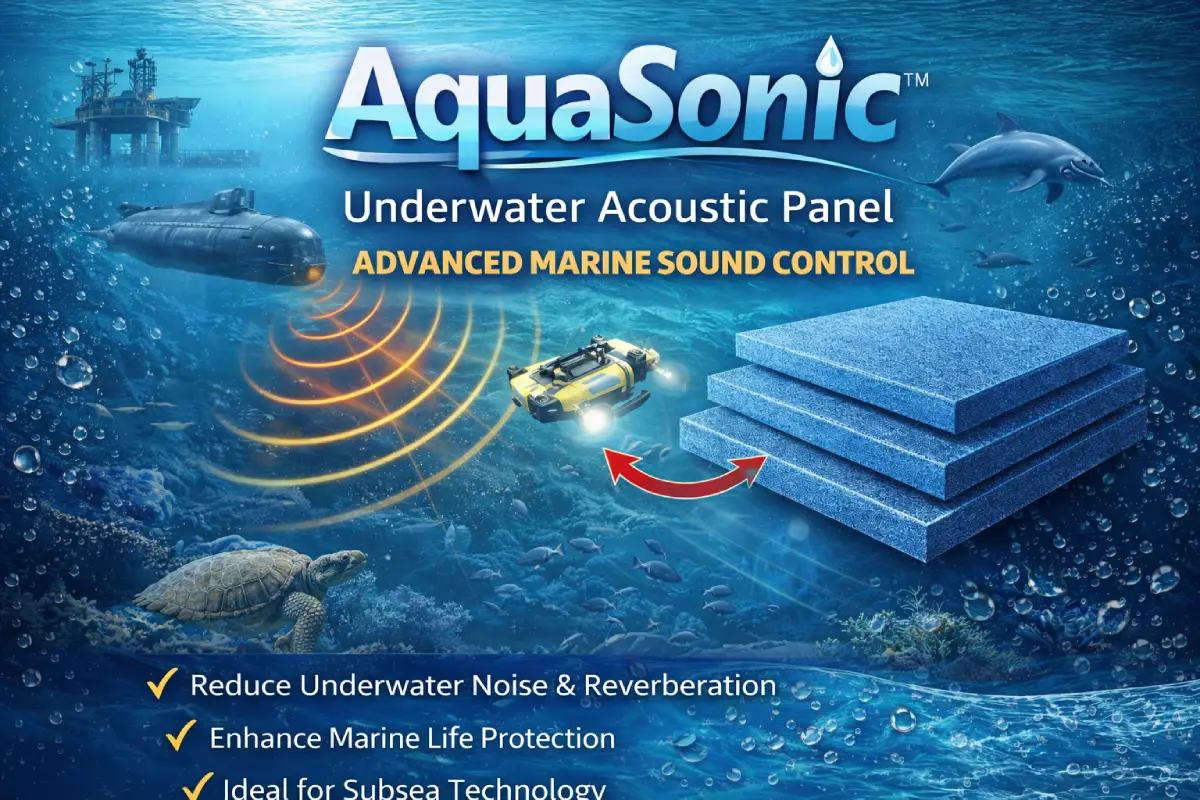
Sound behaves fundamentally differently underwater than it does in air. In the ocean, sound is the primary medium through which information travels — it propagates vast distances, bends around obstacles, reflects off boundaries, and penetrates materials that are opaque to light and radio waves. For submarines, ROVs, AUVs, offshore platforms, and deep-sea research installations, managing underwater sound is not merely a comfort consideration. It determines mission success, crew safety, sensor accuracy, tactical survivability, and increasingly, environmental compliance.
AquaSonic™ Underwater Acoustic Panels are advanced, marine-grade sound-absorbing solutions engineered specifically for the submerged environment. Built to perform under hydrostatic pressures of up to 50 bar, operating reliably across a thermal range of –10°C to +85°C, achieving an NRC of up to 0.90 in submerged settings, and fully compliant with IMO FTP Code Parts 2 and 5, these panels represent one of the most technically complete underwater acoustic treatment solutions available from an Indian manufacturer.
Designed, tested, and produced indigenously by Packsound in India, AquaSonic™ Underwater Acoustic Panels bring world-class submerged acoustic performance to Indian naval, commercial marine, offshore, and scientific research applications — with the supply chain reliability, domestic pricing, and technical support advantages that only indigenous manufacturing can deliver.
Request an Underwater Acoustic Consultation →
Why Underwater Acoustic Treatment Is Fundamentally Different from Surface Acoustic Treatment
Before specifying any underwater acoustic panel, it is essential to understand why the submerged environment imposes requirements that standard surface acoustic panels — even high-performance marine panels – simply cannot meet.
The Physics of Sound in Water
The speed of sound in sea water is approximately 1,500 metres per second – roughly 4.4 times faster than in air. This dramatically affects the acoustic wavelengths at any given frequency. A 1 kHz sound wave has a wavelength of approximately 34 cm in air; in water, the same frequency produces a wavelength of approximately 1.5 metres. This fundamental difference means that acoustic absorption mechanisms that work in air must be re-engineered for the water-borne acoustic environment.
Additionally, the acoustic impedance of water – the product of its density and the speed of sound through it – is approximately 3,500 times greater than that of air. This enormous impedance mismatch means that most airborne acoustic absorbers are essentially acoustically transparent in water – sound passes through them without meaningful absorption because the material properties are not matched to the acoustic environment they inhabit.
Effective underwater acoustic panels must be designed from first principles for the water-borne acoustic domain – not adapted from airborne products. This is precisely what distinguishes AquaSonic™ Underwater Acoustic Panels from conventional acoustic panel products applied in marine contexts.
The Pressure Challenge
Every 10 metres of water depth adds approximately 1 bar of hydrostatic pressure. At a depth of 100 metres – within the operational range of conventional submarines, many deep ROV deployments, and offshore subsea installations – the ambient pressure is approximately 10 bar. At 500 metres, pressure reaches 50 bar. Acoustic panels that rely on air voids or open-cell foam structures for their absorption mechanism lose performance rapidly under hydrostatic compression – the voids collapse, the absorption mechanism degrades, and the panel may lose structural integrity.
AquaSonic™ Underwater Acoustic Panels are specifically engineered and tested for pressure performance across the full operational depth envelope of their intended applications — ensuring that the acoustic performance specified at installation is maintained throughout the operational life of the panel at depth.
The Temperature and Chemical Environment
Subsurface marine environments span a wide thermal range – from near-freezing in deep water and polar regions (approaching –2°C) to warm shallow tropical waters (above 30°C) and elevated temperatures in engine room spaces within pressure hulls (potentially reaching 85°C). Acoustic panel materials must maintain stable acoustic and mechanical performance across this entire range.
Additionally, panels within submarine and surface ship spaces are exposed to fuel, oils, hydraulic fluids, cleaning chemicals, and the humid, salt-laden atmosphere of a sealed pressure hull. Panels on offshore installations face seawater immersion, biological fouling, and the chemical environment of the offshore oil and gas production process. AquaSonic™ panel materials are formulated for stability in all of these environments.
AquaSonic™ Underwater Acoustic Panel: Construction and Technology
The AquaSonic™ Underwater Acoustic Panel is a multi-layer composite system in which each layer serves a distinct and complementary acoustic and structural function:
Layer 1 – Micro-Perforated Surface
The outermost layer presented to the sound field is a micro-perforated panel (MPP) surface – a precisely engineered array of micro-holes through which incident sound energy enters the panel. The perforation geometry is calculated to optimise viscous acoustic absorption at the perforation edges across the target frequency range, consistent with the micro-perforated panel (MPP) theory established in acoustic engineering.
The facing material is selected for the specific application environment: PVC-coated polymer skin for general submerged use, glass-cloth reinforced skin for elevated-temperature applications, or custom material specifications for specialised environments. Facing options include Navy Grey, Deep Blue, and fully custom colour configurations.
Layer 2 – Closed-Cell Elastomeric Foam Core
At the heart of the panel is a closed-cell elastomeric foam core – the primary acoustic absorption medium. The closed-cell architecture is essential for underwater applications: unlike open-cell foam (which rapidly fills with water, becoming acoustically inert and structurally degraded), the closed-cell structure resists water ingress through individual cell impermeability.
The elastomeric formulation is chosen for its visco-elastic acoustic loss properties – converting acoustic energy into negligible quantities of heat through internal material damping – combined with the compressive strength and resilience necessary to maintain dimensional stability under hydrostatic loading. The foam density, cell size, and wall thickness are specified based on the target frequency range and depth rating of the panel.
Layer 3 – Rigid Backing Structure
The innermost layer provides structural rigidity and serves as an acoustic backing boundary. For applications requiring the panel to be bonded to a structural surface (bulkhead, hull frame, or facility wall), the backing layer also provides the bonding interface. Options include steel backing for maximum structural integrity in naval applications, or lightweight polymer backing where weight considerations are paramount (ROV and AUV applications).
The combination of this three-layer architecture – MPP surface + elastomeric core + rigid backing – creates an acoustic system that achieves high sound absorption coefficients in the underwater acoustic domain while maintaining structural integrity at operational depths, thermal stability across the full operational temperature range, and chemical resistance in marine environments.
Technical Specifications
| Parameter | AquaSonic™ Underwater Acoustic Panel |
|---|---|
| NRC (Noise Reduction Coefficient) | Up to 0.90 in submerged settings |
| Acoustic Core | Closed-cell elastomeric foam |
| Panel Skin / Facing | PVC-coated, glass-cloth, or custom marine-grade polymer |
| Panel Thickness | Customisable from 10 mm to 50 mm |
| Hydrostatic Pressure Rating | Up to 50 bar (≈ 500 m depth) |
| Water Absorption | < 0.5% by volume (ASTM C272) |
| Thermal Operating Range | –10°C to +85°C |
| Fire Classification | IMO FTP Code Part 2 & 5 compliant; UL94 V-0 |
| Available Surface Finishes | PVC-coated; glass-cloth; custom skins |
| Available Colours | Navy Grey; Deep Blue; custom hues |
| Supply Formats | Pre-cut panels; rolls; modular kits |
| Installation Method | Adhesive bonding; mechanical fasteners |
| Service Life | Up to 10 years with proper maintenance |
| Manufacture | Indigenously designed and produced in India by Packsound |
Acoustic Performance in Underwater Environments
Understanding NRC in the Submerged Context
NRC (Noise Reduction Coefficient) measures the fraction of incident sound energy that a panel absorbs, averaged across the 250 Hz, 500 Hz, 1000 Hz, and 2000 Hz octave bands. An NRC of 0.90 means the panel absorbs 90% of the incident acoustic energy that strikes it – returning only 10% as reflected sound.
In air, NRC is the standard metric for acoustic panel performance. In underwater applications, the equivalent measure is the sound absorption coefficient (α) measured at relevant frequencies in the water-borne acoustic domain. AquaSonic™ panels achieve an NRC equivalent of up to 0.90 in submerged settings – placing them among the highest-performance underwater acoustic absorption products available.
This performance level is critically important in applications such as:
- Submarine compartment acoustic treatment, where effective absorption of machinery noise improves crew acoustic comfort and reduces fatigue
- Underwater acoustic test facility lining, where high absorption of boundary reflections is necessary for accurate free-field measurement conditions
- Offshore platform and subsea installation acoustic treatment, where noise control is required for both worker wellbeing and marine environmental compliance
Frequency Performance
AquaSonic™ Underwater Acoustic Panels are optimised for absorption across a broad frequency range relevant to marine acoustic environments. Panel thickness – configurable from 10 mm to 50 mm – is the primary lever for adjusting the frequency at which peak absorption occurs:
- Thinner panels (10–20 mm): Optimised for higher-frequency absorption (1 kHz and above) – appropriate for compartment treatment where airborne machinery noise at mid and high frequencies is the primary concern
- Mid-thickness panels (25–35 mm): Broadband performance across the 300 Hz to 3 kHz range – appropriate for general-purpose submarine compartment treatment and underwater facility lining
- Thicker panels (40–50 mm): Extended low-frequency performance reaching down toward 100–200 Hz – appropriate for applications requiring control of low-frequency propulsion and machinery noise
For applications requiring absorption at the lowest frequencies (below 100 Hz), AquaSonic™ Underwater Acoustic Panels can be combined with the AquaSonic™ PHCH Low Frequency Super Absorber to achieve comprehensive broadband absorption from approximately 50 Hz upward.
Applications of AquaSonic™ Underwater Acoustic Panels
Submarine Compartment Acoustic Treatment
The interior acoustic environment of a submarine is one of the most demanding in all of acoustic engineering. Crew members live and work within the pressure hull for extended periods – often weeks or months at a time – while surrounded by machinery noise from propulsion systems, auxiliary equipment, HVAC, and sonar systems operating continuously. This constant acoustic exposure creates physiological stress, contributes to crew fatigue, degrades sleep quality in off-watch periods, and – in operational contexts – reduces the alertness and decision-making capacity that crew performance demands.
AquaSonic™ Underwater Acoustic Panels installed on the interior surfaces of submarine compartments – crew berths, mess decks, control rooms, engineering spaces, and sonar rooms – provide effective absorption of the reverberant noise field within these spaces. By reducing the reverberation time of compartment spaces, the panels lower the ambient noise level experienced by crew members, reducing noise exposure and fatigue during long operational deployments.
Critical compartments for submarine acoustic treatment:
Control Room and Sonar Bay: These are the most acoustically critical spaces on the submarine. Operators must hear subtle acoustic signals – contact classifications, bearing changes, low-level sonar returns – against a background of machinery and flow noise. Reducing the reverberant noise level in these spaces through AquaSonic™ panel treatment improves the signal-to-noise ratio available to operators and directly enhances operational effectiveness.
Crew Berths and Accommodation: Quality of sleep during off-watch periods is a significant operational readiness determinant. Acoustic treatment of crew berth compartments reduces the noise level during rest periods, directly improving crew health, recovery, and sustained operational readiness during long patrols.
Engine Room and Machinery Spaces: AquaSonic™ panels in engineering spaces reduce the reverberant noise level within the machinery compartment itself – improving the ability of technical crew to detect anomalous mechanical sounds that may indicate machinery malfunction, and reducing cumulative noise exposure for engineering personnel working in these spaces.
Torpedo and Weapons Compartments: Noise treatment of weapons compartments improves conditions for the precise, low-error technical work involved in torpedo maintenance and readiness management.
Remotely Operated Vehicles (ROVs)
ROVs operating in offshore energy, scientific research, and naval mine countermeasure roles carry onboard electrical and hydraulic machinery – thrusters, hydraulic power units, cameras, sonar systems, lights – all of which generate noise and vibration. This onboard noise has two negative effects:
First, it degrades the performance of the ROV’s own sonar and acoustic sensor systems, which must operate against a background of self-generated noise. Acoustic treatment of the ROV’s machinery spaces reduces the acoustic self-noise floor, improving sensor detection performance.
Second, it increases the ROV’s acoustic signature, potentially disturbing marine life during scientific surveys, revealing the presence of the ROV during sensitive security operations, or interfering with the acoustic monitoring activities of other subsea equipment in the vicinity.
AquaSonic™ Underwater Acoustic Panels in lightweight configurations appropriate for the weight-sensitive ROV platform provide effective noise management for these applications. The panels’ resistance to hydrostatic pressure at ROV operating depths – which may range from shallow coastal waters to several thousand metres for deep-rated systems – is an essential specification characteristic.
Autonomous Underwater Vehicles (AUVs)
AUVs for naval mine countermeasures, ocean survey, pipeline inspection, and scientific research missions carry similarly demanding acoustic requirements. The AUV’s own propulsion and electronics generate acoustic self-noise that limits the sensitivity of onboard acoustic sensors. Acoustic treatment of AUV pressure housings and propulsion compartments reduces this self-noise, improving mission performance.
For naval AUVs deployed in sensitive intelligence, surveillance, and reconnaissance (ISR) roles, reducing the AUV’s acoustic signature is a tactical requirement – acoustic treatment contributes to making the AUV harder for adversary passive sonar systems to detect and track.
Offshore Platforms and Deep-Sea Installations
Offshore oil and gas platforms, floating production storage and offloading (FPSO) vessels, offshore wind farm foundation structures, and deep-sea research installations generate substantial underwater noise – from drilling operations, compressors, gas turbine generators, pumps, risers, and structural responses to waves and current. This noise propagates through the water column for tens of kilometres, affecting marine species that depend on acoustic communication, navigation, and prey detection.
Environmental regulations and permits for offshore operations increasingly require measurement and mitigation of underwater noise emissions. AquaSonic™ panels applied to the surfaces of underwater structures – pile foundations, riser pipes, jacket structures, and subsea equipment housings – reduce the transmission of structural vibration into radiated underwater noise, helping offshore operators meet noise exposure thresholds for marine protected species.
India’s expanding offshore energy sector – including ONGC’s deepwater exploration programmes, the developing offshore wind energy sector along India’s extensive coastline, and subsea pipeline infrastructure in the Arabian Sea and Bay of Bengal – creates a growing and underserved market for underwater acoustic management solutions.
Underwater Research Laboratories and Oceanographic Facilities
Scientific institutions conducting underwater acoustic research – including DRDO’s Naval Physical and Oceanographic Laboratory (NPOL) in Kochi, the National Institute of Ocean Technology (NIOT), IIT research groups, and university oceanographic laboratories – require controlled acoustic environments within their test tanks and research facilities.
AquaSonic™ panels installed on the walls, floor, and ceiling of underwater acoustic test tanks create the low-reflection boundary conditions necessary for accurate, free-field acoustic measurements. Without effective boundary absorption, reflections from tank walls corrupt measurement data, introduce systematic errors in transducer calibration, and limit the accuracy of sonar performance assessments.
The AquaSonic™ Underwater Acoustic Panel’s combination of high absorption coefficient (NRC up to 0.90), hydrostatic pressure stability, and dimensional stability under prolonged water immersion makes it appropriate for permanent installation in research facility test tanks.
Naval Sonar Test Ranges and Calibration Facilities
India’s naval sonar test and evaluation infrastructure – supporting sonar system development, acceptance testing, and crew training at facilities operated by the Indian Navy and DRDO — requires high-performance underwater acoustic treatment for test pool and range boundary surfaces. See also the AquaSonic™ Sonar Reflection Control Panel & Signal Damper for the specific sonar reflection control application within these facilities.
Marine Environmental Monitoring Stations
Passive acoustic monitoring stations deployed on the seafloor or in the water column for monitoring shipping noise, marine mammal vocalisations, and underwater soundscape characterisation require acoustic isolation from local structure-borne noise sources. AquaSonic™ panels applied to the mounting structures of hydrophone systems reduce the transmission of structural vibration to the sensors, improving the signal-to-noise ratio of acoustic monitoring data.
Installation Formats and Options
AquaSonic™ Underwater Acoustic Panels are available in multiple supply formats to suit different project types and installation conditions:
Pre-Cut Panels: Standard or custom panel dimensions, ready for direct installation by adhesive bonding or mechanical fastening. Appropriate for most compartment and facility lining applications where access is manageable.
Roll Format: Continuous sheet supply for applications requiring seamless coverage of curved or irregular surfaces — including ROV pressure hull interiors, pipe acoustic treatment, and curved submarine compartment surfaces.
Modular Kit Format: Pre-cut, packaged panel sets configured for specific compartment layouts, with all panels labelled and keyed to an installation drawing. Reduces on-site cutting and fitting time, improving installation accuracy and speed.
Custom Fabricated Assemblies: For specialist applications – complex curved surfaces, integrated structural and acoustic elements, or bespoke panel assemblies for specific vessel compartment geometry – Packsound provides custom fabricated panel assemblies manufactured to the client’s supplied drawings.
Installation Methods
Adhesive Bonding: The preferred installation method for permanent panel applications. Marine-grade structural adhesive provides a continuous, void-free bond between the panel backing and the substrate surface. Surface preparation – degreasing, priming, and surface roughening – is critical for bond integrity, particularly in engine room and machinery space environments where fuel and oil contamination is present. AquaSonic™ installation guidelines specify compatible adhesive systems for each surface type.
Mechanical Fastening: For applications where adhesive bonding alone is insufficient – high-vibration zones adjacent to main machinery, installations requiring periodic panel removal for maintenance access, or surfaces where adhesion is not achievable – marine-grade stainless steel mechanical fasteners supplement or replace adhesive bonding. Fastener locations are sealed against acoustic flanking.
Hybrid Bonding and Fastening: In demanding naval applications, both adhesive bonding and mechanical fastening are used simultaneously to provide maximum bond redundancy under sustained vibration loading.
Environmental Compliance and Marine Life Protection
Underwater noise pollution is an increasingly recognised and regulated environmental issue. The OSPAR Convention, EU Marine Strategy Framework Directive, and emerging Indian environmental regulations for offshore operations all include provisions for the management of anthropogenic underwater noise. The International Whaling Commission and the International Maritime Organization are both actively developing frameworks for the management of shipping and offshore noise impacts on marine mammals.
For offshore operators, ONGC’s environmental management framework, and project-specific environmental impact assessments increasingly require underwater noise monitoring and, in some cases, active mitigation measures for noise-sensitive species including sperm whales, blue whales, humpback whales, and dolphins — all present in Indian Ocean waters.
AquaSonic™ Underwater Acoustic Panels contribute to reducing the underwater noise emissions of offshore structures and vessels — supporting both environmental compliance obligations and the broader objective of protecting India’s marine biodiversity from anthropogenic acoustic disturbance.
Why Specify AquaSonic™ from Packsound for Underwater Acoustic Treatment
Genuine Pressure-Rated Performance
AquaSonic™ Underwater Acoustic Panels are rated and tested for hydrostatic pressures up to 50 bar – corresponding to approximately 500 metres of water depth. This pressure rating is validated through materials testing rather than estimated from material properties, providing confidence that the panel will maintain its acoustic performance characteristics throughout its operational depth envelope.
Multi-Parameter Environmental Specification
The combination of hydrostatic pressure rating, thermal range (–10°C to +85°C), water absorption limit (< 0.5% by volume, ASTM C272), IMO fire code compliance, and chemical resistance makes AquaSonic™ panels among the most comprehensively specified underwater acoustic panels available from any Indian manufacturer.
Customisable for Every Application
Panel thickness (10 mm to 50 mm), surface finish, colour, format (pre-cut, roll, modular kit), and backing specification are all configurable per application — allowing the panel to be precisely matched to the acoustic, environmental, structural, and aesthetic requirements of each project.
Indigenous Manufacture with Strategic Advantages
As a product designed and manufactured in India, AquaSonic™ Underwater Acoustic Panels offer Indian defence, offshore energy, and research clients the supply chain security, domestic pricing, DPP procurement alignment, and direct domestic technical support that imported alternatives cannot provide. For defence procurement specifically, indigenous manufacture supports Aatmanirbhar Bharat objectives and reduces strategic dependence on foreign supply chains for critical naval acoustic materials.
Integration with Packsound’s Full Naval Acoustic Ecosystem
AquaSonic™ Underwater Acoustic Panels sit within Packsound’s broader naval and marine acoustic product family, allowing comprehensive acoustic management of any vessel or facility from a single manufacturing partner.
Frequently Asked Questions
What is the difference between AquaSonic™ Underwater Acoustic Panels and the Hull Sound Damping Panels?
The AquaSonic™ Underwater Acoustic Panel is designed for submerged applications – installed on surfaces that are either permanently immersed in water or subject to regular immersion, and rated for hydrostatic pressure. Its primary acoustic mechanism is sound absorption in the water-borne acoustic domain. The AquaSonic™ Hull Sound Damping Panel is designed for installation within vessel interior spaces – addressing structure-borne and airborne noise transmission through hull, bulkhead, and deck structures – typically in dry or intermittently wet environments. Both products are essential components of a complete vessel acoustic management system.
What depth can these panels withstand?
AquaSonic™ Underwater Acoustic Panels are rated for hydrostatic pressures up to 50 bar – corresponding to approximately 500 metres of water depth. This covers the operational depth envelope of conventional submarines, deep-rated ROVs, and the majority of offshore subsea installations. For applications requiring performance at greater depths, contact Packsound’s naval acoustic team to discuss deep-rated configurations.
Do the panels maintain their acoustic performance at depth?
Yes. The closed-cell elastomeric foam core is designed to maintain its acoustic and mechanical properties under hydrostatic compression within the rated pressure range. The water absorption limit of less than 0.5% by volume (ASTM C272) ensures that the acoustic core remains effective rather than becoming waterlogged. Packsound validates pressure performance through material testing before supply for depth-rated applications.
Are the panels suitable for fresh water as well as sea water?
Yes. AquaSonic™ Underwater Acoustic Panels are compatible with both fresh water and sea water environments. For fresh water research facilities – including inland test tanks and freshwater research installations – the panels provide equivalent acoustic performance to sea water applications, with reduced risk of chloride corrosion on any exposed metallic components.
How are the panels cleaned and maintained?
Panel surfaces can be wiped clean with standard marine cleaning agents. The closed-cell structure prevents cleaning agents from penetrating the core material. For underwater installations, the panels should be visually inspected during scheduled maintenance dives or ROV surveys to verify bonding integrity and surface condition. Panels showing signs of delamination, physical damage, or biological fouling should be reported to Packsound for assessment.
Can these panels be used in acoustic test tanks alongside research equipment?
Yes. AquaSonic™ Underwater Acoustic Panels are specifically suited to acoustic test tank applications, where their high absorption coefficient reduces reflections from tank boundaries and allows more accurate free-field acoustic measurements. The panels’ dimensional stability under prolonged water immersion ensures that the tank geometry and acoustic treatment performance remain consistent over the long operational life of the facility. Panels should be installed with appropriate support and sealing to prevent air gaps from developing between the panel and the tank wall during long-term immersion.
What is the lead time for supply?
Standard configurations in common thicknesses and finishes are available with relatively short lead times. Custom thicknesses, colours, and large-quantity defence or offshore project supply requires longer lead times. Contact Packsound’s team with project timelines at the enquiry stage to ensure supply scheduling is integrated into your project programme.
Engage with Packsound’s Underwater Acoustic Team
AquaSonic™ Underwater Acoustic Panels represent Packsound’s most environmentally demanding acoustic product — engineered for the harshest submerged conditions that any acoustic material must withstand. They are specified by naval architects, offshore facility designers, underwater vehicle engineers, and acoustic research scientists who understand the unique requirements of the submerged acoustic environment.
Share your application details – vessel type, installation zone, depth rating requirement, acoustic problem, regulatory framework, and project timeline – and our team will develop a panel specification and quotation tailored to your exact requirements.
Visit Us: A-719 Tower 3, NX One Techzone IV, Greater Noida West, Uttar Pradesh 201306, India
Email: sales@packsound.in | abhinav@packsound.in Call: +91 980 980 2016 | +91 9809802016 Hours: Monday to Saturday, 9:00 AM to 7:00 PM
Request an Underwater Acoustic Consultation →
Explore the Complete AquaSonic™ and Packsound Range
- AquaSonic™ — Full Specialist Acoustic Range – Parent page for all AquaSonic products
- AquaSonic™ Hull Sound Damping Panels — Internal vessel noise reduction
- AquaSonic™ PHCH Low Frequency Super Absorber — Metamaterial bass absorption from ~50 Hz
- AquaSonic™ Sonar Reflection Control Panel — Naval acoustic stealth and sonar test facility treatment
- Acoustic Wall Panels — Above-water vessel interior and shore facility treatment
- Acoustic Ceiling Panels — Ceiling acoustic systems for vessel and shore interiors
- Acoustic Baffles — Suspended absorption panels for large vessel and facility volumes
- Acoustic Clouds — Ceiling acoustic cloud systems for shore facility spaces
- Metal Ceiling Tiles — Acoustic metal ceiling systems for vessel interior finishing
- Auditorium Acoustics — Naval briefing theatres and shore training facility acoustics
- ThinkPod Acoustic Office Pods — Acoustic workspace solutions for naval command and operations centres
- Auraluxe Premium Acoustic Panels — Premium decorative acoustic panels for luxury vessel interiors and shore facilities
AquaSonic™ Underwater Acoustic Panel is part of the AquaSonic™ specialist marine and defence acoustic range by Packsound — a brand of Ecotone Acoustic Limited, indigenous manufacturer of advanced acoustic solutions for naval, offshore, research, and architectural applications across India.