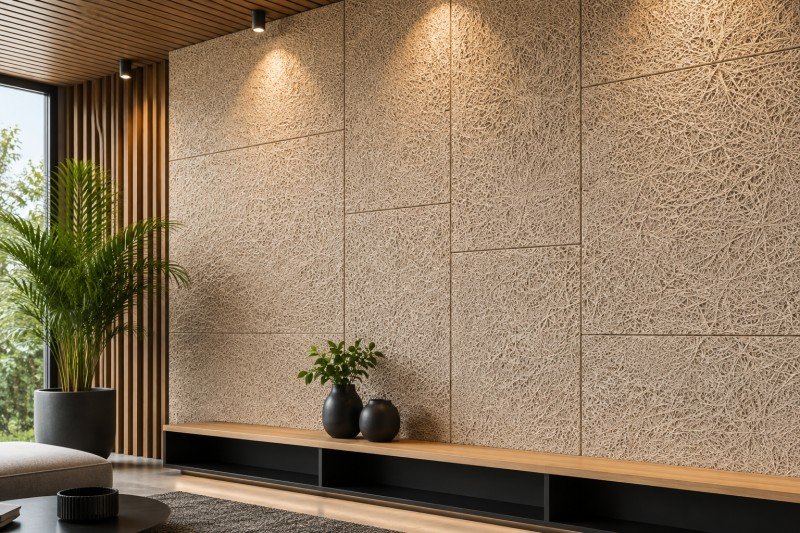
Wood wool acoustic panels are among the most versatile, durable, and visually distinctive acoustic treatment products available in the Indian market today. Unlike fabric-wrapped glass wool panels that require careful handling and can degrade in humid conditions, or PET panels that need fire retardant treatment for commercial use, wood wool panels arrive as a ready-to-install rigid board that is simultaneously an acoustic absorber, a fire-resistant surface finish, a moisture-regulating material, a structurally robust wall lining, and a natural design element.
A single wood wool acoustic panel replaces what would otherwise require four separate product decisions. That is why architects across India specify them for auditoriums, schools, multiplex cinemas, stadium interiors, hotels, offices, hospital waiting areas, sports halls, and premium commercial interiors where the brief calls for acoustic performance without sacrificing surface durability, aesthetic quality, or fire safety.
This page covers Packsound’s complete wood wool acoustic panel offering, including full product specifications, NRC performance data, thickness and density options, surface finish and colour availability, a complete space-by-space application guide, installation guidance, price guidance for India in 2026, comparison against alternative acoustic materials, and how to get a free consultation and quotation for your project.
What Is a Wood Wool Acoustic Panel
A wood wool acoustic panel, also called a wood fiber acoustic panel, wood wool board, or wood cement acoustic panel, is a rigid acoustic panel manufactured from long, fine wood fibres, typically sourced from sustainable softwood species such as pine or spruce, that are mineralised through a chemical impregnation process and then bound together with a cement or magnesite binder under pressure. The result is a panel that combines the acoustic properties of natural wood fibre with the structural rigidity and fire resistance of a cementitious matrix.
The surface of a wood wool panel has an open, fibrous texture created by the exposed wood fibres. This open surface structure is what gives wood wool its acoustic properties. Sound waves entering the room strike the panel surface and penetrate into the fibrous matrix. As the sound wave attempts to propagate through the open fibre structure, the energy of the wave is converted into a tiny amount of heat through friction between the wave and the fibres. This is the same physical process that makes glass wool and polyester fibre effective acoustic absorbers, but it happens within a rigid, cement-bound structure that can be installed directly onto walls and ceilings without any additional facing, frame, or protective casing.
The cement binder that holds the wood fibres together serves several additional functions beyond structural rigidity. Cement is non-combustible, which gives wood wool panels a fire resistance class that no purely organic acoustic material can achieve. Cement is dimensionally stable, which means wood wool panels do not sag, warp, or deform under the temperature and humidity variations typical of Indian commercial buildings. And cement is inert, which means wood wool panels do not off-gas volatile organic compounds, do not harbour mould or bacteria, and do not deteriorate in the presence of the moderate humidity levels found across most Indian climate zones.
Packsound Wood Wool Acoustic Panel Specifications
Packsound’s wood wool acoustic panels, marketed under the WFF product designation, are manufactured to consistent quality standards with the following verified specifications.
- NRC Performance: Packsound WFF wood wool acoustic panels achieve an NRC of 0.90 when installed with a 50mm rock wool backing at 48 kg/m³ density. This is one of the highest NRC values achievable in any rigid acoustic panel format and makes wood wool an appropriate specification for the most acoustically demanding commercial and institutional spaces in India. NRC testing is conducted as per ISO 354-1985 and ASTM C423-90a. Full test documentation is available on request.
- Panel Thickness: Available in 20mm standard thickness. Custom thicknesses from 15mm to 25mm are available for project-specific requirements. The 20mm panel with 50mm rock wool backing achieves the rated NRC of 0.90 performance.
- Panel Density: 400 to 450 kg/m³. This high density reflects the cement binder matrix and gives the panel exceptional structural robustness, impact resistance, and dimensional stability.
- Standard Panel Size: 1200mm x 600mm and 595mm x 595mm. Custom panel dimensions are available for project-specific requirements on larger orders.
- Fire Rating: Meets stringent fire ratings as per ASTM D-876. Wood wool panels are classified as non-combustible or low-flame-spread due to the cement binder matrix, making them appropriate for use in commercial buildings subject to National Building Code of India 2016 Part 4 fire and life safety requirements.
- Moisture Resistance: Tested for weather resistance as per IS 3308. Thermal insulation tested as per IS 3346-1980. The panel maintains dimensional stability at 90 percent relative humidity at 60 degrees Celsius for 15 days with no deterioration. This performance under sustained high humidity conditions is one of the distinguishing characteristics of wood wool panels compared to other acoustic materials.
- Thermal Performance: Tested as per EN 13168:2001. Wood wool panels provide useful thermal insulation in addition to acoustic performance, contributing to the overall thermal envelope performance of the wall or ceiling assembly in which they are installed.
- VOC Emissions: Zero VOC emissions. Wood wool panels are free from formaldehyde, phenolic resins, and chemical binders. The natural wood fibre and cement composition produces no off-gassing into the occupied building environment, supporting LEED, IGBC, and WELL Building Standard Indoor Environmental Quality credits.
- Surface Finish: Natural open-fibre texture in natural wood tone as standard. Fully paintable in any colour with no significant reduction in acoustic performance. Custom colour options available for project-specific requirements.
- Facing Option: Available as an unfaced board (direct open texture installation) and as a fabric-faced tile covered with acoustically transparent fabric on the front face, available in multiple fabric colours. The WFF tile with fabric facing is recommended for office and commercial interior applications where a softer visual finish is preferred over the raw wood texture.
- Installation Compatibility: The 595mm x 595mm format is compatible with standard grid ceiling and wall systems. The 1200mm x 600mm format is installed on GI or aluminium channel framing systems (18mm minimum channel depth). Panels can be fixed directly onto wall surfaces with appropriate adhesive and mechanical fasteners.
- Termite and Fungus Resistance: The cement mineralisation process that binds the wood fibres renders the wood wool matrix fully resistant to termite attack and fungal growth. This is a significant advantage over timber and MDF-based acoustic products in Indian conditions where termite risk is high in many climate zones.
- Asbestos Free: Packsound WFF wood wool acoustic panels are completely asbestos-free and contain no carcinogenic materials or substances.
Why Wood Wool Outperforms Alternative Acoustic Materials in Demanding Indian Applications
The Indian acoustic panel market offers several material choices for commercial acoustic treatment. Wood wool occupies a specific and important position in that market, and understanding why it outperforms alternatives in certain applications helps buyers make the right specification decision.
Wood Wool vs Fabric-Wrapped Glass Wool Panels
Fabric-wrapped glass wool panels are the most widely specified acoustic wall panel for commercial office and institutional applications in India. They deliver high NRC values, a clean professional finish, and a wide range of fabric colours. Where they have limitations, wood wool addresses those limitations directly.
Fabric-wrapped panels require care during installation and cannot be installed in environments where mechanical impact or surface abrasion is a risk. A school corridor, a sports hall wall, a gymnasium, a stadium concourse, or a factory canteen are all environments where a fabric-wrapped panel would be damaged within months of installation. Wood wool panels in these environments perform for ten to twenty years without surface degradation because the cement matrix is robust enough to withstand incidental contact, cleaning, and the physical use that high-traffic institutional spaces impose on their surfaces.
Fabric-wrapped glass wool panels also require the acoustic core to be protected by the fabric facing. If the facing is torn or compromised, the panel must be replaced. Wood wool panels have no facing to protect. The acoustic-active surface is the panel itself. There is nothing to tear, delaminate, or compromise.
Wood Wool vs Acoustic Foam
Acoustic foam is the lowest-cost acoustic panel option available in India. It is also combustible, degrades over time, achieves limited NRC values without independent test certification, and is not appropriate for any commercial or institutional application in India where NBC 2016 fire safety requirements apply. Wood wool panels are the specification that replaces acoustic foam in any serious commercial project where durability, fire safety, and verified acoustic performance are required.
Wood Wool vs PET Polyester Fiber Panels
Polyester fiber panels are moisture resistant, safe to handle, and available in wide colour ranges, making them appropriate for offices, schools, and canteens. Wood wool panels add two performance characteristics that PET panels cannot match: structural rigidity and impact resistance, and the higher density that produces genuine broadband sound absorption including at lower frequencies. For spaces where the wall surface must withstand physical impact, cleaning with pressure washers, or sustained contact with moisture and humidity, wood wool panels perform where PET panels would deform or deteriorate.
Wood Wool vs Grooved Wooden Slat Panels
Grooved wooden slat panels and perforated wooden panels are the premium visual specification for auditorium walls, high-end hospitality interiors, and corporate boardrooms. They combine engineered timber aesthetics with acoustic performance and diffusion. Where they are specified for visual reasons in premium environments, they are the right choice. Where the budget does not support premium timber pricing and the application requires robust acoustic performance in a durable commercial finish, wood wool is the more practical specification that delivers comparable acoustic performance at lower cost.
The Paintability Advantage: Infinite Colour Possibilities Without Acoustic Loss
One of the most commercially important features of wood wool acoustic panels that is consistently underappreciated by buyers in India is their paintability. Unlike fabric-wrapped acoustic panels where changing the colour means sourcing and applying a new fabric facing, wood wool panels can be painted in any colour using standard architectural paint without any significant reduction in acoustic performance.
This means that a school can specify wood wool panels painted in the school’s brand colours. A corporate office can specify panels painted to match the company’s interior palette. A hotel can specify panels in any finish colour that suits the interior design brief. A children’s educational facility can paint panels in bright primary colours. A sports facility can paint panels in team colours. All of this is achievable from the same base product without any additional cost or lead time for a bespoke acoustic product.
The open fibre structure of the wood wool panel allows paint to coat the outer surfaces of the fibres without sealing the gaps between them, which is why the acoustic performance of painted wood wool panels remains within 5 to 10 percent of unpainted panels. For most commercial applications, this small performance reduction is negligible relative to the design freedom that paintability provides.
Packsound supplies wood wool panels in natural finish ready for site painting, and in pre-finished colours for projects where factory colour consistency is preferred over site-applied paint.
Wood Wool Acoustic Panels: Application Guide for Indian Projects
Wood wool panels are appropriate across a very wide range of applications in Indian commercial, institutional, and industrial construction. Here is the complete application guide.
School Auditoriums and Multi-Purpose Halls
School and college auditoriums are one of the most important applications for wood wool acoustic panels in India. The combination of acoustic performance requirements, fire safety requirements, and the physical robustness required in an educational facility makes wood wool the specification that best addresses all three simultaneously.
A school auditorium with hard plaster walls and a reflective ceiling typically has a reverberation time of 2 to 4 seconds, which creates significant speech intelligibility problems during assemblies, performances, and examinations. Wood wool panels installed on the side walls and rear wall at the calculated coverage area, combined with acoustic ceiling treatment, bring the RT60 down to the target range of 0.8 to 1.0 seconds that delivers both speech clarity and musical liveliness for school performances.
Wood wool panels installed in schools carry Class A fire rating compliance, withstand the physical contact and cleaning that school walls are subject to, and can be painted in the school’s colour scheme. These three characteristics make them the natural specification for school auditorium walls in India. Packsound has delivered school auditorium acoustic treatment projects including a 450-seat auditorium in Bengaluru and has completed the prestigious Nalanda University Auditorium at Rajgir, Bihar, inaugurated by the Vice President of India. See packsound.in/auditorium-acoustics.
Multiplex Cinema Halls
Multiplex cinema halls in India have very specific acoustic requirements. The hall must provide even sound distribution from the speaker array to every seat position, with controlled reverberation to prevent echo but sufficient acoustic energy to maintain the cinematic sound experience. Wood wool panels on the side walls provide controlled broadband absorption that manages lateral reflections without creating the overly dead acoustic character that too much fabric absorption can produce. The robust surface of wood wool panels also withstands the frequent cleaning and maintenance that multiplex interiors require.
Sports Halls and Gymnasiums
Sports halls are among the most acoustically challenging spaces in any building programme. High ceilings, hard floors, block or concrete walls, and the absence of any natural sound absorption create reverberation times of 5 to 10 seconds or more in untreated halls. At these reverberation times, referee whistles cannot be distinguished clearly, coaching instructions are unintelligible, and assemblies or events held in the hall are acoustically unusable.
Wood wool panels on the lower 3 metres of the sports hall walls are the standard specification for sports hall acoustic treatment in India. The panels withstand ball impact, physical contact from players, cleaning with mops and pressure washers, and the general physical environment of sports use. No fabric-wrapped panel or foam product can survive in this environment. Wood wool is specified for sports halls precisely because it is the only acoustic panel material that delivers high acoustic performance in a surface robust enough to handle sports hall conditions.
Hospital Waiting Areas and Healthcare Facilities
Healthcare facilities in India require acoustic treatment to reduce the noise levels that cause patient stress and impair staff communication. Wood wool panels are appropriate for healthcare waiting area walls because they contain no chemical binders or VOC-emitting materials, can be wiped down with surface disinfectants without panel degradation, are mould and bacteria resistant due to the cement matrix, and achieve the acoustic absorption required to bring waiting area RT60 within the WHO recommended range for patient comfort.
For healthcare projects requiring acoustic treatment in clinical areas, Packsound’s team can advise on the appropriate wood wool specification and any additional hygiene considerations relevant to the specific clinical environment.
Hotel Ballrooms and Banquet Halls
Hotel ballrooms and banquet halls are used for events ranging from conferences and award ceremonies to weddings and live music performances. The acoustic brief is complex because the space must serve speech intelligibility for conferences while providing the liveliness that makes music events feel energetic. Wood wool panels on the side walls provide broadband absorption that manages the worst reverberation peaks while preserving some acoustic energy for musical events.
Painted wood wool panels in the hotel’s colour scheme, or panels with a fabric facing in a premium finish, integrate with the interior design of a ballroom without requiring the custom specification that premium grooved timber panels demand. Packsound has completed acoustic treatment for hospitality projects including Hyatt Regency Bhikaji Cama Place in Delhi and Crowne Plaza Gurgaon.
Offices and Conference Rooms
For office reception areas, open-plan floors, and meeting rooms where a more textured, natural surface aesthetic is preferred over the smooth fabric finish of conventional acoustic panels, wood wool panels provide an architecturally distinctive alternative. The natural wood fibre texture gives a warm, organic quality to the wall surface that contrasts effectively with the glass and metal typical of modern corporate interiors.
For conference rooms specifically, a rear wall treatment in wood wool panels combined with acoustic ceiling treatment above the meeting table brings RT60 within the target range of 0.4 to 0.6 seconds that delivers optimal speech intelligibility for both in-room participants and remote video conference attendees. Pair wood wool wall panels with fabric acoustic wall panels on adjacent walls and acoustic ceiling clouds above the table for a complete conference room acoustic solution.
Recording Studios and Home Theatres
Recording studio wall treatment typically prioritises high NRC values with good broadband frequency coverage including low frequencies. Wood wool panels at 20mm thickness with 50mm rock wool backing achieve NRC 0.90, which places them at the high-performance end of the available acoustic panel range for studio applications. The rigid, impact-resistant surface is also an advantage in recording studios where microphone stands, equipment cases, and studio furniture regularly make contact with walls.
For home theatres, wood wool panels provide the acoustic treatment required for clean, precise sound reproduction, while the natural textured surface finish is architecturally distinct enough to contribute positively to the immersive character of the home cinema interior.
Railway Stations, Airports, and Public Transport Facilities
Large-volume public transport spaces including railway station concourses, metro station platforms, and airport terminal waiting areas have severe acoustic problems caused by the combination of very large volumes, reflective hard surfaces, and high background noise from announcements, mechanical systems, and large numbers of people. Announcement intelligibility is a safety issue in these environments: passengers must be able to clearly hear train platform announcements and flight gate changes.
Wood wool panels on concourse walls and column surfaces provide acoustic treatment that is robust enough for public space use, moisture resistant enough for environments that are not fully climate controlled, and can be painted to match the architectural colour scheme of any station or terminal interior. The panels are also resistant to the graffiti and surface damage that public space installations inevitably face.
Food Processing and Industrial Facilities
Factory canteens, food processing areas, and light industrial spaces require acoustic treatment materials that can withstand cleaning with water and industrial cleaning solutions. Wood wool panels, due to their cement matrix, are resistant to moisture and can be cleaned with standard industrial cleaning products. For food processing areas above the production line, Packsound advises on appropriate facing and specification options to meet food safety requirements. For factory canteen walls and ceiling zones, wood wool panels are a practical acoustic treatment specification that survives the conditions of industrial food service environments where standard fabric panels would not.
Wood Wool Acoustic Panel Installation Guide
Correct installation is essential to achieving the rated NRC of 0.90 from Packsound’s WFF wood wool panels. Here are the key installation principles.
Install with rock wool backing for maximum NRC.
The rated NRC of 0.90 is achieved when the wood wool panel is installed with a 50mm rock wool backing at 48 kg/m³ density behind the panel. This backing layer absorbs the sound energy that passes through the open wood wool matrix and provides the low-frequency absorption that the wood wool alone would not achieve at 20mm thickness. Without the rock wool backing, the NRC value is lower. For any application where the rated NRC is the design target, the rock wool backing must be included in the installation.
Use GI or aluminium channel framing for the standard 1200x600mm format.
The standard installation method for 1200mm x 600mm wood wool panels uses 18mm GI or aluminium channel framing fixed to the wall or ceiling structure. The panels are then mounted onto the framing using screws through the panel face into the channel. The framing creates the air gap that allows the rock wool backing to be inserted between the panel and the wall structure.
Use grid ceiling systems for the 595x595mm format.
The 595mm x 595mm panel format is designed to fit directly into standard suspended grid ceiling and wall systems. This format allows wood wool to be integrated into existing grid ceiling installations without bespoke framing, which significantly reduces installation cost and time in commercial office and institutional fitout projects.
Paint after installation when specifying site-painted panels.
When panels are to be painted on site rather than supplied in a pre-finished colour, painting should be carried out after the panels are installed and the installation is complete. Use a brush or roller rather than a spray gun where possible to maintain the open fibre texture at the panel surface. Two coats of standard emulsion paint in the specified colour are typically sufficient.
Install with an air gap for improved low-frequency performance.
In addition to the rock wool backing, maximising the air gap between the back of the rock wool and the solid wall surface behind it improves low-frequency acoustic absorption at 125 Hz and 250 Hz. A total installation depth of 75mm to 100mm from the solid wall to the face of the wood wool panel delivers the best broadband NRC performance achievable with this product system.
Packsound’s installation team manages all aspects of wood wool panel installation for commercial and institutional projects across India, from wall preparation through panel fixing, rock wool backing installation, and final finishing. Contact the team to discuss installation support for your project.
Wood Wool Acoustic Panel vs Grooved Wooden Acoustic Panels: Which Is Right for Your Project
Both wood wool panels and grooved wooden acoustic panels appear frequently in Indian architectural specifications for auditoriums, premium offices, and hospitality interiors. Understanding the distinction helps buyers make the right choice.
Wood wool panels provide higher broadband acoustic absorption (NRC up to 0.90 with backing) at a lower cost than engineered grooved timber panels. Their surface is robust and impact-resistant, making them the right specification for spaces with physical wear requirements. Their appearance is textured and natural but industrial in character, making them the right specification for sports halls, schools, factories, and institutional spaces where a raw material aesthetic is appropriate.
Grooved wooden acoustic panels provide a premium engineered timber aesthetic with precision-machined groove profiles. They are appropriate for spaces where the panel must function as a premium design feature: a corporate boardroom, a hotel lobby, a premium restaurant, or an architectural auditorium where the visual quality of the surface is as important as the acoustic performance. Grooved panels provide a combination of sound absorption and sound diffusion that produces a more musically natural acoustic character, which is preferred in spaces where music performance is a primary use.
For many auditorium projects, Packsound specifies wood wool panels for the side walls and rear wall where broadband absorption is the primary requirement, and grooved or perforated wooden panels at the stage zone and front walls where absorption-diffusion balance is important for performer monitoring. This combination achieves both the acoustic design targets and the visual quality expected of a premium auditorium interior. See the grooved wooden panel range at packsound.in/acoustic-wall-panels.
Wood Wool Acoustic Panel Price Guide for India in 2026
Wood wool acoustic panel pricing in India varies based on panel thickness, finish, framing requirement, and supplier. Here is an honest pricing guide for buyers in 2026.
Standard unfaced 20mm wood wool acoustic panels in natural finish are available in the Indian market from approximately Rs 45 to Rs 80 per square foot for commodity market products from IndiaMart and general building material suppliers. At this price point, quality varies considerably and independent NRC test documentation is typically not available.
Packsound WFF wood wool acoustic panels with full specification documentation including NRC test certificates to ISO 354-1985 and ASTM C423-90a, fire rating data to ASTM D-876, and moisture resistance data to IS 3308, are priced at a premium over commodity market products that reflects the verified performance, consistent manufacturing quality, and full documentation coverage that commercial and institutional projects require.
Fabric-faced WFF tiles with acoustically transparent fabric in selected colours carry an additional cost over the unfaced natural panel, reflecting the fabric lamination process.
For complete project pricing including panels, rock wool backing, GI channel framing, and professional installation, contact Packsound with your project dimensions and specification requirements. The team provides project-specific quotations within two working days of receiving your project brief.
Pricing for wood wool panels alone without installation is available for contractors and project managers who have their own installation teams. Contact the team to discuss supply-only pricing for your project.
Green Building Credentials: Wood Wool in LEED and IGBC Projects
Wood wool acoustic panels support green building certification in Indian commercial projects across several material and environmental quality credit categories.
The wood fibre used in wood wool panels is sourced from managed softwood plantations rather than old-growth forest, supporting FSC (Forest Stewardship Council) material certification credits in LEED and IGBC schemes.
The cement binder is an inorganic, inert material with no VOC or formaldehyde content. Wood wool panels contribute to LEED and IGBC Indoor Environmental Quality credits for low-emitting interior materials, which are particularly valuable in office and educational facility certifications.
The natural moisture regulation properties of wood wool (the fibrous structure absorbs excess moisture from the room air and releases it when the room is dry) contribute to indoor climate quality, supporting the occupant comfort and wellbeing objectives of the WELL Building Standard.
The long service life of wood wool panels, typically twenty or more years without replacement in commercial applications, reduces the embodied carbon cost per year of service compared to acoustic materials with shorter service lives.
For projects seeking LEED, IGBC, or GRIHA certification, Packsound can provide material specification documentation, VOC emission data, recycled content data where applicable, and acoustic performance certification to support the green building submission.
Frequently Asked Questions About Wood Wool Acoustic Panels in India
What NRC do Packsound wood wool acoustic panels achieve?
Packsound WFF wood wool acoustic panels achieve NRC 0.90 when installed with a 50mm rock wool backing at 48 kg/m³ density. This is tested as per ISO 354-1985 and ASTM C423-90a. Full test certificates are available on request.
Can wood wool acoustic panels be painted?
Yes. Wood wool panels are fully paintable in any colour using standard architectural emulsion paint without significant reduction in acoustic performance. The open fibre surface structure allows paint to coat the fibre surfaces without sealing the acoustic pores between fibres. This makes wood wool an ideal specification for projects requiring custom colour finishes.
Are wood wool panels fire rated for commercial buildings in India?
Yes. Packsound WFF wood wool panels carry fire rating classification as per ASTM D-876. The cement binder matrix of wood wool panels provides inherent fire resistance, giving them a non-combustible or low-flame-spread classification appropriate for commercial buildings subject to NBC 2016 Part 4 requirements.
Are wood wool panels suitable for humid Indian climates and coastal cities?
Yes. Wood wool panels are tested for weather and moisture resistance as per IS 3308, maintaining dimensional stability at 90 percent relative humidity at 60 degrees Celsius for 15 days with no deterioration. This performance makes them appropriate for use in coastal cities including Mumbai, Chennai, Kochi, and Goa where sustained high humidity is a regular condition.
What is the standard size of wood wool acoustic panels?
Packsound WFF wood wool panels are available in 1200mm x 600mm (for GI channel installation) and 595mm x 595mm (for grid ceiling and wall system installation). Custom sizes are available for project-specific requirements.
How are wood wool panels different from grooved wooden acoustic panels?
Wood wool panels are made from fine wood fibres bound with cement into a rigid composite panel with an open fibrous surface texture. They are highly impact resistant, cost-effective, and appropriate for robust institutional environments. Grooved wooden acoustic panels are made from engineered timber with precision-machined groove profiles. They provide a premium timber aesthetic with acoustic absorption and diffusion and are specified for high-end hospitality, premium corporate, and architectural auditorium applications.
Do wood wool panels need a rock wool backing?
The rated NRC of 0.90 is achieved specifically with a 50mm rock wool backing at 48 kg/m³ density behind the wood wool panel. Without the backing, the NRC value is lower. For any project where achieving the rated NRC is the design requirement, the rock wool backing is a necessary part of the installation.
What is the price of wood wool acoustic panels per square foot in India?
Commodity wood wool panels from general market suppliers are available from Rs 45 to Rs 80 per square foot. Packsound WFF panels with full NRC test certification, fire rating documentation, and moisture resistance certification are priced at a specification premium reflecting the verified performance and documentation coverage required for commercial and institutional projects. Contact Packsound for project-specific pricing.
Do you supply and install wood wool panels across India?
Yes. Packsound supplies and installs wood wool acoustic panels across India including Delhi NCR, Mumbai, Bengaluru, Hyderabad, Chennai, Pune, Kolkata, Ahmedabad, and all major cities. For large institutional and commercial projects anywhere in India, the team manages supply logistics and installation coordination directly.
Request a Free Quote for Wood Wool Acoustic Panels
Packsound supplies certified WFF wood wool acoustic panels for commercial, institutional, educational, hospitality, industrial, and healthcare projects across India. Every project receives a free acoustic consultation covering panel specification, rock wool backing requirements, coverage area calculation, colour and finish selection, installation method advice, and a complete project quotation covering product supply and installation.
Our team has delivered acoustic treatment for projects including the Nalanda University Auditorium at Rajgir inaugurated by the Vice President of India, the Assam Rifles Auditorium in Shillong, Hyatt Regency Bhikaji Cama Place in Delhi, Crowne Plaza Gurgaon, and Pfizer Visakhapatnam. Wood wool acoustic panels are part of the product range that delivers those results.
Contact the Packsound team today for a free consultation and quotation.
Call: +91 980 980 2016 or +91 9990 858 797 Email: Sales@packsound.in or Abhinav@packsound.in Address: A-719 Tower 3, NX One Techzone IV, Greater Noida West, Uttar Pradesh 201306 Monday to Saturday, 9:00 AM to 7:00 PM
Explore the Full Packsound Acoustic Product Range
Fabric Wrapped Acoustic Wall Panels for high-NRC soft-finish acoustic wall treatment in offices, studios, conference rooms, and educational facilities.
- Grooved Wooden Acoustic Panels for premium engineered timber acoustic panels combining absorption and diffusion for auditoriums, hospitality, and high-end corporate interiors.
- Perforated Wooden Acoustic Panels for precision-perforated timber acoustic panels in architectural auditorium wall and ceiling applications.
- Acoustic Ceiling Baffles for suspended vertical ceiling baffles in sports halls, factories, canteens, and large-volume commercial spaces.
- Acoustic Ceiling Clouds for horizontal suspended ceiling acoustic treatment in restaurants, conference rooms, and commercial interiors.
- AquaSonic Range for moisture-resistant acoustic treatment solutions for swimming pool halls, canteens, food processing areas, and coastal commercial spaces.
- Auraluxe Premium Range for 3D luxury acoustic wall panels, printed acoustic panels, EchoGlow acoustic ceiling lights, and AeroLoom woven ceiling clouds for premium commercial and hospitality projects.
- Acoustic Design and Consultancy for full acoustic design services including RT60 calculation, wood wool panel specification, coverage area design, IS 2526 compliance documentation, and post-installation acoustic measurement.
- Auditorium Acoustic Treatment for complete acoustic treatment for school, college, government, and institutional auditoriums across India.
Packsound is a brand of Ecotone Acoustic Limited, Greater Noida, India. NRC 0.90 tested as per ISO 354-1985 and ASTM C423-90a. Fire rating as per ASTM D-876. Weather resistance as per IS 3308. Full test documentation available on request. Over 150 acoustic projects delivered across India since 2015.