
Acoustic Foam Panels for Echo Reduction | Packsound
Acoustic foam panels usually work best when what your dealing with is echo, muffled recordings, or way too much reverberation inside a room. They aren’t really a soundproofing kind of material. Like if you can still hear your neighbour’s television through the wall, no foam is going to fix that, not even the fancy stuff. What foam actually does exceptionally well is tidying up vocal recordings, cutting down those distracting reflections during Zoom calls, and also making the decay shorter in echoey areas such as bare concrete offices or tiled classrooms.
For most Indian studio and office setups, going for something like 30 to 40 percent wall coverage using 50mm foam panels , plus adding foam treatment on the ceiling at the first-reflection points, tends to give noticeable results in RT60 reduction and speech intelligibility. And you can do it without any major construction work .
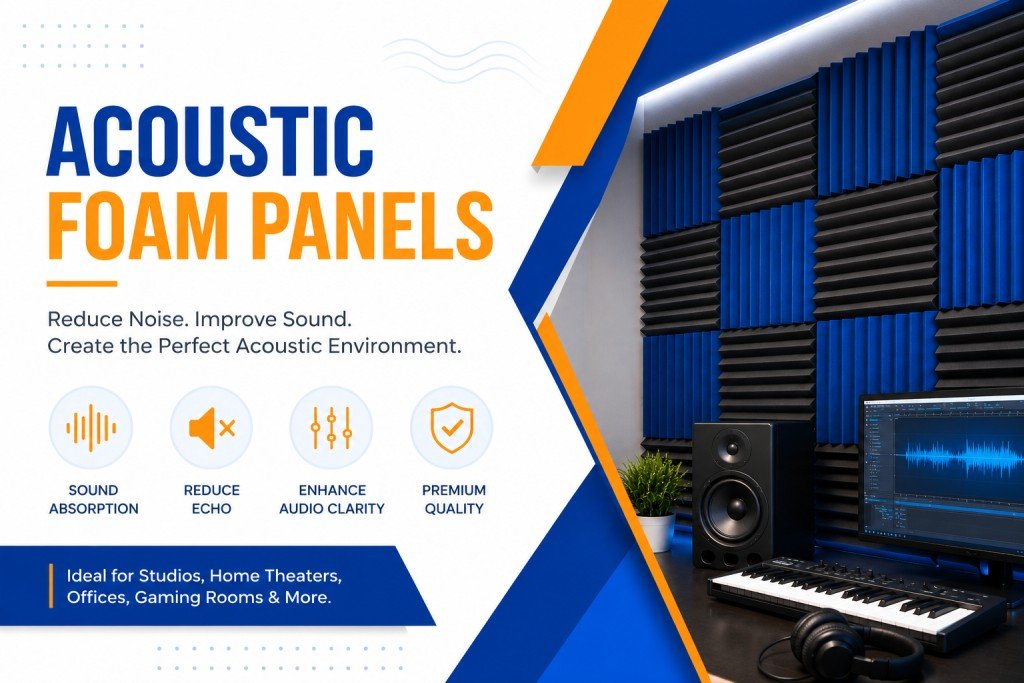
What Are Acoustic Foam Panels and How Do They Reduce Echo?
Acoustic foam panels are basically open-cell polyurethane or melamine foam tiles made to absorb sound energy, so it doesn’t just bounce back from rigid walls and ceilings. When sound waves push into the foam’s porous texture , the airflow friction does its job and turns that energy into a bit of minimal heat, which then cuts down flutter echo, slap-back, and that lingering reverberation people hear inside a space. PackSound acoustic foam panels come in wall and ceiling options, including foam ceiling applications as well, and they offer NRC ratings up to 0.95. You can also choose thickness levels from 25mm up to 100mm, depending on how much damping you need. In general these acoustic panels are a recommended first-layer treatment for recording studios, podcast rooms, home theatres, corporate meeting rooms, and even classrooms across India, where echo control tends to be the main acoustic headache.
| Parameter | Detail |
|---|---|
| Material | Open-cell polyurethane foam or melamine foam |
| Thickness Options | 25mm, 50mm, 75mm, 100mm |
| NRC Rating | 0.55 (25mm) to 0.95 (100mm) |
| Panel Size | Standard 600 × 600mm; custom sizes available |
| Profile Types | Wedge, Pyramid, Egg-crate, Flat, Bass Trap Corner |
| Fire Rating | Class B fire retardant (Melamine: Class A available) |
| Colour Options | Charcoal, Black, Grey, Off-white, Custom colours |
| Benefit | What it means for you |
|---|---|
| Cuts down on flutter echo | Stops that quick sound ping-pong between two parallel walls. |
| Makes your voice easier to hear | Cleaner recordings, clearer conference calls, and speech that sounds sharper. |
| Lightweight and DIY-friendly | Easy installation using adhesive or clips with minimal structural effort. |
| Low-cost starter option | One of the most cost-effective acoustic treatment options per square metre. |
| Works on walls and foam ceilings | Controls first reflections and overhead sound bounce simultaneously. |
| Mid-to-high wideband absorption | Absorbs frequencies from roughly 500 Hz and above for speech clarity. |
| Customisable coverage | Choose from spot treatment to full-room acoustic control based on your needs. |
| Application | Recommended Coverage |
|---|---|
| Recording & Podcast Studios | 40 to 60% of wall area, plus acoustic foam on ceiling reflection points |
| Home Theatre Rooms | 30 to 40% on side walls, rear wall, and ceiling cloud treatment |
| Corporate Meeting Rooms | 25 to 35% across walls, centered around first reflection zones |
| Classrooms & Lecture Halls | 20 to 30% on rear and side walls to improve speech clarity |
| Gaming & Streaming Rooms | 30 to 45% on walls and ceiling for cleaner audio capture |
| Vocal Booths & Isolation Rooms | 50 to 70% full coverage including acoustic foam ceiling panels |
| Server Rooms & Data Centres | 40% or more to reduce equipment fan noise reflections |
| Step | Action |
|---|---|
| 1 | Measure and Plan Calculate the target wall and ceiling coverage area before buying anything. |
| 2 | Identify Reflection Points Use a small mirror on the wall to find the first reflection zones from your listening spot. |
| 3 | Clean the Surface Wipe the walls with a dry cloth to remove dust, grease, and any moisture. |
| 4 | Apply Adhesive Use acoustic foam glue, a Z-clip system, or hook and loop fasteners for a removable setup. |
| 5 | Mount with an Air Gap Keep the panels about 25 to 50 mm off the wall to boost low frequency absorption. |
| 6 | Install Foam Ceiling Panels Fix ceiling panels with mechanical clips, or apply adhesive directly to suspended ceiling tiles or drywall. |
| 7 | Verify Coverage Pattern Stagger the panels on parallel walls so exposed patches on one wall are matched by panel coverage on the other. |
| Myth | Reality |
|---|---|
| “Foam panels soundproof a room.” | Foam reduces echo, but it cannot stop sound from entering or passing through building walls. |
| “More foam means better sound.” | After about 60% coverage, the room can feel overly dead and affect recording clarity. |
| “Egg cartons work like acoustic foam.” | Egg cartons have almost no NRC and can become a fire hazard, so they are not a real solution. |
| “Thin 25mm foam is enough for bass.” | Low bass frequencies under 250 Hz need thicker foam, bass traps, or dense wool panels. |
| “Foam panels work on both sides.” | They absorb echo inside a room but do not block sound transmission between spaces. |
| “Acoustic foam panels for ceiling are unnecessary.” | Ceiling reflections often create major echo issues, so ceiling treatment is important. |
| “White foam panels perform the same as black.” | Color does not impact performance. Density and thickness determine effectiveness. |
Expert Insights from Real Projects
The Coverage Percentage Trap
Every foam guide kinda recommends “20 to 30 percent coverage” but they never really explain that this number is built on the idea of a normal rectangular room, with a 2.7 metre ceiling, and hard plaster walls. In Indian construction, where it’s pretty common to see exposed brick, polished marble, and low false ceilings, the same area might need 40 to 50 percent coverage, just to get results that are comparable. Also don’t just trust the coverage percentage by itself, measure your room’s reverberation time (RT60) before and after the installation. A free mobile app like Spectroid can give you a rough RT60 reading, so you can check whether your treatment is actually working.
The Air Gap Upgrade Almost Nobody Does
Mounting acoustic foam panels straight to a wall is kinda the usual thing, but if you mount them about 50mm off the wall using standoff clips, you end up with a little air gap behind them, and that gap… sort of doubles the panel’s low frequency action. For Indian studio builders that are already stuck using 50mm foam, and cant swing thicker or pricier panels, this one installation change can push the useful absorption lower, to around 300 Hz instead of roughly 500 Hz. The standoff hardware cost is basically negligible compared to upgrading the foam thickness across the whole room, so yeah it’s a sensible swap.
Foam Ceiling Panels vs Suspended Ceiling Baffles: When to Choose What
Acoustic foam panels really work out for ceiling use in rooms that are under 3.5 metre ceiling height, where you can mount them directly, and it actually makes sense to do so. In bigger places like commercial areas, auditoriums, or open-plan offices, especially where the height goes above 4 metres, these foam ceiling panels start to lose their effect, because the sound energy kind of spreads out before it even reaches the treatment surface. For that kind of environment, suspended acoustic baffles or ceiling clouds hung in the air , placed around 2.5 to 3 metres from the floor, will intercept the reflections much more efficiently. So if your space is taller than 3.5 metres, dont waste budget on foam ceiling tiles… just specify suspended baffles instead, and move on.
How Indian Climate Affects Foam Longevity
Open-cell polyurethane foam, in places with high humidity like Mumbai Kolkata or coastal cities, ends up pulling in moisture little by little over time and then it starts degrading in about three to five years. Most times this part is not really disclosed by domestic foam resellers, so people only notice later. Melamine foam on the other hand has a closed microstructure and it stands up to humidity far more consistently , staying stable and maintaining its NRC performance for around eight to twelve years in the same kind of weather. So for any permanent setup in India’s high-humidity regions, choosing melamine-grade foam or even fibre-based fabric panels is a much better long term bet than standard polyurethane tiles.
Why Studio Engineers Combine Foam with a Different Panel Type at Corners
Acoustic foam panels kind of absorb the mid and high frequencies pretty well but they do almost nothing when you go below around 250 Hz . At that point bass frequencies tend to pile up in room corners , forming standing waves, and you get this boomy muddy low end that messes up recordings and even cinema audio. In practice professional acoustic engineers will deal with it by installing dedicated corner bass traps, made from 100mm to 150mm rockwool or fibreglass, right at every floor to ceiling corner and also the wall to wall corners. The foam panels are more for reflections across the flat surfaces , while the bass traps are meant for the low end modal buildup inside those corners . So if you treat a room with only foam and no bass traps , it will pretty much always sound lopsided , no matter how much foam coverage you apply.
Frequently Asked Questions About Acoustic Foam Panels
Do acoustic foam panels actually reduce echo in a room?
Yes, mostly. These panels soak up mid and high frequency reflections that make things sound echo-y and kind of lingering inside a room.
Will acoustic foam panels stop my neighbour’s noise from coming through the wall?
No, not really. Foam deals with echo inside your space, but it won’t block outside noise. To stop that you need mass-based soundproofing, like heavier construction or proper insulation.
How much foam coverage do I need on my walls and ceiling?
Usually 25 to 40 percent is enough for most rooms. If it’s for recording studios or podcast booths, go higher 40 to 60 percent.
Are acoustic foam panels for ceiling different from wall panels?
They’re basically the same material. But ceiling panels often need mechanical clips or adhesive that is rated for overhead weight and the right mounting orientation.
What thickness of foam panel do I need for a home studio?
A solid starting point is 50mm. For corners and first-reflection points, 75 to 100mm works much better, especially if you want better low-mid control.
Can I use acoustic foam panels in an office meeting room?
Yes. Around 25 to 35 percent wall coverage can improve speech clarity in a noticeable way and reduce echo on video calls, even with people moving.
How do I install acoustic foam panels without damaging walls?
Use hook-and-loop strips or removable mounting tape made for foam. No drilling, and no permanent adhesive needed, so it’s less hassle later.
Do foam ceiling panels help with bass and low frequencies?
Not much. Foam is not very effective under about 250 Hz. For bass you’ll want corner bass traps using rockwool or fibreglass instead.
How long do acoustic foam panels last in humid Indian climates?
In typical humid zones, standard polyurethane foam lasts roughly three to five years. Melamine foam generally lasts longer, about eight to twelve years.
What is the NRC rating of PackSound acoustic foam panels?
It ranges from 0.55 on 25mm panels up to 0.95 on 100mm panels, and this is verified via certified lab testing.
PackSound also supplies the complete ecosystem of acoustic treatment products that foam panels work best alongside:
- Fabric-wrapped acoustic panels (NRC 0.90+) for commercial offices, auditoriums, and boardrooms
- Grooved wooden slat acoustic panels for premium hospitality and office interiors
- Acoustic ceiling baffles and clouds for large open-plan spaces
- AcoFascia™ sliding folding acoustic partitions for flexible sound isolation between spaces
- Complete soundproofing and acoustic wall panel systems for all project types and budgets
PackSound serves clients across Delhi NCR, Mumbai, Bengaluru, Hyderabad, Chennai, Pune, Guwahati, Raipur, and cities throughout India – with end-to-end project services from acoustic consultation and design through product supply, delivery, and professional installation.