
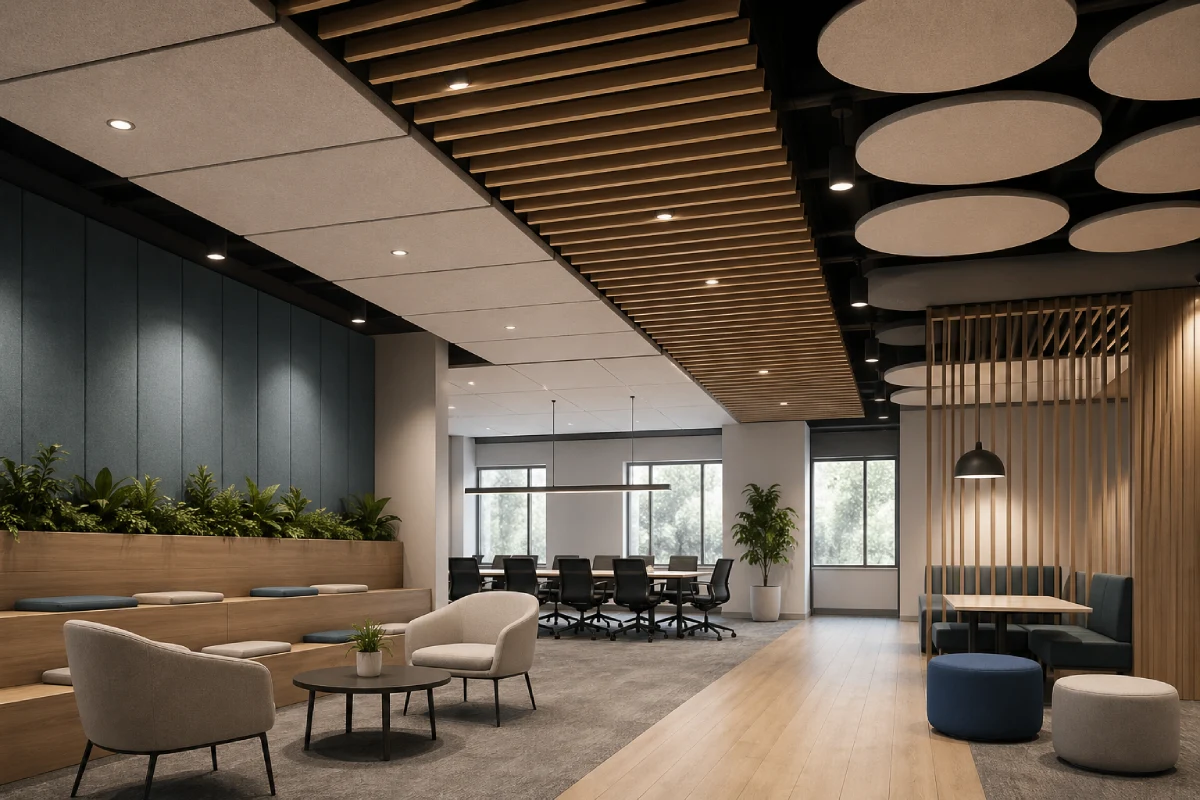
Why Acoustic Ceiling Design Is No Longer Optional
Modern architecture is built around aesthetics — open-plan offices, glass facades, concrete floors, and soaring ceilings. These choices look impressive but create a serious acoustic problem. Hard, reflective surfaces bounce sound waves in every direction, causing echo, reverberation, and noise buildup that affects concentration, communication, and even health.
Acoustic ceiling design is the single most powerful intervention available because the ceiling is almost always the largest unobstructed surface in any room. A well-designed acoustic ceiling can reduce reverberation time by 50 % or more, improve speech intelligibility, and transform a chaotic sound environment into a controlled, comfortable one — without disturbing the visual design of the space.
This guide covers everything you need to know about acoustic ceiling design: what it is, how it works, the types of systems available, where each solution is best applied, and how to choose the right one for your project.
What Is an Acoustic Ceiling?
An acoustic ceiling is a ceiling system — or a set of elements attached to or suspended from a ceiling — that is specifically engineered to absorb sound energy and reduce unwanted reverberation inside a room. Unlike a standard plaster or drywall ceiling, which simply reflects sound back into the space, an acoustic ceiling is constructed from porous, fibrous, or composite materials that convert sound energy into a negligible amount of heat.
In construction terms, acoustic ceilings are generally non-load-bearing elements. They can be:
- Installed directly onto the structural ceiling (direct-fix systems)
- Suspended below the structural slab on a grid or hangers (false ceiling or dropped ceiling systems)
- Hung as discrete elements such as baffles, clouds, or canopies in open spaces
The key performance metric for any acoustic ceiling material is the Noise Reduction Coefficient (NRC) — a number between 0.0 and 1.0 that describes how much sound the material absorbs. An NRC of 1.0 means virtually all sound is absorbed; an NRC of 0.0 means everything is reflected. For most commercial and industrial applications, an NRC of 0.7 or above is recommended.
How Sound Behaves Without Acoustic Ceiling Treatment
To appreciate acoustic ceiling design, it is important to understand what happens in an untreated room. When someone speaks, machinery operates, or music plays, sound waves radiate outward and strike every surface they encounter.
On a hard surface — concrete, glass, ceramic tile, bare drywall — most of the energy is reflected back into the room. The reflected sound combines with the original sound and all subsequent reflections, producing a sustained noise level known as reverberation.
Prolonged reverberation has measurable consequences:
- Reduced speech intelligibility: Words become blurred as one syllable overlaps with the reflection of the previous one.
- Elevated noise levels: A room’s overall decibel level rises well above the actual source level because energy accumulates from multiple reflections.
- Increased cognitive load: The brain works harder to separate useful sound from ambient noise, leading to fatigue and stress.
- Reduced productivity: Research consistently links poor acoustics in offices and classrooms to lower output, lower test scores, and higher stress-related absenteeism.
The ceiling is often the primary culprit because it covers the entire floor plan, has no furniture or people to interrupt reflections, and is typically made from the most reflective materials available.
Types of Acoustic Ceiling Systems
Acoustic ceiling design is not a one-size-fits-all discipline. There are several distinct system types, each suited to different spaces, ceiling heights, budgets, and aesthetic requirements.
1. Acoustic Ceiling Baffles (Hanging Baffles)
Acoustic ceiling baffles are vertically suspended panels that hang perpendicular to the ceiling surface. Because both faces of each panel are exposed to the room, baffles absorb sound traveling from multiple directions — upward, sideways, and diagonally. This makes them significantly more efficient per unit of material than flat ceiling systems.
How they work: Sound waves that travel upward from machinery, conversations, or crowd activity strike both faces of the baffle. The porous absorptive core — typically glass wool, mineral wool, or high-density polyester — converts the kinetic energy of the sound wave into an imperceptible amount of heat.
NRC performance: High-quality ECOTONE™ hanging baffles achieve an NRC rating of up to 1.0, meaning they absorb virtually the full spectrum of mid- and high-frequency sound that strikes them.
Available specifications:
- Panel sizes: 500 mm × 1000 mm or 600 mm × 1200 mm
- Thickness: 30 mm to 50 mm
- Fire compliance: Non-flammable materials meeting IS/ASTM Class fire ratings
- Finish: Fabric-wrapped, perforated metal, or plain mineral wool
Best for: Factories, warehouses, sports halls, canteens, auditoriums, airports, and any space with high ceilings or exposed structural elements where wall coverage is limited.
2. Acoustic Clouds (Horizontal Canopy Panels)
Acoustic clouds are flat panels suspended horizontally, parallel to the ceiling surface. Unlike baffles, clouds primarily address vertical sound reflections — the sound that bounces down from the ceiling to the floor and back up.
Because of their flat orientation, clouds are most effective in spaces where ceiling heights are moderate (3 m to 5 m) and noise levels are controlled. They are also highly popular with architects and interior designers because they can be integrated with lighting, projectors, and HVAC grilles, creating a clean, engineered ceiling appearance.
Understanding the difference between acoustic ceiling baffles and acoustic clouds is critical to selecting the right system. Clouds treat vertical reflections; baffles treat multi-directional reflections. For spaces with very high ceilings or significant horizontal noise propagation, baffles generally outperform clouds.
Best for: Corporate offices, conference rooms, hospitality spaces, restaurants, healthcare waiting rooms, and educational facilities.
3. Acoustic Ceiling Tiles and Grid Systems
Suspended grid ceilings fitted with acoustic mineral fibre tiles are among the most widely installed acoustic ceiling systems globally. The tiles sit in a recessed metal grid suspended below the structural slab, creating a uniform dropped ceiling appearance.
Advantages: Accessible panels allow easy maintenance of services (HVAC, electrical, sprinkler) above the ceiling. Excellent cost-to-performance ratio for large commercial fit-outs.
Limitations: Fixed grid spacing limits design flexibility. Not suitable for very high ceilings or irregular room geometries.
NRC range: 0.5 to 0.9, depending on tile density and perforation pattern.
Best for: Offices, retail spaces, healthcare facilities, educational institutions, and government buildings.
4. Acoustic Plaster and Spray Systems
Seamless acoustic plaster systems apply a microporous coating directly to ceiling substrates, creating an aesthetically invisible acoustic treatment. These systems are ideal when the architect demands a monolithic, joint-free ceiling finish that maintains the visual integrity of the space.
The porous surface structure allows sound to penetrate and be absorbed by the backing layer, typically a glass or mineral wool substrate. This combination significantly increases the absorption coefficient.
Best for: High-end commercial interiors, heritage buildings, museums, concert halls, and spaces where visual disruption must be minimised.
5. Wood Wool and Mineral Board Tiles
Wood wool acoustic tiles are manufactured from wood fibres bonded with cement or mineral binder. They combine moderate acoustic performance with a distinctive textural aesthetic and are commonly used in educational, hospitality, and cultural spaces.
Advantages: Sustainable material composition, strong compressive resistance, good moisture tolerance, aesthetically distinctive.
NRC range: 0.6 to 0.85, depending on thickness and density.
6. Industrial Acoustic Ceiling Baffles
For environments involving heavy machinery, dust, moisture, and mechanical vibration, standard commercial baffles are insufficient. Industrial acoustic baffles are engineered with robust outer shells — perforated steel, galvanised metal, or high-density polyester — to withstand harsh operational conditions while delivering reliable sound absorption.
Ecotone Systems’ industrial baffles are specifically designed for manufacturing plants, power plants, automotive workshops, food processing facilities, and textile factories where uncontrolled sound can compromise worker safety, communication, and regulatory compliance.
Key Acoustic Parameters Every Designer Should Know
Understanding acoustic ceiling design requires familiarity with a few essential performance parameters:
Noise Reduction Coefficient (NRC): The average sound absorption coefficient measured at 250 Hz, 500 Hz, 1000 Hz, and 2000 Hz. The higher the NRC, the better the material absorbs sound. Target NRC ≥ 0.7 for offices and classrooms; NRC ≥ 0.85 for industrial and large-volume spaces.
Reverberation Time (RT60): The time (in seconds) it takes for a sound to decay by 60 dB after the source stops. Shorter RT60 values mean a drier, clearer acoustic environment. Offices typically target RT60 of 0.4–0.6 s; industrial spaces may target 1.0–1.5 s depending on their use.
Sound Transmission Class (STC): A measure of how much a partition or ceiling assembly reduces sound passing from one space to another. Relevant when the acoustic ceiling also needs to provide room-to-room isolation. Ecotone’s soundproof enclosure systems achieve STC ratings of up to 50.
Absorber Class (EN ISO 11654): European classification A through E, where Class A represents the highest absorption performance. Class A materials absorb the broadest frequency range most efficiently.
Applications of Acoustic Ceiling Design by Space Type
Acoustic ceiling design is universal — every built environment benefits from controlled acoustics. Below is a space-by-space breakdown of the right approach.
Offices and Open-Plan Workspaces
Open-plan offices are particularly challenging because dozens of people share a large, reflective space with minimal acoustic barriers. Ceiling-mounted acoustic baffles for office spaces or acoustic clouds can reduce ambient noise levels by 6–10 dB and cut reverberation time from 1.2 seconds to under 0.5 seconds.
The result is a measurable improvement in speech privacy, reduced cognitive fatigue, and better focus — all of which directly impact employee productivity and retention. For conference rooms, hanging baffles combined with wall acoustic panels create an environment where every participant can hear and be heard clearly, regardless of seat position.
Recommended systems: Acoustic clouds, fabric-wrapped hanging baffles, acoustic ceiling tiles (NRC ≥ 0.7)
Factories and Warehouses
Industrial environments are among the most acoustically demanding. Large volumes, concrete floors, steel roofing, and continuous machinery operation combine to create reverberation times well above 3 seconds. This does not just create discomfort — it poses real safety risks when alarms, instructions, and emergency signals cannot be heard clearly.
Acoustic ceiling baffles in factories and warehouses are the preferred solution because they utilise overhead space that is otherwise unused. Wall space in industrial facilities is typically occupied by machinery, storage racking, and electrical panels, making wall-mounted treatments impractical. Vertically suspended industrial baffles intercept sound from all directions and deliver consistent noise reduction across the entire production floor.
Recommended systems: Industrial acoustic hanging baffles (NRC 0.85–1.0), perforated metal baffles for dust-heavy environments
Educational Institutions
Research published across multiple countries consistently demonstrates that poor classroom acoustics reduce speech intelligibility, slow reading development, and increase teacher vocal strain. Children — particularly those with hearing impairment or learning differences — are disproportionately affected by reverberant classrooms.
Acoustic ceiling tiles or hanging baffles installed in classrooms, libraries, and lecture halls bring reverberation time within the recommended range for educational speech (RT60 ≤ 0.6 s for classrooms), significantly improving the learning environment.
Recommended systems: Acoustic ceiling tiles (NRC 0.7–0.85), cloud panels with integrated lighting
Healthcare Facilities
Hospitals, clinics, and medical practices have two acoustic objectives: protecting patient privacy and reducing noise stress. Studies link elevated hospital noise levels to slower patient recovery, increased medication errors, and greater staff burnout.
Acoustic ceiling systems in healthcare must also meet strict hygiene and fire safety requirements. Wipeable, non-porous acoustic tile surfaces combined with seam-sealed ceiling assemblies are the standard approach. For corridors and waiting areas, hanging clouds can reduce ambient noise without requiring complex installation.
Recommended systems: Acoustic ceiling tiles (wipeable, Class A fire rated), cloud panels in corridors and waiting areas
Auditoriums, Concert Halls, and Conference Centres
Performance venues and public assembly spaces require the most rigorous acoustic ceiling design. The ceiling must be shaped and configured not only to absorb excess energy but also to direct useful sound energy toward the audience.
Ecotone Systems’ building noise control expertise includes acoustic design for auditoria, recording studios, conference centres, and entertainment venues — spaces where reverberation control, sound diffusion, and speaker coverage must be engineered simultaneously.
Recommended systems: Custom-shaped acoustic canopies, acoustic plaster on shaped substrates, hanging baffles behind stage structures
Restaurants and Hospitality
A poor dining acoustic environment drives customers away. Excessive noise prevents conversation, creates stress, and shortens the average table duration. Yet many restaurant designers overlook acoustics in favour of visual materials like exposed brick, polished concrete, and glass.
Acoustic ceiling clouds integrated with pendant lighting, or discrete hanging baffles above seating areas, can reduce reverberation time from above 1.5 s to under 0.8 s — dramatically improving the dining experience without altering the visual concept.
Swimming Pools and Wet Areas
High-humidity environments require acoustic ceiling systems made from moisture-resistant materials. Standard glass wool baffles are not suitable for these environments. Perforated aluminium or stainless steel shells with sealed acoustic cores are the appropriate choice. The ceiling must maintain its performance and structural integrity over years of exposure to condensation and chlorinated air.
Museums, Airports, and Transport Hubs
Public assembly spaces need acoustic ceilings that support clear verbal announcements. In an airport departure hall or a museum gallery tour, speech intelligibility is a safety and accessibility requirement. Large-format cloud panels or baffle arrays reduce ambient noise and background reverberation, ensuring that PA systems and tour guides can be heard clearly by all visitors.
Acoustic Ceiling Design vs. Wall Acoustic Treatment: Which Should You Prioritise?
A common question from architects and project managers is whether to invest in ceiling-mounted or wall-mounted acoustic treatment first. The answer depends on the geometry of the space and the nature of the noise problem.
In most commercial and industrial spaces, the ceiling is the higher priority for several reasons:
- The ceiling is typically the largest uninterrupted surface in the room.
- Wall space is often occupied by doors, windows, furniture, equipment, and shelving.
- Sound reflected from the ceiling travels the longest path before returning to listeners, producing the most significant echo and reverberation contribution.
- Hanging ceiling systems (baffles and clouds) can treat the full floor plan from a single installation point.
Wall acoustic panels are highly effective as a complementary treatment, particularly for addressing side-wall reflections in conference rooms, recording studios, and home theatres. A holistic acoustic design strategy combines ceiling-mounted absorbers with targeted wall panel placement.
Sustainable and Eco-Friendly Acoustic Ceiling Options
Sustainability is an increasing priority in construction and interior fit-out projects. The good news is that eco-friendly acoustic ceiling baffles are not a compromise — they are a genuine high-performance choice.
Materials available for sustainable acoustic ceiling design include:
- Recycled PET felt: Manufactured from post-consumer plastic bottles, delivering NRC values comparable to glass wool with zero fibre release and excellent colourfastness.
- Wood wool boards: Made from natural wood fibres, sustainably sourced and biodegradable at end of life.
- Recycled glass mineral wool: High-performance absorption with a significant recycled content fraction.
- Natural fibre composites: Hemp, cotton, and jute-based composites for low-VOC, biophilic interior applications.
Eco-friendly acoustic ceiling panels can be laser-cut, printed, and colour-matched to match corporate branding or biophilic design schemes, making them both a functional and a design asset. Their long service life — typically 10 to 15 years with minimal maintenance — also makes them financially competitive with conventional materials on a lifecycle cost basis.
Acoustic Ceiling Installation: Practical Considerations
Good acoustic ceiling design delivers results only when installation is carried out correctly. Key installation considerations include:
Coverage area: As a general rule, acoustic ceiling treatment should cover 25–40 % of the total ceiling area in commercial offices, and up to 60 % in industrial spaces or high-reverberation environments. Insufficient coverage leaves the reverberation problem partially unsolved.
Suspension height: Hanging baffles should be installed approximately 300–600 mm below the structural ceiling for optimal airflow and absorption performance. In office environments, a drop of 300–450 mm typically provides the best balance between performance and visual integration.
Spacing between baffles: Baffles should be spaced to allow air to circulate freely between panels. A typical spacing of 150–300 mm between parallel baffles provides effective absorption while maintaining ventilation. In industrial environments where HVAC ductwork is present overhead, baffles can be arranged to route around ductwork without sacrificing coverage.
Fire compliance: All acoustic ceiling materials should carry appropriate fire classification certificates. ECOTONE™ ceiling baffles meet IS/ASTM fire rating requirements, ensuring compliance with Indian building safety codes.
Combination with other elements: Acoustic ceiling baffles perform best when combined with complementary treatments — carpeted floors, upholstered furniture, acoustic wall panels, and movable partitions. A room-level acoustic strategy always outperforms a single-element approach.
How to Choose the Right Acoustic Ceiling System
Selecting the correct acoustic ceiling design solution requires a structured evaluation of the following factors:
Step 1 — Define the acoustic problem: Is the primary issue excessive reverberation (long decay time), high ambient noise levels, or poor speech intelligibility? Each problem may require a different combination of solutions.
Step 2 — Assess the space geometry: Ceiling height, floor area, room shape, and the volume of the space determine the quantity of acoustic treatment required. Large-volume spaces with high ceilings almost always benefit from hanging baffles rather than flat ceiling tiles.
Step 3 — Identify environmental constraints: Is the space dusty, humid, or exposed to mechanical vibration? These conditions rule out standard fabric-wrapped panels and require industrial-grade solutions.
Step 4 — Consider aesthetics and design intent: Acoustic ceiling design should complement the architectural vision of the space. Cloud panels integrate with contemporary minimalist designs; wood wool tiles suit natural or biophilic interiors; industrial baffles work with exposed structural aesthetics.
Step 5 — Verify regulatory and fire compliance: Confirm that the selected system meets the applicable fire safety classification (IS Class, ASTM Class, or EN 13501-1) and any sector-specific requirements (e.g., healthcare infection control).
Step 6 — Engage an acoustic consultant: For complex projects — auditoriums, industrial facilities, healthcare buildings — a professional acoustic assessment ensures that the ceiling design achieves the target RT60 and NRC values without over- or under-specifying treatment.
Ecotone Systems provides acoustic consulting services with over 40 years of cumulative expertise, supporting architects, developers, and contractors from design through to commissioning.
Maintenance and Long-Term Care for Acoustic Ceiling Systems
Acoustic ceiling systems are low-maintenance, but periodic care is essential to maintain both performance and appearance. Proper maintenance of acoustic ceiling baffles follows a simple protocol:
- Routine dusting: Use a soft microfibre duster or low-suction vacuum with a brush attachment every 3–6 months to prevent dust from blocking the absorptive pores.
- Spot cleaning: Address stains immediately using a mild detergent solution applied with a damp cloth. Never use abrasive cleaners or high-pressure water.
- Annual inspection: Check suspension cables, mounting brackets, and panel edges annually for signs of wear, corrosion, or physical damage. Replace damaged mounting hardware promptly.
- Professional deep cleaning: For large industrial installations or spaces with heavy particulate loading, schedule professional cleaning annually using specialist low-pressure equipment.
With appropriate maintenance, high-quality acoustic ceiling baffles maintain their performance for 10 to 15 years. Fabric-wrapped panels may require re-covering after 7–10 years in high-traffic or high-humidity environments.
Why Choose Ecotone Systems for Acoustic Ceiling Design?
Ecotone Systems is one of India’s most established acoustic engineering companies, with over 40 years of combined expertise in acoustic design, manufacturing, and installation. Our ISO 9001, ISO 14001, and ISO 45001 certifications reflect our commitment to quality, environmental responsibility, and occupational safety across every project we undertake.
Our acoustic ceiling portfolio covers the full spectrum of commercial and industrial requirements:
- Acoustic hanging baffles with NRC up to 1.0, available in standard and custom sizes
- Acoustic clouds for offices, conference rooms, and hospitality spaces
- Industrial ceiling baffles engineered for harsh environments
- Complete building acoustic treatment including wall panels, acoustic doors, and partitions
- Acoustic consulting services for complex projects across all sectors
Every solution is custom-designed to meet the specific acoustic targets of your project. Our experienced design and installation teams manage the complete process — from acoustic assessment and design, through material supply, to on-site installation and final acoustic verification.
We have delivered acoustic ceiling solutions for industrial plants, corporate campuses, educational institutions, healthcare facilities, auditoriums, and public infrastructure projects across India. Our clients include leading names across the manufacturing, power, automotive, pharmaceutical, and hospitality sectors.
Frequently Asked Questions
What is the most effective type of acoustic ceiling for a large factory?
Vertically hanging industrial acoustic baffles are the most effective solution for large factories. They absorb sound from multiple directions, utilise overhead space, and can withstand dust, heat, and humidity.
How much ceiling area needs to be covered with acoustic treatment?
A general guideline is 25–40 % coverage for commercial offices and up to 50–60 % for industrial or high-volume spaces. An acoustic consultant can calculate the precise coverage required to achieve your target reverberation time.
Can acoustic ceiling baffles be installed in an existing building without major construction?
Yes. Hanging baffles and clouds are suspended from existing structural ceilings using cables, rods, or anchor points. Installation is non-invasive and does not require significant structural work, making them ideal for retrofit projects.
Do acoustic ceiling systems interfere with fire sprinkler systems?
Not when properly designed. Acoustic ceiling systems are installed with appropriate clearance from sprinkler heads. Open baffle arrays allow sprinkler water to pass through freely.
Are acoustic ceiling panels suitable for humid environments like swimming pools?
Standard fabric-wrapped panels are not suitable for high-humidity environments. Perforated metal-faced baffles or moisture-resistant polyester-core panels should be specified for swimming pools, wet areas, and kitchens.
What is the typical installation time for an acoustic ceiling system?
Small office installations (under 500 m²) typically take 2–5 days. Large industrial installations may take 1–3 weeks depending on ceiling height, access requirements, and the quantity of panels.
Conclusion: Invest in Acoustic Ceiling Design Before the Building Is Finished
Acoustic ceiling design is most cost-effective when planned as part of a building’s original design process. Retrofitting acoustic treatment into an existing space typically costs 20–40 % more than specifying it at the construction stage due to access constraints, disruption to occupants, and the need for bespoke solutions to work around existing services.
Whether you are designing a new office, upgrading a factory, building an educational facility, or fitting out a healthcare centre, integrating a well-designed acoustic ceiling from the start delivers immediate and lasting benefits: better speech clarity, reduced stress, improved productivity, and compliance with occupational health and environmental noise regulations.
Ecotone Systems is ready to support your project at any stage — from initial acoustic assessment and product specification, through to full design-and-build delivery. Contact our acoustic engineering team today to discuss the best acoustic ceiling design solution for your space.
For related reading, explore our in-depth articles on sound baffles — what they are and how they work, acoustic baffles vs acoustic panels, and how to clean and maintain acoustic ceiling baffles.