
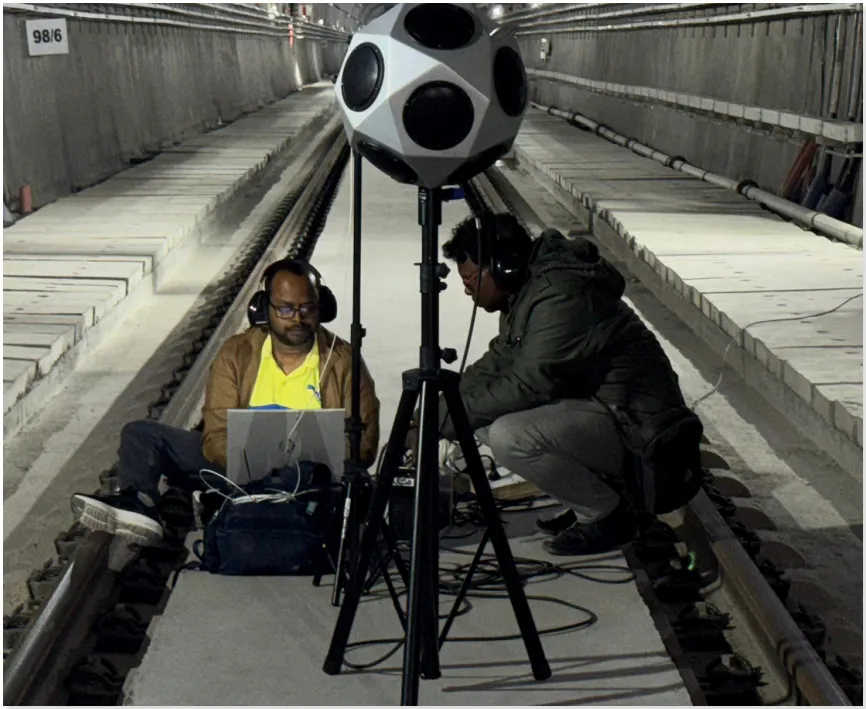
Acoustic Camera Mapping
At Packsound, we offer state-of-the-art Acoustic Camera Mapping Services to detect, visualize, and analyse sound sources in real-time using advanced beam forming and microphone array technology.
Our portable, high-resolution acoustic imaging system overlays a color-coded sound intensity map onto real world visuals helping clients locate noise hotspots, identify leaks, and optimize acoustic performance in environments ranging from factories and testing labs to auditoriums and construction sites.
| Parameter | Specifications |
|---|---|
| Microphone Array | 24 to 128 MEMS or condenser microphones (circular, spiral, or customized array configuration) |
| Frequency Range | 30 Hz – 20,000 Hz (broadband) |
| Dynamic Range | > 60 dB |
| Sound Pressure Level | Detectable from 30 dB(A) to 130 dB(A) depending on environment |
| Spatial Resolution | 1–10 cm at 1 meter distance (varies with array size and algorithm) |
| Image Overlay | Real-time heatmap (dB scale) over high-res camera feed |
| Mapping Output | dB(A), 1/3 Octave, FFT, Spectrogram, Tonal Detection |
| Frame Rate (Visual) | Up to 25–30 fps with live acoustic overlay |
| Detection Range | 0.5 m to 50 m (optimized for short to mid-range precision diagnostics) |
| Beamforming Algorithms | Time Delay, Adaptive Beamforming, CLEAN-SC, MUSIC (based on software used) |
| Operating Environment | Indoor / Outdoor (weather-resistant options available) |
| Power Supply | Battery or AC-powered; portable system with 2–6 hour operational time |
| Data Export | Heatmap video, stills, .wav audio logs, .csv spectral data |
| Mounting Options | Tripod, hand-held, wall-mounted, drone-compatible (optional) |
| Software Features | Live view, frequency filtering, source isolation, automatic peak finder |
| Compliance Standards | ISO 3382 (room acoustics), ISO 3745 / 3744 (sound source level), EN 61672, IEC 60268-16 |
Why Choose PackSound for Acoustic Camera Mapping?
PackSound’s Acoustic Camera Mapping services provide precise, high-resolution visualization of sound sources, helping you identify and analyze noise and vibration in any environment. Using advanced microphone arrays with 24 to 128 MEMS or condenser microphones, we capture acoustic data across 30 Hz to 20 kHz, enabling detailed spatial and spectral analysis of sound.
Our systems generate real-time heatmaps, FFT, 1/3 octave, spectrograms, and tonal detection overlays on high-resolution video, giving engineers, consultants, and facility managers an intuitive visual understanding of sound behavior. With support for multiple beamforming algorithms like Time Delay, CLEAN-SC, MUSIC, and Adaptive Beamforming, we ensure accurate pinpointing of sources from 0.5 m to 50 m depending on the environment.
Whether you’re assessing industrial machinery, HVAC systems, building acoustics, or outdoor noise, our portable, battery or AC-powered setups with tripod, wall, hand-held, or drone mounting options deliver flexibility and precision. Data exports in heatmap videos, stills, audio logs, and spectral CSVs allow for further analysis, reporting, and compliance documentation.
PackSound empowers you to visualize, analyze, and solve noise problems with actionable insights, enabling informed decisions for design, mitigation, R&D, or regulatory purposes. With Acoustic Camera Mapping, identifying and controlling sound becomes measurable, precise, and presentation-ready.
We work closely with you to customize EchoStop™ panels that perfectly fit your space’s acoustic needs and design preferences, ensuring optimal sound control and a seamless aesthetic.
Our team provides professional acoustic consultation and detailed design planning to integrate panels effectively, maximizing both performance and visual appeal.

Certified installers ensure your acoustic panels are fitted precisely and securely, delivering flawless results that enhance sound quality and durability.
EchoStop™ panels require minimal upkeep. With simple cleaning and periodic checks, your acoustic solution will maintain its performance and appearance for years to come.