
table of contents
- 1-Person Focus Pods (Phone Booths)
- 2–4 Person Meeting Pods
- 4–6 Person Collaboration Pods
- Lounge / Soft-Seating Pods
- Acoustic Performance (Most Important)
- Ventilation System
- Lighting
- Power and Connectivity
- Modularity and Relocatability
- Materials and Sustainability
- Co-Working Spaces
- Corporate Offices (50–500+ employees)
- Startups and Scale-ups
- Educational Institutions
- Healthcare Facilities
- Related Reading
At a glance: Meeting pods are self-contained, soundproofed enclosures that sit inside an open-plan office — giving teams a private space for calls, video conferences, and focused collaboration without building permanent rooms. This guide covers everything: how they work, the types available in India, what to look for acoustically, and how to decide how many your office actually needs.
Picture this: it’s Tuesday, your busiest in-office day. Every desk is occupied. The sales team is on calls. Someone two rows over is presenting to a client on a screen. You have a sensitive HR conversation in 20 minutes, and the only available meeting room is booked solid until 4 PM.
This is the hybrid work paradox — offices are simultaneously emptier on average and more chaotic when people do show up. And it’s exactly the environment that has made meeting pods one of the fastest-growing categories in workplace design globally.
At PackSound, we design and manufacture the ThinkPod™ range of acoustic office pods for workplaces across India — from early-stage startups to large corporate campuses. We’ve seen firsthand what a well-specified pod does to a workplace, and what a poorly specified one doesn’t. This guide distils everything we know.
What Is a Meeting Pod?
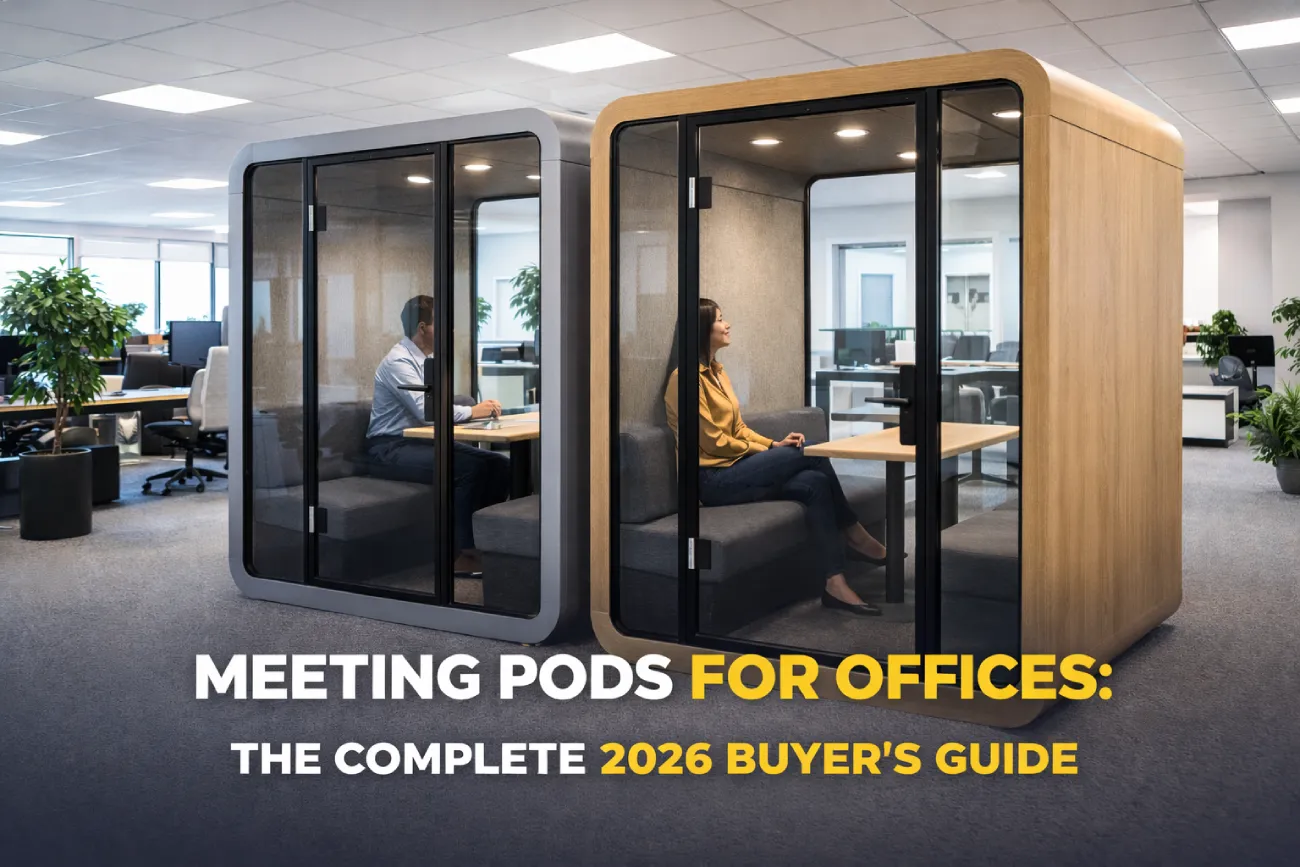
A meeting pod (also called an office pod, acoustic booth, or privacy pod) is a freestanding, pre-fabricated enclosure placed within an open-plan office. It functions like a mini-meeting room — but without any construction, permits, or permanent commitment.
Inside, the walls, ceiling, and floor are lined with sound-absorbing materials. A double-glazed door seals the acoustic environment. Built-in ventilation keeps the air fresh. Integrated lighting and power outlets make the space work-ready from day one.
The result: a quiet, private, acoustically controlled space that employees can step into for a call, a confidential conversation, a focused work block, or a small team discussion — and step out of just as easily.
Why now? The global meeting pods market was valued at approximately USD 2.89 billion in 2025 and is projected to reach USD 21.6 billion by 2035 — a CAGR of over 22%. The driver is straightforward: hybrid work has made open offices louder and more unpredictable at exactly the same time that employees’ tolerance for noise and lack of privacy has reached its limit.
Why Open Offices Need Meeting Pods in 2026
The open-plan office has been the dominant workplace format in India for over a decade. The logic was sound: lower cost per square foot, easier collaboration, more natural light, a visible culture of activity. But acoustic design was almost always an afterthought.
Here’s what that has cost:
- 70% of employees in open offices cite noise as their biggest workplace distraction
- Workers in noisy environments lose an average of 86 minutes of productive time every day to interruptions and the effort required to refocus afterward
- Hybrid work has intensified the problem — on peak attendance days, demand for meeting space far exceeds supply, while quiet days leave expensive rooms empty
The traditional fix — building more meeting rooms — doesn’t scale. A traditional meeting room build-out costs upward of ₹8–15 lakh per room when you factor in structural modifications, electrical, HVAC, and finishes. It takes weeks to months to complete. And once built, it’s permanent — unable to move when your team grows, downsizes, or reorganises.
Meeting pods solve all three problems simultaneously.
How Do Meeting Pods Work Acoustically?
A quality acoustic meeting pod achieves sound reduction through layered engineering — not just “foam on the inside.”
The key components:
1. Multi-layer wall construction The best pods use three or more layers of different-density materials (typically acoustic felt, mineral wool or foam, and a rigid panel). Each layer targets a different frequency range. The layering prevents resonance — a single-material wall vibrates at its natural frequency and actually amplifies certain sounds.
2. Double-glazed acoustic glass Standard single-pane glass transmits sound efficiently. Double-glazed panels with a gap between the panes break the sound path. Premium pods use laminated acoustic glass for further attenuation.
3. Acoustic door seals The weakest point of any soundproofed enclosure is its door. Quality meeting pods use compression seals around the door frame — the same principle as a recording studio door — to eliminate the gaps where most sound leakage occurs.
4. Decoupled floor and ceiling Sound travels through structure as well as air. Pods with vibration-damped floor mounts and ceiling panels prevent low-frequency sound from transmitting through the building slab and back into the room.
What does this achieve? Top-tier meeting pods achieve 30–35 dB of sound reduction — the equivalent of moving from a busy open-plan office to a quiet library. Conversations inside a properly specified pod are inaudible to people sitting two metres away outside it.
Look for pods tested to ISO 23351-1:2020 — the international standard for measuring speech privacy in acoustic enclosures. This gives you a verified, comparable performance figure rather than a manufacturer’s claim.
Types of Meeting Pods
1-Person Focus Pods (Phone Booths)
The smallest category — typically 0.8–1.2 m² footprint. Designed for a single person to make calls, join video conferences, or work with deep focus without disturbing colleagues. Usually standing-height or with a single fixed stool.
Acoustic target: 28–32 dB reduction
Best for: Open-plan offices, co-working spaces, sales floors, contact centres
PackSound ThinkPod Solo: Our single-person pod with silent ventilation (refreshes air every 3 minutes), motion-activated LED lighting, and dual power outlets
2–4 Person Meeting Pods
The most versatile category, and the most in-demand. A 2–4 person meeting pod provides enough space for a proper team discussion — with seating, a work surface, screen connectivity, and acoustic privacy for the whole group.
Acoustic target: 30–35 dB reduction
Best for: Client calls, interview rooms, quick team check-ins, mentoring conversations, sensitive HR or finance discussions
PackSound ThinkPod Duo/Quad: Available with integrated monitor mounts, wireless charging, and whiteboard panels
4–6 Person Collaboration Pods
Larger enclosed spaces that function as small conference rooms — but modular and relocatable. These typically include a meeting table, multiple seating positions, a mounted display for hybrid calls, and enhanced ventilation to support longer sessions.
Acoustic target: 30–35 dB reduction
Best for: Team stand-ups, project reviews, client presentations, workshops
Best in: Organisations with 50+ employees and frequent need for spontaneous group sessions
Lounge / Soft-Seating Pods
Semi-enclosed acoustic structures — not fully sealed like a phone booth, but enough to reduce ambient noise by 10–18 dB. These use high-backed acoustic seating panels and overhead canopies to create a quieter “zone” within the open plan for informal catch-ups.
Acoustic target: 10–18 dB attenuation
Best for: Informal meetings, one-to-one feedback, creative brainstorming
Not ideal for: Confidential conversations or video calls — they don’t provide full speech privacy
Key Features to Look for in a Meeting Pod
Not all pods are equal. Here’s what genuinely separates a high-quality office meeting pod from a good-looking box:
Acoustic Performance (Most Important)
Request ISO 23351-1 test data. A speech transmission index (STI) of ≤ 0.20 inside the pod is the benchmark for acoustic privacy. Don’t accept “up to X dB” marketing claims without independent certification.
Ventilation System
This is the most common complaint about lower-quality pods: they become stuffy within minutes. A properly engineered meeting pod refreshes the full air volume every 2–3 minutes using silent, low-vibration fans with muffled air inlets and outlets that don’t compromise acoustic performance.
Lighting
Adjustable colour temperature (3,000K–6,500K range) and brightness matters more than people expect. Video calls need bright, neutral light. Focused writing or reading is more comfortable at warmer lower-intensity settings. Sensor-controlled or dimmer-integrated lighting is worth specifying.
Power and Connectivity
At minimum: 2x standard sockets, 1x USB-A, 1x USB-C. Premium pods add wireless charging surfaces and integrated cable management. Confirm that the electrical installation is certified — this is especially important for commercial fit-outs subject to safety inspections.
Modularity and Relocatability
Your office layout will change. A pod that cannot be disassembled and moved is a liability within 3–5 years. Ask specifically about disassembly time, whether it requires specialist tools, and whether the components can be reused or reconfigured.
Materials and Sustainability
For offices targeting LEED, GRIHA, or IGBC certification, the materials in your pods contribute to credit categories including Indoor Environmental Quality and Materials. Pods made with low-VOC finishes, sustainably sourced panels, and recyclable components align with green building requirements and protect indoor air quality.
Our ThinkPod™ range is manufactured using eco-responsible materials — consistent with the broader PackSound commitment to sustainable acoustic solutions.
Meeting Pods vs. Traditional Meeting Rooms: The Real Comparison
This is the question every facilities manager asks. Here’s an objective breakdown:
| Factor | Meeting Pod | Traditional Meeting Room |
|---|---|---|
| Upfront cost | ₹1.5L–5L per pod (size dependent) | ₹8L–20L+ per room (construction + fit-out) |
| Installation time | Hours to 2 days | Weeks to months |
| Permanence | Fully relocatable | Permanent structural modification |
| Permits required | No | Often yes (structural, electrical, fire) |
| Acoustic performance | 28–35 dB reduction | Depends entirely on build quality |
| Flexibility | Reconfigurable, scalable | Fixed size and location |
| Downtime during install | Zero | Significant disruption |
| Tax treatment in India | FF&E — depreciable asset | Capital expenditure |
| Green credentials | Eco-materials available | Depends on contractor |
The financial case is compelling. A pod serving 2–4 people costs 55–70% less than an equivalent built meeting room — with faster deployment, full mobility, and no structural commitment. For growing companies and hybrid workplaces where headcount fluctuates, that flexibility has real value beyond the initial purchase price.
How Many Meeting Pods Does Your Office Need?
A question we get asked constantly — and one where most organisations either underbuy (and create waiting lists) or overbuy (and leave pods idle).
A practical planning framework:
Step 1: Establish your peak attendance figure How many people are in your office on your busiest day? This is your planning number — not your total headcount.
Step 2: Estimate call and meeting demand For knowledge workers, 30–40% of working time typically involves calls or meetings that benefit from a private space. On a peak day of 50 people, that suggests 15–20 people need acoustic privacy at any one time.
Step 3: Apply a utilisation ratio Unlike meeting rooms (which are typically booked in blocks), pods have faster turnover — average session length is 15–30 minutes for calls, 30–60 minutes for small meetings. A single pod can serve 6–10 sessions per day.
Step 4: Use this planning ratio as a starting point
| Office type | Suggested ratio |
|---|---|
| General knowledge work | 1 pod per 8–10 employees (peak attendance) |
| Sales / customer success / legal | 1 pod per 5–6 employees |
| Creative / tech (deep focus need) | 1 pod per 6–8 employees |
| Co-working space | 1 pod per 10–12 members |
Start conservative, track utilisation for 4–6 weeks, and scale from there. A modular pod system like our ThinkPod™ range makes scaling a procurement decision — not a construction project.
Where to Place Meeting Pods in Your Office
Placement matters as much as specification. A few principles from projects we’ve delivered:
Near, not far Place pods adjacent to the teams that will use them most. Every additional 15 metres of walking distance to a pod reduces its utilisation significantly.
Avoid HVAC vents Background HVAC noise from nearby ceiling vents or fan coil units raises the ambient noise floor just outside the pod — reducing the perceived privacy for occupants.
Natural light access where possible Enclosed pods can feel isolating without any visual connection to the exterior. Where floor plan allows, position pods near windows so occupants have a sightline to natural light.
Wayfinding visibility Employees need to see at a glance whether a pod is occupied. Pods with occupancy indicator lights (red/green LED) dramatically reduce “wasted trips” across the floor.
Power access Confirm that the pod location has access to the electrical infrastructure it needs. Most pods require a standard 15A circuit; larger pods may require a dedicated 20A supply.
Meeting Pods for Different Office Types
Co-Working Spaces
Pods are one of the highest-value amenities in a co-working environment — members cite private call space as a primary reason for choosing or leaving a space. A mix of 1-person and 2–4 person pods covers both solo call demand and small team needs.
Corporate Offices (50–500+ employees)
For large offices returning to hybrid work patterns, pods supplement (rather than replace) formal meeting rooms. They absorb the demand for quick, spontaneous sessions that don’t warrant booking a full conference room.
Startups and Scale-ups
Fast-growing companies benefit enormously from pods’ relocatability. As headcount grows and layouts change, pods adapt. They’re also depreciable as FF&E — a meaningful accounting advantage over capital construction.
Educational Institutions
Meeting pods in staff rooms, admin areas, and libraries give faculty and administrators a private space for parent meetings, student welfare conversations, or focused preparation — without the expense of building dedicated consultation rooms.
Healthcare Facilities
Acoustic privacy in clinical settings isn’t optional — it’s a regulatory and ethical requirement. Pods deployed in outpatient areas, admin offices, and staff zones support confidential conversations without permanent construction.
The PackSound ThinkPod™: Built for India
Most meeting pods in the Indian market are imported — designed for European climates and spec’d for European building standards. Our ThinkPod™ range is engineered specifically for Indian conditions:
- Ventilation designed for Indian ambient temperatures — enhanced airflow capacity for warm climates without sacrificing acoustic performance
- Electrical spec to Indian standards — IS-certified wiring, 5/15A sockets, and compatible with standard Indian office electrical infrastructure
- Materials specified for humidity tolerance — relevant in coastal and high-humidity climates like Mumbai, Chennai, and Kochi
- GRIHA and IGBC material compliance — panels and finishes support green building certification where required
- Pan-India delivery and installation support — including metros and Tier 2 cities
→ Explore the full ThinkPod™ range
→ Request a sample visit or demo
Frequently Asked Questions
What is the difference between a meeting pod and a phone booth?
A phone booth (or focus pod) is typically 1-person capacity — designed for solo calls and focused work. A meeting pod accommodates 2–6 people and is configured for group conversations, with a work surface, multiple seating positions, and often a display screen. Both provide full acoustic privacy, but serve different use cases.
How much do meeting pods cost in India?
Pricing depends on size and specification. Single-person pods typically start from ₹1.2–2L. A 2–4 person acoustic meeting pod generally ranges from ₹2.5–5L. Larger 4–6 person models can reach ₹5–10L+. Imported premium brands (Framery, ROOM, Bureau) range significantly higher. Our ThinkPod™ range offers comparable acoustic performance at India-appropriate pricing — contact us for a project quote.
Are meeting pods worth it compared to building a meeting room?
For most hybrid offices, yes. A meeting pod costs 55–70% less than a traditional meeting room build-out, installs in hours not months, requires no permits, and can be relocated as your office evolves. The ROI case is especially strong for growing companies and any organisation that has changed office layout in the last five years.
How loud is the ventilation in a meeting pod?
In quality pods, ventilation noise should be below 35 dB(A) at occupant ear level — quieter than a library. Cheaper pods use commodity fans that are both louder and less effective at air exchange. Always ask for ventilation noise specifications (in dB(A)) alongside acoustic reduction specs.
Can meeting pods be customised for branding?
Yes. Frame colours, upholstery materials, glass tints, and even external graphic panels can all be customised for brand alignment. Our ThinkPod™ range supports custom colour specification across all standard models — speak to our design team for options.
Do meeting pods require planning permission in India?
No. Meeting pods are classed as furniture (FF&E), not built structures. They do not require planning permission or building approvals. This classification also means they are depreciable assets rather than capital expenditure — with implications for how they’re accounted for.
How do I maintain a meeting pod?
Routine maintenance is minimal. Interior acoustic panels should be vacuumed periodically. Glass panels can be wiped with standard glass cleaner. Ventilation filters (where fitted) typically need replacement every 6–12 months. We provide a full maintenance guide with every ThinkPod™ installation.
Ready to Add Meeting Pods to Your Office?
If you’re designing a new office fit-out, retrofitting an existing open plan, or simply trying to solve a noise and privacy problem that’s been bothering your team for years — meeting pods are almost certainly part of the answer.
The next step is a conversation. Tell us about your office: size, headcount, how hybrid your team is, and what problems you’re trying to solve. We’ll come back with a pod configuration recommendation, acoustic specification, and an honest estimate of how many pods your space actually needs.
Book a free workspace acoustic review →
Or explore the product range first:
Browse the ThinkPod™ meeting pod collection →
Published by the PackSound Acoustic Team — PackSound.co.in
PackSound designs and manufactures eco-friendly acoustic solutions and office pods for workplaces, educational institutions, and commercial spaces across India.