
table of contents
Most rooms in India were not designed with acoustics in mind. Concrete walls, tiled floors, glass partitions, and bare ceilings are everywhere, from corporate offices in Gurugram to apartment home theatres in Chennai, and they all share one characteristic: they are acoustically hostile. Sound bounces off every hard surface, builds up into a wash of reverberation, and makes every conversation, meeting, recording, or presentation harder than it needs to be.
Acoustic wall panels are the most direct and practical solution to this problem. Installed on walls, they absorb reflected sound energy before it has a chance to accumulate, bringing reverberation under control and transforming how a space sounds and feels. The difference between a bare room and a properly treated one is not subtle — it is immediate and obvious to anyone who walks in.
What is less obvious is which panels to choose, where to put them, how many you need, and what you should expect to pay. The market in India has expanded considerably over the last few years, and the range of products available now is genuinely wide. This guide cuts through the confusion and gives you a clear picture of everything you need to know to make the right choice for your project.
What Are Acoustic Wall Panels and How Do They Work?
Acoustic wall panels are surface-mounted or recessed panels made from porous or fibrous materials that absorb sound energy rather than reflecting it back into the room. When a sound wave strikes a hard wall, most of its energy bounces back and continues to travel around the room, colliding with other waves and creating the echo, reverb, and general loudness that makes untreated spaces uncomfortable. When that same wave strikes an acoustic wall panel, it enters the open porous structure of the absorptive core, where friction between the air molecules and the fibres converts the sound energy into a negligible amount of heat. The wave is absorbed rather than reflected, and the room becomes quieter, clearer, and easier to communicate in.
The measure of how effectively a panel does this is the Noise Reduction Coefficient, or NRC. This is a number between 0 and 1 that represents the fraction of incident sound energy the panel absorbs. An NRC of 0.90 means the panel absorbs 90 percent of the sound energy that strikes it. High-quality acoustic wall panels from reputable manufacturers achieve NRC ratings between 0.80 and 1.05, making them among the most effective tools available for controlling room acoustics.
One thing worth being clear about from the start: acoustic wall panels are not soundproofing. They improve the acoustic quality inside the room where they are installed by reducing reflections and reverberation. They do not prevent sound from passing through the wall to an adjacent room. That is a different problem, called sound isolation, and it requires different products and construction approaches. Most practical acoustic projects involve both, but they are distinct objectives and it pays to be clear about which one you are primarily trying to achieve.
Why Acoustic Wall Panels Matter More Than Ever in India
The way India works, studies, and entertains itself has changed dramatically. Open-plan offices are now the default for technology companies, startups, and financial services firms across every major city. Home recording and podcasting have grown from niche pursuits to mainstream activities. Premium residential projects routinely include dedicated home theatre rooms. Educational institutions are being held to higher standards of acoustic performance as research into the link between classroom noise and learning outcomes becomes more widely understood.
In all of these environments, sound control is no longer a luxury or an afterthought. It is a functional requirement that affects how well the space performs its intended purpose. A boardroom where presentations echo and colleagues struggle to hear each other clearly is a poorly designed boardroom regardless of how expensive the furniture is. A home studio where vocals pick up room reflections sounds amateur regardless of how good the microphone is. A classroom where children at the back cannot follow the teacher wastes the entire purpose of the space.
Acoustic wall panels address these problems directly and cost-effectively. They are available in a range of materials, finishes, and price points that suit everything from a budget home studio to a flagship corporate headquarters. And because they are surface treatments rather than structural changes, they can be added to existing spaces without construction work or significant disruption.
Types of Acoustic Wall Panels: Understanding Your Options
The Indian market now offers a genuinely diverse range of acoustic wall panel types. Understanding what each type is made from, how it performs, and where it is best suited helps you choose the right product rather than simply the most heavily marketed one.
Fabric Wrapped Acoustic Panels
Fabric wrapped acoustic panels are the professional standard for commercial, institutional, and serious residential applications. A rigid core of high-density mineral wool, fiberglass, or polyester fibre is enclosed in a timber frame and wrapped tightly with acoustically transparent fabric. The fabric allows sound waves to pass freely into the absorptive core while presenting a clean, tailored surface that suits the visual standards of corporate offices, boardrooms, studios, and premium hospitality interiors.
The performance credentials of fabric wrapped panels are strong. High-quality versions achieve NRC ratings between 0.85 and 1.0. They carry good fire ratings because the mineral wool or fiberglass core is inherently non-combustible. They are dimensionally stable, resistant to sagging, and do not degrade in Indian humidity conditions the way foam panels do. With hundreds of fabric colours, textures, and weaves to choose from, they also give designers genuine creative latitude.
PackSound’s fabric wrapped acoustic panels are manufactured with high-density mineral fibre cores and are available in a wide range of fabric finishes to suit diverse interior styles. Ecotone Acoustic Limited’s fabric acoustic panels complement this range for commercial and institutional projects requiring custom sizing, specific NRC targets, or fire certification documentation.
Grooved Wooden Acoustic Panels
Grooved wooden acoustic panels, also called wood slat panels or slatted wall panels, consist of a series of parallel wooden slats or grooves over an absorptive backing of mineral wool or acoustic foam. Sound enters the channels between the slats and is absorbed by the backing material, while the wooden face provides the warmth, texture, and visual character of natural timber.
These panels have become extremely popular in India over the past few years, particularly in premium residential interiors, restaurants, hotel lobbies, and creative office environments. The combination of acoustic performance and visual warmth fills a gap that neither foam panels nor plain fabric wrapped panels can address: spaces where the panel itself needs to be a design feature rather than a functional background element.
PackSound’s grooved wooden slat panels are engineered for consistent groove geometry and stable performance across varying humidity conditions. Ecotone’s grooved wooden acoustic panels are specified extensively in hospitality, commercial, and institutional projects where a premium wood finish is required alongside tested acoustic performance.
Perforated Wooden Acoustic Panels
Perforated wooden acoustic panels use a drilled or CNC-cut pattern of holes in an engineered wood face panel, backed by an absorptive mineral wool or fibre layer. Sound passes through the perforations into the backing and is absorbed, while the solid wood face provides a more uniform and formal appearance than grooved panels. The size, density, and pattern of the perforations affect both the acoustic performance and the visual character of the finished panel.
These panels suit formal commercial environments — boardrooms, reception areas, auditorium walls, and educational corridors — where a clean, architectural surface finish is required without sacrificing acoustic performance. PackSound’s perforated panels and Ecotone’s perforated wooden acoustic panels both offer a range of perforation patterns and wood species to suit different specification requirements.
Micro Perforated Panels
Micro perforated panels take the perforated panel concept further, using an engineered facing material with thousands of perforations so small they are barely visible to the naked eye. The acoustic absorption mechanism in micro perforated panels is fundamentally different from fibre-based products: viscous losses as air moves through the narrow channels dissipate sound energy without any fibrous core at all. This makes them suitable for environments where hygiene is critical, where a hard wipe-clean surface is required, or where exposed fibres of any kind are not acceptable.
PackSound’s micro perforated panels and Ecotone’s micro perforated panels address this specific requirement, with options in metal and engineered wood facing materials for different environment types.
Composite Acoustic Panels
Composite acoustic panels layer different materials to achieve acoustic performance that no single material can match alone. A typical construction combines a dense mass-loaded facing with a fibrous absorptive layer, providing both sound absorption within the room and meaningful resistance to sound transmission through the panel itself. This dual performance makes composite panels the right choice for machine enclosures, industrial partitions, and any application where the panel must serve as both a room treatment and a sound barrier simultaneously.
PackSound’s composite panels and Ecotone’s composite acoustic panels are engineered for exactly these demanding environments.
CNC PET Acoustic Panels
PET acoustic panels made from recycled polyester fibre are increasingly specified where sustainability credentials matter alongside acoustic performance. They absorb well, resist moisture, carry good fire ratings, and can withstand the physical knocks that come with use in educational or public-access environments. PackSound’s CNC PET panels add a further dimension: precision CNC-cut decorative patterns that give the panel visual character while maintaining or enhancing its absorptive performance. For architects and interior designers who want an acoustic solution that is also a design element, these panels offer a compelling combination.
Fiberglass and Mineral Fibre Acoustic Wall Panels
Fiberglass acoustic panels and mineral fibre panels are the workhorse specification for commercial and institutional applications where consistent high NRC performance is required across large areas. They achieve strong absorption at modest thicknesses, carry excellent fire ratings, and are dimensionally stable across the temperature and humidity cycles that characterise Indian buildings. Ecotone’s fiberglass and mineral fibre acoustic wall panels are widely specified for offices, healthcare facilities, educational buildings, and government projects.
Wooden Fibre Acoustic Panels
Wooden fibre panels are made from wood particles or fibres bonded into a rigid board, typically with cement or a mineral binder. The resulting material is dense, durable, moisture-resistant, and surprisingly effective acoustically despite its apparent hardness. These panels suit industrial buildings, basements, car parks, and other environments where mechanical robustness is a priority and a conventional fabric or foam finish would not survive. Ecotone’s wooden fiber acoustic panels are specified for exactly these conditions.
Where Acoustic Wall Panels Are Used: Applications Across India
Recording Studios and Home Recording Rooms
Recording studios depend on controlled acoustics more than almost any other space type. Untreated rooms with hard parallel walls create flutter echo, comb filtering, and bass buildup that make recordings sound unprofessional regardless of the equipment used. Fabric wrapped panels at first-reflection points on side walls and the rear wall, combined with corner bass traps using thick mineral wool panels, address the mid and high-frequency reflections that cause the most damage to recorded sound. Thicker panels at 75 mm to 100 mm extend absorption into the lower frequencies that affect vocal clarity and instrument separation.
For home recording rooms where budget is a consideration, PackSound’s fabric wrapped panels offer professional-grade NRC performance at a price point that suits residential projects.
Corporate Offices and Meeting Rooms
Open-plan offices across India suffer from the same fundamental acoustic problem: hard surfaces, high ceilings, and constant background conversation create a noise environment that reduces productivity measurably. Speech intelligibility in meeting rooms suffers when reverberation times exceed 0.5 seconds, which is common in glass-and-concrete office fit-outs.
Acoustic wall panels on meeting room walls, supplemented by ceiling treatment with acoustic baffles or acoustic clouds, reduce reverberation to comfortable levels and improve speech privacy. For open-plan areas, acoustic screens and acoustic divider partitions from PackSound’s AcoFascia range add targeted treatment at desk level where it matters most for individual workers.
For teams that need a private space for calls, recordings, or focused work within an open-plan layout, PackSound’s ThinkPod office pods offer self-contained acoustic environments that require no construction and can be repositioned as needs change.
Auditoriums, Multiplex Cinemas, and Performance Spaces
Auditorium acoustics requires a careful balance of absorption, reflection, and diffusion across a large three-dimensional space. Too much absorption and the room feels dead; too little and speech and music blur into unintelligibility. Wall panels in auditoriums are typically specified as part of a complete acoustic design that also includes ceiling reflectors, diffusers, and upholstered seating.
Ecotone Acoustic Limited provides auditorium acoustic treatment services that combine product supply with acoustic design support, ensuring that panel types, positions, and quantities are optimised for the specific acoustic requirements of the space.
Schools, Colleges, and Educational Institutions
Classroom acoustics directly affects learning outcomes. Research consistently shows that reverberation times above 0.6 seconds in classrooms reduce speech intelligibility enough to disadvantage students, particularly those with hearing difficulties, language differences, or attention challenges. Yet most Indian classrooms have reverberation times well above this threshold because they are built entirely from hard materials.
Acoustic wall panels at the rear and side walls of classrooms, combined with acoustic ceiling tiles in grid systems, bring reverberation within specification cost-effectively. The panels do not interfere with display areas, whiteboards, or interactive screens, and they can be specified in colours that complement existing interior finishes.
Healthcare Facilities and Hospitals
Acoustic privacy between consulting rooms and treatment areas is a patient confidentiality requirement in healthcare settings. Reverberation in ward corridors and waiting areas creates stress for patients and makes communication between staff and patients more difficult. Acoustic wall panels in healthcare environments need to be moisture-resistant, easy to clean, and free of exposed fibres. Fabric wrapped panels with appropriate fabric specifications, or micro perforated panels with solid facing materials, meet these requirements while delivering meaningful acoustic improvements.
Hospitality: Restaurants, Hotels, and Event Spaces
A restaurant that is too loud to have a comfortable conversation is a restaurant people do not return to, regardless of the food. Hotels where noise bleeds between guest rooms or from the lobby into sleeping areas generate negative reviews that directly affect booking rates. Event spaces that echo reduce the perceived quality of every event held within them.
Acoustic wall panels in hospitality environments need to perform acoustically while contributing to the interior design. PackSound’s Auraluxe range of decorative acoustic panels — including 3D wall panels, acoustic blades, and printed wall panels — is designed specifically for premium commercial and hospitality interiors where visual impact and acoustic performance are both non-negotiable.
Industrial and Manufacturing Facilities
In factories and warehouses, acoustic wall panels are not about aesthetics. They are about reducing the reverberant noise level throughout the space to lower worker noise exposure, improve communication, and support compliance with CPCB noise standards. Robust mineral wool panels or wooden fibre panels on upper walls, supplemented by acoustic hanging baffles and acoustic clouds on industrial ceilings, are the standard treatment approach for these environments.
How to Choose the Right Acoustic Wall Panel
The right panel for your project depends on five practical factors. Work through each one and the choice becomes much more straightforward.
What problem are you solving? If the primary issue is echo and reverberation within the room, any of the absorptive panel types will help. If you also need to reduce sound transmission between rooms, composite panels or dense partition constructions are required in addition to surface treatment.
What is the target frequency range? For speech intelligibility in offices and classrooms, 50 mm panels absorb the dominant mid-frequencies effectively. For recording studios, home theatres, or music rooms where bass control matters, 75 mm to 100 mm panels are needed for the lower frequencies that thin panels miss entirely. Corner placement with thick panels provides the best low-frequency absorption.
What are the environmental requirements? High-humidity environments need panels with moisture-resistant cores and facings. Food processing, pharmaceutical, and healthcare environments require wipe-clean surfaces. Buildings with fire safety requirements need panels with documented fire ratings. Industrial environments need physical robustness. Check that the panel you are specifying meets the demands of the specific environment, not just the acoustic ones.
What surface finish is required? In a professional studio or simple office, a plain fabric wrapped panel is perfectly appropriate. In a restaurant, hotel lobby, or premium office reception, the panel needs to look as good as it performs. Grooved wooden slat panels, 3D Auraluxe panels, and printed panels from PackSound give designers and architects genuinely beautiful options that do not compromise on NRC.
What is your budget and expected service life? The cost-per-year calculation always favours premium panels over cheap foam alternatives when the full service life is considered. A well-made fabric wrapped or wooden panel that lasts 20 to 25 years and performs consistently throughout is better value than foam that degrades in five years and performs poorly even when new. That said, a range of products at different price points exists, and the right choice is the one that meets the acoustic and aesthetic requirements for your budget over a realistic time horizon.
How Many Acoustic Wall Panels Do You Need?
This is the question most buyers struggle with, and the honest answer is that it depends on the room’s dimensions, its existing surface materials, and the target reverberation time. However, some practical rules of thumb give a useful starting point.
For general office, meeting room, or classroom treatment, covering 20 to 30 percent of the total wall and ceiling surface area with absorptive panels will produce a clear improvement in most rooms. For rooms with predominantly hard surfaces — glass, concrete, or stone — 30 to 40 percent coverage is often needed to bring reverberation within comfortable limits.
For recording studios and critical listening rooms, coverage typically needs to be higher, and the acoustic design needs to be more deliberate about placement to achieve even absorption across the frequency range. A simplified Sabine calculation using the room’s volume, surface areas, and the NRC values of the panels being specified can give a reasonable estimate of the reverberation time that different coverage levels will achieve.
For larger or more complex projects, Ecotone’s acoustic design and consultancy service can carry out a full acoustic model of the space and recommend panel types, quantities, and placement layouts before any products are purchased.
Acoustic Wall Panel Placement: Where to Put Them
Getting placement right matters as much as buying good panels. Here is how to think about it.
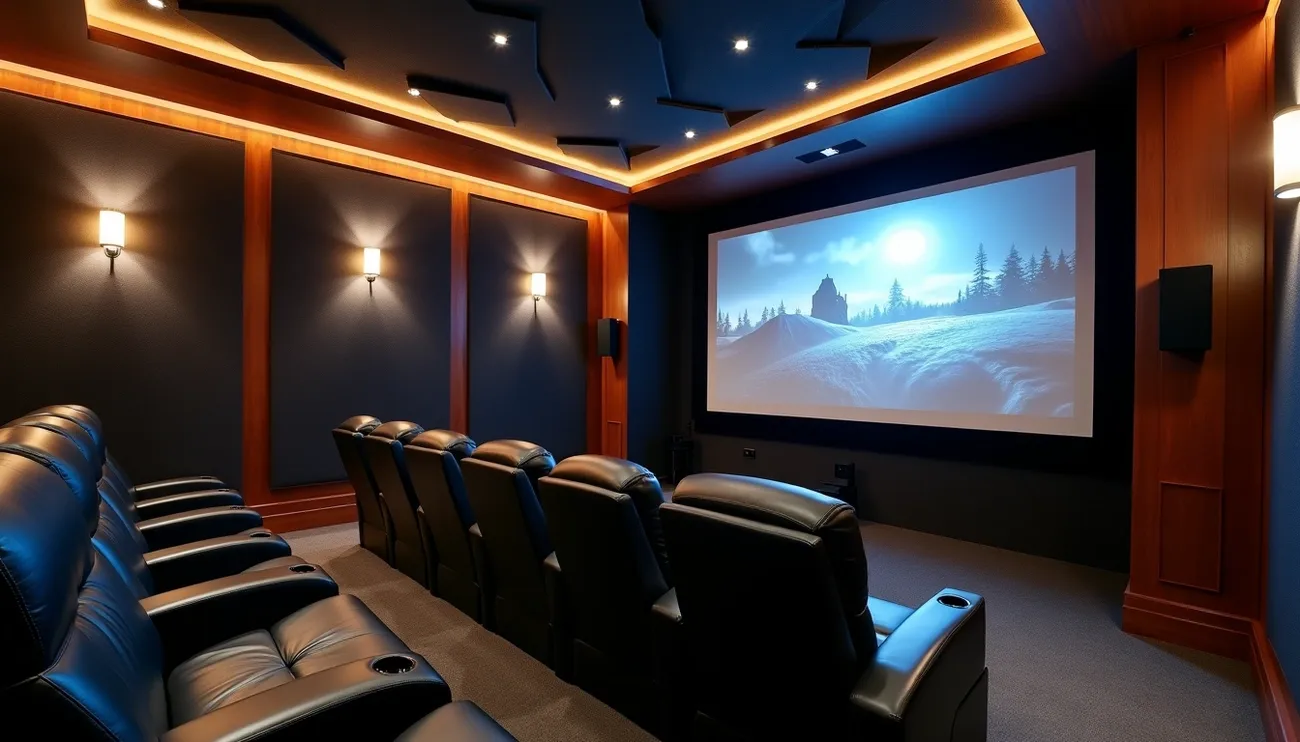
First-reflection points are the priority. These are the positions on walls and ceilings where sound from the primary source first bounces toward the listener. In a home theatre, that is the side walls at the midpoint between the screen and the main seating position, and the ceiling directly above the seating. In a boardroom, it is the walls parallel to the long axis of the table. Treating first-reflection points delivers the best acoustic return per panel installed.
Rear walls need treatment in most spaces. Sound that travels the full length of the room and reflects back from the rear wall arrives at the listener as a delayed echo that muddies the original sound. A broad rear wall treatment, using fabric wrapped panels or a combination of absorption and diffusion, addresses this effectively.
Corners are where bass energy concentrates. Low-frequency sound builds up at wall-wall and wall-ceiling-wall junctions. Thick panels — 75 mm or more — placed in corners act as bass traps and reduce the low-frequency buildup that makes rooms sound boomy and muddy.
Distribute panels evenly rather than clustering them. Sound energy is present throughout the room. Panels in one corner treat reflections from that direction. A balanced distribution across multiple walls produces more consistent improvement across the whole space than the same number of panels in a single location.
Mount panels with an air gap for better low-frequency performance. A panel mounted on a batten 50 mm off the wall behaves acoustically as though it were 100 mm thick at lower frequencies. This is an inexpensive way to improve low-frequency absorption without buying thicker panels.
Installation: How Acoustic Wall Panels Are Fixed
Z-Clip and Impaling Clip Systems
Z-clips are the professional standard for surface-mounted acoustic wall panels in commercial applications. Two interlocking metal clips — one fixed to the wall, one fixed to the panel back — allow panels to be hung, repositioned, or removed without tools and without damage to either the panel or the wall surface. This is important in rented commercial spaces or anywhere the acoustic layout may need to be adjusted over time.
Impaling clips are fixed to the wall and the panel is pressed onto the protruding pins. They are simpler and slightly less expensive than Z-clips, but panels fixed with impaling clips are less easily removed without damage. They suit permanent installations where repositioning is not anticipated.
Direct Adhesive Fixing
For smaller panels or situations where a very flat finish is needed, panels can be bonded directly to walls using appropriate construction adhesive. This is a permanent fixing that does not allow for adjustment, and it requires a flat, clean, painted wall surface for reliable adhesion. It is most commonly used in residential home studios and home theatre rooms where the layout is fixed from the start.
Suspended Panel Systems
Where structural walls are not available for direct fixing, or where panels are intended to float in front of a wall as a design feature, suspended systems using concealed wire rope or threaded rod provide a clean, architect-friendly installation. This approach is often used in combination with acoustic ceiling baffles and clouds for a fully integrated treatment scheme.
Acoustic Wall Panel Costs in India: What to Budget in 2026
Pricing for acoustic wall panels in India varies considerably across product types. Here is a realistic summary for 2026.
CNC PET and basic polyester fibre panels for straightforward applications are priced from around ₹300 to ₹600 per square foot. These offer reasonable NRC performance and good durability at an accessible price point for residential and budget commercial projects.
Fabric wrapped acoustic panels with mineral fibre or fiberglass cores are priced from approximately ₹700 to ₹2,500 per square foot for factory-finished products. Thickness, core density, fabric specification, and custom sizing all affect where within this range a particular panel lands. This is the most widely specified panel type for professional commercial, studio, and institutional applications.
Grooved wooden slat and perforated wooden panels sit at a comparable price point to mid-range fabric wrapped panels, with the premium reflecting the cost of the engineered wood facing and precise manufacturing tolerances. Pricing is typically ₹900 to ₹3,000 per square foot depending on wood species, finish, and panel dimensions.
Decorative 3D and premium designer panels from ranges like PackSound’s Auraluxe are priced at the upper end of the market, reflecting their combined acoustic and design function. These are specified where a panel is simultaneously a room treatment and an architectural feature.
Installation costs typically add ₹80 to ₹300 per square foot depending on ceiling height, fixing system, and project location. Professional installation ensures panels are level, evenly spaced, and fixed securely, and it avoids the acoustic performance loss that comes from panels that are not properly seated against their fixings.
Frequently Asked Questions About Acoustic Wall Panels
How are acoustic wall panels different from soundproofing panels?
Acoustic wall panels reduce reflections and reverberation within a room, improving its internal sound quality. Soundproofing reduces how much sound passes through the structure between rooms. The two problems require different solutions. If your issue is echo or a noisy, reverberant feel inside the room, acoustic wall panels address that directly. If noise from an adjacent space is the problem, you need isolation measures including mass, sealing, and structural decoupling. An acoustic consultant can help identify which problem is primary if you are not sure.
Can acoustic wall panels be used in humid environments like bathrooms or coastal cities?
Fabric wrapped and foam panels with standard fabric or foam facings are not suitable for genuinely wet areas. For high-humidity environments like coastal cities, marine environments, or food processing facilities, mineral fibre panels with moisture-resistant facings, micro perforated metal panels, or wooden fibre panels with sealed surfaces are the appropriate choice. Most of PackSound and Ecotone’s product range includes specifications suitable for high-humidity Indian conditions.
Do acoustic wall panels help with noise coming in from outside?
Only to a small extent. Surface-mounted acoustic wall panels primarily affect internal acoustics. For external noise, the transmission path is through the building envelope — walls, windows, and roof — and addressing that requires upgraded glazing, improved wall construction, or external noise barriers depending on the source and severity of the problem.
What NRC rating should I look for?
For general commercial applications where speech intelligibility is the goal, panels with NRC ratings of 0.70 and above will produce meaningful improvement. For recording studios, critical listening rooms, and high-specification boardrooms, panels with NRC 0.85 and above are appropriate. Always ask for tested NRC data when specifying panels for a commercial project, rather than relying on estimated or uncertified values.
How do I maintain acoustic wall panels?
Most fabric wrapped acoustic panels can be gently vacuumed using a soft brush attachment to remove dust. Surface soiling on fabric facings can usually be spot-cleaned with a damp cloth and mild detergent, but always check with the manufacturer before cleaning. Grooved wooden and perforated wooden panels can be dusted or lightly wiped like any other wood surface. Avoid saturating any panel with water during cleaning.
Call to Action
Ready to transform how your space sounds? Whether you need a single meeting room treated or a full commercial fit-out specified, our acoustic specialists work across India and are happy to help with product selection, quantity estimation, placement guidance, and full project support.