
table of contents
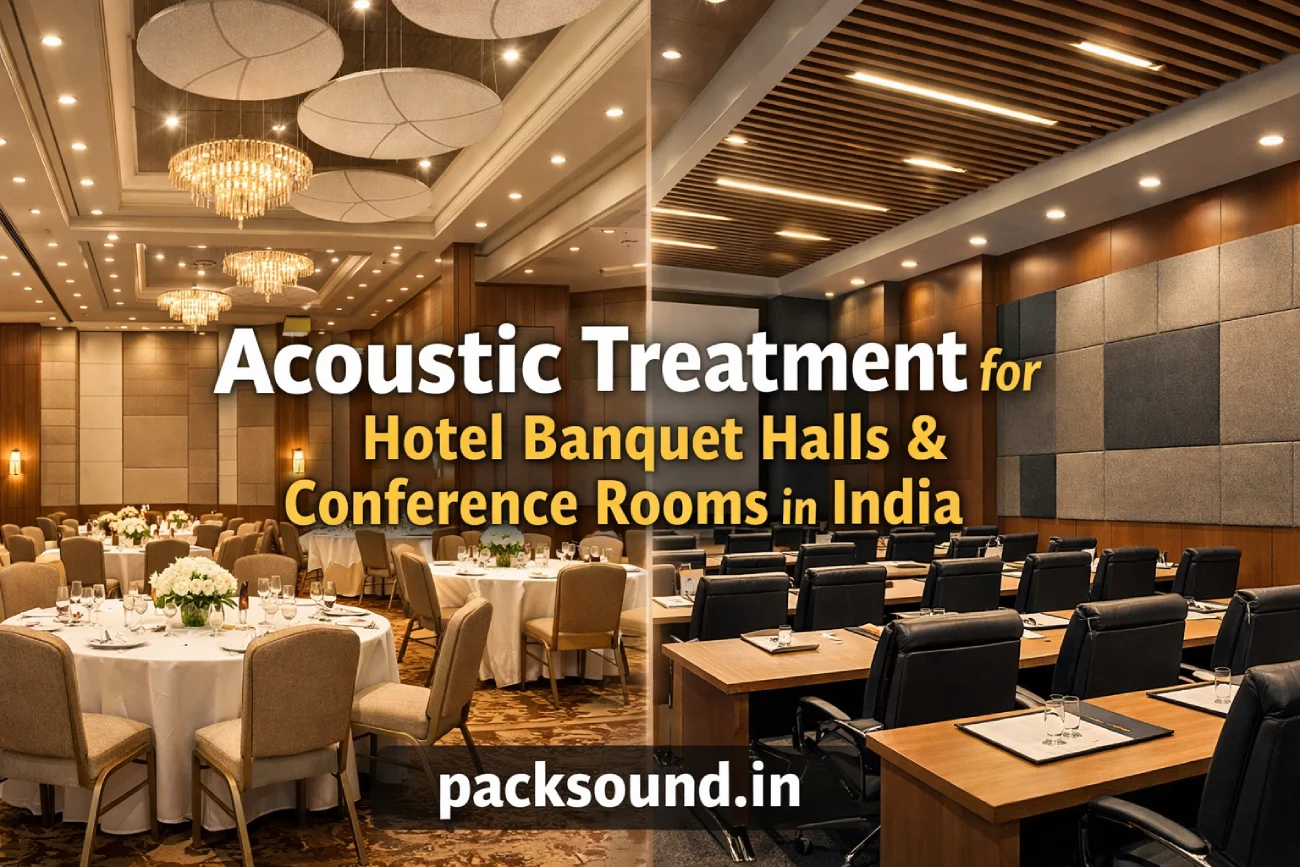
Acoustic Treatment for Hotel Banquet Halls and Conference Rooms in India (2026)
By PackSound® | India’s Leading Acoustic Solutions Manufacturer
Walk into a well-designed banquet hall or conference room and you rarely think about the acoustics. The sound just works — speeches are clear, music feels warm, conversations don’t bleed between tables. Walk into a poorly treated one and within five minutes you know exactly what’s wrong. The DJ’s bass is thundering into the dining room next door. The keynote speaker is fighting a two-second echo. Guests at the back can’t hear a word.
In India’s booming hospitality sector — with luxury hotels multiplying in tier-1 and tier-2 cities, destination wedding venues proliferating across Rajasthan, Goa, and Kerala, and corporate conference facilities expanding into every major business district — acoustic treatment has moved from afterthought to strategic investment. It’s the difference between a venue that gets five-star Google reviews and one that gets noise complaints filed with management.
This guide covers everything hotel procurement teams, architects, banquet hall owners, and hospitality interior designers need to know about acoustic treatment in India — from understanding the science, to specifying the right materials, to knowing exactly what PackSound has done in properties like Hyatt Regency Bhikaji Cama Place, Crowne Plaza Gurgaon, and Isha Banquet Hall, Hyderabad.
Why Hotel Acoustics Are a Business-Critical Investment in India
Before we dive into materials and specifications, it’s worth understanding what’s actually at stake commercially when acoustics are handled poorly.
Guest Satisfaction Scores Are Directly Tied to Noise
Noise complaints are consistently among the top drivers of negative hotel reviews on TripAdvisor, Google, and Booking.com. A guest who can’t sleep because the banquet hall below their room is running a DJ set until midnight — or who can’t follow a conference keynote because the adjacent hall’s sound is bleeding through — does not return, and more importantly, does not stay quiet about it online. In a market as competitive as Indian hospitality, where differentiation on service quality is hard-fought and expensive, acoustic failure is an entirely avoidable brand liability.
The Multi-Function Hall Reality
Indian banquet and conference facilities operate under unique pressure that few Western markets face to the same degree. A single venue must routinely transition between a wedding reception for 800 people, a corporate AGM for 200, a small board meeting for 12, and a product launch with live performance — sometimes on the same calendar day. This multi-function reality demands acoustic systems that are simultaneously flexible, high-performing, and operationally reliable.
Static acoustic treatment (panels on walls, tiles on ceilings) handles reverberation within a space. But the challenge of multi-function Indian venues adds a second dimension: spatial flexibility combined with acoustic isolation. That’s where sliding and folding acoustic partition systems — one of PackSound’s most demanded hospitality solutions — become central to the conversation.
New Construction vs. Retrofit: Both Are Growing
India’s hospitality sector is growing on two tracks simultaneously. New luxury hotel developments in cities like Ayodhya, Varanasi, Amritsar, Ahmedabad, and Tier-2 metros are specifying acoustic treatment from the design stage — giving architects maximum latitude to achieve ideal results. At the same time, existing hotels are retrofitting banquet halls and conference rooms as guests become more discerning and management benchmarks more demanding. PackSound serves both segments, and the approach to each differs meaningfully.
The Acoustics of Hotel Spaces: What You’re Actually Solving
Hotel venues face a dual acoustic challenge that’s worth separating clearly, because they require different solutions.
Challenge 1: Internal Reverberation — The Echo Problem
Every large room with hard surfaces — marble floors, glass facades, painted concrete walls, high ceilings — creates reverberation. Sound bounces. In a banquet hall with a 6-metre ceiling, marble flooring, and no acoustic treatment, a single clap can echo for 3–4 seconds. In that environment, a speaker’s words overlap themselves. Music becomes muddy. Background conversation levels rise as everyone speaks louder to be understood — the classic “cocktail party effect” — which makes everyone speak louder still.
The metric used to measure this is RT60 (Reverberation Time) — the time it takes for sound to decay by 60 decibels after a source stops.
Here are the targets for hospitality spaces:
| Space Type | Target RT60 | Why |
|---|---|---|
| Small conference room (under 100 sqm) | 0.4–0.6 seconds | Speech clarity, videoconferencing intelligibility |
| Large conference / boardroom | 0.6–0.8 seconds | Speech clarity with some warmth for larger audiences |
| Banquet hall (speech events) | 0.8–1.2 seconds | Clear speech with subtle ambience |
| Banquet hall (music events) | 1.2–1.8 seconds | Warmth and fullness without echo |
| Multi-function hall | 0.8–1.4 seconds (variable) | Compromised target for mixed use |
Most untreated Indian banquet halls — with marble floors, high ceilings, glass, and hard wall surfaces — have RT60 values of 3–5 seconds. That’s cathedral territory. Treating this requires strategic placement of absorptive materials on walls and ceilings to bring the room into a functional range.
Challenge 2: Sound Transmission — The Bleed Problem
The second challenge is entirely different: preventing sound from travelling between spaces. When two banquet halls run simultaneously — a corporate conference in one, a wedding DJ in the other — the critical question is how much of one event bleeds into the other.
This is measured by STC (Sound Transmission Class) — a single number indicating how well a partition blocks airborne sound. Higher is better:
| STC Rating | What It Means | Application |
|---|---|---|
| STC 35–40 | Loud speech audible but not clearly intelligible | Basic partitions, temporary dividers |
| STC 40–45 | Loud speech barely intelligible | Budget hotel conference rooms |
| STC 50–55 | Normal speech private; loud sounds audible | Minimum standard for luxury hotels, banquet halls |
| STC 55–60 | Speech fully private; most sounds controlled | High-end hotel conference rooms, boardrooms |
| STC 60+ | Near-complete isolation | Executive boardrooms, broadcast studios |
For Indian banquet halls running concurrent events, the minimum meaningful STC target is STC 50. Premium hotel brands — Marriott, Hyatt, IHG — typically specify STC 55+ as a brand standard. PackSound’s AcoFascia® Sliding Folding Acoustic Partition achieves STC ratings up to 55 dB, meeting the most demanding hospitality brand requirements.
The Four Acoustic Zones of a Hotel Banquet Venue
Any serious acoustic treatment plan for a hotel or standalone banquet venue must address four distinct zones. Missing any one of them creates a weak link that undermines the entire system.
Zone 1: The Banquet Hall Ceiling
The ceiling is the single most impactful surface for controlling reverberation in a large hall. It’s the largest uninterrupted hard surface in the room, and without treatment, it functions as a giant sound mirror. Sound from a speaker or DJ bounces off the ceiling and returns to the room 20–80 milliseconds later — long enough to blur the original signal significantly.
Solution: Acoustic ceiling tiles, suspended acoustic baffles, or acoustic clouds installed at regular intervals across the ceiling plane. For high-ceiling banquet halls (5m+), suspended Acoustic Baffles or Acoustic Clouds are ideal — they address the ceiling volume without requiring structural modification of the ceiling itself.
PackSound’s PerfoAudile® Acoustic Ceiling Panel range includes multiple options suited to hospitality environments — from concealed-fit tiles for conference rooms to feature acoustic clouds for premium banquet hall ceilings that function as design elements in their own right.
Zone 2: The Banquet Hall Walls
Walls account for the secondary reflections that extend reverberation time and create flutter echo — the rapid back-and-forth reflection between parallel hard wall surfaces. In rectangular banquet halls (the most common Indian format), this flutter echo is a near-universal problem without treatment.
Solution: Acoustic wall panels on a minimum of two opposing wall surfaces, targeting 25–40% surface coverage depending on room volume and target RT60. For premium hospitality interiors, Grooved Wooden Slat panels, Fabric Wrapped Panels, and Composite Acoustic Panels deliver high acoustic performance without compromising the premium aesthetic that hotel interiors demand.
In renovation projects where significant wall coverage may visually disrupt existing décor, Micro Perforated Panels offer an elegant solution — they are visually subtle (appearing as standard wall panels or timber) while performing as broadband sound absorbers behind the perforated surface.
Zone 3: The Partition Walls Between Spaces
This is where the sound transmission battle is won or lost. For hotels with adjacent banquet halls or conference rooms that operate independently, the dividing partitions — whether permanent structural walls or operable sliding systems — must meet the STC specification required by the venue’s operating model.
For fixed walls in new construction: drywall assemblies with acoustic infill (rockwool or glasswool insulation) can achieve STC 50–60 depending on the number of layers and whether decoupled framing is used. PackSound’s AcoFascia® Drywall Partition system is designed specifically for hospitality applications with STC performance targets built into the specification.
For operable partitions in multi-function halls: this is where PackSound’s Sliding and Folding Acoustic Partition system becomes the centrepiece of the acoustic design. More on this in detail below.
Zone 4: The Conference Room
Conference rooms within hotels face a concentrated version of the banquet hall problem: hard surfaces, reflective conference tables, glass walls, and the added complexity of AV and videoconferencing systems where speech intelligibility is non-negotiable.
The WELL Building Standard — which is increasingly referenced in Indian commercial and hospitality construction — recommends a conference room RT60 of 0.6 seconds or less. Meeting this standard in a glass-heavy, hard-surfaced modern conference room requires targeted panel placement on at least two walls and, where ceiling height allows, overhead acoustic treatment.
For premium hotel boardrooms and executive conference facilities, PackSound’s Auraluxe® 3D Luxury Wall Panels deliver acoustic performance in formats that read as high-end interior architecture — appropriate for the client-facing spaces where design credibility is as important as acoustic function.
Sliding Folding Acoustic Partitions: The Game-Changer for Indian Hospitality
If there’s one product category that defines modern Indian hotel and banquet hall acoustics, it’s the sliding folding acoustic partition. Understanding why requires understanding how Indian hospitality venues actually operate.
A 5,000 sq ft banquet hall in Hyderabad needs to host a 600-person wedding reception on Saturday evening — requiring the full open floor plate, high music levels, and maximum visual impact. On Sunday morning, the same space needs to divide into a 200-person conference hall and a 50-person breakout room, both operating simultaneously with speech intelligibility as the primary acoustic requirement. On Sunday evening, it’s a corporate dinner for 180 guests.
Permanent walls cannot serve this operational reality. Temporary fabric dividers have STC ratings barely above 25 — functionally useless for acoustic separation. The only solution that delivers genuine acoustic isolation with operational flexibility is a professionally engineered sliding folding partition system.
What Makes a Partition System Actually Work
Not all sliding partitions are equal — and in India’s market, where imported catalogue products sit alongside locally manufactured systems of highly variable quality, understanding what to specify is important.
The performance of a sliding folding partition depends on four engineering factors:
1. Panel Core Construction. The acoustic core — typically high-density mineral wool or rockwool sandwiched between structural panels — is the primary sound blocker. Density matters more than thickness. PackSound’s AcoFascia® partition uses high-density acoustic cores engineered to achieve STC 50–55 dB.
2. Perimeter Sealing. This is where most budget partition systems fail. Sound finds gaps. The perimeter seals at the top track, bottom floor contact, and panel-to-panel joints must create a continuous acoustic barrier. PackSound’s system uses dual PVC perimeter seals with retractable pressure seals at top and bottom, creating a secure acoustic closure that users activate through a simple on-site mechanism.
3. Track Engineering. A top-hung track system (no floor rail) is the standard specification for hospitality environments — floor rails are a trip hazard, collect debris, and limit furniture placement options. PackSound’s ceiling-track system accommodates panels up to 7,000mm in height — suitable for India’s high-ceiling banquet formats — without compromising acoustic performance.
4. Panel Height and Dimensional Accuracy. Any gap between the partition and the structural ceiling or floor is an acoustic failure point. Panels must be precision-manufactured to fit the specific room dimensions — which is why PackSound manufactures every partition system to project-specific dimensions in our Greater Noida facility, not from a catalogue of standard sizes.
PackSound’s Hospitality Partition Projects
The proof of performance is in completed projects.
At Isha Banquet Hall, Hyderabad, PackSound installed a custom sliding folding partition that enables the venue to run concurrent events at full acoustic isolation. The system integrates seamlessly with the interior décor and can be deployed by venue staff in minutes without specialist intervention.
At Crowne Plaza Gurgaon, the project required partition systems that met IHG’s international brand acoustic standards while integrating with a premium interior design specification. PackSound delivered a system achieving the required STC performance within the visual language of a five-star hotel environment.
At Hyatt Regency Bhikaji Cama Place, New Delhi, the sliding partition installation transformed a single large banquet space into a flexible multi-function venue — one of New Delhi’s most frequently booked corporate event destinations.
In Rishikesh, PackSound installed a sliding folding partition for I Design and Spaces — an interior design firm requiring a partition system that met both acoustic performance standards and the aesthetic sensibility of a premium wellness destination project.
These projects collectively cover the full spectrum of Indian hospitality: international five-star hotel brands, mid-market venue operators, and premium standalone banquet facilities.
Material Selection for Hospitality Acoustic Panels: What Performs in India
Hotel and banquet hall environments place specific demands on acoustic panel materials that differ from offices, schools, or studios. The material you specify must be:
- Visually premium — appropriate for ₹10,000-per-night hotel environments
- Durable — resistant to cleaning chemicals, high-traffic contact, and repeated repositioning
- Moisture-resistant — critical in Indian coastal cities and for venues with beverage service
- Fire-rated — mandatory for public assembly occupancies
- Acoustically effective — genuinely meeting the RT60 targets for the space
Here is how the primary material categories perform against these demands.
Fabric Wrapped Panels — The Hospitality Standard
Fabric wrapped acoustic panels — a rigid absorptive core (typically high-density glasswool or polyester fibre) wrapped in acoustic fabric — are the most widely specified wall treatment for Indian hotel conference rooms and banquet halls. They deliver excellent NRC performance (0.80–0.95 at standard thicknesses), can be specified in any fabric that matches the hotel’s colour palette and brand identity, and carry fire ratings appropriate for public assembly use.
PackSound’s Fabric Wrapped Panel range offers custom sizing, custom fabric selection, and framing options that allow the panels to integrate with existing wall finishes — a critical consideration for renovation projects where panels are being added to an operating hotel.
Grooved Wooden Slat Panels — Premium Visual Quality
For banquet halls targeting luxury positioning — five-star hotels, premium wedding venues, boutique properties — grooved wooden slat panels deliver the visual warmth and material quality that premium hospitality interiors require. The linear groove pattern provides broadband sound absorption through a combination of surface absorption and Helmholtz resonance effects, while the wood finish reads as an architectural surface feature rather than an acoustic retrofit.
Grooved Wooden Slat panels also perform well in the low-to-mid frequency range where music energy concentrates — a significant advantage for banquet halls that regularly host live music and DJ events.
Perforated and Micro-Perforated Panels — Clean Integration
For conference rooms where a seamless, corporate-grade interior finish is required, Perforated Panels and Micro Perforated Panels provide acoustic performance behind a visually clean surface. From a distance, they read as standard wall or ceiling panels — no visible acoustic treatment, no disruption to the design language. The perforation pattern allows sound to penetrate to the absorptive material behind.
These are increasingly specified in luxury conference rooms, boardrooms, and hotel executive floors where the acoustic treatment must be completely invisible.
3D Luxury Panels — Statement Ceilings and Feature Walls
For hotels targeting design distinctiveness — boutique properties, destination wedding venues, luxury resorts — PackSound’s Auraluxe® 3D Wall Panel and 3D Ceiling Cloud ranges transform acoustic treatment into a design feature. These premium panel systems combine architectural 3D form with acoustic absorption — creating feature walls and ceiling installations that serve as focal points in high-end interiors while simultaneously managing the room’s acoustic environment.
The AeroLoom Acoustic Clouds are particularly well-suited to high-ceiling banquet halls — suspended ceiling elements that introduce acoustic treatment into the overhead volume without requiring ceiling modification, while creating the sense of intimate scale that large-volume banquet halls often lack.
The Acoustic Treatment Design Process: How PackSound Approaches a Hotel Project
Understanding the process helps procurement teams, hotel general managers, and architects know what to expect and how to plan.
Step 1: Acoustic Assessment
Every project begins with measurement. For new construction, PackSound’s acoustic engineers review architectural drawings to model the RT60 and identify likely acoustic problems before a single panel is installed — saving significant cost compared to fixing problems in a completed space. For renovation projects, we conduct on-site RT60 measurement in each space to establish the baseline reverberation condition.
PackSound’s RT60 and Speech Intelligibility Testing service provides the objective data that drives every material specification decision.
Step 2: 3D Acoustic Modelling
For significant hospitality projects — major hotel banquet halls, flagship conference centres — PackSound’s engineers use 3D acoustic modelling to simulate the treated room’s performance before specifying materials. This allows the client to visualise the acoustic improvement, understand the coverage required, and explore alternative panel configurations to balance acoustic performance with budget and design priorities.
Step 3: Material and System Specification
With the acoustic model validated, PackSound prepares a full specification: panel type, size, coverage area, mounting method, ceiling treatment type, and (where required) partition system specification including STC target, panel dimensions, track configuration, and finish options.
Step 4: Manufacturing
All PackSound acoustic panels and partition systems are manufactured at our facility in Greater Noida, Uttar Pradesh. This is not a reselling operation — we manufacture to project-specific dimensions and specifications, which means hotel projects get panels designed for their specific room dimensions, not adapted from a standard catalogue size.
Step 5: Professional Installation
PackSound provides end-to-end installation through trained specialist teams. Acoustic panel installation — particularly ceiling baffles, clouds, and high-level wall panels in hotel environments — requires specialist equipment and methodology. Incorrect installation (wrong mounting depth, inadequate fixing into substrate, incorrect panel spacing) can significantly degrade acoustic performance even with the right materials.
Common Acoustic Mistakes in Indian Banquet Halls and Conference Rooms
If you’re reviewing an existing space or evaluating a design, here are the most frequent acoustic failures PackSound’s engineers encounter in Indian hospitality projects.
Marble floors with no ceiling treatment. This is the single most common configuration in Indian banquet halls. Marble is beautiful, easy to clean, and acoustically disastrous — it is a near-perfect sound reflector. Without ceiling treatment to absorb some of the reflected energy, RT60 values are consistently 3–5 seconds. The fix: suspended acoustic baffles or clouds, which require no floor modification and can be installed in an operating venue between events.
Glass facade conference rooms with no wall panels. Glass walls are endemic in modern Indian corporate hotel design. Acoustically, they function like mirrors — every surface reflects, nothing absorbs. A glass-walled conference room without acoustic panel treatment cannot achieve the RT60 target required for videoconferencing intelligibility. Fix: fabric wrapped or micro-perforated panels on the two non-glass walls, plus ceiling treatment.
Inadequate partition STC for concurrent events. Budget partition systems specified on price rather than performance are the leading cause of sound bleed between adjacent hotel event spaces. An STC 35 partition is acoustically close to nothing — the DJ in one hall is clearly audible in the conference next door. Specify STC 50 minimum for any partition separating spaces that will operate simultaneously.
Acoustic treatment only at eye level. A common misconception is that acoustic panels should be placed at seating height — where guests are. In fact, for reverberation control in large spaces, treating the upper wall zone (above 2m) and ceiling plane is equally or more important, because that’s where the long-travel reflections originate.
No flanking path analysis. Sound travels around partitions as well as through them — through shared HVAC ducts, above suspended ceilings into a shared plenum, through structural elements. A well-specified partition system can still fail if these flanking paths are not addressed during the design phase.
Approximate Investment Guide for Hotel Acoustic Treatment in India (2026)
One of the most common questions from hotel procurement teams and banquet hall owners is cost. Here is a transparent guide based on current Indian market conditions.
Conference Room (150–300 sqm)
Full acoustic treatment to achieve RT60 0.5–0.7 seconds: typically ₹8–20 lakhs installed, depending on panel material specification (standard fabric wrapped vs. premium grooved wood or 3D panels), ceiling height, and existing room finish. This covers wall panels on 2–3 surfaces, ceiling acoustic tiles or baffles, and professional installation.
Medium Banquet Hall (300–800 sqm)
Ceiling baffles/clouds plus wall panel treatment to achieve RT60 0.8–1.4 seconds: typically ₹20–65 lakhs installed, depending on hall height, ceiling construction, panel specification, and whether feature lighting integration is required. The wide range reflects the difference between standard acoustic specification and premium design-led installations for luxury venues.
Sliding Folding Partition System (per installation)
Single partition installation for a medium banquet hall division: typically ₹15–45 lakhs installed, depending on partition height, length, STC requirement, and finish specification. Multi-partition configurations for large convention centres are quoted on project basis.
Full Hotel Acoustic Retrofit (Multiple Spaces)
Large hotel property acoustic retrofit covering banquet hall, multiple conference rooms, and lobby areas: typically ₹1–5 crore total project value, depending on property scale and specification level. PackSound has delivered projects at both ends of this range.
These are budgetary estimates. Every project receives a specific consultation and quotation — contact PackSound’s team at Sales@packsound.in or +91 980 980 2016 for a project-specific assessment.
Hotel Acoustic Treatment Checklist
Use this checklist for any hospitality acoustic project — new construction specification, renovation design, or operational problem diagnosis.
Reverberation Control (Internal Acoustics)
- RT60 target defined for each space based on primary use
- Ceiling treatment specified (tiles, baffles, or clouds based on height)
- Wall panel coverage calculated (minimum 25% of total wall area for speech spaces)
- Panel NRC values verified at relevant frequencies (250Hz–2kHz for speech, 125Hz–4kHz for music)
- Floor treatment considered (carpet, rugs, or soft seating zones)
- Fabric and finish specification matches hotel interior design standard
Sound Transmission (Between Spaces)
- STC target defined for each partition based on adjacent space use
- Partition system STC rating verified with certified test data (not marketing claims)
- Perimeter sealing methodology specified (top, bottom, and panel-to-panel)
- Flanking paths identified and addressed (HVAC ducts, ceiling plenum, structural connections)
- Operable partition system specified for multi-function spaces
Installation and Operational Requirements
- Installer experience in hospitality environments confirmed
- Installation timeline compatible with hotel operations (work during off-hours, phased delivery)
- Maintenance requirements defined (cleaning methods, panel replacement protocol)
- Warranty documentation provided for panels and partition system
Why PackSound Is India’s Preferred Acoustic Partner for Hospitality
PackSound has delivered acoustic solutions to some of India’s most demanding hospitality environments — international hotel brands, luxury wedding venues, and standalone banquet facilities across the country. What makes the difference is not just product quality, but the end-to-end capability that procurement teams and architects actually need:
Manufacturing capability. Every panel and partition is made to project specifications in India — no minimum order constraints, no standard-size compromises, no import lead time delays.
Acoustic engineering. PackSound’s team provides RT60 analysis, 3D acoustic modelling, and STC specification support — not just product supply. You’re buying a result, not just a material.
Installation expertise. Our specialist installation teams have completed acoustic projects in operating hotels — understanding the scheduling, access, and quality requirements of hospitality environments.
Complete product range. From EchoStop® wall panels to PerfoAudile® ceiling systems, AcoFascia® partition systems, Auraluxe® luxury panels, and SonicGuard® acoustic doors — PackSound can address every acoustic requirement in a hotel or banquet facility from a single supplier relationship.
Proven hospitality references. Hyatt, Crowne Plaza, Isha Banquet Hall, Pfizer, and 1,900+ completed projects across India and internationally. Request case studies and client references for your specific property type.
Frequently Asked Questions
Can acoustic treatment be installed in an operating hotel without closing the venue?
Yes — and this is a standard requirement on PackSound hospitality projects. We schedule installation work during venue off-hours, in phased sections that allow continued operation. Most wall panel installations and ceiling baffle systems can be completed in individual rooms within 1–3 days, minimising operational disruption.
How long does an acoustic treatment installation last?
Quality fabric wrapped panels and wood fiber wall panels have design lives of 15–25 years in hotel environments. Sliding folding partition systems are rated for 10+ years of commercial operation with standard maintenance. PackSound provides installation warranties and aftercare support for all hospitality projects.
Do acoustic panels require specialist maintenance?
Standard maintenance involves periodic dusting and occasional fabric or surface cleaning using mild cleaning solutions. Fabric wrapped panels can have their fabric replaced at end of life without replacing the core — cost-effective for hotels undergoing periodic interior refreshes.
What is the lead time for a hotel acoustic project?
Standard panel supply for a conference room or mid-size banquet hall: 15–25 working days from confirmed specification. Custom partition systems for large banquet halls: 4–8 weeks including site survey, manufacturing, and installation scheduling. Contact PackSound early in the project timeline — acoustic treatment specified late in a construction programme is significantly more expensive to deliver.
Does PackSound handle acoustic projects outside Delhi/NCR?
PackSound delivers and installs nationwide. Completed projects include Hyderabad, Shillong, Bihar, Visakhapatnam, Rishikesh, and multiple cities across India. Contact us for project-specific logistics planning.
The Bottom Line: Acoustics Is a Revenue Investment, Not a Cost
Hotel and banquet hall owners who approach acoustic treatment as a cost to minimise are missing the business case entirely. A properly treated banquet hall commands higher event rates, receives better reviews, achieves higher rebooking rates, and avoids the reputational damage of noise complaints. A well-specified conference facility justifies premium day delegate rates and attracts corporate business that lesser-equipped venues cannot compete for.
The question is not whether to invest in acoustic treatment. The question is whether to do it correctly at design or construction stage — where it is straightforward and cost-efficient — or to fix it expensively after complaints have accumulated and reviews have been written.
PackSound’s acoustic engineers work with hotel developers, operators, and architects at every project stage. Whether you’re designing a new property, retrofitting an existing venue, or troubleshooting a specific acoustic problem, the conversation starts with a free consultation.
Ready to transform your hotel or banquet hall acoustics?
Get a free acoustic consultation from India’s most trusted acoustic manufacturer.
📞 +91 980 980 2016 | +91 9990 858 797 📧 Sales@packsound.in 🌐 packsound.in | ecotone.co.in
📍 A-719, Tower 3, NX One, Techzone IV, Greater Noida West, UP 201306
PackSound® is a brand of Ecotone Acoustic Limited — India’s leading acoustic products manufacturer with 1,900+ completed projects, 25+ years of acoustic excellence, and 1.5 crore sq ft of acoustic treatment installed across India and internationally.
Related Reading:
- Sliding and Folding Acoustic Partition — AcoFascia® Series
- Acoustic Wall Panels — EchoStop® Series
- Acoustic Ceiling Panels — PerfoAudile® Series
- Auraluxe® 3D Luxury Acoustic Panels
- Case Study: Hyatt Regency Bhikaji Cama Place
- Case Study: Crowne Plaza Gurgaon Sliding Partition
- Case Study: Isha Banquet Hall Hyderabad
- Eco-Friendly Acoustic Panels: PET Felt vs Wood Fiber vs Foam