
Acoustic Baffles vs Ceiling Panels: What Works Best for Large Halls?
Large halls, auditoriums, and multipurpose venues are prone to echo, noise reverberation, and uneven sound distribution. In such spaces, effective acoustic control is essential to ensure clear speech, crisp music, and overall comfort for occupants. Among the most popular solutions for sound absorption in large halls are acoustic baffles and acoustic ceiling panels.
While both solutions target the same problem—reducing noise and improving sound quality—their design, installation, and performance characteristics differ significantly. Understanding these differences helps architects, interior designers, and facility managers choose the right system to meet both acoustic and aesthetic requirements.
This article explores the key differences between acoustic baffles and ceiling panels, their ideal applications, costs in India, and expert recommendations for large halls.
What Are Acoustic Baffles?
Definition and Purpose
Acoustic baffles are suspended sound-absorbing panels designed to reduce noise and control reverberation in open spaces. Unlike traditional ceiling panels, baffles hang vertically or at angles from the ceiling, creating barriers that intercept and absorb sound waves.
Their primary purpose is to enhance speech clarity and reduce echo in spaces like auditoriums, gymnasiums, airports, and conference halls. By controlling excessive reverberation, baffles improve acoustic comfort without compromising room volume or architectural design.
How Acoustic Baffles Work
Acoustic baffles function by intercepting sound waves that travel through the air and reflect off hard surfaces. When sound hits the baffle, the porous material inside absorbs part of the sound energy, converting it into heat and reducing overall noise levels.
Because baffles are suspended, they provide 360-degree sound absorption, making them highly effective in large open spaces with high ceilings. Their vertical orientation helps control mid-to-high-frequency noise, which is particularly important for speech intelligibility.
Common Materials Used in Baffles
The performance of acoustic baffles depends on the material used. Common materials include:
- Mineral wool: Highly effective in absorbing mid-to-high frequencies; fire-resistant and durable.
- Fiberglass panels: Lightweight, eco-friendly, and available in various densities for specific NRC (Noise Reduction Coefficient) requirements.
- Polyester fibers: Affordable, easy to shape, and available in custom colors for design integration.
- Fabric-wrapped panels: Combine aesthetic flexibility with functional sound absorption.
Advanced baffles may include recycled materials or sustainable acoustic composites, offering both environmental benefits and acoustic efficiency.
What Are Acoustic Ceiling Panels?
Definition and Usage
Acoustic ceiling panels, also known as sound-absorbing ceiling tiles, are flat panels installed directly onto the ceiling surface or suspended from a grid system. They aim to reduce sound reflections, control reverberation, and enhance speech clarity in large halls, offices, schools, and entertainment spaces.
Unlike baffles, ceiling panels are generally horizontal and cover larger areas, making them suitable for rooms with uniform ceiling layouts.
Types of Ceiling Panels
Acoustic ceiling panels are available in several forms, each tailored to different applications:
- Suspended or drop ceiling panels: Installed in a metal grid system, commonly used in commercial spaces and auditoriums.
- Direct-mount panels: Fixed directly to the ceiling surface, ideal for high ceilings or industrial aesthetics.
- Perforated panels: Made of wood, metal, or MDF, with holes or slots for sound absorption and architectural design.
- Fabric-wrapped panels: Combine sound absorption with aesthetic versatility, allowing custom patterns and colors.
Materials and Finishes Available
Ceiling panels are constructed from a wide range of materials to optimize acoustic performance and visual appeal:
- Mineral fiber: Fire-resistant, lightweight, and cost-effective.
- Fiberglass: High NRC ratings, excellent for mid-to-high-frequency absorption.
- Wood or MDF: Provides moderate acoustic control with premium visual appeal.
- Metal perforated panels: Used for modern, industrial aesthetics, with sound-absorbing backing.
- Fabric-wrapped or foam panels: Offer versatility in color and texture for designer interiors.
Key Differences Between Acoustic Baffles and Ceiling Panels
Design and Installation
Acoustic baffles are suspended vertically, making them easier to install in spaces with high ceilings and irregular layouts. They require less ceiling coverage while still offering effective sound absorption.
Acoustic ceiling panels, in contrast, are installed horizontally and often cover large ceiling areas. They may require a grid suspension system or direct mounting, which can be more labor-intensive and restrictive in design flexibility.
Sound Absorption Performance
While both solutions improve acoustic quality, baffles tend to outperform ceiling panels in high-ceiling spaces because their vertical orientation intercepts sound waves more efficiently. Ceiling panels, though effective in large area coverage, may require higher density or thicker panels to match the performance of baffles.
Aesthetic Flexibility
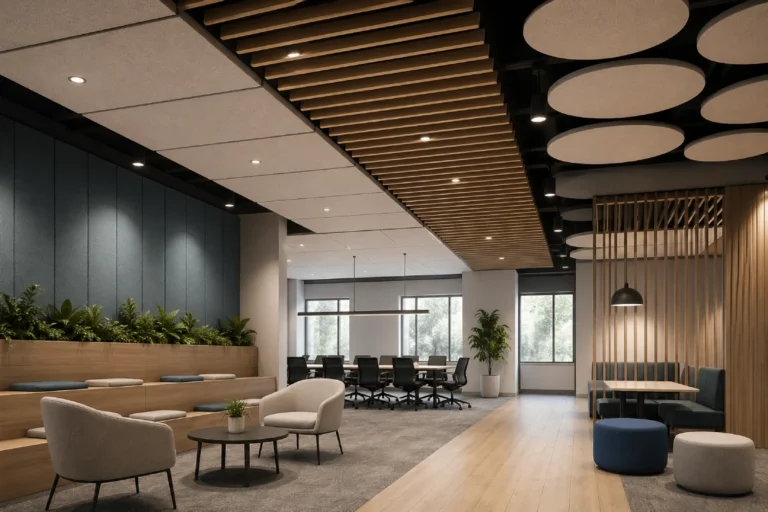
Baffles offer modern, artistic appeal and can be customized in shapes, colors, and patterns to enhance interior design. They are often used as visual features in large halls, creating dynamic architectural statements.
Ceiling panels provide a clean, uniform look, suitable for corporate or traditional spaces. Perforated, textured, or fabric-wrapped panels can add some design flexibility but generally lack the dramatic impact of suspended baffles.
Maintenance and Cost Comparison
Maintenance of baffles is usually simpler since they are easily accessible, can be dusted, and replaced individually. Ceiling panels require grid disassembly or lifting, which may be more labor-intensive.
From a cost perspective:
- Baffles can be slightly higher per sq. ft but often reduce the total number of panels needed due to targeted coverage.
- Ceiling panels may be cheaper upfront but require more extensive installation and maintenance over time.
Acoustic Performance in Large Halls
Sound Reflection and Reverberation Control
Large halls face challenges with sound reflections and echoes, particularly in spaces with hard flooring and high ceilings. Acoustic baffles intercept sound in vertical planes, preventing it from bouncing across the room.
Ceiling panels absorb sound horizontally, reducing reflections from overhead surfaces. For rooms with moderate ceiling heights, ceiling panels may be sufficient. However, in voluminous auditoriums, baffles provide superior echo control.
NRC (Noise Reduction Coefficient) Comparison
The NRC rating measures a material’s ability to absorb sound:
- Acoustic baffles: Typically offer 0.8–1.0 NRC, especially for fibrous or mineral wool panels.
- Ceiling panels: Commonly range from 0.6–0.9 NRC, depending on thickness and material.
Higher NRC indicates better sound absorption, making baffles more suitable for large spaces with high reverberation times.
Ideal Placement for Maximum Efficiency
For optimal performance:
- Baffles: Space evenly across the hall, suspended at mid-ceiling height, targeting areas where reflections are strongest.
- Ceiling panels: Cover large areas uniformly, especially above seating zones or stage areas, for consistent sound reduction.
A combination of both can sometimes achieve premium acoustic performance.
Design Considerations for Large Spaces
Ceiling Height and Layout Planning
High ceilings (>15 feet) favor suspended baffles, as they provide vertical absorption without overwhelming the visual space. Lower ceilings can benefit from ceiling panels, which avoid reducing headroom.
Lighting and HVAC Integration
Baffles allow more flexible lighting layouts, as fixtures can pass between them without obstruction. Ceiling panels may require cutouts or integration with air ducts, adding complexity to design.
Visual Appeal and Architectural Harmony
Baffles offer sculptural, modern aesthetics, suitable for auditoriums, museums, and performance halls. Ceiling panels deliver a clean, professional appearance, ideal for corporate, educational, or convention spaces.
Cost Comparison in India (2025)
Average Price per Sq. Ft
- Acoustic baffles: ₹500–₹1,200 per sq. ft (material dependent).
- Ceiling panels: ₹300–₹800 per sq. ft (mineral fiber or fiberglass).
Installation and Maintenance Costs
Baffles require suspension hardware, while ceiling panels need grid systems or adhesives. Maintenance for baffles is typically simpler and cheaper, whereas ceiling panels may incur higher labor costs over time.
Long-Term Value and Durability
High-quality baffles often outlast ceiling panels, especially in environments with humidity or heavy usage. Ceiling panels may need replacement or repainting more frequently.
When to Choose Acoustic Baffles
Best Use Cases and Environments
- Auditoriums, concert halls, gymnasiums
- Spaces with high ceilings or irregular layouts
- Modern, architecturally-focused interiors
Pros and Cons
Pros:
- Superior echo and reverberation control in large halls
- Flexible design and aesthetics
- Easy maintenance and replacement
Cons:
- Slightly higher initial cost
- May require professional installation expertise
When to Choose Acoustic Ceiling Panels
Ideal Applications and Design Advantages
- Conference rooms, offices, classrooms
- Spaces with moderate ceiling height
- Uniform acoustic coverage with a clean, flat ceiling appearance
Pros and Cons
Pros:
- Cost-effective for smaller large halls
- Standardized installation with minimal customization
- Variety of materials for aesthetic versatility
Cons:
- Less effective in very high ceilings
- Limited design impact compared to baffles
Expert Recommendation: Which Works Best for Large Halls?
Side-by-Side Performance Summary
| Feature | Acoustic Baffles | Acoustic Ceiling Panels |
|---|---|---|
| Installation | Suspended vertically | Horizontal/grid mounted |
| NRC Rating | 0.8–1.0 | 0.6–0.9 |
| Ideal Ceiling Height | High | Moderate |
| Aesthetic Flexibility | High | Moderate |
| Maintenance | Easy | Moderate |
| Cost | Moderate-High | Low-Moderate |
PackSound’s Expert Insight
According to acoustic experts, baffles are generally more effective for large, high-ceiling halls, while ceiling panels serve well in mid-sized auditoriums or classrooms. A hybrid approach, combining both systems, can optimize sound absorption, aesthetics, and cost efficiency.
Conclusion
Choosing between acoustic baffles and ceiling panels requires careful consideration of ceiling height, room size, acoustic requirements, design preferences, and budget.
Key takeaways:
- Baffles excel in large, high-ceiling spaces and offer visual appeal.
- Ceiling panels provide uniform coverage in moderate spaces at a lower cost.
- NRC ratings, installation methods, and maintenance requirements influence long-term performance.
- For optimal results, consider consulting acoustic specialists and potentially using a hybrid system.
By understanding these differences, architects and designers can create acoustically optimized and visually appealing large halls, enhancing user experience and sound clarity.
FAQs
Q1: Are acoustic baffles better than ceiling panels for echo control?
Yes, baffles generally provide superior echo control in high-ceiling large halls due to their vertical suspension and effective sound interception.
Q2: What is the NRC value difference between both?
Baffles: 0.8–1.0 NRC, Ceiling Panels: 0.6–0.9 NRC, making baffles more effective in controlling sound.
Q3: Can both systems be used together in large halls?
Absolutely. Using baffles with ceiling panels can provide maximum sound absorption, reduce echo, and improve speech clarity.
Q4: Which option is more cost-effective for Indian projects?
For small to medium halls, ceiling panels are more cost-effective. For high-ceiling auditoriums or modern architectural spaces, baffles offer better long-term value despite a slightly higher initial cost.


One Comment