Quick Answer: How to Improve Auditorium Acoustics
To improve the auditorium acoustics, you basically want to get a grip on the reverberation time (RT60) first, then remove that annoying flutter echo, make sure the sound is distributed evenly throughout the space, and finally improve speech intelligibility with STI scores ideally above 0.60. In practice, this is achieved through a layered acoustic treatment strategy that combines absorptive wall panels, diffusers, ceiling clouds above the audience, bass traps for low frequencies, and carefully designed surface geometry that helps control sound reflections. Every solution is calibrated according to the room volume and its primary use, whether for speech, music, or multipurpose events. The right solution is never simply about adding more acoustic panels. It requires professional acoustic modelling, proper material selection, and expert installation that complies with IS:4954 or ISO 3382 standards.
What Is Auditorium Acoustic Design and Why Does It Matter?
Auditorium acoustic design is the science and practice of shaping how sound behaves inside a big enclosed space so you can reach clarity, a sort of balance, and even uniform coverage for every seat in the house. In plain language it’s basically the difference between an audience that catches every word ,and each music note cleanly… and one that keeps fighting echo, muddy low end, or dead zones that feel too quiet.
Bad auditorium acoustics aren’t just a comfort thing— they impact learning results in school halls, how long people stay engaged in performance venues, and how well speech lands in conference auditoriums. As per the World Health Organization, if background noise rises beyond 35 dB(A) in learning environments, comprehension drops in measurable ways and academic performance also suffers. The same idea shows up everywhere, especially in any auditorium where the main mission is communication, not just volume.
This guide is for facility managers, architects, AV consultants, and institution leaders in India who want a practical expert level roadmap to improve auditorium acoustics, whether you’re planning a fresh build or retrofitting a space that’s already there. PackSound has already delivered acoustic treatment for 150+ projects in India, including school auditoriums in Bengaluru, corporate conference halls across Delhi NCR, and multiplex cinemas in Pune.
How to Improve Auditorium Acoustics: The Expert’s Starting Point
If you have ever sat in an auditorium and strained to catch every third word, or maybe you noticed that the music sounds kinda washed out and indistinct-like the detail sort of disappears-then you already met what acoustic consultants call a “reverberant field failure.” The room becomes louder than the actual signal. That is the core issue that auditorium acoustic design tries to fix, and yes it can be done.
Most venues in India were planned with looks, or sometimes seating capacity, as the main driver. Acoustics were treated like an after note, or they got addressed with generic foam panels, which absorb a lot of the high frequency content but still leave the low frequency area to do its own booming thing. So the end result is a space that looks professional enough, but sounds pretty amateur.
What actually works is not random additions but a systematic workflow: you measure the room, you model the RT60 target for the primary use case, you pick materials that achieve the correct NRC across the right frequency bands and then you install them at the locations that interrupt first reflection paths and stop lateral flutter. This article lays out that full framework, based on real project experience and aligned with the IS:4954 guidelines for auditorium acoustic performance in India.
What Is RT60 and Why Is It the Core Metric for Auditorium Acoustic Design?
RT60 (Reverberation Time) is the time, in seconds, for the sound energy to drop by 60 dB once the sound source stops. It’s worked out with the Sabine equation: RT60 = 0.161 x V / A, where V means room volume in cubic metres and A is total sound absorption in Sabin units.
Getting RT60 right is kind of the backbone for all auditorium acoustic treatment. Every material pick every panel placement choice, and even the surface geometry decisions just keep flowing from the RT60 target, for your particular use case.
RT60 Targets by Use Case:
| Use Case | Target RT60 (500 Hz) | Primary Treatment Focus |
|---|---|---|
| Speech / Lectures / Conference | 0.6 – 0.8 sec | High absorption, rear wall diffusion |
| School Auditorium (Multipurpose) | 0.8 – 1.0 sec | Balanced absorption + diffusion |
| Drama / Theatre | 0.9 – 1.2 sec | Selective absorption, side wall diffusion |
| Orchestral Music | 1.4 – 1.8 sec | Low absorption, shape-driven diffusion |
| Worship Spaces (Music-heavy) | 1.6 – 2.2 sec | Minimal absorption, reflective surfaces |
What Acoustic Panels Are Used in Auditoriums?
A quick-reference guide to the primary panel types used in auditorium acoustic treatment in India:
| Product Type | NRC Rating | Panel Thickness | Key Benefit | Best Application | Installation Method |
|---|---|---|---|---|---|
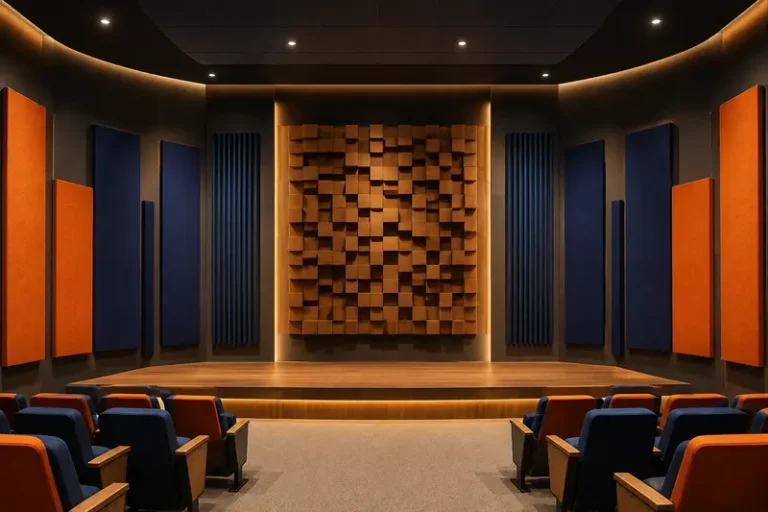
| Fabric-Wrapped Mineral Wool Panel | 0.85 – 0.95 | 50 mm / 75 mm | Broadband sound absorption | Side walls, rear walls | Wall-mounted adhesive or Z-clip |
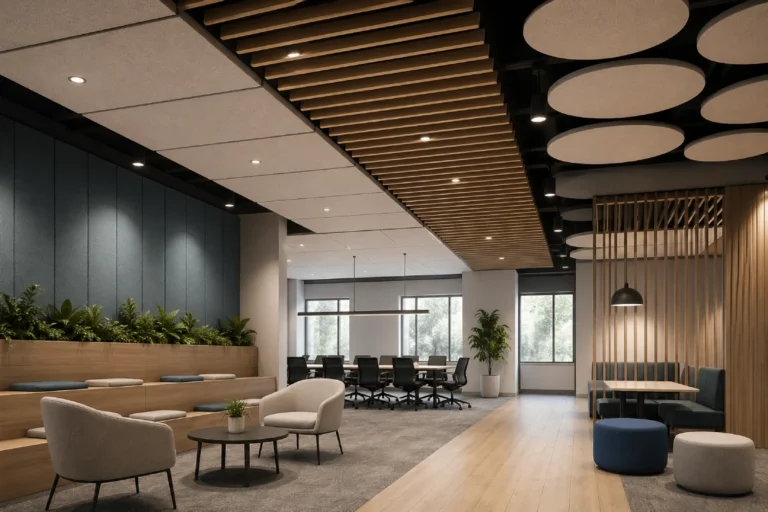
| Perforated Wooden Panel (with backing) | 0.70 – 0.85 | 18 mm + 50 mm air gap | Aesthetic finish with mid/high frequency absorption | Feature walls, ceiling soffits | Suspended or direct-fix frame |
| Acoustic Ceiling Cloud | 0.80 – 0.90 | 50 mm | Controls early ceiling reflections | Over stage, front seating area | Suspension wire rigging |
| QRD Diffuser (Quadratic Residue) | N/A (Scattering) | 150 – 200 mm depth | Eliminates flutter echo | Rear wall, side wall panels | Direct-fix or framed mount |
| Bass Trap (Corner Wedge) | 0.90 – 1.00 (Low Frequency) | 100 – 200 mm | Low-frequency control | Floor-to-ceiling corners | Corner-fitted with bracket |
| Acoustic Baffle (Suspended) | 0.75 – 0.90 | 50 mm | Treats large open volumes | High ceilings, open halls | Ceiling rigging / track system |
| Grooved Wooden Slat Panel | 0.65 – 0.80 | 18 mm + cavity | Combined absorption and diffusion | Side walls, stage wings | Direct-fix or subframe |
What Is the Correct Sequence for Auditorium Acoustic Treatment?
Follow these steps in order. Skipping the measurement phase is the most common and most expensive mistake made in Indian auditorium projects.
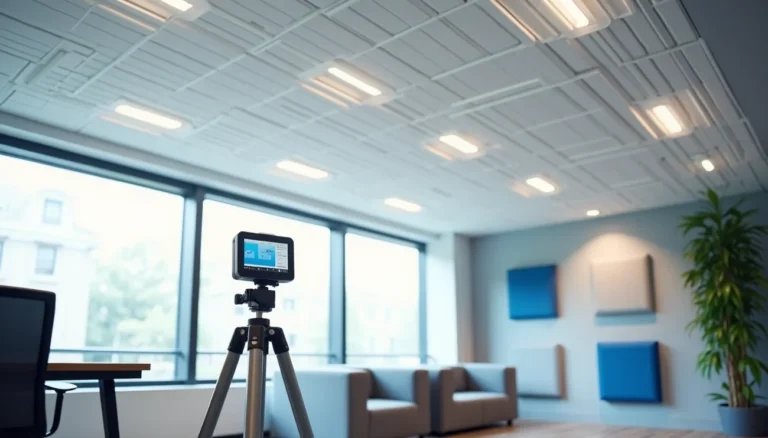
1. Do an acoustic survey- like honestly, Measure the existing RT60 at 125 Hz, 250 Hz, 500 Hz, 1 kHz, 2 kHz, and 4 kHz using a calibrated SPL meter plus impulse response software (for example, Room EQ Wizard or DIRAC) and just check that the setup is stable.
2.Then set the use-case target- define if this space is speech primary, music primary or multipurpose. This will decide your RT60 target plus the absorption coefficient needs, because yes it all ties together.
3. Next, model the room acoustically. You can use ODEON, EASE, or Sketchup with acoustic plugins to forecast what the treatment will do before you actually buy materials, This typically helps you save something like 20 to 40% in material cost, since it prevents over treatment, or under too.
4. After that deal with low frequencies first. Most Indian auditoriums run into bass buildup in the corners, and it gets messy fast. Put 100 mm to 200 mm deep bass traps in all floor-to-ceiling corners, then continue only after that is done properly,
5. Next treat the first reflection points. Find the side-wall and ceiling spots where a sound ray from the stage would bounce one time before it reaches the audience. Those panel locations are usually the most important.
6. Now add rear-wall diffusion. A hard rear wall can make flutter echo and late reflections which then harms speech intelligibility. So install QRD diffusers or profiled wooden panels there, not flat absorbers, please.
7. Don’t ignore the ceiling treatment. Acoustic clouds placed about 3 to 4 metres above the front seating area can control early ceiling reflections while still keeping the sense of openness / spaciousness.
8. Finally verify with measurement again. Re-measure RT60 after installation across all frequency bands, and compare the readings with IS:4954 targets for the particular use type you defined earlier.
9. Commission the PA system only after acoustics are finalised. EQ tweaks and speaker placement decisions should follow the room treatment not the other way around.
Which Acoustic Materials Work Best for Indian Auditoriums?
India climate and construction norms make some material constraints that people rarely talk about in the generic acoustic guides. In coastal cities, high humidity messes with mineral wool panels if they do not have proper facing protection, and it’s a big deal. Also dust just builds up on open cell foam panels in non-AC spaces, and over time that makes the absorption less effective than expected. Then there is termite risk, it can impact a few wood backed panel systems pretty directly. So, here is how the main material categories tend to perform in Indian conditions:
| Material | Climate Suitability (India) | Fire Rating | Maintenance | Recommended Use |
|---|---|---|---|---|
| Rockwool / Mineral Wool (Fabric-Wrapped) | High – Moisture-resistant if faced | Class A / B depending on facing | Low – Wipe-clean fabric | First choice for side walls and rear walls |
| Wood Fibre Acoustic Board | Moderate – Avoid high-humidity zones | Class B | Low | School auditoriums and corporate halls |
| Perforated MDF / Plywood with Backing | High – Sealed face protects the core | Class B (treated) | Low | Ceilings and feature wall panels |
| Open-cell Acoustic Foam | Low – Dust accumulation and humidity can degrade performance within 3 to 5 years | Class E (usually) | High | Avoid for permanent installations |
| Recycled PET Fibre Panels | Very High – Moisture and mould resistant | Class A (certified) | Very Low – Washable | Excellent for schools and public venues |
| Stretched Fabric System | High – Replaceable fabric | Depends on core material | Medium | Premium auditoriums and executive halls |
How Do You Measure and Improve Speech Intelligibility in an Auditorium?
Speech intelligibility is quantified by the Speech Transmission Index (STI), scored from 0 (unintelligible) to 1.0 (perfect). An STI above 0.60 is considered acceptable for public address in auditoriums. Most untreated Indian halls score between 0.35 and 0.50 – firmly in the “poor” to “fair” range.
The critical factors that reduce STI are excessive RT60 (especially above 1.0 second in speech venues), strong early lateral reflections arriving more than 35 milliseconds after the direct sound, and high background noise from HVAC systems (target NC-25 or lower for auditoriums).
Checklist to Improve STI Score:
- Reduce RT60 to target range through panel treatment (see RT60 table above)
- Ensure HVAC noise is below NC-25 at audience positions
- Eliminate flutter echo between parallel reflective walls
- Treat ceiling with clouds or baffles to suppress long-path reflections
- Use directional PA loudspeakers (line array or column arrays) to maximise direct-to-reverberant ratio
- Avoid over-absorption – rooms treated to below 0.5 seconds RT60 lose warmth and naturalness
Auditorium Acoustic Design for Multipurpose Halls: The Variable Acoustics Challenge
How Do You Design Acoustics for a Hall Used for Both Speech and Music?
This is the most common brief in Indian institutions: one hall, used for morning assembly (speech), afternoon drama rehearsals (music+voice), evening concerts (amplified music), and annual day events (everything at once).
The solution is variable acoustics – a system that can shift the room’s RT60 between 0.8 seconds (speech mode) and 1.4 seconds (music mode) without structural changes. This is achieved through:
- Movable acoustic curtains on side walls (heavy velvet or mass-loaded drape) that can be deployed or retracted
- Reversible panels with absorptive fabric on one face and reflective painted wood on the other, rotatable on a pivot
- Variable ceiling clouds on adjustable suspension that can be raised or lowered to change the effective room height
This approach adds 15 to 25% to the acoustic treatment budget but eliminates the compromise of a fixed treatment that serves neither speech nor music well. For institutions with limited budgets, the practical minimum is heavy side-wall drapes combined with fixed ceiling clouds – this alone typically achieves a 0.4-second range of RT60 variability.
Conclusion: Building Auditoriums That Sound as Good as They Look
Improving auditorium acoustics is not about covering walls with panels. It is a systematic engineering process that starts with measurement, proceeds through acoustic modelling, and ends with verified post-installation performance against IS:4954 or ISO 3382 targets.
The hierarchy of priorities for most Indian auditoriums is: control RT60 first, address flutter echo second, treat the ceiling third, and install variable elements last for multipurpose spaces. PA system tuning and speaker selection should always follow room treatment – not replace it.
PackSound has delivered this process across 150+ projects in India, including a 450-seat school auditorium in Bengaluru that achieved IS:4954-compliant RT60 after installation of perforated wooden panels and suspended baffles. If your auditorium is underperforming acoustically, the most cost-effective first step is a professional site measurement and acoustic brief – not a panel purchase.
Get a free acoustic consultation for your auditorium from PackSound.
Frequently Asked Questions About Auditorium Acoustics
Q1. What is the ideal RT60 for a school auditorium used for speech?
Target RT60 is 0.6 to 0.8 seconds at mid frequencies for speech-primary halls.
Q2. How many acoustic panels do I need for a 500-seat auditorium?
Panel quantity depends on room volume and existing absorption; acoustic modelling determines exact coverage.
Q3. Can acoustic panels be installed without damaging existing walls?
Yes, Z-clip and rail systems allow panel installation with no permanent wall damage.
Q4. What is the difference between NRC and STC ratings for acoustic panels?
NRC measures sound absorption within a room; STC measures sound blocking between rooms.