
AquaSonic™ Sonar Reflection Control Panel & Signal Damper
AquaSonic sonar reflection control panels reduce the acoustic signature of vessels by damping sonar reflections and radiated noise. They are designed for naval, research and marine engineering applications.
Your details stay private. No spam.
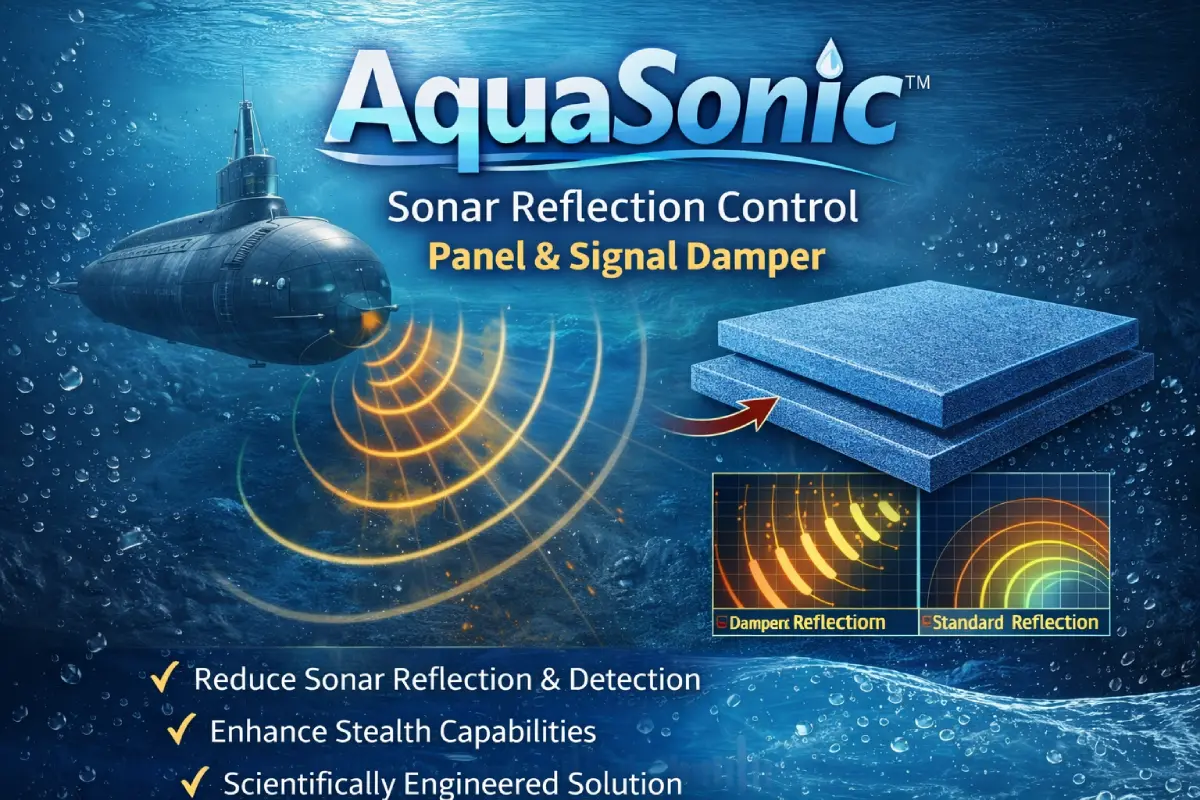
In the underwater domain, acoustic signature is everything. A surface ship or submarine that generates strong, detectable sonar reflections — or that radiates noise efficiently into the surrounding water — is a vessel that can be located, tracked, and engaged. A vessel with a well-managed acoustic profile, by contrast, operates with a critical tactical advantage that no amount of speed, armament, or electronic countermeasure can fully replace: the advantage of not being found.
At the same time, in the research, testing, and calibration facilities that develop and validate sonar systems — underwater acoustic ranges, reverberation test tanks, transducer calibration facilities, and naval research laboratories — uncontrolled acoustic reflections from facility boundaries corrupt measurement data, introduce systematic errors, and fundamentally limit the accuracy of the sonar performance data being generated.
AquaSonic™ Sonar Reflection Control Panels & Signal Dampers address both of these critical acoustic challenges with a single, indigenously designed and manufactured product range — engineered specifically for the requirements of the Indian naval, defence, and acoustic research community.
Request a Defence Acoustic Consultation →
Two Distinct Missions, One Product Family
The AquaSonic™ Sonar Reflection Control Panel serves two technically related but operationally distinct application contexts:
Mission 1 — Acoustic Stealth: Applied to the external or internal surfaces of naval vessels — surface ships, submarines, and underwater unmanned vehicles (UUVs/AUVs) — to reduce the vessel’s acoustic signature, degrade sonar detection performance against it, and improve its survivability in contested maritime environments.
Mission 2 — Test Facility Control: Installed as wall, floor, and ceiling linings within underwater acoustic test tanks, sonar calibration ranges, and naval acoustic research facilities to absorb and control reflections from facility boundaries — ensuring that measurements conducted within these facilities accurately represent free-field underwater acoustic conditions rather than the artefacts of a reverberant test environment.
Both missions draw on the same fundamental acoustic physics — the engineering of materials and structures that absorb, redirect, or damp incident acoustic energy across specified frequency ranges — but they present different environmental, structural, and performance requirements that the AquaSonic™ product range addresses through application-specific configurations.
Mission 1: Naval Acoustic Stealth — Sonar Reflection Control for Vessels
The Sonar Detection Problem
Active sonar — the technology by which ships, helicopters, aircraft, and sonobuoys detect submerged submarines — operates by transmitting acoustic pulses (pings) into the water and measuring the echoes that return from any objects encountered. The strength of the return echo from a target is characterised as its Target Strength (TS) — defined as the ratio of the reflected acoustic energy returned to the source to the incident acoustic energy striking the target. Higher target strength means a larger, more detectable echo — easier for the adversary’s sonar operator to detect, classify, and track.
A submarine without acoustic treatment reflects a significant fraction of incident sonar energy back toward the transmitter. Applied acoustic stealth treatment — historically called anechoic coating — reduces target strength by absorbing incident sonar waves rather than reflecting them. The absorbed energy is converted to heat through viscous dissipation within the coating material. The returned echo is correspondingly weaker, reducing the effective range at which active sonar can detect the vessel.
Simultaneously, passive sonar — which detects the noise radiated by a vessel’s own machinery, propulsion, and hydrodynamic sources — relies on the acoustic energy the vessel transmits into the surrounding water. An acoustic stealth coating that also provides effective sound isolation and damping between the vessel’s hull and the surrounding water reduces the vessel’s passive sonar signature, making it harder for adversaries to detect using passive listening arrays, towed arrays, or sonobuoys.
India’s Strategic Context for Naval Acoustic Stealth
India operates in one of the world’s most contested maritime strategic environments. The Indian Ocean Region (IOR) is home to advanced submarine fleets from multiple regional and extra-regional navies, all equipped with sophisticated passive and active sonar detection capabilities. The Indian Navy’s submarine fleet — currently including conventional Type 209 HDW submarines, Project 75 Scorpène submarines, and the INS Arihant-class nuclear ballistic missile submarines — must operate within this environment while maintaining the acoustic stealth that is fundamental to their tactical effectiveness.
Recent reporting has confirmed active indigenous development of advanced submarine rubber tile and anechoic coating technology within India — a strategically significant capability that reduces dependence on imported materials for this critical stealth technology. AquaSonic™ Sonar Reflection Control Panels represent Packsound’s contribution to this indigenous naval acoustic capability — proudly designed and manufactured in India to support the Indian Navy’s Make in India and Aatmanirbhar Bharat objectives for critical defence technologies.
How AquaSonic™ Panels Reduce Sonar Reflections
AquaSonic™ Sonar Reflection Control Panels are engineered using visco-elastic polymer composites and purpose-designed void geometries that create the impedance mismatch and internal loss mechanisms necessary for effective sonar absorption. The key performance mechanisms include:
Impedance Matching at the Water Interface: Sound energy transmission between two media depends on the acoustic impedance of each — the product of the material’s density and the speed of sound through it. Sea water has a specific acoustic impedance that is very different from steel or aluminium hull plating, causing strong reflection at an untreated hull surface. AquaSonic™ panels are engineered with a graduated impedance architecture — presenting an impedance at the water-facing surface that is closely matched to sea water, allowing incident sonar energy to enter the panel rather than reflecting from its surface.
Internal Absorption Through Void Resonances: Within the panel interior, precisely sized and distributed air or gas-filled voids act as resonant elements. Incident sound energy causes these voids to vibrate, and the energy of this vibration is dissipated as heat through the visco-elastic walls of the void. The frequency at which each void resonates most strongly depends on its size and shape — by distributing voids of multiple sizes, the panel achieves broadband absorption across a range of sonar operating frequencies.
Damping Layer Construction: Additional visco-elastic damping layers within the panel construction address the structure-borne component of the vessel’s acoustic signature — preventing machinery vibrations within the hull from being efficiently transmitted through the hull plating and radiated into the surrounding water. This addresses passive sonar detection as well as active sonar target strength.
Hydrostatic Pressure Stability: At operational submarine depths — which may range from periscope depth to several hundred metres for conventional submarines — the ambient water pressure can reach tens of bars. AquaSonic™ panels are designed and tested to maintain their acoustic performance characteristics under the hydrostatic pressures encountered throughout the operational envelope of the vessels they protect. Void geometry, material formulation, and panel bonding systems are all specified to prevent acoustic performance degradation under pressure.
Performance Targets for Sonar Reflection Control
Documented performance parameters for effective sonar reflection control coatings include:
| Performance Parameter | Target for Effective Sonar Stealth |
|---|---|
| Minimum Insertion Loss | ≥ 6 dB across target frequency range |
| Echo Reduction (Active Sonar TS Reduction) | ≥ 9 dB against target sonar frequencies |
| Passive Noise Attenuation | Significant reduction in radiated noise across 20–2000 Hz |
| Hydrostatic Pressure Stability | Performance maintained across full operational depth range |
| Bonding Integrity | Tile-to-hull adhesion maintained at operational depth and temperature |
| Service Life | ≥ 15–20 years with appropriate maintenance |
| Compliance | ASTM standards for material consistency; IMO fire safety requirements |
A 9 dB reduction in echo strength means the reflected acoustic energy returned to an adversary’s sonar system is reduced to approximately 12% of its untreated level — a transformation that dramatically reduces detection range and increases the uncertainty of sonar classification. In tactical terms, even a 6 dB reduction in target strength can double the range at which a submarine can close to weapon employment range before being detected.
Applications for Naval Acoustic Stealth Panels
Conventional Submarine Hull Coating The primary application for sonar reflection control panels — applied to the outer pressure hull and casing of conventional submarines to reduce both active sonar target strength and passive sonar radiated noise. Application covers the full external envelope of the submarine including the pressure hull, fin, casing, hydroplanes, and propulsor shroud where acoustically significant.
Nuclear Submarine / SSBN Hull Treatment For India’s Arihant-class and future SSBN submarine programme, indigenous acoustic stealth coating represents a critical component of the boat’s overall survivability architecture. AquaSonic™ panels offer an indigenously sourced alternative to imported solutions for this strategically sensitive requirement.
Surface Ship Acoustic Treatment Acoustic treatment is not exclusive to submarines. Surface ships — particularly frigates, destroyers, and corvettes operating in ASW roles — benefit from reduced radiated noise signatures that make them less detectable to adversary submarines. AquaSonic™ damping panels applied to surface ship hull sections above and below the waterline reduce structure-borne noise radiation and improve the acoustic stealth of these platforms.
Unmanned Underwater Vehicles (UUVs) and AUVs India’s growing programme of autonomous underwater vehicles for mine countermeasures, ISR, and anti-submarine warfare applications places stringent demands on the acoustic signatures of these platforms. Small UUVs are particularly sensitive to acoustic signature management — their small size means they can be detected by sonar systems at relatively short ranges unless acoustic treatment is applied. AquaSonic™ panels in lightweight, thin configurations are appropriate for UUV acoustic treatment.
Torpedoes and Underwater Weapons The acoustic signature of torpedo bodies during their transit to target affects the probability of detection by the target’s passive acoustic systems. Acoustic treatment of torpedo outer bodies using thin, lightweight AquaSonic™ materials reduces detectability during the approach phase.
Mission 2: Sonar Test Facility Reflection Control
The Acoustic Measurement Challenge in Test Facilities
Every sonar system, transducer, and underwater acoustic sensor is validated through testing in a controlled acoustic environment before it enters operational service. These tests are conducted in underwater acoustic ranges, anechoic test tanks, reverberation chambers, and calibration pools — facilities that must provide acoustic conditions representative of the open ocean environment in which the equipment will ultimately operate.
The fundamental challenge in any bounded test facility is that sound does not behave in a bounded pool or tank the same way it behaves in the open ocean. In the ocean, sound propagates outward from a source and gradually attenuates with distance — there are no nearby boundaries to reflect sound back into the measurement region. In a test tank, every wall, floor, and ceiling surface reflects incident sound waves back into the test volume, creating a reverberant field of reflected signals that overlaps with and corrupts the direct signal being measured.
For sonar transducer characterisation, directional pattern measurement, sensitivity calibration, and source level verification — all requiring accurate knowledge of only the direct acoustic signal from the device under test — this reflected energy creates systematic measurement errors that undermine the validity of the test data. The only solution is to line the test facility boundaries with materials that absorb the reflected sound rather than returning it to the test volume.
This is exactly the function of AquaSonic™ Sonar Reflection Control Panels in test facility applications — creating the acoustic boundary conditions within an underwater test facility that allow accurate, repeatable free-field measurements to be conducted.
Types of Sonar Test Facilities Using Reflection Control Panels
Underwater Acoustic Anechoic Tanks Large water-filled tanks — ranging from a few cubic metres for transducer component testing to hundreds of cubic metres for full-system sonar characterisation — lined with AquaSonic™ reflection control panels on all surfaces. The panels absorb incident acoustic energy at the tank walls, preventing reflections from contaminating the direct-signal measurement data. Performance is characterised by the panel’s Voltage Standing Wave Ratio (VSWR) or reflection coefficient across the frequency range of the test.
Sonar Calibration Pools Dedicated pools for calibrating hydrophone sensitivity, projector source level, and sonar system performance require controlled, low-reflection acoustic environments. AquaSonic™ panels provide the boundary absorption necessary for accurate calibration measurements to be conducted without interference from reflected signals.
Reverberation Test Chambers Conversely, some underwater acoustic test programmes require high reverberation — controlled reflection from facility boundaries — to simulate the reverberant conditions of shallow-water littoral environments where sonar performance may be degraded. AquaSonic™ panels can be configured for controlled partial reflection as well as high absorption, allowing facility managers to adjust the acoustic character of the test environment for different test programmes.
Acoustic Research Laboratories Naval research establishments, university acoustics laboratories, and DRDO (Defence Research and Development Organisation) acoustic research facilities conducting fundamental research into underwater acoustic physics, transducer development, and sonar signal processing all require controlled acoustic test environments. AquaSonic™ reflection control panels enable research-quality acoustic measurements within purpose-built or converted test facilities.
Transducer Manufacturing Quality Control Manufacturers of sonar transducers, hydrophones, and acoustic sensors use small reflection-controlled test tanks for production quality assurance. AquaSonic™ panels in compact, standard configurations enable cost-effective QC acoustic testing without the expense of large-scale acoustic range facilities.
Technical Requirements for Test Facility Panels
Unlike hull-applied acoustic stealth panels — where the primary environment is the open ocean — test facility reflection control panels must perform in a fresh or salt water environment within an enclosed structure, and must meet additional requirements:
Frequency Range Coverage: Test facility panels must absorb effectively across the full frequency range of the sonar systems being tested — which may span from a few kilohertz for long-range ocean surveillance sonars to hundreds of kilohertz for high-resolution mine detection and imaging sonars. Panel configuration is specified based on the frequency range of the test programme.
Reflection Coefficient Performance: Panel performance in test facility applications is characterised by the reflection coefficient — the fraction of incident acoustic energy that is reflected rather than absorbed. For high-quality acoustic measurement environments, reflection coefficients below 0.1 (i.e., less than 10% of incident energy reflected) across the target frequency range are required. AquaSonic™ panels are designed and tested to specified reflection coefficient targets.
Water Compatibility and Durability: Panels immersed in test facility water must resist long-term water ingress, biological fouling, and chemical attack from pool treatment compounds — while maintaining stable acoustic performance over years of continuous immersion. AquaSonic™ panel materials are selected and formulated for compatibility with both fresh and sea water test environments.
Dimensional Stability: Panels that absorb water and swell significantly would create uneven surface geometries that compromise acoustic performance and potentially damage test facility structures. AquaSonic™ panels maintain dimensional stability under prolonged immersion through their closed-cell and sealed material construction.
Installation and Maintenance Access: Test facility panels must allow periodic maintenance inspection, cleaning, and replacement without requiring complete facility decommissioning. AquaSonic™ panels are designed for installation systems that allow individual panel removal and reinstatement without disturbing adjacent panels.
Technical Specifications
| Parameter | AquaSonic™ Sonar Reflection Control Panel |
|---|---|
| Primary Function | Sonar signal absorption — reflection reduction and signal damping |
| Applications | Naval acoustic stealth; sonar test facility reflection control |
| Core Material | Visco-elastic polymer composite with engineered void geometry |
| Acoustic Mechanism | Impedance matching + void resonance absorption + viscous damping |
| Frequency Coverage | Configurable — specified per target sonar frequency range |
| Echo Reduction (Hull Application) | ≥ 9 dB (target — application dependent) |
| Insertion Loss (Hull Application) | ≥ 6 dB minimum (application dependent) |
| Hydrostatic Pressure Resistance | Tested to operational depth requirements (submarine application) |
| Water Absorption | < 0.5% by volume (ASTM C272) |
| Thermal Range | –10°C to +40°C (standard); extended range available |
| Bonding System | High-strength marine-grade adhesive; mechanical fastening options |
| Fire Classification | IMO FTP Code compliant configurations available |
| Service Life | 15–20 years (hull application); project-specific (test facility) |
| Customisation | Geometry, void distribution, frequency tuning per application |
| Origin | Designed and manufactured indigenously in India |
AquaSonic™ Sonar Panels and India’s Naval Expansion
India’s ambitious naval shipbuilding programme — encompassing the construction of next-generation destroyers under Project 15B, frigates under Project 17A, conventionally powered submarines under Project 75 (Scorpène) and the forthcoming Project 75I, the indigenously developed nuclear submarine programme, and an expanding fleet of mine countermeasure and patrol vessels — creates a sustained and growing demand for advanced acoustic stealth materials manufactured indigenously.
The strategic importance of this demand cannot be overstated. Acoustic stealth technology for submarines is one of the most tightly controlled export categories in international arms control — advanced anechoic coating technology is not freely available on the open market, and dependence on foreign suppliers for this capability creates a strategic vulnerability that the Indian naval establishment has been systematically working to eliminate.
AquaSonic™ Sonar Reflection Control Panels represent a meaningful step toward indigenous capability in this critical domain. Designed and manufactured by Packsound in India, they draw on the same acoustic engineering principles that underpin international state-of-the-art sonar stealth systems — while being available for supply to Indian naval programmes through domestic channels, with domestic technical support, and without the export control complications that govern the supply of equivalent technologies from foreign suppliers.
For DRDO laboratories, Indian naval architects, Indian shipyards engaged in submarine and surface ship construction, and Indian naval procurement agencies — AquaSonic™ offers an indigenously sourced acoustic stealth solution aligned with the policy objectives of Make in India and Aatmanirbhar Bharat in defence.
Complementary AquaSonic™ and Packsound Naval Acoustic Products
AquaSonic™ Sonar Reflection Control Panels are part of a broader suite of naval acoustic products from Packsound. Comprehensive acoustic management of a naval vessel or acoustic test facility typically requires multiple product types working together:
- AquaSonic™ Hull Sound Damping Panels — Internal hull acoustic treatment for structure-borne and airborne noise reduction within vessel spaces, crew comfort, and engine room acoustic management
- AquaSonic™ PHCH Low Frequency Super Absorber — Advanced metamaterial absorber for broadband low-frequency absorption starting from ~50 Hz — applicable to submarine compartments requiring very low-frequency noise control
- AquaSonic™ Underwater Acoustic Panels — Submerged acoustic panels for underwater test facility applications and submarine interior compartment treatment
- Acoustic Baffles — Suspended acoustic absorption elements for above-water vessel spaces and shore-side facility treatment
- Acoustic Wall Panels — Architectural acoustic treatment for shore facilities, control rooms, briefing spaces, and command centres
- Auditorium Acoustics — Complete acoustic design for naval briefing theatres, training facilities, and command auditoriums
Frequently Asked Questions
What is sonar target strength and why does reducing it matter?
Target strength (TS) is the acoustic measure of how strongly a submerged object reflects incident sonar energy back toward the sonar source. A submarine with high target strength produces a strong return echo detectable at long range. By reducing target strength through acoustic stealth panels, the returned echo becomes weaker — the sonar system must either reduce its search range or operate closer to the target to achieve reliable detection. Even modest reductions in target strength (6–9 dB) translate into meaningful tactical advantages in real operational environments.
What is the difference between active and passive sonar signatures, and how do AquaSonic™ panels address both?
Active sonar signature (target strength) relates to how much incident sonar energy a vessel reflects back to the transmitter. AquaSonic™ panels reduce this by absorbing incident sonar waves through impedance matching and internal dissipation mechanisms. Passive sonar signature relates to the acoustic noise the vessel radiates into the surrounding water from its own machinery and structural vibrations. AquaSonic™ panels reduce this by providing isolation and damping between the hull structure and the water, reducing the efficiency with which internal machinery noise is transmitted into the ocean. AquaSonic™ Sonar Reflection Control Panels address both mechanisms simultaneously.
Are these panels classified defence technology?
Sonar stealth and acoustic signature management technology is a sensitive dual-use area that intersects civilian acoustic engineering and strategic defence capability. Packsound engages with defence clients through appropriate procurement channels and can discuss specific application requirements, performance specifications, and supply arrangements under appropriate confidentiality frameworks. Contact our team to initiate a technical discussion.
Can AquaSonic™ panels be applied to existing vessels as a retrofit?
Yes. Acoustic stealth treatment can be applied during new construction (preferred, as it allows integration with the hull surface treatment process) or as a retrofit during scheduled maintenance periods. Retrofit application requires hull surface preparation, removal of existing coatings if present, and careful attention to tile bonding procedures to ensure adhesion integrity under operational pressure and temperature conditions. Packsound can support retrofit projects with technical guidance on surface preparation and application methodology.
What hydrostatic pressures can these panels withstand?
Panel performance under hydrostatic pressure is a design parameter that is specified based on the operational depth envelope of the target vessel. Conventional submarines operate to depths of several hundred metres; nuclear submarines may operate to greater depths. AquaSonic™ panels are designed and validated for the hydrostatic pressure range relevant to the specified application. Contact our naval acoustic team with your operational depth requirement for a pressure-rated specification.
How do you test the acoustic performance of installed panels?
Performance verification of sonar reflection control panels is conducted using calibrated underwater acoustic measurement systems — typically a projector-hydrophone pair with known source levels and calibrated sensitivity, measuring the reflection coefficient of the installed panel in a controlled test facility or in situ configuration. Packsound supports performance verification protocols relevant to the specific application and can assist clients in establishing appropriate test methodologies.
Are AquaSonic™ panels compatible with India’s DRDO and DPP procurement frameworks?
Packsound is an Indian manufacturer and can engage with defence procurement under the Defence Procurement Procedure (DPP) and its successors, including the provisions for Make in India and domestically manufactured defence products. We can discuss engagement under appropriate DRDO research collaboration arrangements and defence supply frameworks. Contact us for a confidential discussion of your procurement requirements.
Engage with Packsound’s Naval Acoustic Team
The AquaSonic™ Sonar Reflection Control Panel & Signal Damper represents Packsound’s most technically specialised acoustic product — designed for the precise requirements of the Indian naval and defence acoustic research community.
Whether you are a naval architect specifying acoustic treatment for a new submarine build, a DRDO laboratory evaluating acoustic facility treatment options, an Indian shipyard engaged in naval construction, or a defence procurement agency assessing indigenous capability for sonar stealth materials — we welcome a confidential technical conversation.
Visit Us: A-719 Tower 3, NX One Techzone IV, Greater Noida West, Uttar Pradesh 201306, India
Email: sales@packsound.in | abhinav@packsound.in Call: +91 980 980 2016 | +91 9809802016 Hours: Monday to Saturday, 9:00 AM to 7:00 PM
Initiate a Technical Discussion →
Explore the Full AquaSonic™ Naval Acoustic Range
- AquaSonic Acoustic Solutions — Full Range — Parent page for all AquaSonic specialist acoustic products
- AquaSonic™ Hull Sound Damping Panels — Internal vessel noise reduction for crew comfort and operational performance
- AquaSonic™ PHCH Low Frequency Super Absorber — Metamaterial technology for deep bass absorption from 50 Hz
- Acoustic Wall Panels — Architectural acoustic treatment for naval shore facilities
- Acoustic Ceiling Panels — Ceiling acoustic systems for vessel interiors and shore buildings
- Acoustic Baffles — Suspended absorption elements for large facility volumes
- Acoustic Clouds — Ceiling acoustic cloud systems for shore facility interiors
- Auditorium Acoustics — Acoustic design for naval briefing theatres and training facilities
- ThinkPod Acoustic Pods — Acoustic workspace solutions for naval command and operations centres
AquaSonic™ Sonar Reflection Control Panel & Signal Damper is part of the AquaSonic™ specialist naval and defence acoustic range by Packsound — a brand of Ecotone Acoustic Limited, indigenous manufacturer of advanced acoustic solutions for naval, defence, and research applications in India.