
Grooved Wooden Slat Acoustic Wall Panels
Grooved Wooden Slats are engineered wood acoustic wall panels with linear surface grooves and rear micro-perforations that let sound waves pass through the face and get trapped by a fibre backing. This is one of the most widely specified forms of wooden acoustic panels in India for offices, auditoriums, home theatres, schools and music studios that need both noise reduction and a warm, timber-finished wall.
Your details stay private. No spam.
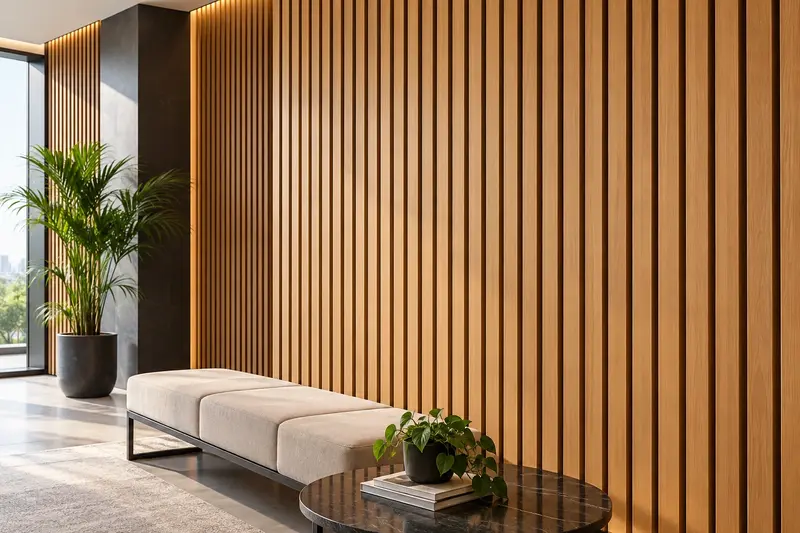
Grooved Wooden Slats: Specifications, Benefits, Applications and Installation
| Specification | Detail |
|---|---|
| Groove Width | 2 mm to 5 mm |
| Groove Pitch | 14 mm to 32 mm |
| Backing Layer | Acoustic fleece, polyester fibre, mineral wool |
| Surface Finish | Veneer, laminate, melamine, paint |
| Emission Standard | E1 grade low-formaldehyde board |
| Weight | Approx 8 to 12 kg per sq m |
| Colour Options | Custom RAL and wood-tone finishes. |
| Benefit | Why It Matters |
|---|---|
| Sound Absorption | Reduces echo in halls, studios and offices |
| Speech Clarity | Improves intelligibility in meeting and lecture rooms |
| Aesthetic Finish | Warm timber look replaces bare acoustic foam |
| Design Flexibility | Multiple groove patterns and finishes available |
| Durability | Engineered core resists warping with correct core choice |
| Low Maintenance | Dry dusting keeps panels performing for years |
| Eco Options | Low-emission boards support green building targets. |
| Space | Use Case |
|---|---|
| Music Studio Soundproofing | Vocal booths and control rooms in India |
| Home Theatre Soundproofing | Residential media rooms and home cinemas |
| Auditorium Soundproofing | Colleges, cultural halls and convention centres |
| Multiplex Soundproofing | Cinema screens and lobby noise control |
| School Soundproofing | Classrooms and school auditoriums in India |
| Office Soundproofing | Cabins, boardrooms and open-plan floors |
| Hospitality | Restaurants, lobbies and banquet halls |
| Step | Action |
|---|---|
| 1 | Check wall for level, dry, clean surface |
| 2 | Fix battens or metal channel at 500 to 600 mm |
| 3 | Place mineral wool or polyester fibre backing |
| 4 | Leave 25 to 50 mm air gap where possible |
| 5 | Fix panels with screws or interlocking clips |
| 6 | Align grooves and close joints with trims |
| 7 | Inspect fixing and clean the finished wall. |
| Myth | Reality |
|---|---|
| Thicker wood always absorbs more sound | Backing material matters more than slat thickness |
| Any wooden panel soundproofs a room | Only backed, engineered panels reduce noise well |
| Grooved slats fully block outside noise | They absorb echo, not structural sound transmission |
| One panel type suits every room | Groove ratio changes by room use case |
| Higher NRC number means better in every case | Real room result depends on coverage and gap |
What Are Grooved Wooden Slats?
Why Groove Ratio Matters More Than Groove Depth
Most buyers ask about groove depth first, but after specifying hundreds of rooms, the ratio of open groove width to solid slat width (commonly written as 13/3, 28/4, or similar) has a bigger effect on absorption than depth alone. A tighter ratio like 8/2 exposes more backing per metre and suits office soundproofing and speech-heavy rooms. A wider ratio like 28/4 reads as more solid timber and suits home interiors where aesthetics matter as much as acoustics. If your supplier only discusses veneer colour and never asks about groove ratio for your room’s use case, that is a sign the specification was not engineered for your acoustic problem.
Technical Data Sheet (TDS)
| Parameter | Value |
|---|---|
| Product Name | EchoStop Grooved Wooden Slats |
| Core Material | MDF, HDF or plywood |
| Panel Length | 2440 mm (standard) |
| Panel Width | 128 mm to 192 mm |
| Thickness | 12 mm to 18 mm |
| NRC Range | 0.70 to 0.95 |
| Fire Rating | Fire-retardant grade optional. |
Customization Options
| Material Choices | Panels can be manufactured using MDF, HDF, plywood or other engineered boards depending on budget, durability and acoustic needs. Moisture-resistant and fire-retardant variants are also available for specialized applications. |
| Surface Finishes | A wide variety of finishes can be applied to achieve the desired look. Options include natural wood veneers, laminates, melamine coatings and custom paint finishes. This allows seamless integration with existing interior themes. |
| Groove Patterns and Designs | Different groove configurations such as 13/3, 28/4 or custom patterns can be selected to influence both aesthetics and sound absorption. Variations in groove width, depth and spacing create distinct visual textures and acoustic responses. |
| Panel Sizes and Thickness | Panels can be customized in terms of length, width and thickness to fit specific wall or ceiling dimensions. This helps reduce wastage and ensures a clean installation. |
| Acoustic Backing Options | The type and density of backing material, such as mineral wool or polyester fiber, can be adjusted to achieve the required sound absorption levels. Additional air gaps can also be incorporated for improved low-frequency performance. |
| Edge Detailing and Orientation | Panels can be designed with different edge profiles for seamless joints or highlighted lines. They can also be installed vertically or horizontally to create varied design effects. |
| Color and Branding Options | Custom colors, patterns or even branding elements can be incorporated, especially for commercial spaces and corporate environments. |
| Customization Flexibility | This flexibility makes grooved wooden slats suitable for both standard and highly customized acoustic solutions, ensuring they meet functional requirements while aligning with the overall design vision. |
Grooved Wooden Slats FAQs
Grooved wooden slats are primarily used for acoustic treatment. They help reduce echo, control noise and improve sound clarity while also enhancing the visual appeal of interiors.
The grooves on the panel surface allow sound waves to pass through and get absorbed by the acoustic backing material behind. This reduces sound reflection and improves overall acoustic comfort.
The Noise Reduction Coefficient (NRC) typically ranges from 0.70 to 0.95, depending on the groove pattern, backing material and installation method.
Yes, they can be installed on both walls and ceilings. Ceiling applications are common in offices, auditoriums and commercial spaces for better sound distribution.
They are usually made from MDF, HDF, plywood or other engineered boards, with finishes like veneer, laminate or melamine.
Yes, they are highly customizable in terms of size, groove pattern, finish, color and acoustic backing to meet specific project requirements.
Fire-retardant versions are available and can be specified based on project safety requirements.
They require minimal maintenance. Regular dusting or light cleaning is usually sufficient to keep them in good condition.
Yes, they can be installed on existing surfaces using a framework system, provided the wall is structurally sound and level.
They are used in offices, auditoriums, home theaters, conference rooms, restaurants, studios and other spaces where sound control is important.